


Artificial Intelligence Innovations In Automobile Industry Training Ppt




Try Before you Buy Download Free Sample Product
 Impress Your
 Audience
 100%
100% Editable
 Save Hours
 of Time


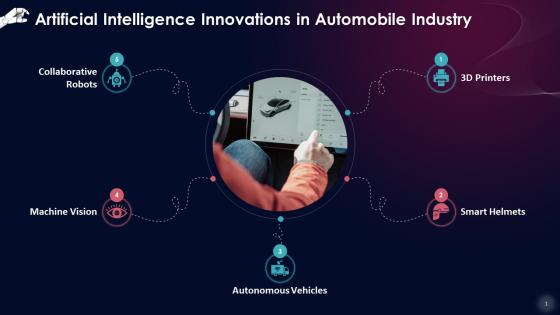
This slide lists types of innovations based on Artificial Intelligence in the automobile industry such as 3D printers, smart helmets, autonomous vehicles, machine vision, and collaborative robots.
People who downloaded this PowerPoint presentation also viewed the following :
Artificial Intelligence Innovations In Automobile Industry Training Ppt with all 17 slides:
Use our Artificial Intelligence Innovations In Automobile Industry Training Ppt to effectively help you save your valuable time. They are readymade to fit into any presentation structure.












FAQs for Artificial Intelligence Innovations In Automobile
Key applications include predictive maintenance, quality control systems, robotic assembly automation, supply chain optimization, and production scheduling algorithms. These AI technologies streamline manufacturing by reducing downtime through early fault detection, enhancing product quality via real-time inspection, and optimizing resource allocation, with many automotive manufacturers finding that integrated AI systems deliver significantly faster production cycles and lower operational costs.
AI enhances vehicle safety through ADAS by enabling real-time hazard detection, automated emergency braking, lane departure warnings, and adaptive cruise control systems. These technologies streamline driver decision-making by processing sensor data, predicting collision risks, and executing preventive actions, with automotive manufacturers finding that AI-powered safety systems ultimately deliver reduced accident rates and enhanced driver confidence.
AI optimizes automotive supply chain management through predictive analytics, demand forecasting, inventory optimization, supplier risk assessment, and automated procurement processes. These technologies streamline operations by reducing excess inventory, minimizing production delays, and enhancing supplier relationships, with many automotive manufacturers finding that AI-driven supply chains deliver significant cost reductions and improved operational efficiency.
Data analytics and machine learning transform predictive maintenance by analyzing sensor data, identifying failure patterns, and predicting component breakdowns before they occur. Through real-time monitoring systems, automotive manufacturers and fleet operators reduce unexpected breakdowns, minimize repair costs, and optimize maintenance schedules, while ultimately delivering enhanced vehicle reliability and significantly lower operational expenses for consumers and businesses.
AI serves as the foundational technology for autonomous vehicles, enabling perception through computer vision, decision-making via machine learning algorithms, path planning, sensor fusion, and real-time processing. Through deep learning and neural networks, automotive manufacturers like Tesla, Waymo, and traditional automakers enhance vehicle safety, optimize traffic flow, and reduce human error, ultimately delivering safer transportation and competitive advantage in an increasingly automated mobility landscape.
AI enhances automotive customer experiences by enabling personalized vehicle recommendations, predictive maintenance alerts, and intelligent chatbots for instant support. Through machine learning algorithms, dealerships streamline inventory matching, automate service scheduling, and deliver real-time diagnostics, with many automotive retailers finding that AI-powered systems reduce wait times and increase customer satisfaction significantly.
Implementing AI in automotive design presents challenges including high development costs, complex integration with existing systems, regulatory compliance requirements, data quality concerns, and skilled talent shortages. While these technologies revolutionize design processes through enhanced simulation, predictive modeling, and automated testing, many manufacturers find that strategic partnerships and phased implementations help overcome initial barriers, ultimately delivering faster development cycles and competitive advantages.
Artificial intelligence optimizes fuel efficiency and reduces emissions through predictive engine management, real-time route optimization, adaptive transmission control, and intelligent energy distribution systems. Through machine learning algorithms, automotive manufacturers like Toyota and BMW achieve up to 15% better fuel economy while minimizing carbon footprints, ultimately delivering cost savings for consumers and environmental compliance for manufacturers in an increasingly regulated landscape.
AI in automotive raises concerns about decision-making transparency, data privacy, job displacement, liability in accidents, and algorithmic bias in safety systems. While these technologies enhance vehicle safety and operational efficiency, manufacturers must balance innovation with responsible deployment, ensuring equitable access to AI-powered features and maintaining human oversight, ultimately delivering safer transportation while addressing societal implications.
AI is revolutionizing vehicle infotainment through advanced voice recognition, personalized content curation, predictive maintenance alerts, seamless smartphone integration, and intelligent route optimization. These technologies enhance driver experiences by delivering intuitive interfaces, real-time traffic updates, and customized entertainment options, while automotive manufacturers increasingly leverage AI-driven connectivity to streamline operations and deliver competitive advantage.
AI significantly reduces automotive production costs through predictive maintenance, quality control automation, supply chain optimization, and resource allocation improvements. These technologies streamline manufacturing by minimizing downtime, reducing defects, and optimizing material usage, with many automotive manufacturers finding that AI-driven systems deliver cost savings of 10-20% while enhancing overall operational efficiency.
AI technology personalizes vehicle features through machine learning algorithms, biometric recognition, behavioral pattern analysis, and predictive modeling that adapt to individual driving styles, comfort preferences, and usage patterns. These systems automatically adjust seat positions, climate control, infotainment settings, and navigation routes based on driver identification, while continuously learning from user interactions to enhance personalization, ultimately delivering seamless, customized driving experiences that improve satisfaction and safety.
AI in automotive regulatory compliance presents both opportunities and challenges, enabling automated safety testing, real-time emissions monitoring, predictive maintenance scheduling, and streamlined documentation processes. While these technologies enhance compliance accuracy and reduce manual oversight costs, they also require new regulatory frameworks for AI validation, with many automotive manufacturers finding that strategic AI implementation ultimately delivers faster approvals and competitive advantages.
Automotive companies leverage AI to analyze customer feedback and market trends through natural language processing for social media sentiment analysis, predictive analytics for demand forecasting, machine learning algorithms for review classification, and automated surveys. These technologies enable manufacturers like Ford and Toyota to identify emerging preferences, predict vehicle feature demands, and optimize product development cycles, ultimately delivering more targeted vehicles and enhanced customer satisfaction.
Autonomous driving systems, AI-powered predictive maintenance, intelligent manufacturing automation, personalized in-vehicle experiences, and real-time traffic optimization are expected to revolutionize automotive markets. These technologies streamline production costs, enhance safety protocols, and deliver seamless customer experiences, with manufacturers increasingly finding that strategic AI integration provides competitive advantages in an evolving transportation landscape.
-
Nothing beats the well-formatted and professionally designed templates offered. Kudos to SlideTeam for their amazing collection of PPT slides.
-
I faced no difficulty while searching for the slide I wanted. Honestly, the website’s interface is easy to use and can be navigated easily!