

Automated Vs Manual Inventory Tracking System Strategies To Order And Maintain Optimum




Try Before you Buy Download Free Sample Product
 Impress Your
 Audience
 100%
100% Editable
 Save Hours
 of Time


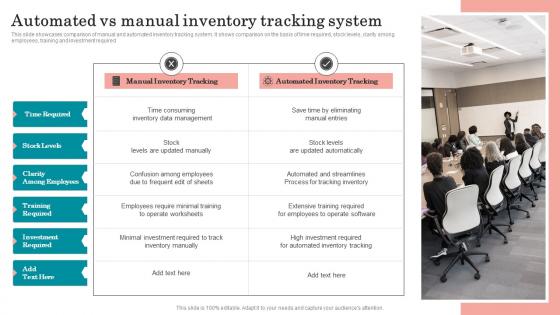
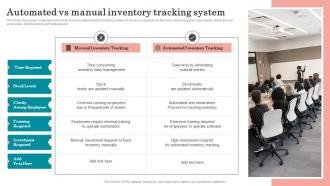
This slide showcases comparison of manual and automated inventory tracking system. It shows comparison on the basis of time required, stock levels, clarity among employees, training and investment required.
People who downloaded this PowerPoint presentation also viewed the following :
Automated Vs Manual Inventory Tracking System Strategies To Order And Maintain Optimum with all 6 slides:
Use our Automated Vs Manual Inventory Tracking System Strategies To Order And Maintain Optimum to effectively help you save your valuable time. They are readymade to fit into any presentation structure.





FAQs for Automated Vs Manual Inventory Tracking System Strategies To Order
Automated inventory tracking systems deliver reduced labor costs, real-time stock visibility, minimized human errors, improved order accuracy, and enhanced customer satisfaction for small businesses. These technologies streamline operations by automating reorder processes, preventing stockouts and overstock situations, and providing detailed analytics, with many retail and manufacturing businesses finding that automated systems ultimately enable faster growth while reducing operational overhead.
Automated inventory tracking minimizes human error by using barcode scanning, RFID technology, and real-time data updates to eliminate manual counting mistakes, misplaced items, and recording inaccuracies. These systems enable warehouses and retail operations to maintain precise stock levels, reduce shrinkage, and streamline reorder processes, ultimately delivering improved accuracy and operational efficiency.
Technology solutions for automated inventory tracking include RFID systems, barcode scanners, IoT sensors, warehouse management software, and AI-powered analytics platforms. These technologies streamline operations by providing real-time visibility, reducing manual errors, and optimizing stock levels, with many retailers and manufacturers finding that automated systems deliver faster restocking, lower carrying costs, and enhanced customer satisfaction.
Automated inventory tracking enhances supply chain efficiency by providing real-time visibility into stock levels, reducing manual counting errors, and enabling predictive analytics for demand forecasting. Through RFID sensors and IoT devices, manufacturers and retailers streamline reorder processes, minimize stockouts and overstock situations, ultimately delivering faster fulfillment and reduced operational costs.
Businesses should monitor key metrics including inventory accuracy rates, stockout frequency, carrying costs, order fulfillment speed, and demand forecasting precision. These performance indicators enable organizations to optimize warehouse operations, reduce excess inventory, and enhance customer satisfaction, with many retailers and manufacturers finding that comprehensive metric tracking delivers improved cash flow and competitive advantage in increasingly dynamic markets.
Businesses integrate automated inventory tracking with ERP systems through API connections, middleware platforms, and cloud-based data synchronization tools that enable seamless real-time communication between systems. This strategic combination streamlines operations by eliminating manual data entry, reducing inventory discrepancies, and enhancing supply chain visibility, with many manufacturing and retail organizations finding that integrated systems deliver faster decision-making and improved operational efficiency.
Transitioning from manual to automated inventory tracking presents challenges including staff training requirements, initial system integration complexities, data migration accuracy concerns, and upfront technology investments. However, organizations across retail, manufacturing, and healthcare find that these short-term hurdles ultimately deliver streamlined operations, reduced human error, and significantly enhanced inventory visibility, creating lasting competitive advantages.
Real-time inventory visibility enhances customer satisfaction by providing accurate product availability, reducing stockouts, and enabling faster order fulfillment. Through automated tracking systems, retailers can offer reliable delivery promises, proactive communication about delays, and seamless omnichannel experiences, while manufacturing companies streamline supply chains, ultimately delivering improved service reliability and competitive advantage.
Automated inventory tracking supports sustainability by minimizing waste through precise demand forecasting, reducing overproduction, optimizing storage efficiency, and enabling circular economy practices through better product lifecycle management. These systems streamline resource allocation and reduce environmental impact, with manufacturing and retail companies finding that automated tracking delivers significant waste reduction, lower carbon footprints, and enhanced operational sustainability.
Barcodes and RFID technology serve as the foundational data capture mechanisms in automated inventory tracking, enabling real-time visibility, accurate stock counts, precise location tracking, and seamless integration with management systems. While barcodes offer cost-effective scanning for basic tracking, RFID delivers advanced capabilities like bulk reading and automated updates, with many retailers and warehouses finding that this strategic combination streamlines operations and minimizes human error.
Predictive analytics enhances automated inventory tracking by forecasting demand patterns, identifying seasonal trends, and anticipating supply chain disruptions before they occur. Through machine learning algorithms, retailers and manufacturers can optimize stock levels, reduce carrying costs, and minimize stockouts, while enabling proactive reordering decisions that ultimately deliver improved customer satisfaction and operational efficiency.
Industries that benefit most from automated inventory tracking include retail, manufacturing, healthcare, automotive, and food services, where inventory accuracy directly impacts operations and customer satisfaction. These sectors leverage automated systems to minimize stockouts, reduce carrying costs, and enhance supply chain visibility, with many retailers and manufacturers finding that real-time tracking delivers significant competitive advantages through improved efficiency.
Startups face higher proportional implementation costs but gain faster scalability, while established businesses benefit from economies of scale and existing infrastructure integration. Startups typically invest 3-5% of revenue initially, whereas larger enterprises spread costs across extensive operations, with both ultimately achieving 15-25% reduction in inventory holding costs and improved cash flow management.
Automated inventory tracking accommodates seasonal fluctuations through predictive analytics, dynamic reorder points, demand forecasting algorithms, and historical data analysis. These systems automatically adjust stock levels based on seasonal patterns, with retail and hospitality businesses finding that automated triggers prevent both stockouts during peak periods and excess inventory during slower seasons, ultimately optimizing cash flow.
Emerging trends in automated inventory management include AI-powered demand forecasting, autonomous mobile robots for warehouse operations, blockchain-enabled supply chain transparency, IoT sensors for real-time monitoring, and predictive analytics for maintenance optimization. These technologies streamline operations by reducing human error, accelerating order fulfillment, and enhancing inventory accuracy, with many retailers and manufacturers finding that integrated automation delivers significant cost reductions and competitive advantages.
-
Use of icon with content is very relateable, informative and appealing.
-
The PPTs are extremely simple to modify. Thank you for providing the slides that are ready to be used. They assist me in saving a lot of time.