

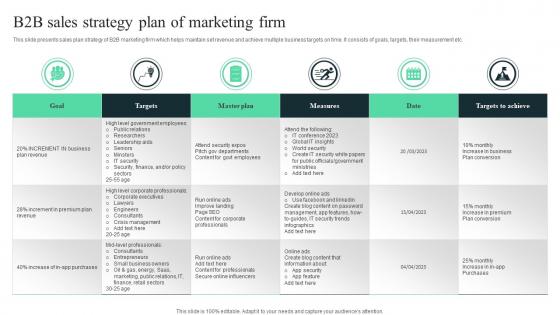
B2b Sales Strategy Plan Of Marketing Firm




Try Before you Buy Download Free Sample Product
 Impress Your
 Audience
 100%
100% Editable
 Save Hours
 of Time


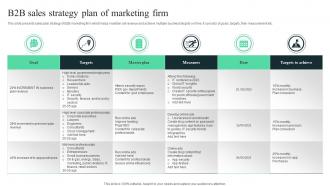
This slide presents sales plan strategy of B2B marketing firm which helps maintain set revenue and achieve multiple business targets on time. It consists of goals, targets, their measurement etc.
People who downloaded this PowerPoint presentation also viewed the following :
B2b Sales Strategy Plan Of Marketing Firm with all 6 slides:
Use our B2b Sales Strategy Plan Of Marketing Firm to effectively help you save your valuable time. They are readymade to fit into any presentation structure.





FAQs for B2b Sales Strategy Plan
Businesses can effectively identify their target audience through market research, customer data analysis, competitor evaluation, industry segmentation, and stakeholder mapping. These strategic approaches streamline prospecting by revealing pain points, budget constraints, and decision-making processes, with many organizations finding that detailed buyer personas and firmographic data ultimately deliver higher conversion rates and more efficient resource allocation.
A successful B2B sales pitch includes clear value proposition, thorough needs assessment, competitive differentiation, ROI demonstration, and compelling case studies. These components work together by addressing specific pain points, quantifying business impact, and building credibility through proven results, with many organizations finding that tailored pitches significantly enhance conversion rates and accelerate deal closure.
Understanding business decision-making processes allows sales teams to tailor their approaches by identifying key stakeholders, mapping approval hierarchies, and timing presentations strategically. This insight enables sales professionals to address specific concerns of financial officers, technical evaluators, and executive sponsors, while anticipating objections and providing relevant documentation, ultimately shortening sales cycles and increasing conversion rates.
Relationship-building serves as the foundation of B2B sales success, enabling trust development, long-term partnerships, and increased deal closure rates through consistent communication, value demonstration, and strategic account management. Companies optimize relationships by leveraging CRM systems, personalized outreach, and regular touchpoints, with many sales organizations finding that strong client relationships ultimately deliver higher customer lifetime value, reduced acquisition costs, and sustained competitive advantage.
Data analytics enhances B2B sales strategies by identifying high-value prospects, optimizing pricing models, predicting customer behavior patterns, and personalizing outreach campaigns based on historical performance data. Through predictive modeling and customer segmentation, sales teams streamline lead qualification, accelerate deal closure rates, and ultimately deliver higher conversion rates, with many organizations finding significantly improved revenue outcomes.
Common B2B sales mistakes include inadequate prospect research, generic pitches, focusing on features over solutions, poor follow-up consistency, and neglecting relationship building throughout lengthy sales cycles. These missteps often result from rushed approaches and insufficient understanding of complex buyer dynamics, with many organizations finding that strategic personalization, solution-focused messaging, and systematic nurturing ultimately deliver higher conversion rates and stronger client partnerships.
Sales teams leverage customer feedback to refine B2B tactics by analyzing deal closure patterns, identifying common objections, tracking post-purchase satisfaction, and monitoring communication preferences throughout the sales cycle. Through systematic feedback collection, organizations streamline their approach by personalizing pitches, adjusting pricing strategies, and enhancing follow-up processes, ultimately delivering higher conversion rates and stronger client relationships.
Effective B2B lead nurturing strategies include personalized email sequences, educational content marketing, targeted social media engagement, strategic follow-up calls, and marketing automation workflows. These approaches streamline relationship-building by delivering relevant value at each funnel stage, addressing specific pain points, and maintaining consistent touchpoints, with many organizations finding that this systematic nurturing ultimately accelerates conversions and enhances customer lifetime value.
Content marketing supports B2B sales efforts by educating prospects, building trust, and nurturing leads through the sales funnel with valuable insights and expertise. Through strategic content like whitepapers, case studies, and thought leadership articles, organizations demonstrate industry knowledge, address client pain points, and establish credibility, ultimately shortening sales cycles and enhancing conversion rates.
Techniques to shorten B2B sales cycles include qualifying leads rigorously, leveraging social proof through case studies, implementing automated nurturing sequences, conducting discovery calls early, and providing detailed ROI calculations upfront. These approaches streamline decision-making by addressing objections proactively, building trust through demonstrated success in similar organizations, and enabling prospects to visualize tangible business outcomes, ultimately accelerating procurement processes and reducing lengthy evaluation periods.
B2B pricing strategies emphasize value-based models, relationship-driven negotiations, and customized solutions, while B2C focuses on competitive market pricing and standardized offerings. B2B transactions involve longer decision cycles, multiple stakeholders, and complex ROI calculations, with companies in manufacturing, software, and professional services finding that consultative pricing approaches ultimately deliver stronger partnerships and sustainable revenue growth.
CRM tools are essential for managing B2B sales processes because they centralize customer data, automate follow-ups, and track sales pipeline progress across complex buying cycles. These systems enable sales teams to nurture long-term relationships, identify upselling opportunities, and coordinate multi-stakeholder engagements, ultimately delivering improved conversion rates and enhanced customer retention for sustained revenue growth.
Developing a strong B2B value proposition requires deep customer research, competitive analysis, clear differentiation, and quantifiable benefits that address specific pain points. Through market segmentation and stakeholder interviews, businesses can identify unique advantages, articulate measurable ROI, and communicate outcomes like cost reduction or efficiency gains, ultimately delivering compelling messaging that resonates with decision-makers.
Effective objection handling involves active listening, acknowledging concerns, reframing challenges as opportunities, providing evidence-based responses, and asking clarifying questions to understand underlying issues. Through strategic preparation and consultative selling approaches, sales teams transform objections into dialogue opportunities, building trust while addressing specific client needs, ultimately converting resistance into partnership discussions that accelerate deal closure.
Partnerships and alliances enhance B2B sales strategy by expanding market reach, leveraging complementary expertise, sharing resources and costs, and accessing established customer networks. Through strategic collaborations, companies accelerate market entry, reduce acquisition costs, and deliver comprehensive solutions, with many organizations finding that joint ventures ultimately provide competitive advantages and faster revenue growth.
-
Informative and engaging! I really like the design and quality of the slides.
-
They had the topic I was looking for in a readymade presentation…helped me meet my deadline.