


Bakery Cafe Business Plan Powerpoint Presentation Slides




Try Before you Buy Download Free Sample Product
 Impress Your
 Audience
 100%
100% Editable
 Save Hours
 of Time


Developing a Bakery Cafe Business Plan aims to thoroughly examine the global bakery industry, covering aspects such as market size, trends, growth prospects, critical success factors, and key challenges. This PowerPoint presentation offers a comprehensive overview, starting with an executive summary, mission statement, vision, goals, and a summary of initial expenses. It goes on to include an analysis of market gaps, outlining the range of products that the bakery startup will offer. The Bakery SWOT presentation also provides vital statistics related to the U.S. bakery industry, as well as information about the target market and customer personas, incorporating TAM Total Addressable Market, SAM Serviceable Addressable Market, and SOM Serviceable Obtainable Market analysis. It highlights a comparison of major players in the bakery industry based on attributes, along with a SWOT analysis and the application of Porters five forces model. Furthermore, the Bakery Marketing Plan PowerPoint outlines a marketing plan that covers sales, distribution, and promotional strategies aimed at establishing the businesss credibility. It also addresses pricing strategies and the customer journey. The operational and financial plans are an integral part of the presentation, encompassing financial assumptions, revenue generation models, break even analysis, profit and loss statements, cash flow statements, balance sheets, scenario analyses, and discounted cash flow assessments. To conclude, the Bakery Industry Strategies PowerPoint offers a management summary, exit strategies, and a list of key abbreviations relevant to the bakery business. Get access now.
People who downloaded this PowerPoint presentation also viewed the following :
Content of this Powerpoint Presentation
Slide 1: This slide presents Bakery Cafe Business Plan cover slide. Commence by putting your company name.
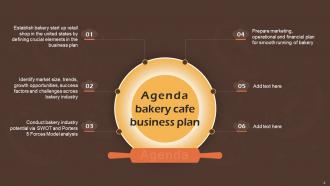
Slide 2: This slide presents Agenda of Bakery business plan.
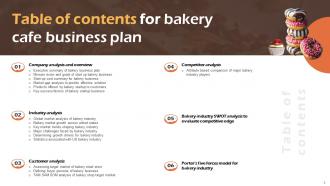
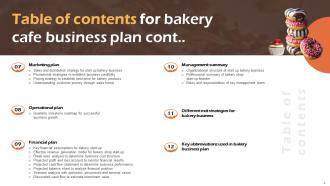
Slide 3: This slide presents Table of Contents.
Slide 4: This slide presents Table of Contents.
Slide 6: This slide showcases the executive summary of bakery business plan which includes company summary such as strength, marketing strategies, etc. It also includes entity such as web address, incorporation date, location, products, etc
Slide 7: This slide represents the mission and vision of the start-up bakery business, which shows the future desired position of the business. It also covers goals such as maintaining high sanitation, expanding business, increasing customer base, training the workforce, etc
Slide 8: This slide showcases the start up summary of bakery business which includes start up expenses such as equity capital, licensing & lease security deposit, fixed assets, essential supplies, cash buffer, etc
Slide 9: This slide covers the market gap analysis to provide effective solution which includes concern such as customized cake orders and no online ordering service. It also shows business solution such as offering customized orders.
Slide 10: This slide focuses on products offered by bakery start up to customers such as breads, cookies, pastries, muffins, desserts and pizza.
Slide 11: This slide shows key success factors of bakery industry such as team collaboration, competitive advantage, excellent customer service, qualified employees and offer free samples
Slide 12: This slide presents Table of Contents.
Slide 13: This slide showcases the global market analysis of bakery industry which includes projected market size during the period of 2021 to 2028.
Slide 14: This slide focuses on bakery market growth across United States which includes market value, highest share in North America region, economic impact, etc
Slide 15: This slide covers the key market trends shaping global bakery industry which includes gluten-free products, reduced sugar trend, longer shelf life, plant-based diet, enhanced nutrition in baked goods, etc
Slide 16: This slide showcases the major challenges faced by bakery industry which includes shelf-life management, fluctuating consumer preferences, emerging competition, supply chain disruption, hygiene practices, etc
Slide 17: This slide covers the growth drivers for bakery industry which includes increased demand for convenient food products, rising urbanization, increased women empowerment, rising prominence of in-store bakeries, etc
Slide 18: This slide shows the statistics associated with bakery industry across United States which includes bakery segment by revenue share such as commercial and retail
Slide 19: This slide presents Table of Contents.
Slide 20: This slide represents the target market of bakery retail store which includes upper and middle income people, tourists, households & residents, working class people, students, etc
Slide 21: This slide showcases the buyer persona of bakery business which includes demographics, key concern & pain points, personality traits, spending habits, factors affecting purchase behavior, eyc
Slide 22: This slide showcases the TAM, SAM and SOM analysis of bakery shop target market which includes global bakery market value, US market size and serviceable obtainable market
Slide 23: This slide presents Table of Contents.
Slide 24: This slide covers the comparison of major bakery industry players on the basis of different attributes such as founding date, headquarters, website, revenue, qualified bakers, target market, etc
Slide 25: This slide presents Table of Contents.
Slide 26: This slide showcases the strengths, weakness, opportunities and threats to evaluate competitive position of bakery which includes experience staff, high prices, economic recession, etc
Slide 27: This slide presents Table of Contents.
Slide 28: This slide showcases the Porter’s five forces model for bakery industry which includes competitive rivalry, bargaining power of buyers & suppliers, threat of new entrants, etc
Slide 29: This slide presents Table of Contents.
Slide 30: This slide represents the sales and distribution strategy for start up bakery business which includes provide nutrition information for products, unique packaging, offer free samples and remain active on social media
Slide 31: This slide showcases the promotional strategies to establish business credibility which includes social media marketing, website development and email marketing along with description and initiatives
Slide 32: This slide showcases the pricing strategy to establish best price for bakery products which includes expenses by US households, implementing pricing strategy, basis for calculating future prices, etc
Slide 33: This slide shows the customer journey through sales funnel which includes awareness, conversion, loyalty and retention which helps company to track how well they are doing to acquire potential leads
Slide 34: This slide presents Table of Contents.
Slide 35: This slide shows the quarterly milestone roadmap for successful business growth which includes pre-launch checklist, marketing strategies and additional milestones
Slide 36: This slide presents Table of Contents.
Slide 37: This slide represents the key financial assumptions for bakery start up which includes baking expenses, balance sheet adjustments, etc. The computations are based on market trends and conditions prevailing in the
Slide 38: This slide covers the revenue generation model for bakery shop start up which includes revenue projection for different products such as breads & rolls, cookies, pastries, muffins, desserts and pizza
Slide 39: This slide shows the break even analysis of company to determine cost structure which includes average revenue, contribution per year, discount rate, payback period, etc
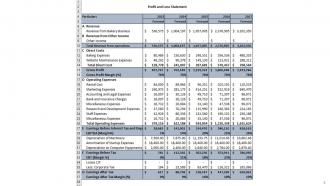
Slide 40: This slide showcases the projected profit and loss statement prepared by company to monitor financial results which includes revenue, direct costs, operating expenses, EBITDA, earning before and after tax
Slide 41: This slide showcases the graphical representation of projected profit and loss statement prepared by company to monitor financial results which includes revenue, direct costs, operating expenses, EBITDA, earning before and
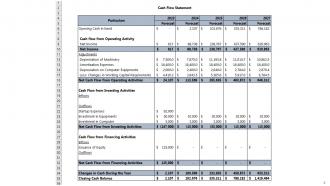
Slide 42: This slide covers the projected cash flow statement to determine business performance which shows inflow and outflow of cash from operating, investing and financing activities
Slide 43: This slide covers the graphical representation of projected cash flow statement to determine business performance which shows inflow and outflow of cash from operating, investing and financing activities along with closing
Slide 44: This slide represents the projected balance sheet to analyze the financial position of the company which includes assets and liabilities for five years from 2023 to 2027
Slide 45: This slide represents the graphical representation of projected balance sheet to analyze the financial position of the company which includes total assets for five years from 2023 to 2027
Slide 46: The purpose of this slide is to examine the effects of potential future events on the bakery start-up performance by considering numerous different outcomes, including optimistic, pessimistic, and nominal case scenarios.
Slide 47: This slide shows the effects of potential future events on the bakery start-up performance by considering numerous different outcomes, including optimistic, pessimistic, and nominal case scenarios.
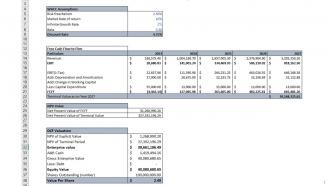
Slide 48: This slide showcases the discounted cash flow for the valuation of investment which includes WACC, NPV value, free cash flow to firm, DCF valuation, etc
Slide 49: This slide presents Table of Contents.
Slide 50: This slide represents the organizational structure of bakery start up company which includes owner, general manager, bakery chef leader, cashier, wait staff, sales staff, pie baker, bread maker, etc
Slide 51: This slide shows the professional summary of bakery store start-up founder which includes educational qualification and skills such as sales & marketing, team communication, decision making, etc
Slide 52: This slide covers the roles and responsibilities of bakery management team to ensure effectiveness and efficiency in operations. It also helps the company in avoiding repetition of tasks
Slide 53: This slide covers the roles and responsibilities of bakery management team to ensure effectiveness and efficiency in operations.
Slide 54: This slide presents Table of Contents.
Slide 55: This slide showcases the exit strategies for bakery business which includes mergers, acquisitions, private offerings, and venture capital
Slide 56: This slide presents Table of Contents.
Slide 57: This slide showcases the key abbreviations used in bakery business plan which includes CEO, US, CAGR, FCFF, SEO and SEC
Slide 58: This is the Icons slide.
Slide 59: This slide presents Additional Slides.
Slide 60: This is the About us slide.
Slide 61: This slide presents Our mission.
Slide 62: This is the Idea generation slide that can be used present new ideas.
Slide 63: This is the Roadmap slide that can be used to present series of events.
Slide 64: This is 30 60 90 days plan that can be used to create robust plans.
Slide 65: This is the Puzzle slide that can be used to present creative thinking.
Slide 66: This is Post it notes slide that can be used to present important information.
Slide 67: This is a Thank You slide for acknowledgment.
Bakery Cafe Business Plan Powerpoint Presentation Slides with all 75 slides:
Use our Bakery Cafe Business Plan Powerpoint Presentation Slides to effectively help you save your valuable time. They are readymade to fit into any presentation structure.








FAQs for Bakery Cafe Business Plan
Start with market research - check if people actually want what you're planning. Financial projections are key too, but honestly most people lowball their startup costs by like 30%. Location is everything - I've seen great concepts fail just because of bad foot traffic. Figure out your menu and how you'll stand out from other cafes nearby. Don't skip the boring operational stuff either: staffing, suppliers, equipment lists. Ingredient costs will surprise you, so be realistic about pricing and when you'll actually turn a profit. Hit up similar cafes in your area first to see what works.
Honestly, hit up your competition first - walk around other bakeries and cafes, see what they're charging and when they're slammed. Then actually talk to people in your area about what they want and what's missing (I did this for hours when my friend opened her place, kinda obsessive but whatever). Google Trends is super helpful for seeing what people search for locally. Survey folks at farmers markets or just chat them up - you'd be surprised how much people love giving opinions about food. Also check supplier costs because ingredients can get crazy expensive depending on the season.
Honestly, location can make or break your bakery cafe. You need to be where people already go - shopping areas, office buildings, neighborhoods with good foot traffic. I've watched amazing bakeries tank because they picked awful spots (so frustrating to see). Sure, rent's cheaper in some random strip mall, but you'll blow your budget on ads trying to get people there. Scout different times of day to see real traffic patterns. High visibility matters. Easy parking or walkable spots work best. Oh, and make sure the neighborhood actually fits your vibe before you commit.
Honestly, just start by watching who actually walks in your door. Check your POS data - are people grabbing coffee and running or camping out with laptops? Survey customers about age, income, when they visit. Your morning rush crowd is totally different from Sunday brunch people, so don't lump them together. Social media tells you a lot too about what they actually want. Once you figure out your main groups, tweak your menu and prices for each one. It's way easier than trying to appeal to everyone at once.
Okay so you'll need five main financial pieces for your bakery plan. Startup costs first - all your equipment, renovations, initial inventory, that stuff. Monthly sales forecasts are huge too, break it down by pastries, coffee, sandwiches, whatever you're selling. Operating expenses like rent, labor, ingredients need their own section. Cash flow projections are probably the most important (and where most food places mess up honestly). Then break-even analysis and P&L statements for the first three years. Oh and don't make your numbers too rosy - investors hate that unrealistic optimism thing.
Start with like 60-70% baked stuff, 30-40% drinks - but honestly your location matters way more than some random ratio. Office crowd? They're grabbing coffee and pastries in the morning, maybe wanting actual food later. Track what's selling when. I swear mornings are always coffee and muffins, then afternoons people want fancy lattes and desserts. Your drinks should work with your pastries, not fight them for space. Oh and test different mixes for a few weeks - actual sales numbers don't lie like your gut does sometimes.
Look, branding can literally make or break your bakery cafe. People will drive across town for places they connect with emotionally - it's wild how that works. Your brand touches everything: logo, how the space feels, packaging, even your Instagram captions. Consistency is huge because customers want to know what vibe they're getting when they walk in. I always tell people to figure out what makes their spot different first. Maybe it's that cozy grandmother's kitchen feel or super sleek modern thing? Once you nail that down, just let it show up everywhere naturally. Trust me, it's worth the effort.
Hey! So for sustainability - definitely start with local farms for ingredients. Transportation costs drop and customers eat up that farm-to-table vibe (seriously, it sells itself). Cut food waste by donating day-old stuff, composting scraps, maybe discount those wonky-looking croissants. Energy-efficient equipment helps, plus biodegradable packaging instead of plastic. Oh, and track your numbers monthly - waste, energy usage, all that. You'll actually see progress and can brag about it to eco-conscious customers. Honestly, green practices are good business these days.
Honestly, Instagram and TikTok are perfect for bakeries - your stuff is so photogenic! Post daily pics of fresh pastries and those satisfying behind-the-scenes videos. Partner with local businesses nearby for cross-promotion. Oh, and make sure people can actually smell your bread when they walk by - that's seriously your best weapon. I'd also do email newsletters for weekly specials to keep regulars hooked. Don't try everything at once though. Pick like 2-3 things max so you're not running around crazy the first month.
Start with cost-plus pricing - add up ingredients, labor, overhead, then tack on 60-70% profit for food, 80%+ for drinks. That's your floor though. Check what other places nearby charge because location matters a ton. Upscale area? You can push prices higher. College town? Good luck with that lol. During your soft opening, try different price points and see how people react. Nobody should be doing that visible cringe when they see the total. The goal is finding that sweet spot where you're making money but customers aren't fleeing.
Okay so you'll definitely need a business license and food service permit - the health dept will come inspect your kitchen setup which is kinda nerve-wracking but whatever. Reseller's permit for buying ingredients too. Workers' comp if you're hiring people, plus liability insurance because yeah, stuff happens. Fire department has to sign off on things usually. Honestly the paperwork feels like a lot at first but it's not that bad. Oh, and start at your city's small business office - they know all the local requirements and can help you figure out what order to tackle everything.
Dude, this is HUGE for bakery cafes. Your staff can literally make or break everything. Customers pick up on fake smiles instantly - it's so cringe. Good training means less waste, proper food safety, and that cozy vibe people actually want to hang out in. Plus you won't be constantly hiring because people will actually stick around. Oh, and consistent espresso shots matter more than you'd think! Document your main processes early so you're not scrambling later. Trust me, culture stuff pays off big time.
Honestly, I'd focus on maybe 2-3 things that actually fit your vibe instead of going crazy with changes. Gluten-free stuff is huge right now, or you could do artisanal breads with local grains - that farm-to-table angle works. Interactive experiences are pretty cool too... like decorating classes or those DIY cake kits people love posting about. Some places I know are killing it with specialty coffee pairings or rotating seasonal menus monthly. Oh, and don't sleep on the tech side - loyalty apps or just making everything super Instagram-worthy can really set you apart. The fusion pastry thing is interesting too if you're into experimenting with different cultural flavors.
Honestly, start with a good POS system - that's gonna be your backbone for everything. Get one that tracks inventory so you're not constantly guessing how much flour you have left. Online ordering is huge too, lets people skip the morning coffee line (which your staff will thank you for). Digital menu boards are pretty sweet since you can change prices without reprinting a million things. Oh, and those kitchen display screens help tons during the breakfast chaos. I'd probably wait on the fancy social media automation stuff until you get the basics down first. The ordering and POS combo will make the biggest difference right away.
Seasonal menus are seriously where it's at! Fall means pumpkin everything (obviously), winter's all about peppermint bark and holiday drinks. Summer? Fresh berries sell like crazy. Spring brings Easter stuff and Mother's Day specials - actually spring might be my favorite season for treats. Customers totally expect this now, like they'll genuinely sulk if you don't have autumn spice drinks in October. The trick is planning 6-8 weeks ahead because seasonal ingredients get expensive fast. Create some FOMO with your limited-time marketing too.
-
The best collection of PPT templates!! Totally worth the money.
-
These stunning templates can help you create a presentation like a pro.