


Bank Frauds Prevention Process With Cyber Security Program





Try Before you Buy Download Free Sample Product
 Impress Your
 Audience
 100%
100% Editable
 Save Hours
 of Time


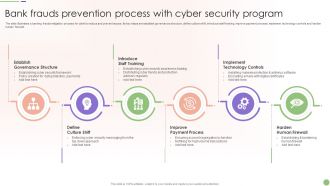
The slide illustrates a banking frauds mitigation process for client to reduce and prevent issues. Its key steps are establish governance structure, define culture shift, introduce staff training, improve payment process, implement technology controls and harden human firewall.
People who downloaded this PowerPoint presentation also viewed the following :
Bank Frauds Prevention Process With Cyber Security Program with all 6 slides:
Use our Bank Frauds Prevention Process With Cyber Security Program to effectively help you save your valuable time. They are readymade to fit into any presentation structure.





FAQs for Bank Frauds Prevention Process With
Common bank fraud schemes include phishing attacks, account takeovers, card skimming, wire transfer fraud, and synthetic identity theft. These threats target vulnerabilities through social engineering, malware deployment, and credential harvesting, with many financial institutions finding that layered detection systems combining behavioral analytics, real-time monitoring, and machine learning significantly enhance fraud prevention capabilities.
Social engineering exploits human psychology to bypass security systems through phishing emails, fake phone calls, pretexting, and baiting techniques that manipulate bank employees and customers into revealing sensitive information. Banks combat these threats by implementing comprehensive employee training programs, multi-factor authentication protocols, and advanced behavioral analytics, while educating customers about common tactics, ultimately reducing successful fraud attempts and protecting institutional reputation.
Advanced cybersecurity technologies for bank fraud prevention include AI-powered anomaly detection, machine learning algorithms, behavioral analytics, real-time transaction monitoring, and multi-factor authentication systems. These technologies enhance security by identifying suspicious patterns, analyzing customer behavior deviations, and flagging irregular transactions instantly, with many financial institutions finding that this strategic combination significantly reduces fraud losses while improving customer trust and operational efficiency.
Financial institutions leverage machine learning and AI to enhance fraud detection through real-time transaction monitoring, behavioral pattern analysis, anomaly detection algorithms, predictive risk scoring, and automated decision-making systems. These technologies streamline fraud prevention by processing vast datasets instantly, identifying suspicious activities before losses occur, and reducing false positives, with many banks finding significantly faster response times and improved customer experiences.
Employee training serves as a critical first line of defense against bank fraud by educating staff to recognize social engineering tactics, phishing attempts, suspicious transactions, and emerging cyber threats. These comprehensive programs enhance institutional security by reducing human error, improving incident response times, and creating a security-conscious culture, with many financial institutions finding that well-trained employees prevent significantly more fraud attempts than technology alone.
Regulations like GDPR and PCI DSS significantly enhance bank fraud prevention by mandating robust data protection, encryption standards, access controls, and breach notification protocols. These frameworks enable financial institutions to streamline compliance while strengthening cybersecurity infrastructure, with many banks finding that regulatory alignment ultimately delivers improved customer trust and competitive advantage.
**INPUT**: What are best practices for secure online banking to protect against fraud? **OUTPUT**: Best practices for secure online banking include using multi-factor authentication, monitoring account activity regularly, avoiding public Wi-Fi for transactions, enabling account alerts, and keeping software updated. These security measures work by creating multiple verification layers, providing real-time fraud detection, and minimizing exposure vulnerabilities, with many financial institutions finding that educated customers experience significantly fewer security incidents. [Word count: 58 words]
Customer education significantly reduces bank fraud by teaching clients to recognize phishing attempts, verify communication authenticity, and understand secure banking practices. Through comprehensive awareness programs, banks empower customers to identify suspicious emails, avoid credential sharing, and report unusual activities promptly, ultimately creating a collaborative defense network that enhances overall security while reducing fraud losses.
Multi-factor authentication significantly enhances bank account security by requiring multiple verification methods, including passwords, biometric scans, SMS codes, and hardware tokens, creating layered defense against unauthorized access. This approach enables financial institutions to reduce fraud incidents by up to 99.9%, while streamlining customer verification processes and delivering enhanced trust, ultimately providing competitive advantage in an increasingly digital banking landscape.
Reputation management helps financial institutions recover from bank fraud by demonstrating transparency, implementing enhanced security measures, and communicating proactive remediation steps to stakeholders. Through strategic communications, crisis response protocols, and customer retention initiatives, banks can rebuild trust while showcasing improved fraud prevention capabilities, ultimately strengthening customer confidence and competitive positioning.
**INPUT**: What are some red flags that may indicate fraudulent activity in online banking transactions? **OUTPUT**: Red flags include unusual login locations, multiple failed authentication attempts, large or frequent transfers to new accounts, transactions outside normal patterns, and access from unfamiliar devices. These indicators enable banks to streamline fraud detection through automated monitoring systems, real-time alerts, and behavioral analytics, ultimately delivering faster response times and enhanced customer protection.
Cybersecurity frameworks can be tailored for banking through regulatory compliance integration, real-time transaction monitoring, multi-layered authentication systems, and sector-specific threat intelligence. These specialized approaches enhance fraud detection capabilities, streamline regulatory reporting, and strengthen customer data protection, with many financial institutions finding that customized frameworks deliver faster threat response and reduced operational risk.
Cryptocurrency presents both challenges and opportunities for bank fraud prevention, introducing new risks like crypto-enabled money laundering while also enhancing detection capabilities through blockchain transparency. Banks increasingly leverage advanced analytics and AI to monitor crypto transactions, trace digital asset flows, and identify suspicious patterns, ultimately delivering faster fraud detection and more comprehensive risk management in an increasingly digital financial landscape.
Collaboration between banks and cybersecurity firms enhances fraud prevention through shared threat intelligence, advanced analytics integration, and real-time monitoring capabilities. This strategic partnership enables banks to leverage specialized security expertise, deploy cutting-edge detection algorithms, and respond faster to emerging threats, ultimately delivering stronger customer protection and reduced financial losses.
Incident response planning minimizes bank fraud effects by enabling rapid threat detection, coordinated containment procedures, systematic evidence preservation, and streamlined communication protocols across security teams. Through structured response frameworks, financial institutions can reduce breach duration, limit financial losses, and maintain customer trust, while regulatory compliance requirements are met efficiently, ultimately transforming potential disasters into manageable security incidents.
-
“You have the structure in place that are easy to explore new opportunities.I will be recommending your services to other people.”
-
They saved me a lot of time because they had exactly what I was looking for. Couldn’t be happier!