

Bars And Pub Business Plan Powerpoint Presentation Slides




Try Before you Buy Download Free Sample Product
 Impress Your
 Audience
 100%
100% Editable
 Save Hours
 of Time


Over the last two years, bars and pubs have grown faster than cafes, owing to younger consumers and competitive pricing. Grab Our readily available template on Bars and Pub Business Plan. It provides detailed information on bars, nightclubs, and pub industry statistics, growth drivers, and market trends. Our Pub and Bars Industry deck incorporates critical industry restraints, including lucrative opportunities. In addition, it also includes a section for entity details, target market, company summary, products and services offered, etc. Furthermore, the business plan presentation caters industry analysis section covering deep dive research on pubs, nightclubs, and restaurant markets. Our Restaurant industry module also showcases Porters framework, go to marketing strategy, and competitive landscape. Lastly, it exhibits a financial summary section, including a revenue model, economic impact, profit and loss statement, break even analysis, etc. Get access to this powerful template now.
People who downloaded this PowerPoint presentation also viewed the following :
Content of this Powerpoint Presentation
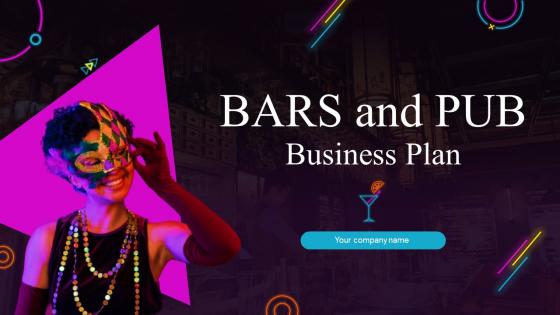
Slide 1: This slide displays the title BARS and PUB Business Plan.
Slide 2: This slide displays the title Agenda for bars and pub business plan.
Slide 3: This slide exhibit table of content.
Slide 4: This slide exhibit table of content- Company analysis and overview.
Slide 5: The purpose of this slide is to provide a broader overview of the global pub industry.
Slide 6: The purpose of the slide is to portray organization details including name, incorporation date, web address, start-up investment, services etc.
Slide 7: The purpose of this slide is to highlight market gap and focus on devising solution to overcome those challenges.
Slide 8: The purpose of this slide is to express the benefits the firm provides to its customers or clients.
Slide 9: The purpose of this slide is to highlight the key success factors of the pub start-up which leverage it with a competitive edge in the market.
Slide 10: This slide portrays an ideal business location for a pub start-up that minimize the risk of failure.
Slide 11: This slide exhibit table of content- Industry analysis
Slide 12: The purpose of this slide is to conduct a thorough assessment of the industry in addition to its market trends.
Slide 13: The purpose of this slide is to conduct a thorough assessment of the industry in addition to its market trends.
Slide 14: The purpose of this slide is to guide stakeholders about the problems prevailing in the industry.
Slide 15: This slide caters to details about various growth drivers resulting in the firm’s progress in terms of increasing preference.
Slide 16: This slide exhibit table of content- Customer profiling and analysis.
Slide 17: This slide covers an assessment of how the firm’s products and services will fit into a certain market and where they will acquire the most traction with customers.
Slide 18: The purpose of this slide is to depict the market potential of the bars and nightclubs industry in terms of TAM, SAM, and SOM to assist startups and enterprise firms.
Slide 19: This slide exhibit table of content- Comprehensive competitor analysis with attributes.
Slide 20: The purpose of this slide is to provide a glimpse of key competitors in the industry to gain insight into their products, services, sales, and marketing tactic.
Slide 21: The purpose of this slide is to provide a glimpse of key competitors in the industry to gain insight into their product, services, sales, and marketing tactic.
Slide 22: This slide exhibit table of content- Detailed SWOT analysis for a pub start-up
Slide 23: The slide includes the strengths, weaknesses, opportunities, and threats analysis of a pub start-up.
Slide 24: This slide exhibit table of content- Porter’s framework – A detailed five forces analysis.
Slide 25: The slide highlights porter’s framework and its implications in the pub and bar industry.
Slide 26: This slide exhibit table of content- Marketing Strategies
Slide 27: The purpose of this slide is to implement an effective go-to-market strategy for bringing start-up services to an end customer taking into consideration elements.
Slide 28: This slide highlights customer journey mapping to track users' actions and key touch points across levels such as awareness, consideration, conversion, loyalty.
Slide 29: This slide exhibit table of content- Implementing yearly milestones for the successful growth of start-up Operational plan
Slide 30: The purpose of this slide is to facilitate managers to convey project progress updates to stakeholders and get their approvals.
Slide 31: This slide exhibit table of content- Financial plan
Slide 32: This slide provides a glimpse of important financial assumptions that are to be made while setting up the firm in terms of income, expense, and balance sheet.
Slide 33: The slide shows the effective revenue model of the pub start-up, which displays the cost incurred and the various sources of income.
Slide 34: The slides highlight the break-even analysis of the firm.
Slide 35: The slides provide a glimpse of the projected profit and loss statement to visualize the platform’s financial performance for the next five years.
Slide 36: The slides provide a glimpse of the projected profit and loss statement to visualize the platform’s financial performance for the next five years.
Slide 37: The slides highlight the cash flow statement of the company. It represents net cash flow from operating, investing, and financing activities.
Slide 38: The slides highlight the cash flow statement of the company.
Slide 39: The slides cover the snapshot of the company's financial position at a specific time.
Slide 40: The slides cover the snapshot of the company's financial position at a specific time.
Slide 41: The purpose of this slide is to examine the effects of potential future events on a pub start-up performance by considering numerous different outcomes.
Slide 42: The purpose of this slide is to examine the effects of potential future events on a pub start-up performance by considering numerous different outcomes.
Slide 43: The purpose of this slide is to calculate the amount of money an investor would get from an investment after adjusting for the time value of money.
Slide 44: This slide exhibit table of content- Management summary.
Slide 45: The purpose of this slide is to craft a successful hierarchical framework for the firm to ensure smooth operations.
Slide 46: The purpose of this slide is to highlight key job roles and responsibilities of the staff to ensure effectiveness and efficiency in the operations.
Slide 47: The purpose of this slide is to highlight key job roles and responsibilities of the staff to ensure effectiveness and efficiency in the operations.
Slide 48: The purpose of this slide is to highlight key job roles and responsibilities of the staff to ensure effectiveness and efficiency in the operations.
Slide 49: This slide exhibit table of content- Possible exit options for stakeholders
Slide 50: This slide represents exit strategy for stakeholders such as IPO, Mergers, Acquisitions, Private offerings, and Venture Capital.
Slide 51: This slide exhibit table of content- Key abbreviations used in the plan.
Slide 52: The purpose of this slide is to highlight the shorter version of existing words to save time and take up less space.
Slide 53: This is the icons slide.
Slide 54: This slide presents title for additional slides.
Slide 55: This slide depicts 30-60-90 days plan for projects.
Slide 56: This slide exhibits yearly timeline of company.
Slide 57: This slide depicts posts for past experiences of clients.
Slide 58: This slide shows Magnifying glass.
Slide 59: This slide displays Venn.
Slide 60: This slide showcase Our target.
Slide 61: This slide exhibits ideas generated.
Slide 62: This is thank you slide & contains contact details of company like office address, phone no., etc.
Bars And Pub Business Plan Powerpoint Presentation Slides with all 67 slides:
Use our Bars And Pub Business Plan Powerpoint Presentation Slides to effectively help you save your valuable time. They are readymade to fit into any presentation structure.









FAQs for Bars And Pub Business Plan
So you'll need the standard stuff - executive summary, market analysis, financials. But honestly, nail down your concept first because that drives everything else. Sports bar vs upscale cocktail spot? Totally different beasts. Get real foot traffic data for your location, plan out your menu and staffing. The licensing paperwork is absolutely brutal but you can't skip it. Marketing's huge too since regulars keep the lights on - way more than random walk-ins. Oh, and don't underestimate how much your atmosphere choice affects your whole strategy.
Look, you can't just throw random numbers at your business plan and hope for the best. Check what's actually trending in your area first - craft cocktails are big money right now, but health-conscious crowds might skip the booze entirely. Economic vibes matter too. People tighten up when recession talk starts. Honestly, labor costs are insane these days (the whole post-COVID thing really messed up hiring). Don't lowball your staffing budget or you'll get burned. Dig into local competition and grab some industry reports before you commit to any projections. Base everything on real market data, not wishful thinking.
Dude, location is EVERYTHING. I've watched awesome bar concepts totally bomb just because they picked a crappy spot. Check out the foot traffic first - are people actually walking by on weekends? Look at what other businesses are nearby (competition vs. complementary), parking situation, and whether the local crowd matches who you're trying to attract. Rent costs vary wildly too depending on the area. Honestly, scope out like 3-5 different places and don't just think about now - see if they're planning any major construction or development that'll mess with your vibe later.
Dude, competitive analysis is basically scoping out what everyone else is doing so you can find your niche. Hit up other pubs and check their menus, prices, vibe - the whole deal. Reviews are clutch too since people love complaining about what sucks. Maybe everyone's crushing the craft beer game but their food is garbage, or cocktails are nonexistent around you. Oh, and definitely visit at different times - seeing when places are packed vs empty tells you everything. Use all that intel to do something different and fill whatever gap you find. Trust me, there's always a gap if you look hard enough.
Honestly, you gotta check out who's actually walking around your neighborhood first. What age groups? How much money do they have? When are they free to drink? Look at other bars nearby - who are they NOT serving? Maybe you could hit the after-work crowd AND college students, just at different times. Surveys help too, though I know that sounds boring. Don't just go with what you'd want - I made that mistake once. Figure out specific customer types with real details about their ages and spending habits. Then you can actually plan your drinks and music around them instead of just winging it.
Startup costs? You're looking at $175k-$500k minimum - equipment, licenses, inventory, renovations, plus that crucial 3-6 month cash cushion. Trust me, everyone burns through way more money than they think before seeing profit. Monthly expenses will eat up about 60-70% of your revenue. Labor alone is like 25-35% of sales, which honestly shocked me when I first learned that. Don't forget rent, utilities, insurance, marketing - it adds up fast. Here's what I'd do: map out every single month for year one, then tack on 20% extra because something will definitely cost more than planned.
Your menu's basically the first impression after someone walks through the door, so it matters way more than you'd think. People scan fast - they're talking, maybe already had a drink or two. Highlight your popular stuff and signature dishes visually. Don't get too fancy with descriptions, just make them sound good. Oh and that price anchoring thing actually works - stick something expensive at the top so everything else looks reasonable. Organize it logically too, obviously. But honestly? Just watch what customers look at first when they sit down.
Dude, map out your monthly revenue based on what you've seen locally - January/February are brutal but summer picks up. Build in flexible staffing so you're not paying full crew when it's dead. Menu tweaks help too. Honestly, most new bar owners panic during their first slow season because they didn't plan for it. Set aside cash for lean months and think up stuff like extended happy hours or trivia nights. Maybe partner with sports leagues? The whole thing is about expecting those dips so you're not freaking out when revenue tanks.
Instagram and TikTok are gonna be your best friends - people can't resist posting their drinks. Facebook events work great for happy hours too. Partner with local businesses and food bloggers, maybe host a soft opening for neighborhood people and influencers. Word-of-mouth is honestly huge in the bar world, like your reputation can make or break you super quickly. Oh, and start posting on social at least 2-3 months before you open. Document the whole build-out process - people eat that behind-the-scenes stuff up. The community aspect is everything, so focus on nailing that vibe from day one.
Look around and figure out what other bars in your area are actually missing. Survey people - what do they wish existed? Your location and crowd matter too. Could be craft cocktails plus board games, or maybe you're doing local breweries with acoustic nights. Just don't be vague about it. "Great vibes" means nothing, but "only sports bar with vintage arcade games and craft beer" - now that's something people remember. I'd honestly skip trying to be everything to everyone. Pick your one thing and build everything around it. Way easier to market yourself that way.
Liquor licensing is your biggest headache - every state and city does it differently. Zoning compliance, health permits, fire codes, workers comp insurance. Liability coverage too because drunk people do stupid things, obviously. Employment law stuff matters a lot, especially the responsible service training and checking IDs properly. Oh and budget way more time for licensing than you think. Like, seriously double whatever timeline you're imagining right now. The bureaucracy moves slow and there's always some random form they didn't mention initially.
Dude, mobile ordering is where you gotta start - cuts down wait times and your staff won't mess up orders as much. QR menus are clutch too, you can update specials instantly without reprinting anything. Those smart tap displays show customers what beers you have on draft, which is pretty slick. Digital payments speed everything up. Oh, and loyalty apps keep people coming back for more. I know a guy who put tablets with games at his tables - sounds gimmicky but customers actually dig it while they wait. The QR thing really took off during the pandemic and stuck around. Social media walls are cool if you want to show off customer posts. Start small though.
Dude, there's actually some cool ways around traditional loans. Crowdfunding could work if you've got good perks - like branded glasses, VIP opening tickets, maybe even naming rights to cocktails. Local breweries might sponsor you for exclusive pouring deals. Pop-ups are huge right now for building hype AND making early cash. People eat that insider stuff up, honestly. Silent partners are another route - folks who want to own part of the nightlife scene without actually running it. I'd start hitting up your network soon, like before you're desperate for money.
Dude, just listen to your customers - they're basically telling you how to fix your pub. Set up surveys or scroll through your social media comments. Chat with the regulars too. Look for patterns in complaints. Everyone saying service is slow? You need more staff. They dig trivia night but the music's too loud? Easy fix. Honestly, drunk people give the most brutally honest feedback lol. Use what you learn to tweak your menu, prices, and how you run things. I'd check this stuff monthly so you don't fall behind.
Honestly, training your staff is what makes or breaks a bar. I've seen too many places tank because bartenders don't know the recipes or how to deal with drunk idiots properly. When everyone's on the same page with drink standards and food safety stuff, customers get consistent service - that's what brings them back. Your staff will be way more confident too, which definitely shows in their tips! Write down your main processes first, then do regular training sessions. Even experienced bartenders need refreshers on how YOU want things done. Otherwise it's chaos when you're not around.
-
“Thanks to SlideTeam. Now I can make smart presentations in a fraction of time without any hassle.”
-
Understandable and informative presentation.