


Pub Business Plan Powerpoint Presentation Slides




Try Before you Buy Download Free Sample Product
 Impress Your
 Audience
 100%
100% Editable
 Save Hours
 of Time


Over the last two years, bars and pubs have grown faster than cafes, owing to younger consumers and competitive pricing. Grab Our readily available template on Pub Business Plan. It provides detailed information on bars, nightclubs, and pub industry statistics, growth drivers, and market trends. Our Pub and Bars Industry deck incorporates critical industry restraints, including lucrative opportunities. In addition, it also includes a section for entity details, target market, company summary, products and services offered, etc. Furthermore, the business plan presentation caters industry analysis section covering deep dive research on pubs, nightclubs, and restaurant markets. Our Restaurant industry module also showcases Porters framework, go to marketing strategy, and competitive landscape. Lastly, it exhibits a financial summary section, including a revenue model, economic impact, profit and loss statement, break even analysis, etc. Get access to this powerful template now.
People who downloaded this PowerPoint presentation also viewed the following :
Content of this Powerpoint Presentation
Slide 1: This slide introduces Pub Business Plan. Commence by stating Your company name.
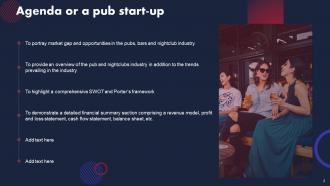
Slide 2: This slide depicts the Agenda of the presentation.
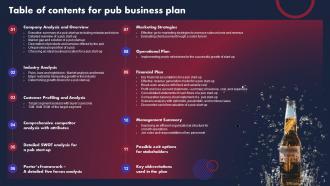
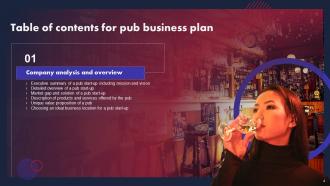
Slide 3: This slide highlights the Table of contents.
Slide 4: This slide elucidates the Title for the Topics to be covered further.
Slide 5: The purpose of this slide is to provide a broader overview of the global pub industry.
Slide 6: This slide portrays the organization details including name, incorporation date, web address, start-up investment, services etc.
Slide 7: This slide talks about the Market gap and solution of a pub start-up.
Slide 8: This slide reveals the Description of products and services offered by the pub.
Slide 9: The purpose of this slide is to highlight the key success factors of the pub start-up which leverage it with a competitive edge in the market.
Slide 10: This slide showcases an ideal business location for a pub start-up that minimize the risk of failure.
Slide 11: This slide indicates the Heading for the Contents to be discussed next.
Slide 12: The purpose of this slide is to conduct a thorough assessment of the industry in addition to its market trends.
Slide 13: This slide continues the assessment of the industry.
Slide 14: This slide lists the Major restraints hampering growth in the industry.
Slide 15: This slide caters to details about various growth drivers resulting in the firm’s progress in terms of increasing preference for binge drinking, rising trend of night-life, etc.
Slide 16: This slide mentions the Title for the Ideas to be covered in the upcoming template.
Slide 17: This slide covers Target Segment analysis with buyer's persona.
Slide 18: The purpose of this slide is to depict the market potential of the bars and nightclubs industry in terms of TAM, SAM, and SOM.
Slide 19: This slide incorporates the Heading for the Ideas to be discussed in the forth-coming template.
Slide 20: This slide continues the Comprehensive competitor analysis.
Slide 21: This is yet another slide continuing the Comprehensive competitor analysis.
Slide 22: This slide presents the Title for the Components to be covered next.
Slide 23: This slide reveals a Detailed SWOT analysis for a pub start-up.
Slide 24: This slide shows the Heading for the Topics to be further discussed.
Slide 25: The slide highlights porter’s framework and its implications in the pub and bar industry.
Slide 26: This slide incorporates the Title for the Contents to be covered in the following template.
Slide 27: The purpose of this slide is to implement an effective go-to-market strategy for bringing start-up services to an end customer.
Slide 28: This slide displays customer journey mapping to track users' actions and key touch points across levels such as awareness, consideration, conversion, loyalty.
Slide 29: This slide contains the Title for the Topics to be discussed next.
Slide 30: The purpose of this slide is to facilitate managers to convey project progress updates to stakeholders and get their approvals.
Slide 31: This slide indicates the Heading for the Contents to be further discussed.
Slide 32: This slide provides a glimpse of important financial assumptions that are to be made while setting up the firm in terms of income, expense, and balance sheet.
Slide 33: The slide shows the effective revenue model of the pub start-up, which displays the cost incurred and the various sources of income.
Slide 34: This slide elucidates the Break-even analysis with fixed and variable cost.
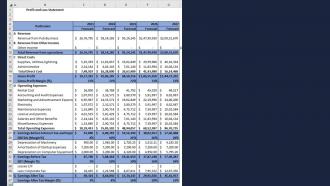
Slide 35: The slides provide a glimpse of the projected profit and loss statement to visualize the platform’s financial performance for the next five years.
Slide 36: This slide continues the Profit and loss account statement.
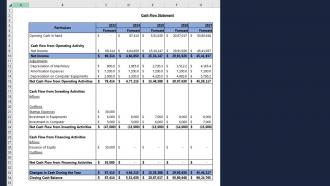
Slide 37: This slide highlights the cash flow statement of the company.
Slide 38: This is yet another slide continuing the Consolidated statements of cash flow of a pub start-up.
Slide 39: The slides cover the snapshot of the company's financial position at a specific time.
Slide 40: This slide is an extension of the Comparative balance sheet statement.
Slide 41: This is yet another slide continuing the Comparative balance sheet statement of a pub start-up.
Slide 42: The purpose of this slide is to examine the effects of potential future events on a pub start-up performance.
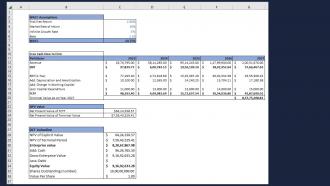
Slide 43: The purpose of this slide is to calculate the amount of money an investor would get from an investment after adjusting for the time value of money.
Slide 44: This slide mentions the Title for the Ideas to be discussed next.
Slide 45: The purpose of this slide is to craft a successful hierarchical framework for the firm to ensure smooth operations.
Slide 46: This slide talks about the Job roles and responsibilities of key personnel.
Slide 47: This slide continues the Job roles and responsibilities of key personnel.
Slide 48: This is an extension of Job roles and responsibilities slide.
Slide 49: This slide presents the Heading for the Ideas to be covered further.
Slide 50: This slide portrays the Possible exit options for stakeholders.
Slide 51: This slide mentions the Title for the Components to be covered in the following template.
Slide 52: This slide elucidates the Key abbreviations used in the plan.
Slide 53: This is the Icons slide containing all the Icons used in the plan.
Slide 54: The purpose of this slide is to depict some Additional information.
Slide 55: This is the About us slide. State your company related information here.
Slide 56: This slide presents the Area chart.
Slide 57: This slide contains the Post it notes for reminders and deadlines.
Slide 58: This is the Venn diagram slide for company related information.
Slide 59: This slide reveals information related to the Financial topic.
Slide 60: This is the Puzzle slide with related imagery.
Slide 61: This slide is used for the purpose of Comparison.
Slide 62: This slide exhibits the 30 60 90 Days Plan.
Slide 63: This slide contains a Magnifying glass for minute details.
Slide 64: This is the Thank you slide for acknowledgement.
Pub Business Plan Powerpoint Presentation Slides with all 69 slides:
Use our Pub Business Plan Powerpoint Presentation Slides to effectively help you save your valuable time. They are readymade to fit into any presentation structure.





FAQs for Pub Business Plan
So you'll need the basics - market research, target customers, location breakdown, financials. Your concept's huge though since pubs live or die by their vibe. Honestly, the licensing paperwork alone will make your head spin. Cover your menu strategy, staffing plans, supplier connections. Marketing's key too. Don't skip seasonal planning - winter's brutal for some places. Break-even analysis and cash flow projections are must-haves for investors. Oh, and definitely check out what's working at other local pubs first. No point reinventing the wheel when you can just make it better, right?
Look, you really can't skip market research if you want your pub to work. Figure out who lives nearby, what they drink, when they're actually out spending money. Too many owners think they just "get" their customers and then wonder why they're hemorrhaging cash six months later. Honestly, it's pretty painful to watch. Your research tells you how to price things, what vibe to go for, where to even set up shop in the first place. Do some local surveys, scope out the competition - that stuff becomes your game plan. Without it you're just throwing money around and hoping something sticks.
Break down your revenue projections - food, drinks, plus any events or gaming stuff you're planning. Cost of goods sold runs about 25-35% for drinks, more for food. Then there's rent, utilities, wages, insurance, all that fun stuff. Pubs are super seasonal too - weather and local events mess with your numbers more than you'd think. Cash flow statements for 18 months minimum since income gets weird. Oh, and definitely include break-even analysis plus 3-5 year profit/loss projections. Start conservative though - better to underestimate than have investors thinking you're full of it.
Honestly, location is everything with cafes. Downtown spots cost a fortune in rent, but you'll get way more foot traffic than some random residential street. The demographic totally changes your whole vibe too - like, are you targeting business people grabbing quick coffee or families wanting to hang out? I'd definitely camp out at potential locations and actually count how many people walk by during different hours. Sounds boring but it's huge for your projections. Also check out the competition nearby - you don't want to open right next to three other coffee shops unless there's clearly enough demand.
Honestly, start with figuring out who your crowd actually is - then go where they hang out. Instagram's perfect for posting food shots, Facebook works better for event announcements. Host stuff like trivia nights or live music to keep people coming back. I'd definitely partner with other local businesses too, maybe sponsor some community events. Word-of-mouth is still everything in this industry, so nail your customer service first. Oh, and email newsletters are surprisingly effective for pushing drink specials to your regulars. Building those local connections will make or break you.
Honestly, your menu needs to match who you're trying to attract. Young professionals will drop serious cash on craft cocktails and those trendy small plates that look good on social media. Families? They want kid menus and prices that won't break the bank. Older regulars usually prefer classic pub food with actual substance to it. Sports crowds are all about wings and stuff they can eat with one hand while watching the game. Here's the thing though - trying to make everyone happy just creates a confusing disaster. Pick maybe 2-3 customer types max and build around what they actually want and can afford.
Dude, the liquor license is gonna be your biggest headache - seriously, start that process NOW because it takes forever. You'll also need the usual business license, food permits if you're doing more than just drinks, and entertainment licensing for music/TVs. Health department and fire clearance are non-negotiable too. The liquor license application is brutal with all the background checks and they even notify your neighbors (awkward). Some places want extra permits for patios or late hours. Honestly, just call your local licensing office ASAP to get the full list and timeline. Every city's different with this stuff.
Basically you'd map out your pub's strengths - like great location, skilled bartenders. Then weaknesses - maybe an outdated kitchen or crappy parking situation. Opportunities could be that new housing development going up nearby or the whole craft beer craze. Threats might be chain restaurants muscling in or your rent going through the roof. Honestly, it sounds super basic but it really does help you see everything clearly. Don't sugarcoat the weak spots though - that'll just bite you later. Once you've got it all laid out, you can build your whole business plan around playing up your strengths while fixing the problem areas.
Yeah, staffing can totally make or break your place - seriously. Map out your core roles first (bar manager, kitchen, cleaning crew) then build from there based on your hours and expected crowds. Labor costs are gonna be massive, so factor that in early. Too many owners try doing everything solo and just burn out hard within like a year. It's brutal to watch honestly. Your plan needs hiring timelines and training stuff, plus backup for when you get slammed. Don't skip the boring details on this one.
Honestly, start with mobile ordering - lets people order from their table instead of waiting at the bar forever. Digital menus are clutch too since you can update them instantly and push daily specials. Get a loyalty app going to track what regulars actually want (and keep them coming back). Contactless payments are pretty much expected now. Social media integration helps promote events, though I'd probably focus on Instagram over Facebook these days. Maybe add digital jukeboxes or trivia later? Don't try everything at once - pick whatever fixes your biggest headache first, then build from there.
Honestly, the biggest headaches you're gonna deal with are licensing stuff and keeping good staff around - turnover is brutal in this industry. Competition from chains is no joke either. Plus everything costs more now - rent, utilities, suppliers - but you can't jack up beer prices too much or people bail. Seasonal swings will mess with your cash flow pretty hard. Oh, and people are drinking at home way more these days instead of going out. Health regulations are always breathing down your neck too. The whole economic uncertainty thing has people cutting back on bar nights. Really think through how you'll handle the slow months financially - that's where most places get screwed.
So you're gonna need to scope out your competition - other pubs, bars, restaurants in your area. Check out their prices, food, vibe, who hangs out there. I'd actually visit them at different times (weekday lunch hits different than Friday night, you know?). This whole process is honestly kind of brutal when you see how many places are already fighting for the same customers. But here's the thing - it'll help you figure out what's missing. Maybe nobody's doing good gastropub food, or there's no decent sports bar. Use that intel to make your place stand out from the crowd.
Honestly, budget around $175k-$500k depending where you are and what vibe you're going for. Lease deposits are brutal, then renovation costs hit hard. Draft systems and kitchen equipment aren't cheap either - oh, and licensing fees? Way more expensive than I expected. You'll definitely need working capital for the first few months since money gets tight fast. Equipment like POS systems add up quick too. My advice? Plan for 20% over whatever you think it'll cost. There's always some random expense that pops up during construction.
Honestly, it's easier than you think! Start with local ingredients and partner with breweries nearby - people are obsessed with that farm-to-table thing right now. Throw in some energy-efficient equipment and recycling programs. Maybe add plant-based options too? Oh, and if you've got space, an actual beer garden with real plants would be pretty cool. Don't just do it to check boxes though - make sustainability part of your whole brand. Write this stuff down in your business plan because investors dig sustainable businesses these days, plus you can totally market it to those eco-friendly customers.
Honestly, focus on revenue per customer and weekly sales patterns first - that's your real money maker. Food vs drink margins matter too since drinks are usually pure profit. Track how often people come back because regulars will literally keep you afloat. Labor costs should stay under 30% of revenue if possible. I'd also watch inventory turnover and see when you're actually busy versus dead. Online reviews are annoying but they really do bring in new faces. Pull this stuff weekly, then compare monthly to what you thought would happen. Start simple with a spreadsheet - no need to overcomplicate it until you know what actually matters for your spot.
-
Extremely professional slides with attractive designs. I especially appreciate how easily they can be modified and come in different colors, shapes, and sizes!
-
Definitely a time saver! Predesigned and easy-to-use templates just helped me put together an amazing presentation.