

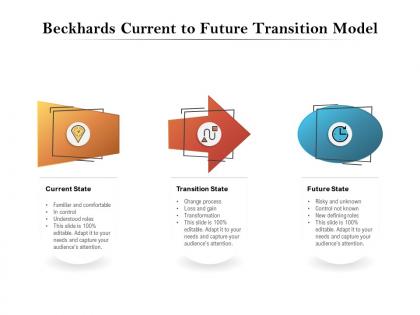
Beckhards current to future transition model




Try Before you Buy Download Free Sample Product
 Impress Your
 Audience
 100%
100% Editable
 Save Hours
 of Time


Our Beckhards Current To Future Transition Model are explicit and effective. They combine clarity and concise expression.
People who downloaded this PowerPoint presentation also viewed the following :
Beckhards current to future transition model with all 2 slides:
Give your audience a fulfilling experience. They will find our Beckhards Current To Future Transition Model elevating.
FAQs for Beckhards current to
So Beckhard breaks it down into three stages that flow together: Present State (your current mess), Transition State, and Future State (where you want to end up). The transition part is honestly brutal - that's where most people give up because of all the resistance and chaos. But here's the thing: you can't navigate that messy middle without knowing exactly where you're headed first. Your present state just shows you the starting line. The stages build on each other, but I'd definitely spend way more time upfront getting crystal clear on that future vision. Trust me on this one - it'll save you later.
Start by mapping out where you are now versus where you want to be - then figure out what activities will get you there. That's basically Beckhard's whole thing. Get everyone on the same page about the destination first though, because most companies skip this step and then act surprised when everything falls apart. Communication is huge during the actual transition since that's when people start pushing back. Oh, and definitely involve your team in planning those transition activities instead of just telling them what to do. Track your progress regularly too - don't just cross your fingers and hope it works out.
Honestly, communication makes or breaks these transitions. People freak out when they don't know what's happening to their job or team. You've got to keep explaining the "why" and paint that picture of where you're headed. Don't just send updates though - actually listen when people push back or share concerns. Those messy middle phases? That's when everyone's stressed and nothing feels normal, so check in more often then. Set up different ways for people to talk to you, not just those formal meetings everyone hates. Two-way conversations beat corporate announcements every time.
Honestly, Beckhard's approach hits different than Kotter or Lewin. Those other models are more like "here's your step-by-step process" while Beckhard dives into the psychology behind why people resist change. His formula is pretty neat: Change = (Dissatisfaction × Vision × First Steps) > Resistance. What I love about it is you can actually pinpoint where things are breaking down. Maybe your team isn't unhappy enough with the status quo, or your vision sucks, or - and this happens a lot - you haven't given people concrete first steps. If any of those three factors tanks, you're screwed. It's way more diagnostic than just following generic phases.
Honestly, the hardest part is just getting people on board - everyone freaks out about change. Your leaders probably won't even explain the end goal clearly, which makes everything confusing. Communication gets totally screwed up too, especially at big companies where the message gets twisted by the time it reaches everyone. Plus you're burning through resources like crazy because you're basically running your old system AND the new one at the same time. The whole framework acts like change happens smoothly, but it's actually chaos most of the time. I learned this the hard way at my last job. Bottom line: explain WHY you're doing this a million times and give yourself way more time than seems reasonable.
So you've got three phases to think about. Right now, teams need to feel safe calling out what's broken - no sugarcoating allowed. The middle part? That's honestly where everything goes to hell if you're not careful. People get anxious and lost, so you'll be overcommunicating like crazy and celebrating every tiny win. Once you hit the final stage, it's about reinforcing those new habits and helping everyone see the actual benefits. Match your style to where people are emotionally - some teams might be further along than others. Map out who's where first, then adjust from there.
Look for people finally being honest about what's broken - no more pretending everything's fine in meetings. When folks start getting genuinely excited about the vision (not just nodding politely), that's huge. During transitions, watch for structured planning and consistent communication. People adapt instead of digging in their heels. Leadership stays present, which honestly makes all the difference. The biggest sign? Resistance fades and things start moving on their own. I'd track this through surveys and casual conversations - sometimes you learn more from random hallway chats than formal feedback sessions.
So Beckhard's model basically gives you three phases to work with: where you are now, where you want to end up, and that chaotic middle part. Honestly, most people skip planning the transition phase and then wonder why everything goes sideways. Start with your end goal first - like, really nail down what success looks like. Then work backwards to figure out what you'll actually need to do to get there. The model makes you think about communication, who's gonna push back (there's always someone), and all those messy details you'd probably forget otherwise. Way better than just hoping things work out.
Set up regular check-ins throughout each phase - weekly pulse surveys or quick team retrospectives work great during transitions. Honestly, I've watched way too many changes crash because leaders just assumed people were on board. Get that feedback and pivot in real-time instead of waiting till it's too late. Once you hit your future state, keep tracking metrics that connect back to your original vision. Oh, and don't overcomplicate the feedback collection - just make it quick and actually use what people tell you. Consistency beats perfection here.
Definitely start with stakeholder mapping - you gotta know who you're dealing with first. RACI matrices are clutch for sorting out who does what (saves you from those awkward "wait, whose job was this?" moments later). Communication plans keep everyone in the loop, and honestly, regular surveys or focus groups are worth their weight in gold for tracking how people are adjusting. Oh, and grab some project management software to stay on top of milestones. The key is layering these tools with Beckhard's model - they fill in the gaps where his framework gets a bit vague on execution.
So with Beckhard's model, you basically adjust which part gets the most attention depending on what kind of change you're dealing with. Mergers? Go heavy on vision because people get confused about the new combined future real quick - I've seen cultural stuff fall apart without clear direction. Restructuring is different though. Everyone's already frustrated with how things are, so focus more on those first concrete steps and dealing with pushback. The D x V x F > R formula doesn't change, but you're cranking up different pieces. Figure out which component is your weakest link first and hit that hard.
So basically you want to track Beckhard's formula: Dissatisfaction × Vision × First Steps > Resistance to Change. Check employee satisfaction to see dissatisfaction levels. Survey people about how clear your vision actually is - focus groups work too. Monitor if teams are finishing those first action steps you set up. Resistance is honestly such a pain to measure, but look at adoption rates and participation in your change stuff. Also track the usual things like productivity and turnover (boring but necessary). The trick is checking all four parts regularly so you can pivot when things aren't clicking. Oh, and feedback sentiment helps too - people will tell you if they're not buying in.
Look, Beckhard's whole thing is that you can't just ignore how people *feel* about change - and honestly, most managers are terrible at this part. People go through actual grief when their familiar work world gets flipped upside down. The smart move? Don't pretend their anxiety isn't real. Get them involved in planning from the start, communicate why this matters to *them* specifically (not just the company), and give folks time to wrap their heads around it. I've watched so many change efforts crash because leadership thought they could just announce something and expect everyone to smile about it. Address the emotional stuff head-on or you're basically setting yourself up to fail.
Yeah, Beckhard's model totally works for nonprofits! The D x V x F > R thing just needs tweaking for your situation. Dissatisfaction could be like dropping donations or programs that feel stale. Vision's your bigger impact goals or updating how you do things. First steps are whatever quick wins you can actually pull off. Nonprofits have this weird advantage where everyone's usually bought into the mission already - though good luck getting the board to agree on anything, right? Just don't pick changes that'll burn through cash you don't have. Map out who needs to hear what: donors want different messaging than volunteers or the people you're actually helping.
Honestly, leadership buy-in is everything - I've seen so many changes fail because executives weren't really committed. Start with your key stakeholders and make sure they're actually on board, not just saying they are. Communication needs to happen constantly, not just upfront. Oh, and definitely pilot test with small groups first - saves you from major disasters later. The companies that did well built in ways to get feedback and pivot quickly when stuff wasn't working. Don't rush the timeline either. I know everyone wants quick results, but pushing too hard just kills all your momentum.
No Reviews