


Benchmarking Analysis Tool For Project Management Quantitative Risk Analysis




Try Before you Buy Download Free Sample Product
 Impress Your
 Audience
 100%
100% Editable
 Save Hours
 of Time


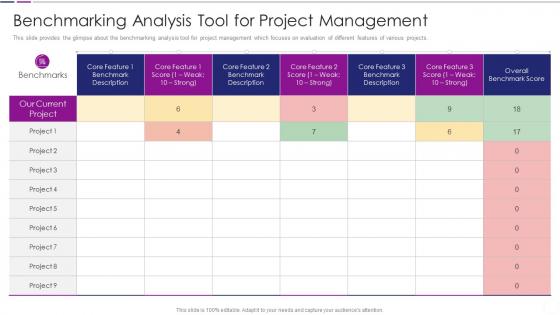
This slide provides the glimpse about the benchmarking analysis tool for project management which focuses on evaluation of different features of various projects.
People who downloaded this PowerPoint presentation also viewed the following :
Benchmarking Analysis Tool For Project Management Quantitative Risk Analysis with all 6 slides:
Use our Benchmarking Analysis Tool For Project Management Quantitative Risk Analysis to effectively help you save your valuable time. They are readymade to fit into any presentation structure.





FAQs for Benchmarking Analysis Tool For Project Management
Effective benchmarking analysis tools include comprehensive data visualization capabilities, customizable comparison frameworks, real-time performance tracking, automated report generation, and integration with existing business systems. These features streamline competitive analysis by enabling dynamic dashboard creation, facilitating cross-industry comparisons, and delivering actionable insights, with many organizations finding that robust visualization and automation capabilities significantly enhance their strategic decision-making processes.
Benchmarking analysis tools facilitate competitive analysis by providing systematic frameworks for comparing performance metrics, market positioning, operational efficiency, and strategic outcomes against industry leaders. These tools enable businesses to identify performance gaps, uncover best practices, and discover competitive advantages through data-driven insights, with many organizations finding that structured benchmarking accelerates strategic decision-making and market differentiation.
Industries with complex operational metrics and intense competition benefit most from benchmarking analysis tools, including healthcare, financial services, manufacturing, retail, and telecommunications. These sectors leverage benchmarking to enhance performance measurement, streamline processes, and identify competitive gaps, with many organizations finding that systematic comparison against industry leaders delivers improved operational efficiency and strategic positioning in increasingly dynamic markets.
Benchmarking analysis tools support performance improvement by identifying gaps between current and best-in-class performance, establishing measurable targets, and tracking progress through standardized metrics and comparative frameworks. These platforms enable organizations to streamline assessment processes, prioritize improvement areas, and implement data-driven strategies, with many companies finding that systematic benchmarking accelerates achievement of operational excellence and competitive positioning.
Yes, benchmarking analysis tools can be integrated with existing business intelligence software through APIs, data connectors, and middleware solutions. This strategic combination enables organizations to streamline data flows, enhance comparative analytics, and deliver comprehensive performance dashboards, with many companies finding that integrated systems significantly reduce manual reporting while improving decision-making speed and accuracy.
Data accuracy serves as the foundation for reliable benchmarking analysis, directly impacting the validity of performance comparisons, strategic insights, and decision-making processes across organizations. Without precise data, companies risk making flawed strategic decisions based on incorrect benchmarks, while accurate data enables meaningful performance gaps identification, competitive positioning assessments, and targeted improvement initiatives, ultimately delivering enhanced operational efficiency and sustainable competitive advantage.
Small businesses can leverage benchmarking analysis tools cost-effectively through free online resources, industry association reports, and basic analytics platforms that track key performance metrics. By focusing on essential KPIs like customer acquisition costs, profit margins, and operational efficiency, small retailers, service providers, and local manufacturers find competitive insights that streamline operations and enhance strategic positioning without significant investment.
Common benchmarking metrics include financial ratios like ROI and profit margins, operational efficiency measures such as cycle time and throughput, customer satisfaction scores, and quality indicators like defect rates. These metrics are calculated by comparing internal performance data against industry standards, competitor analysis, and best-in-class organizations, ultimately delivering actionable insights for strategic improvement and competitive positioning.
Benchmarking analysis tools differ from traditional market research by providing real-time competitive data, standardized performance metrics, and continuous monitoring capabilities, while traditional methods rely on periodic surveys, focus groups, and static reports. These digital tools enable organizations to track competitor pricing, operational efficiency, and market positioning instantly, with many financial services and retail companies finding that automated benchmarking delivers faster strategic insights.
Relying solely on benchmarking analysis tools can lead to outdated comparisons, misaligned metrics that don't reflect your specific business context, and over-dependence on competitor data rather than innovation. While these tools provide valuable market insights, organizations increasingly find that combining benchmarking with internal performance analysis and forward-looking strategic planning delivers more comprehensive competitive advantage.
Benchmarking analysis tools enhance strategic planning by identifying performance gaps, revealing industry best practices, establishing realistic targets, and uncovering competitive advantages across key metrics. These tools enable organizations to make data-driven strategic decisions, prioritize resource allocation more effectively, and accelerate improvement initiatives, with many companies finding that systematic benchmarking delivers measurable competitive positioning and operational excellence.
User-friendly interfaces significantly accelerate the adoption of benchmarking analysis tools by reducing learning curves, minimizing training requirements, and enabling broader organizational access beyond technical specialists. Intuitive dashboards and simplified navigation allow managers across departments like operations, finance, and strategy to independently conduct comparative analyses, ultimately delivering faster decision-making and increased utilization rates.
Real-time data significantly enhances benchmarking tool efficacy by enabling immediate performance comparisons, dynamic trend identification, and rapid response to market changes. Through continuous data feeds, organizations can monitor competitor movements, adjust strategies instantly, and identify emerging opportunities while they develop, ultimately delivering more accurate insights and sustainable competitive advantages in increasingly volatile business environments.
Organizations ensure appropriate benchmarking by selecting industry-specific metrics, identifying relevant peer companies of similar size and market position, and using standardized measurement methodologies. Through strategic benchmark selection, companies can evaluate performance against direct competitors, best-in-class performers, and industry averages, ultimately delivering meaningful insights that drive competitive advantage and operational improvements.
Future trends in benchmarking analysis tools include AI-powered predictive analytics, real-time data integration, industry-specific customization, automated competitive intelligence, and cloud-based collaborative platforms. These advancements streamline comparative analysis by delivering faster insights, enhancing accuracy through machine learning, and enabling cross-functional teams to identify performance gaps more effectively, ultimately providing organizations with strategic advantages in increasingly competitive markets.
-
Satisfied with the way SlideTeam resolved my query regarding the right business PPTs that I was having difficulty finding. I found the perfect match with their assistance.
-
What a stunning collection of customizable templates! Really a time-saver..