

Benchmarking Process In Total Quality Management




Try Before you Buy Download Free Sample Product
 Impress Your
 Audience
 100%
100% Editable
 Save Hours
 of Time


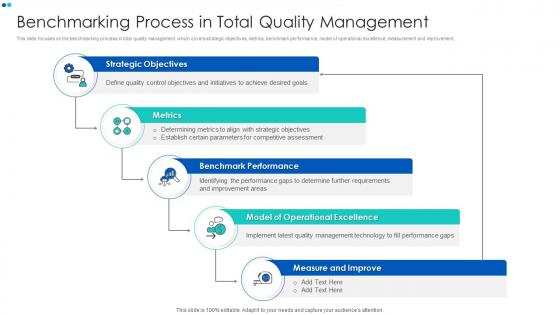
This slide focuses on the benchmarking process in total quality management which covers strategic objectives, metrics, benchmark performance, model of operational excellence, measurement and improvement.
People who downloaded this PowerPoint presentation also viewed the following :
Benchmarking Process In Total Quality Management with all 6 slides:
Use our Benchmarking Process In Total Quality Management to effectively help you save your valuable time. They are readymade to fit into any presentation structure.





FAQs for Benchmarking Process In
Focus on metrics that actually matter to your bottom line - revenue per employee, customer satisfaction, cost ratios, cycle times. I learned this the hard way: measuring everything is a nightmare and gets you nowhere. You'll need your own baseline numbers first, otherwise you're just guessing when you compare with other companies. Pick stuff that's measurable and comparable across different organizations. Oh, and make sure it's something you can actually do something about - tracking metrics you can't influence is basically useless busy work.
Three things to nail down: data sources, methodology, and verification. Get your data from solid, comparable organizations - don't just take whatever's easiest to find. Document your process clearly so you can repeat it later (I've watched so many projects crash because nobody wrote down what they actually did). Cross-check with multiple sources when you can. Also involve people who know the industry to sanity-check your results - sometimes the numbers look right but miss important context. Oh, and create a basic template for collecting data. Makes everything way more consistent.
Honestly, benchmarking is like a reality check for your business. You compare your stuff against the big players or even your own best work, and boom - you see exactly where you're falling short. Kind of brutal sometimes, but at least you know what "good" actually looks like, right? The whole point is figuring out realistic goals from there. Oh, and tracking if you're actually getting better over time - that part's huge. I'd say pick one thing your customers actually care about first. Don't try to benchmark everything at once or you'll go crazy.
Start with metrics that actually move the needle in your industry - revenue's obvious, but think customer satisfaction, market share, operational stuff too. Industry reports and public financials are your best bet for data (some benchmarking services cost a fortune but honestly they're worth it). Here's the thing though - you gotta compare similar companies or the numbers are basically useless. Same size, same markets, same business model. Don't just stare at spreadsheets either. Dig into WHY the top performers are crushing it. Set up monthly or quarterly reviews so you're not scrambling to do this once a year.
So there are four types you'll run into. **Internal** benchmarking is just comparing your own departments - easiest to start with since you already have the data. **Competitive** looks at your direct rivals, which makes sense. Then **functional** benchmarking studies similar processes but in totally different industries (like comparing your customer service to how hotels do it). **Generic** benchmarking finds best practices anywhere, regardless of industry. Most companies honestly just stick with internal at first - way less headache. My advice? Start internal to spot problems, then check out competitors for positioning. Save functional and generic for when you really want to shake things up.
Dude, the automation alone will save you so much time - no more manually pulling data from like 5 different places. Real-time dashboards that actually update themselves? Game changer. AI can figure out which benchmarks are worth your attention instead of you drowning in random metrics that don't matter. The statistical analysis gets way more sophisticated than anything you'd do by hand, plus it catches patterns you'd totally miss. Honestly the visualization tools these days are wild. I'd start with whatever boring manual stuff you're doing now and find tools to automate that first.
Look, numbers only tell you *what* happened, but qualitative stuff explains the *why* behind it all. Say you see a competitor crushing your customer satisfaction scores - that's nice, but interviews might reveal they just doubled their support team training budget. Context is everything here. Without those deeper insights about processes, culture, or strategy decisions, you're basically flying blind. Oh and honestly? I've seen people make terrible calls based purely on metrics. Always throw in some qualitative research with your benchmarking. Even chatting with like 3-4 customers can totally flip how you read the data.
Honestly, ditch the whole annual benchmark thing - it's pretty much pointless now. I'd check your key metrics monthly or quarterly instead. Fast-moving industries change way too quickly for yearly snapshots to matter. Don't just stalk your obvious competitors either. Look at adjacent industries or whoever might shake things up in your space. Mix hard data with softer stuff too - hang out in industry forums, hit conferences, ask customers what they're seeing elsewhere. Oh and make this part of your regular routine, not some big special project you dread doing.
First thing - get proper consent before collecting any data from people. Anonymize everything and don't share stuff that could hurt the companies you're studying. Be upfront about your methods too. Don't cherry-pick results to make yourself look amazing (we've all rolled our eyes at those "studies" that mysteriously forget major competitors exist). Compare similar things and call out where your research has gaps. Oh, and disclose if you have any conflicts of interest right away. Basically treat their data like you'd want yours treated. Golden rule applies to benchmarking too.
Honestly, benchmarking is like having a roadmap instead of just winging it. You'll actually know where you stand against competitors rather than guessing what "good performance" even means. The data helps you spot real gaps and figure out what's actually possible - not just some random target your boss pulled out of thin air. Plus it makes getting budget approval way easier when you can show concrete evidence. I'd start small though, maybe pick 2-3 metrics that matter most and find solid benchmark data for those first. Way less overwhelming than trying to benchmark everything at once.
Biggest mistake is comparing random stuff without knowing what you're even measuring first. Write down what success actually looks like before you start. Don't cherry-pick data just because it makes you look good - I've watched teams do this and it's painful to see. Make it ongoing too, not a one-time thing. Conditions shift way too much for that. Oh and honestly? Focus on stuff you can actually act on instead of just collecting fancy numbers that look impressive in meetings. You'll save yourself so much wasted time if you nail down clear metrics upfront.
Get your team involved from day one - don't just spring the results on them later. They actually know where the real problems are hiding anyway. Have them help pick what to measure and collect the data. Transparency is huge here - share everything, good and bad. Cross-functional teams work best so you get different viewpoints. Oh, and I've watched so many of these projects crash because leadership acted all secretive about it. When you finally make changes, explain why you're doing what you're doing. Give people credit too. Start by asking what they think needs measuring first.
Honestly, benchmarking can be a game-changer for team culture if you don't mess it up. People love having real targets instead of those annoying "just improve" goals managers always give. Plus concrete proof that something's actually achievable? Way more motivating. But yeah, it'll blow up in your face if the benchmarks feel impossible or unfair. I've seen teams get super demoralized when they're compared to groups with totally different resources. The trick is picking realistic comparisons and actually celebrating when people make progress. Oh, and definitely get your team involved in choosing what you're measuring - nobody likes having metrics forced on them.
Oh totally, benchmarking changes big time depending on your industry. Manufacturing folks obsess over production speed and defect rates. Healthcare? They're tracking patient outcomes and readmission stats instead. Tech companies live and die by uptime metrics - honestly, makes sense when you think about it. Financial services get super nerdy about risk ratios and compliance stuff that would put most people to sleep. The trick is figuring out what actually matters for your specific field, then finding similar companies measuring the same things. Don't just steal what works somewhere else though - you've gotta adapt it to whatever weird pressures your industry throws at you.
Pick 3-5 metrics that actually matter to what you're trying to fix - not just stuff that looks good on paper. Honestly, I've watched teams obsess over numbers that sound impressive but don't mean anything. Before changing anything, figure out your baseline. Then check monthly or quarterly to see if you're hitting your targets. Dashboards help, but even a basic spreadsheet works fine. The hard part? Making sure you're tracking things that actually show whether your changes worked. Oh, and don't forget to celebrate the wins - people need that motivation to keep going.
-
The templates are easy to get, and the chat customer support is excellent.
-
SlideTeam offers so many variations of designs and topics. It’s unbelievable! Easy to create such stunning presentations now.