


Introduction To Total Quality Management Powerpoint Presentation Slides





Try Before you Buy Download Free Sample Product
 Impress Your
 Audience
 100%
100% Editable
 Save Hours
 of Time


Boost the quality of your products and meet the customers requirements using Introduction To Total Quality Management PowerPoint Presentation Slides. Eliminate the waste and deficiencies to develop a deliverable that customers like. With the help of Introduction To Total Quality Management PPT slideshow, follow step by step process to intensify the efficiencies of the process. Go through each step and run a total quality management in your organization to produce and deliver high quality products to the consumers. This ready-to-use total quality management presentation covers topics like TQM model, customer focus in TQM, planning process in TQM, determinants of product quality, TQM principles, and more. Execute quality management and try to attain a desired level of excellence. Add these professionally designed content-ready Introduction To TQM PPT templates which will act as a guide for you to run this process for your organization. Click the download button below and grab this readymade deck to make things easier for you. Bridge the intervals with our Introduction To Total Quality Management Powerpoint Presentation Slides. Ensure folks are gainfully engaged during the breaks.
People who downloaded this PowerPoint presentation also viewed the following :
Content of this Powerpoint Presentation
Total quality management, also recognized as TQM, is about ensuring that whatever a company does, it should be of a high standard. It is a way to improve quality in every aspect of the business. It involves everyone in the organization, from the senior management team to executives. Every individual is aligned to work as a team to find solutions for the problems. It is also called continuous improvement. It aids in ensuring that firms deliver the best services to customers and constantly meet their expectations. It aims to ensure quality in every process and every work managed at the company.
Foster a culture of excellence and accountability, drive efficiency, innovation, and long-term success with our total quality management presentation design. Download here.
TQM also results in effective resource management, as it ensures cost savings, improved productivity, and less wastage. It also promotes a perspective of innovation where all employees look to contribute to their full potential. It ensures that every function of the trade is positioned to meet customer needs.
Emphasize customer satisfaction and build enduring relationships with clients with our total quality management deck. Click here to download.
Access our (SlideTeam's) PowerPoint slides to convey the message of total quality management in business success. These professionally created presentation designs help you demonstrate their importance in improving customer experience, product quality, and the entire business. You can easily show how total quality management ensures the better functioning of the businesses. Furthermore, you can make your teammates and stakeholders understand the need to implement such practices. Additionally, you can use these PPT visuals to inspire business associations and achieve excellence.
Using our total quality management overview, you can integrate quality principles into all processes, enhance efficiency, reduce defects, and cultivate a culture of excellence. Download now and get started.
Template 1: TQM Pyramid
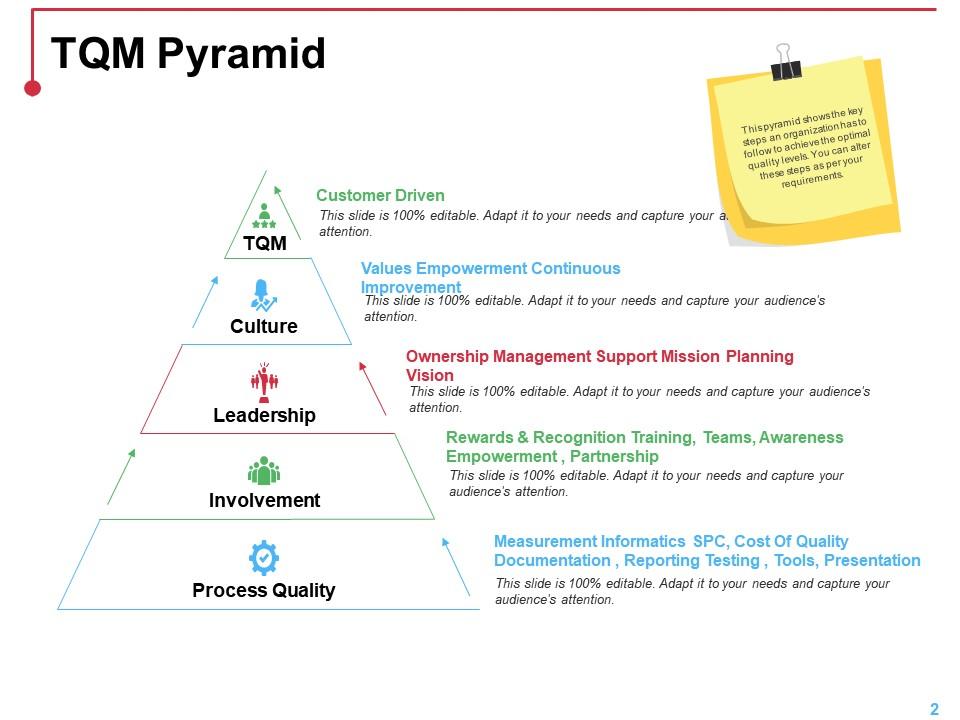
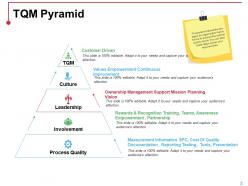
This PowerPoint layout shows the TQM pyramid mode. It highlights its critical components. These are TQM, driven by customer needs and culture, which shapes organizational values like empowerment and continuous improvement. Besides this, the presentation slide focuses on Leadership, which is taking ownership, managing resources, and driving mission planning and execution. The PowerPoint Presentation exhibits involvement strategies, such as rewards and recognition, training, partnership, empowering teams for success, and also on process quality. The design is ideal for quality and operations managers, continuous improvement experts, and research specialists.
Template 2: TQM Model
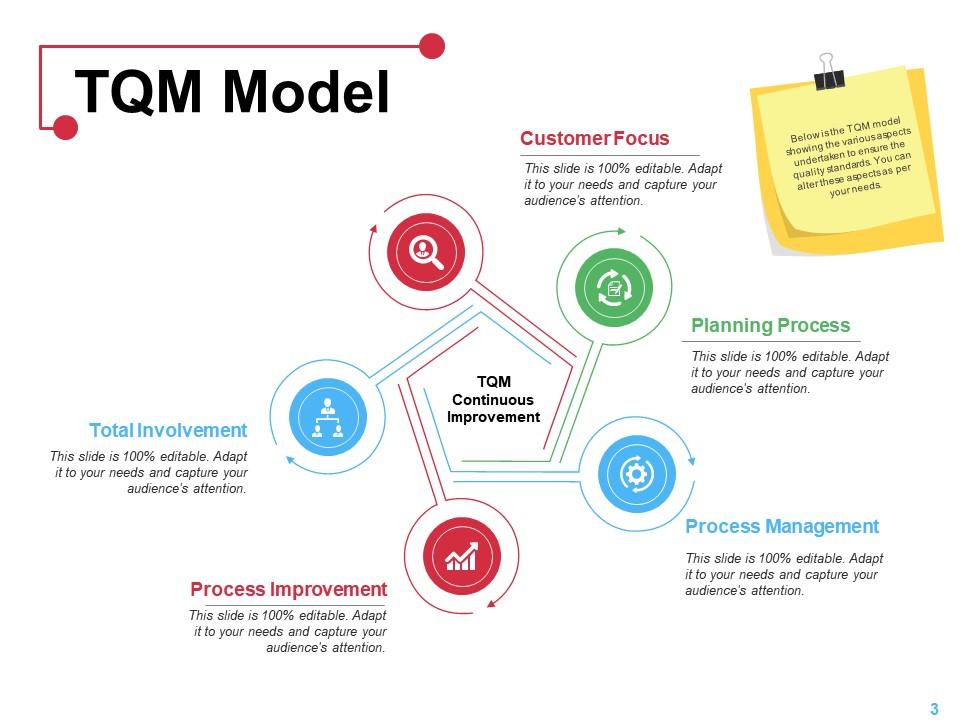
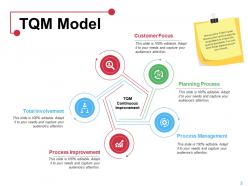
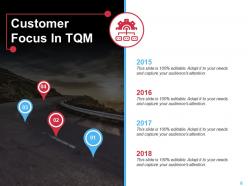
This presentation design summarizes the essence of the TQM mode. It emphasizes continuous improvement at its core. The PowerPoint slide shows a five-step process starting with customer focus, planning process, process management, process improvement, and total involvement. The PPT layout is beneficial for quality assurance managers, process improvement specialists, and operations directors. The visual presentation allows corporate firms to engage their audience and make them understand TQM, with impact.
Template 3: Planning Process in TQM
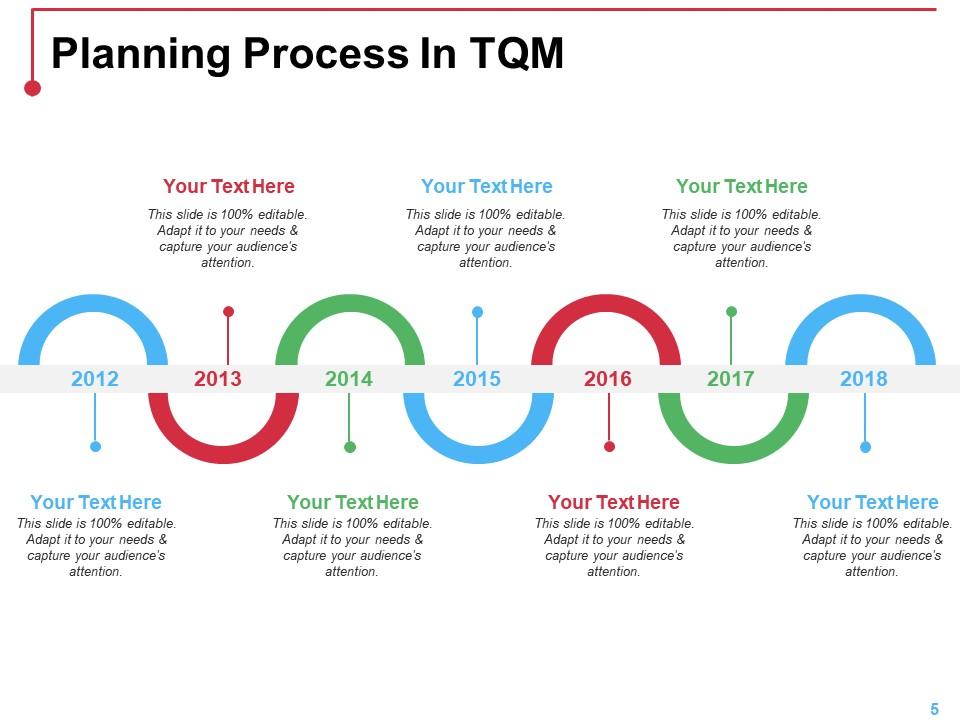
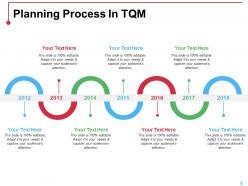
This PPT Slide outlines the planning process for TQM. It illustrates the key milestones as well. The presentation template helps you to represent a crucial phase in the corporate journey towards total quality management implementation, involving strategy development, objective, setting, and resource allocation. The PowerPoint diagram is valuable for quality managers, project managers, and strategic planning experts. The PPT layout helps to align quality measures with business objectives.
Template 4: Business Process Improvement
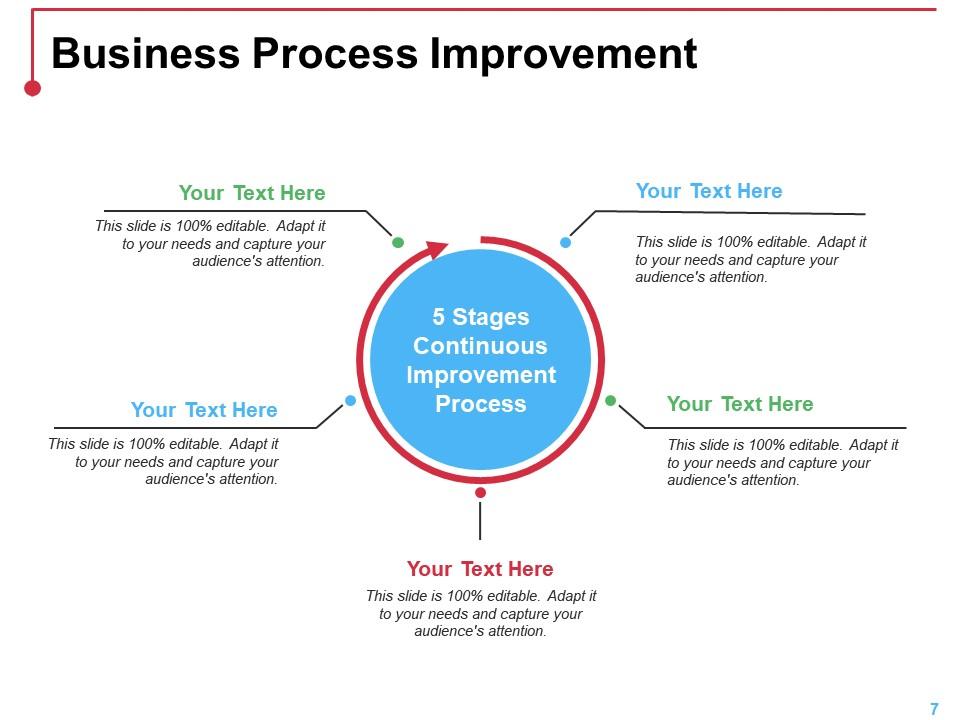
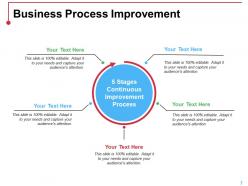
This presentation graphic demonstrates the business improvement framework. The PowerPoint layout is helpful in showcasing five critical stages of the continuous improvement process: define, identify, select, implement, and evaluate. The PPT design is beneficial for process improvement specialists, operations managers, and business analysts. By using this presentation slide, they can focus on improving business operations, increasing productivity, and driving growth. This PowerPoint template creates an opportunity to present to your audience the real meaning of success in a business environment.
Template 5: TQM Elements
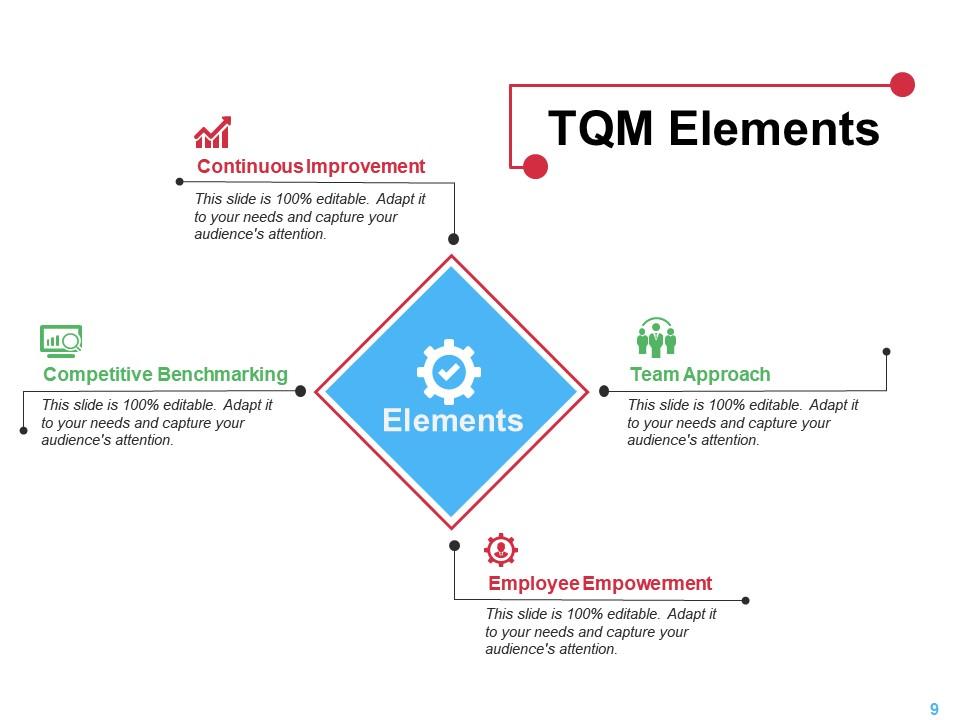
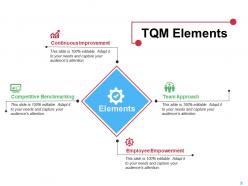
This PowerPoint visual presents the core elements of total quality management: team approach, employee empowerment, competitive benchmarking, and continuous improvement. With this effective strategy, corporate firms can drive innovation and produce results. They can also optimize processes and create new revenue-generating opportunities. Moreover, they can exceed customer expectations and infuse the business with new life. The presentation template helps human resource managers, quality managers, and continuous improvement specialists.
Template 6: Determinants of Product Quality
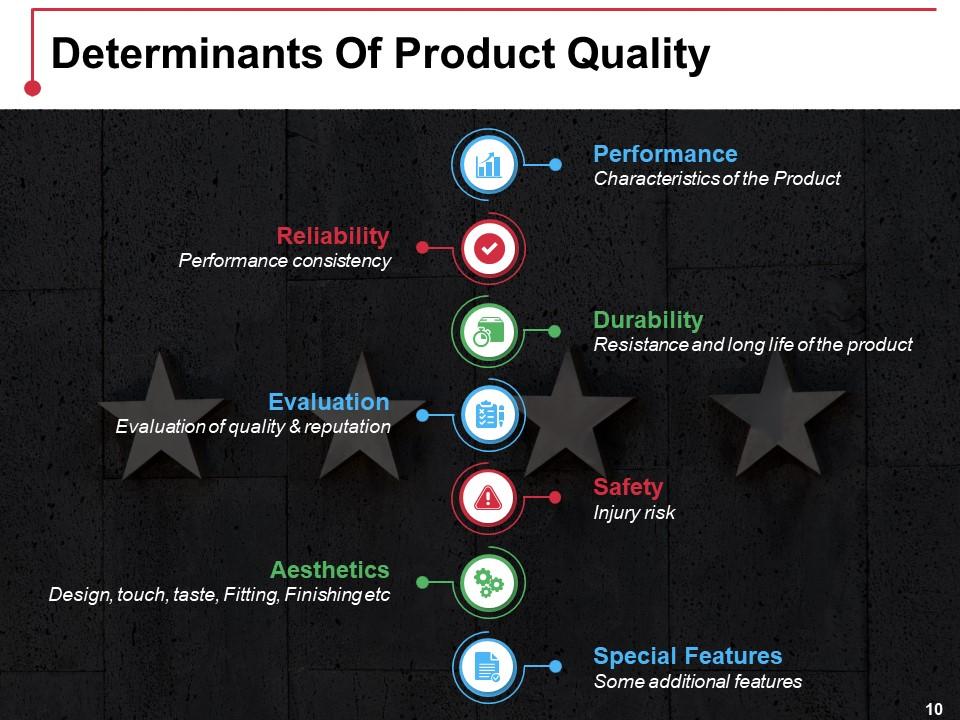
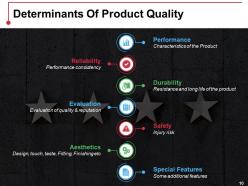
This PPT design exhibits the determinants of product quality. It encompasses performance, reliability, durability, evaluation, safety, aesthetics, and unique features. The presentation slide helps you to highlight that each determinant plays a vital role in ensuring better customer experience and market competitiveness. The PowerPoint layout is apt for product managers, design engineers, and quality assurance engineers.
Template 7: Determinants of Service Quality
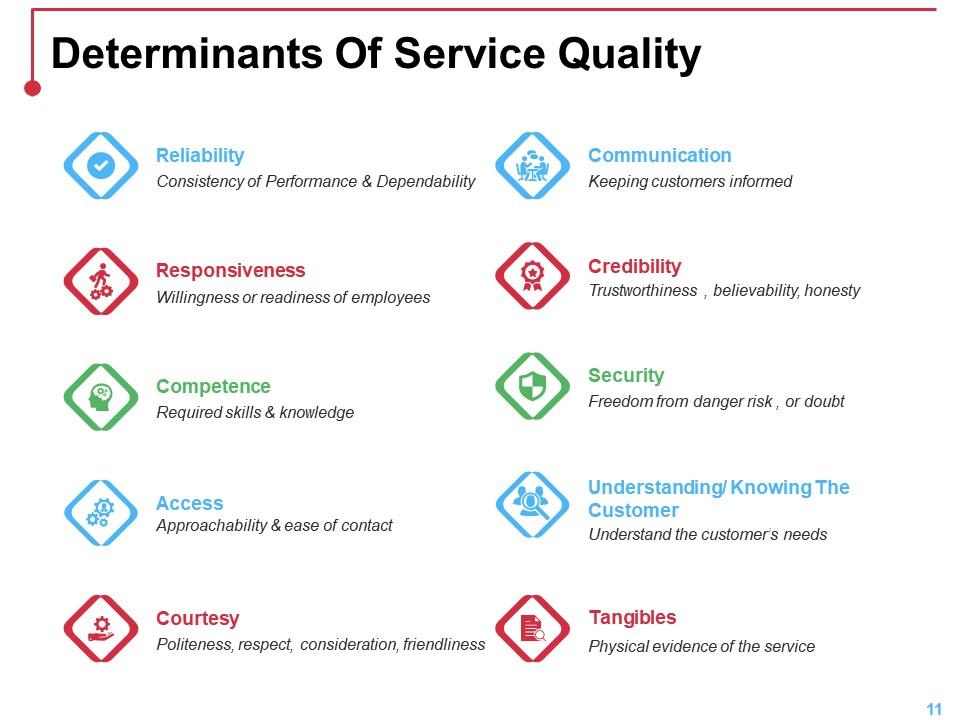
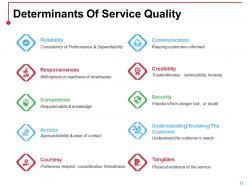
This presentation framework shows the determinants of service quality. It is based on factors crucial in shaping customer assumptions and faithfulness. The factors shown in this PowerPoint design are reliability, courtesy, communication, credibility, and security. Besides this, it also puts the spotlight on understanding the customer, tangibles, responsiveness, competence, and access. This PPT layout is helpful for customer service experts, quality managers, and service designers. This presentation diagram helps to build trust, gain loyalty, and ensure success in today's competitive market.
Template 8: Importance of Good Quality
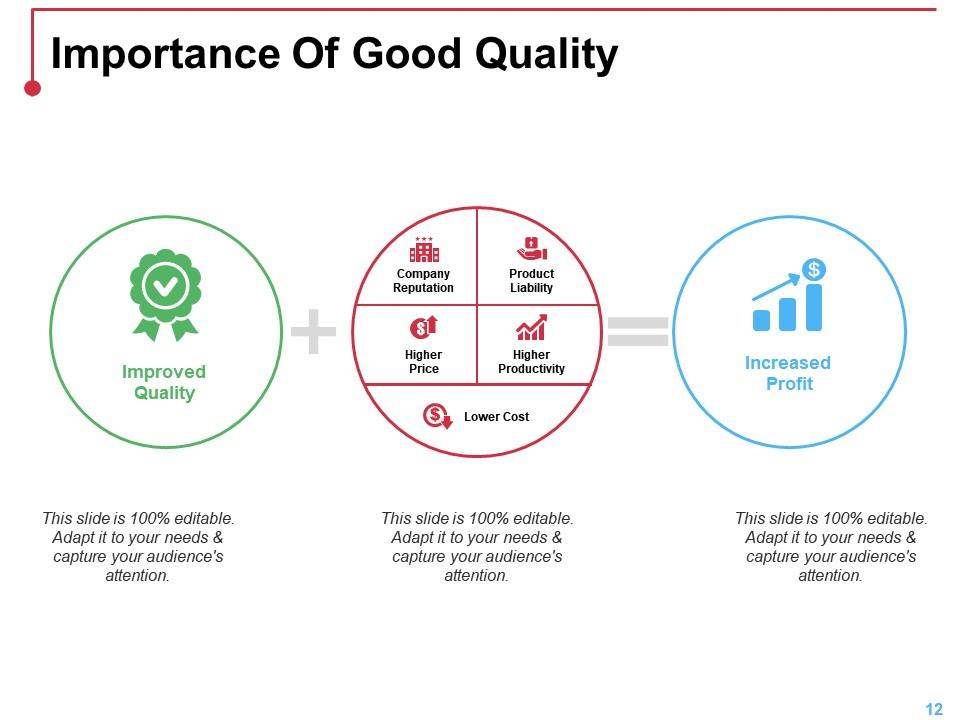
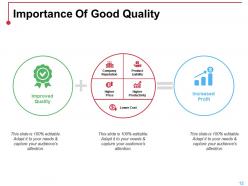
This PowerPoint slide features the importance of good quality. The presentation design helps to understand the value of good quality because it leads to improved quality. Moreover, it also enhances the company's reputation, reduces product liability, higher pricing, increases productivity, and lowers costs. This PPT layout shows all these factors result in increased profits and long-term business success. This PowerPoint template is helpful for product managers, operations directors, and quality assurance managers. The presentation graphic helps to strengthen the market position by building customer trust and loyalty.
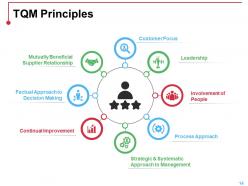
Template 9: TQM Principles
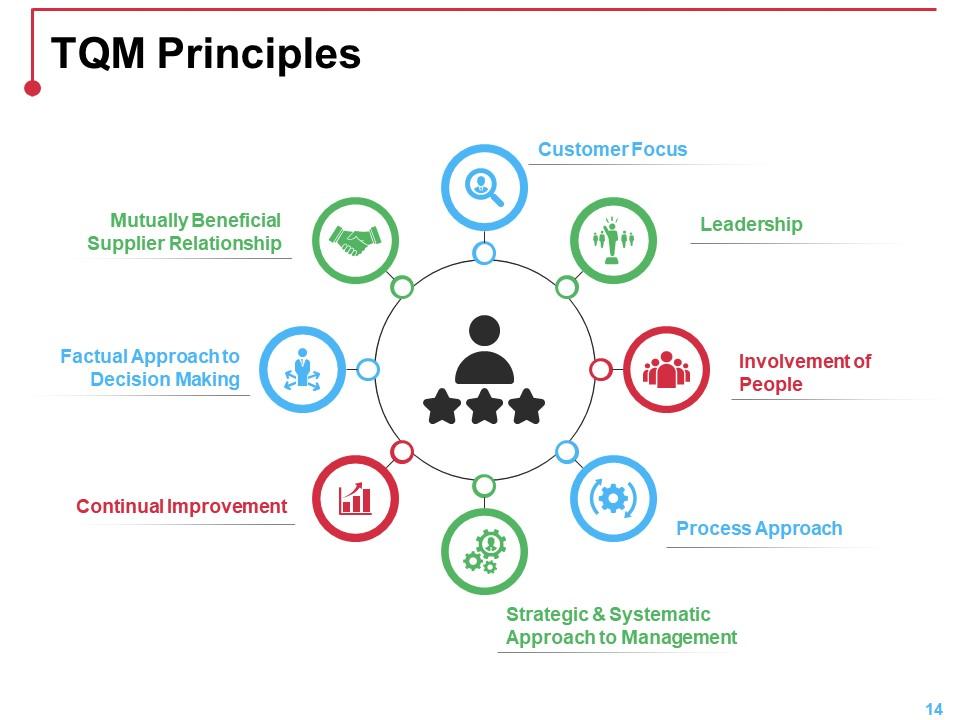
This PPT diagram demonstrates the foundational principles of total quality management (TQM). It shows eight fundamentals to drive success in a corporate firm. These are customer focus, effective leadership, engaging employees, adopting a process-oriented approach, and fostering continual improvement. Additionally, it emphasizes the importance of strategic management, data-driven decision-making, and nurturing mutually beneficial relationships with suppliers. The presentation layout helps process improvement specialists, quality assurance managers, and operations managers. The design helps you to gain a competitive edge.
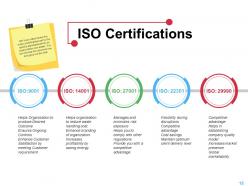
Template 10: ISO Certifications
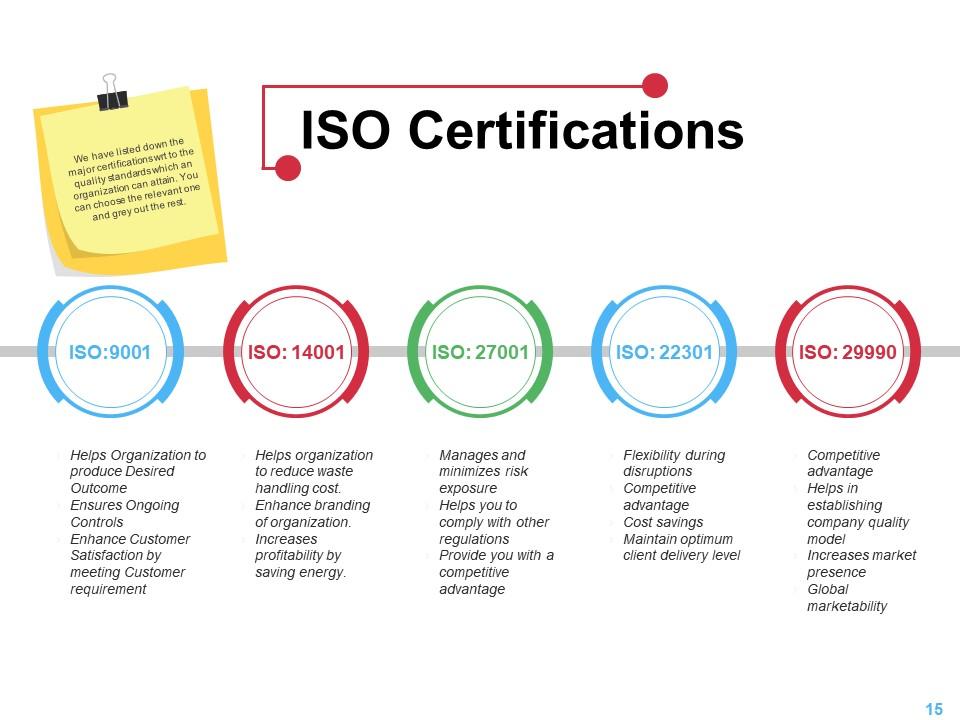
This presentation slide highlights key international organizations for standardization (ISO) certifications. The PowerPoint design focuses on five different ISO certifications. These are ISO 9001 for quality management, ISO 14001 for environmental management, ISO 27001 for information security, ISO 29990 for learning services, and ISO 22301 for business continuity management. The PPT layout is beneficial for business continuity planners, training managers, quality managers, IT security managers, and environmental health and safety specialists. The presentation template helps to drive compliance, improve processes, mitigate risks, and enhance organizational performance.
*****
Total Quality Triumphs: Excellence Ensured!
Our presentation diagrams help you to meet your business needs. Using them, you can effectively communicate any message related to your company. Our TQM PowerPoint Slides are your helping hand when you want to make your team members and investors understand the need to focus on the best. These PPT designs enable you to deliver a strong message and let others be a part of it. Our TQM presentation visuals are next to excellence.
Introduction To Total Quality Management Powerpoint Presentation Slides with all 35 slides:
Don a badge of authority with our Introduction To Total Quality Management Powerpoint Presentation Slides. It is akin to any insignia.

FAQs for Introduction To Total Quality Management
So TQM basically comes down to putting customers first - figure out what they actually want, then build everything around that. The kaizen approach is solid too, just keep tweaking things bit by bit. Everyone needs to own quality, not just dump it on the QC team (honestly, that never works anyway). Get your whole crew involved and focus on fixing processes instead of just panicking when results suck. Oh, and measure everything - you can't improve what you can't track. My advice? Pick one small process to start with, get everyone on board first, then expand from there once you've got some wins under your belt.
So TQM basically makes everyone obsessed with quality - and I mean that in a good way. Your whole team starts thinking about the customer experience, not just whoever's dealing with complaints. The cool part is you're constantly measuring stuff and fixing problems before they blow up. When customers see you consistently delivering what they actually want, they stick around. It's kind of obvious when you put it that way, right? I'd start by figuring out where customers interact with you and spotting the weak points. Oh, and it prevents those annoying defects that usually tank satisfaction scores.
Honestly, if your leadership isn't 100% committed, you're screwed from the start. I've watched so many TQM programs crash and burn because executives just talked a good game but didn't actually walk the walk. Your leaders need to be in training sessions, constantly talking about why quality matters, and giving employees real power to make decisions. The whole thing is a cultural shift that takes forever - not some quick turnaround. Oh, and they have to put actual money behind it too. Get your leadership team completely on board first because everything else depends on that foundation.
Track the obvious stuff first - defect rates, customer satisfaction, cycle times. Employee surveys too. But honestly, the cultural side matters just as much. Are people actually speaking up with ideas? Teams collaborating better? I've watched companies nail their KPIs while the culture stayed toxic. Poll your frontline workers regularly - they catch problems way before management does. Oh, and start measuring whatever you can now, even if it's messy. Perfect systems can wait.
So PDCA cycles are probably your best starting point - they're super straightforward and get people thinking systematically. Root cause stuff like fishbone diagrams and 5 Whys work great too. Kaizen's all about those small tweaks that add up over time. Six Sigma's DMAIC is popular but honestly feels overkill unless you're a huge company. Statistical process control and benchmarking are solid moves. Oh, and don't sleep on employee suggestion systems - people actually know their jobs pretty well. Pick maybe 2-3 things max though. I've seen companies try everything and just confuse everyone.
Look, your frontline people are gonna make or break TQM - they're literally doing the work every day and catch issues before anyone else. You can't just force changes on them and expect it to stick. Get them involved in creating solutions instead. I've seen the numbers - companies that actually listen to their employees get 3-4x better results with defects and customer happiness. Honestly, just start by asking what's not working. They probably already have half the answers sitting right there. People buy into stuff way more when they help build it, you know?
Honestly, the two big killers are employee pushback and leadership that just pretends to care. People hate changing how they do their jobs - it's scary and annoying. Plus TQM eats up tons of time and money for training everyone. You're basically asking your whole company to think long-term instead of quick wins, which goes against human nature lol. The culture shift can drag on for years too. I'd say start with small pilot programs first. And make damn sure your bosses actually want this to work, not just talking about it in meetings.
Honestly, those three work great together since they're all about making things better for customers. TQM gets everyone on board with the whole quality mindset - which is huge because buy-in is everything. Then Lean comes in to cut out all the wasteful stuff in your processes. Six Sigma handles the nerdy data analysis part. Don't try implementing everything at once though, that's a recipe for chaos. Pick one area to start with, maybe use TQM first to get people excited about quality, then gradually add the Lean tools and Six Sigma methods. They really do complement each other well.
So TQM works differently depending on your industry, but the basic idea stays consistent. Manufacturing focuses hard on cutting defects and streamlining processes. Healthcare adapts it for patient safety - which honestly makes total sense when you think about it. Financial companies? They're obsessed with risk management and staying compliant. The philosophy doesn't change, just the specific metrics you track. Figure out what "quality" actually means to your customers first. Then you can build your approach around fixing those particular problems and measuring what matters to them.
TQM basically turns everyone into a problem-solver instead of just management calling the shots. Your whole team starts asking "how can we do this better?" rather than just getting stuff done. Departments actually work together more since quality becomes everyone's thing. Employees feel way more empowered to speak up and fix issues right away. Not gonna lie, it gets chaotic at first - suddenly everyone's analyzing everything! But you end up with this data-driven culture that's super focused on customers. My advice? Test it with a small team first before going all-in company-wide.
Dude, the data thing is a game changer for TQM. Instead of waiting around for monthly reports, you're getting real-time updates on everything. IoT sensors track stuff automatically - which honestly feels like overkill sometimes but whatever, the data's useful. You can actually see trends forming before they blow up into real problems. Predictive analytics help you stop defects before they happen. Dashboards make all that overwhelming data actually readable for your team. Don't go crazy though - start with one process, get it working right, then expand from there.
Honestly, TQM training boils down to three main things. Get your people solid on quality tools - root cause analysis, process mapping, that kind of stuff. Hands-on workshops work way better than boring lectures, trust me. Your managers absolutely have to walk the walk with continuous improvement, not just talk about it. Cross-functional team training is clutch for breaking down those department silos that always mess things up. Oh, and don't forget frontline workers need different training than executives obviously. Best approach? Roll it out in phases and connect everything to actual problems you're dealing with right now. Makes it way more relevant.
Honestly, your supply chain can make or break your TQM efforts. If suppliers are cutting corners, that's gonna show up in your final product no matter what you do on your end. Think of it like... you can't build something solid on a wobbly foundation, right? The trick is treating these partners like they're part of your quality team instead of just random vendors. Better communication flows both ways, problems get fixed faster, and everyone's working toward the same standards. I'd start with solid quality agreements and check in regularly with your most important suppliers. Trust me, it's way easier than dealing with quality disasters later.
Track customer satisfaction scores and defect rates first - those show if you're actually delivering quality. Employee engagement matters too, plus process cycle times and your cost of quality (prevention, appraisal, failure costs). Financial stuff like ROI on quality investments is obvious but necessary. Honestly? Don't go crazy tracking everything - I've seen teams drown in data. Pick maybe 5-7 metrics that match your actual goals. Dashboards help you catch trends early, which beats scrambling to fix big problems later. Oh, and first-call resolution rates are gold if you do customer service.
Dude, you gotta stop waiting for things to blow up before collecting feedback. Set up surveys, team check-ins, whatever - but make it regular. Weekly or monthly, not once a year like most places do (honestly, how do they expect to stay relevant?). The trick is being systematic about it. Suggestion boxes, retrospectives, dashboards tracking your quality stuff in real-time. But here's the thing - you can't just collect it and forget about it. Actually do something with what people tell you, then circle back and let them know what changed. That's how you keep people actually caring enough to keep giving you input.
-
Content of slide is easy to understand and edit.
-
Very unique and reliable designs.
-
current development and its effects of cost and managment accounting