


Maintaining Quality In Manufacturing Process Powerpoint Presentation Slides




Try Before you Buy Download Free Sample Product
 Impress Your
 Audience
 100%
100% Editable
 Save Hours
 of Time


Quality management plays a vital role in establishing a successful business that delivers quality products as per the customer expectations and incorporates continuous change and improvement within the organization. Organizations are spending a lot on providing six sigma and lean manufacturing training to its valuable employees in order to maintain their product quality and increase brand value. This presentation will benefit the organization that wants to enhance their quality management system by setting new quality control benchmarks. Firstly, current quality management system will help the organization to address its present quality management system from raw material procurement to final product delivery. Major issues faced by the firm section will help the firm to communicate the major hurdles faced by the firm and solutions to overcome major issues section will help in addressing the right measures to resolve the same. Firm can utilize setting quality control benchmarks section to set new quality control standards for product quality, raw material quality and equipment supplier quality. Skills evaluation and training section will help the organization in establishing a team to maintain quality control standards section by assessing and providing skill development raining. Developing quality control and assurance plan will help the firm in communicating their quality management plans namely process quality control plan, product quality inspection plan and machine calibration quality assurance plan. To ensure product quality, organization can use maintenance and audit checklist section covering machine maintenance and internal audit checklists. Risk management section will help the firm in addressing its quality risk identification and mitigation plan as well as supplier risk assessment and controlling measures. Business performance forecasting section will help the organization to measure the impact of introducing quality control standards and quality assurance plan on sales performance, revenue generation, customer satisfaction and failure rate. Finally, organization can measure its product manufacturing quality through dashboard for performance measurement section.
People who downloaded this PowerPoint presentation also viewed the following :
Content of this Powerpoint Presentation
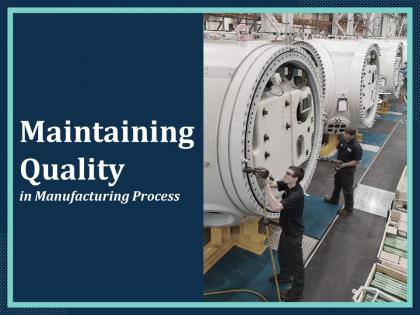
Slide 1: This title slide introduces Maintaining Quality in Manufacturing process. Add the name of your company here.
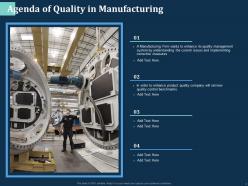
Slide 2: This is the Agenda slide of Effective Quality System in Manufacturing
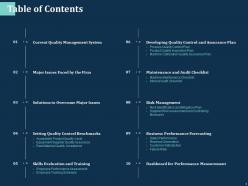
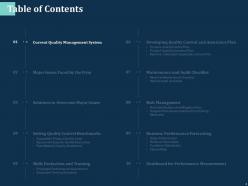
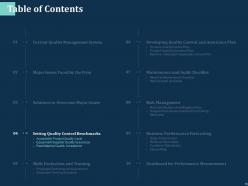
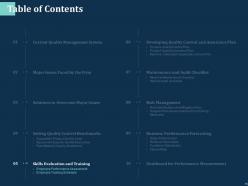
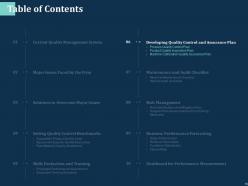
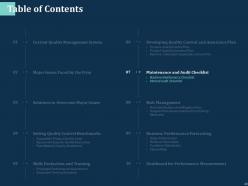
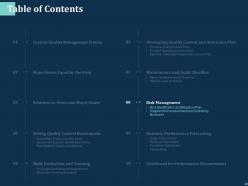
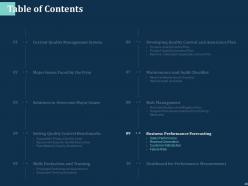
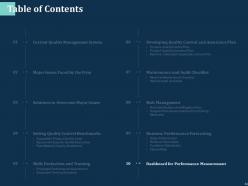
Slide 3: This slide contains the Table of Content. It includes - Current Quality Management System, Major Issues Faced by the Firm, Solutions to Overcome Major Issues, etc.
Slide 4: This is a table of content slide showing the Current Quality Management System.
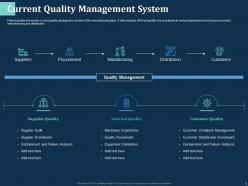
Slide 5: This slide presents the Current Quality Management System. It shows the current quality management system of the manufacturing plant.
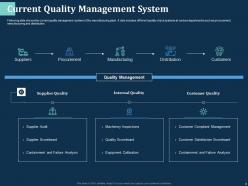
Slide 6: This is another slide presenting the Current Quality Management System. It shows the current quality management system of the manufacturing plant.
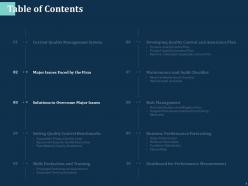
Slide 7: This is a table of content slide showing the Major Issues Faced by the Firm and Solutions to Overcome Major Issues.
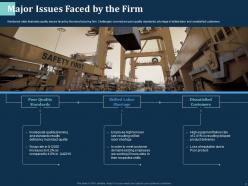
Slide 8: This slide presents the Major Issues Faced by the Firm.
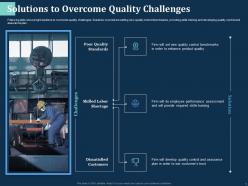
Slide 9: This slide presents the Solutions to Overcome Quality Challenges.
Slide 10: This is a table of content slide showing the Setting Quality Control Benchmarks.
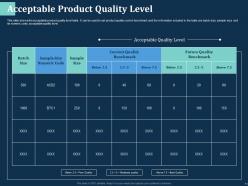
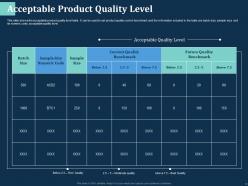
Slide 11: This slide presents the Acceptable Product Quality Level.
Slide 12: This slide presents the Acceptable Product Quality Level.
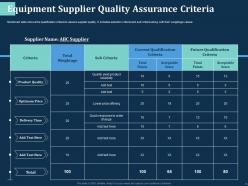
Slide 13: This slide presents the Equipment Supplier Quality Assurance Criteria.
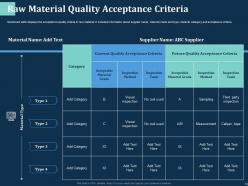
Slide 14: This slide presents the Raw Material Quality Acceptance Criteria.
Slide 15: This is a table of content slide showing the Skills Evaluation and Training.
Slide 16: This slide presents the Employee Performance Assessment (1/2).
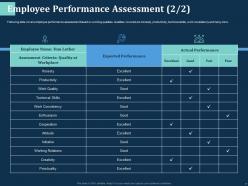
Slide 17: This slide presents the Employee Performance Assessment (2/2).
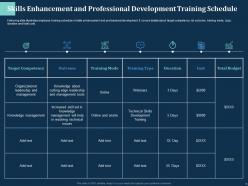
Slide 18: This slide presents the Skills Enhancement and Professional Development Training Schedule
Slide 19: This is a table of content slide showing the Developing Quality Control and Assurance Plan.
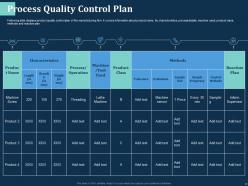
Slide 20: This slide presents the Process Quality Control Plan.
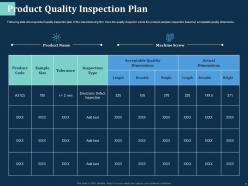
Slide 21: This slide presents the Product Quality Inspection Plan.
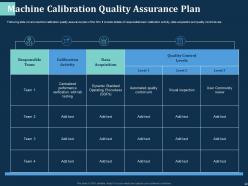
Slide 22: This slide presents the Machine Calibration Quality Assurance Plan.
Slide 23: This is a table of content slide showing the Maintenance and Audit Checklist.
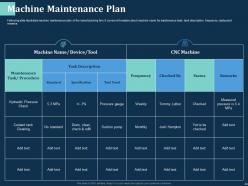
Slide 24: This slide presents the Machine Maintenance Plan.
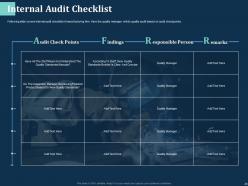
Slide 25: This slide presents the Internal Audit Checklist.
Slide 26: This is a table of content slide showing the Risk Management.
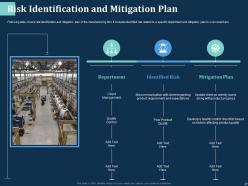
Slide 27: This slide presents the Risk Identification and Mitigation Plan.
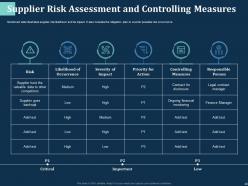
Slide 28: This slide presents the Supplier Risk Assessment and Controlling Measures.
Slide 29: This is a table of content slide showing the Business Performance Forecasting.
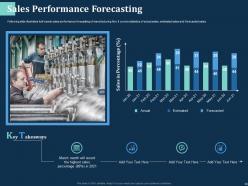
Slide 30: This slide presents the Sales Performance Forecasting.
Slide 31: This slide presents the Revenue Generation Forecasting.
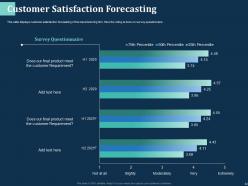
Slide 32: This slide presents the Customer Satisfaction Forecasting.
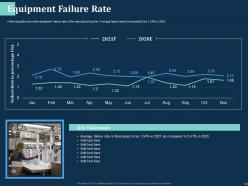
Slide 33: This slide presents the Equipment Failure Rate.
Slide 34: This is a table of content slide showing the Dashboard for Performance Measurement.
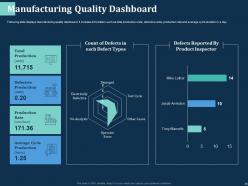
Slide 35: This slide presents the Manufacturing Quality Dashboard.
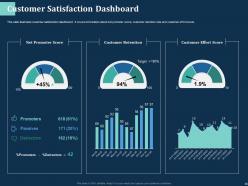
Slide 36: This slide presents the Customer Satisfaction Dashboard.
Slide 37: This slide introduces the Additional Slides.
Slide 38: This is the Icons Slide for Maintaining Quality in Manufacturing process.
Slide 39: This slide contains the information about the company aka the ‘About Us’ section. This includes the Value Clients, the Target Audience, and Premium Services.
Slide 40: This slide provides the Mission for the entire company. This includes the vision, the mission, and the goal.
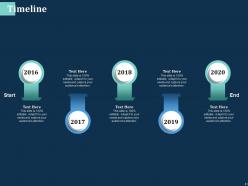
Slide 41: This slide is a Timeline template to showcase the progress of the steps of a project with time.
Slide 42: This slide is a Roadmap template to showcase the stages of a project, for example.
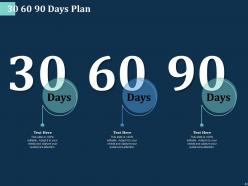
Slide 43: This is a slide with a 30 60 90 Days Plan to set goals for these important intervals.
Maintaining Quality In Manufacturing Process Powerpoint Presentation Slides with all 43 slides:
Use our Maintaining Quality In Manufacturing Process Powerpoint Presentation Slides to effectively help you save your valuable time. They are readymade to fit into any presentation structure.






FAQs for Maintaining Quality In Manufacturing Process
Look, you'll want four key things sorted out. First - quality standards everyone actually gets, not some confusing manual nobody reads. Then set up inspections at the right spots to catch problems early instead of at the very end (learned that one the hard way). Documentation is boring as hell but you need it to spot trends later. And have a decent system for fixing stuff when it goes sideways. Oh, and definitely train your people regularly on the standards. Start by figuring out where defects usually pop up in your process - that shows you exactly where to put your control points first.
Honestly, stop making quality just the QC team's headache - spread it around to everyone. Train your people on standards and show them how their job connects to the end result. When someone does quality work well, make a big deal about it publicly (people eat that recognition up). Let employees actually stop the line when they catch problems, even if it's annoying timing-wise. Oh, and create an environment where people can report issues without getting thrown under the bus - that's huge. Leadership needs to walk the walk too. Maybe start with just one department first and see how it goes before rolling it out everywhere.
Statistical methods in quality control are like having actual data to back up your decisions instead of just guessing. Control charts let you watch processes happen in real-time, which is pretty cool. You can use hypothesis testing to figure out if there's a real problem or just random noise. Sampling techniques save you from testing literally everything - thank god because who has time for that? It sounds intimidating but honestly once you try a few basic control charts, you'll get it. Pick whatever method fits your specific process and don't overthink it.
Okay so manufacturing QC is way more straightforward - you're literally measuring stuff like dimensions and checking for defects. Pretty black and white. Service QC though? That's where it gets tricky because you're dealing with experiences and how people *feel* about your service. You can't measure "good customer service" the same way you'd test if a part fits right. Service companies end up relying on customer surveys and mystery shoppers to figure out what's working. Both types use standards obviously, but honestly service QC feels like more guesswork sometimes since response times and satisfaction scores don't tell the whole story.
Honestly, automated QC is a game changer - no more human errors or people getting tired and missing stuff. You can run it round the clock, catch problems way faster, and get actual data to track patterns. Your team gets to do more interesting work instead of boring inspections all day. The money you save from catching defects early is crazy good. I'd probably start with whatever QC tasks make you want to bang your head against the wall from doing them over and over.
Look, good quality control basically means your customers get what they expect every time. No weird defects or stuff that breaks right away. People trust brands they can count on - it's that simple. I've watched companies completely destroy their rep because a few crappy products made it out the door. Honestly, it's way easier to catch problems before shipping than deal with angry customers later. Plus you'll save money on returns and complaints. The whole thing comes down to being ahead of issues instead of scrambling to fix them after.
Ugh, where do I even start? Inconsistent processes are killer - half your team does things one way, the other half wings it completely. Training usually sucks too, so people don't actually get why they're doing stuff. Equipment breaks at the worst times, obviously. Communication between shifts? Good luck with that mess. Then there's the constant pressure to hit deadlines, which makes everyone want to cut corners. Oh, and don't get me started on tracking all the quality data - it's tedious but you can't skip it. Honestly though, if you can just get everyone following the same process first, you're already ahead of most places.
So basically these standards - ISO, FDA, automotive stuff - they're like the bare minimum you've gotta hit for quality control. What to test, how often, all that documentation nonsense. Honestly? Total headache sometimes but they keep your whole operation consistent. Build them into your workflows right from the start though - retrofitting compliance later is way worse, trust me. Your team needs to know which ones apply to your products. Oh and audit regularly or you'll get burned. Better than dealing with recalls down the road.
So there are a few things that'll actually make a difference. Track your metrics regularly - look for patterns that show where you can improve stuff. When defects happen, dig into the root cause (people skip this way too often but it's super important). Get feedback from customers AND your team since they spot different problems. Process mapping is solid for seeing bottlenecks. Oh, and don't try to fix everything at once - that never works. Small changes beat massive overhauls every time. Just pick one thing to start with this week and go from there.
Honestly, start with defect rates and customer complaints - those tell you the most. First-pass yield is gold though, shows how often you nail it on the first try. Track your cost of quality too (what you're spending on prevention vs fixes). Before changing anything, get your baseline numbers or you'll have no clue if stuff's actually working. Customer satisfaction and return rates are obvious ones but still worth monitoring. Pick maybe 2-3 metrics that actually matter for your process and stick with them. Don't go crazy tracking everything under the sun.
For solid root cause analysis, I'd start with fishbone diagrams - they're super visual and get everyone brainstorming potential causes. The 5 Whys is ridiculously simple but works great for drilling down to what's actually happening. Pareto charts are clutch too since they show you the biggest problems first. FMEA's good for complex stuff, though honestly it can be overkill sometimes. My advice? Stick to 2-3 tools max per investigation. I've seen teams try to use every method under the sun and just end up spinning their wheels instead of actually fixing anything.
So basically, digital transformation is like having superpowers for quality control. You get real-time data from IoT sensors that catch defects automatically using AI. Way better than those endless spreadsheets we used to deal with, honestly. Machine learning gets smarter over time at spotting issues, plus predictive analytics can flag problems before they even happen. The continuous monitoring thing is huge - it picks up patterns people would totally miss. I'd start with digitizing your most critical checkpoints first. That's where you'll see the biggest drop in defects and angry customer calls.
Dude, you NEED proper training and certs for QC work. You're basically the final checkpoint before stuff goes to customers, so missing defects or screwing up equipment isn't an option. I've watched untrained people completely botch quality checks - it's painful to see. Most companies won't even interview you without relevant certifications anyway. The training teaches you industry standards, testing methods, all that regulatory stuff. ASQ certs are solid, or look into ISO standards training depending on your field. Honestly, it's one of those fields where winging it just doesn't work.
Dude, prevention beats playing catch-up every single time - way less expensive too. Instead of checking everything at the very end, build those quality checkpoints right into your process. Focus your energy (and budget) on the stuff that'll actually hurt if it goes wrong. Train your people properly so they're not creating problems to begin with. Honestly? I've seen companies waste tons of money on overkill quality measures that don't move the needle. Track where you're bleeding cash on quality issues first. Map out which defects are costing you the most and tackle those areas. You'll probably find some surprises in there.
So audits are basically your safety net - they catch quality control issues before they blow up into actual problems. You're systematically checking whether you're really following those QC procedures you wrote down (not just pretending you are). Honestly, most teams think they're doing great until an audit proves otherwise. They help you spot patterns, figure out where people need more training, and show stakeholders your quality standards aren't just decorative paperwork. The trick is doing them regularly and - here's the important part - actually fixing what you find instead of shoving the report in a drawer somewhere.
-
Great product with effective design. Helped a lot in our corporate presentations. Easy to edit and stunning visuals.
-
Use of different colors is good. It's simple and attractive.
-
Unique design & color.