


Product quality management in manufacturing firm powerpoint presentation slides




Try Before you Buy Download Free Sample Product
 Impress Your
 Audience
 100%
100% Editable
 Save Hours
 of Time


Our Product Quality Management In Manufacturing Firm Powerpoint Presentation Slides are topically designed to provide an attractive backdrop to any subject. Use them to look like a presentation pro.
People who downloaded this PowerPoint presentation also viewed the following :
Content of this Powerpoint Presentation
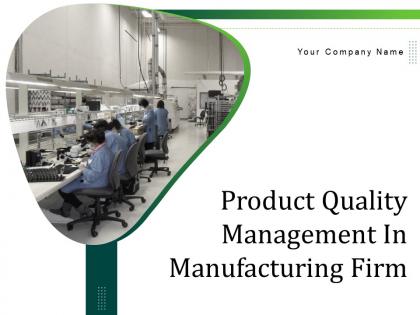
Slide 1: This title slide introduces the Product Quality Management in Manufacturing Firm. Add the name of the company here.
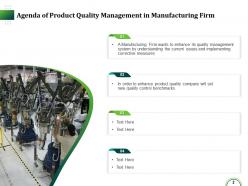
Slide 2: This is the Agenda slide of Product Quality Management in Manufacturing Firm. It includes - A Manufacturing Firm wants to enhance its quality management system by understanding the current issues and implementing corrective measures, in order to enhance product quality company will set new quality control benchmarks, etc.
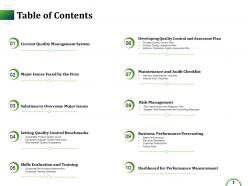
Slide 3: This slide contains the Table of Contents. It includes - Current Quality Management System, Major Issues Faced by the Firm, Solutions to Overcome Major Issues, etc.
Slide 4: This is a table of content slide showing the Current Quality Management System.
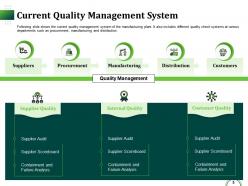
Slide 5: This slide presents the Current Quality Management System. It shows the current quality management system of the manufacturing plant.
Slide 6: This is a table of content slide showing the Major Issues Faced by the Firm
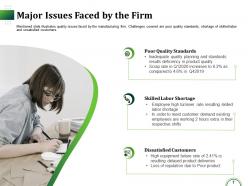
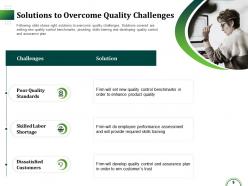
Slide 7: This slide presents the Major Issues Faced by the Firm. Challenges covered are poor quality standards, shortage of skilled labor, and unsatisfied customers.
Slide 8: This is a table of content slide showing the Solutions to Overcome Major Issues
Slide 9: This slide presents the Solutions to Overcome Quality Challenges. Solutions covered are setting new quality control benchmarks, providing skills training, and developing quality control and assurance plan.
Slide 10: This is a table of content slide showing the Setting Quality Control Benchmarks. It includes - Acceptable Product Quality Level, Equipment Supplier Quality Assurance, and Raw Material Quality Acceptance.
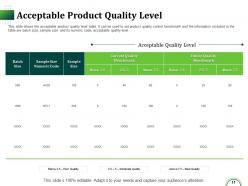
Slide 11: This slide presents the Acceptable Product Quality Level. It can be used to set product quality control benchmarks and the information included in the table are batch size, sample size, and its numeric code, acceptable quality level.
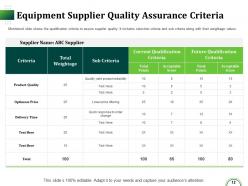
Slide 12: This slide presents the Equipment Supplier Quality Assurance Criteria. It includes selection criteria and sub-criteria along with their weightage values.
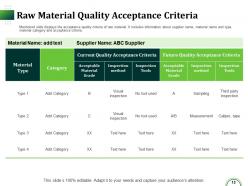
Slide 13: This slide presents the Raw Material Quality Acceptance Criteria. It displays the acceptance quality criteria of raw material. It includes information about supplier name, material name and type, material category, and acceptance criteria.
Slide 14: This is a table of content slide showing the Skills Evaluation and Training. It includes - Employee Performance Assessment and Employee Training Schedule.
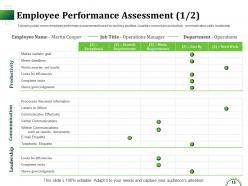
Slide 15: This slide presents the Employee Performance Assessment (1/2). It covers employee performance assessment based on working qualities. Qualities covered are productivity, communication skills, leadership.
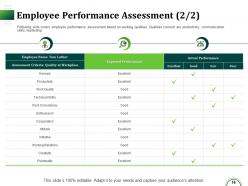
Slide 16: This slide presents the Employee Performance Assessment (2/2). It covers employee performance assessment based on working qualities. Qualities covered are productivity, communication skills, leadership.
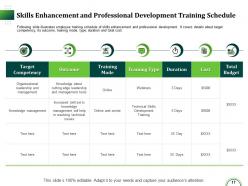
Slide 17: This slide presents the Skills Enhancement and Professional Development Training Schedule. It covers details about target competency, its outcome, training mode, type, duration, and total cost.
Slide 18: This is a table of content slide showing the Developing Quality Control and Assurance Plan. It includes - Process Quality Control Plan, Product Quality Inspection Plan, and Machine Calibration Quality Assurance Plan.
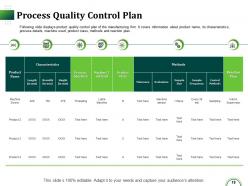
Slide 19: This slide presents the Process Quality Control Plan. It displays the product quality control plan of the manufacturing firm. It covers information about product name, its characteristics, process details, machine used, product class, methods, and reaction plan.
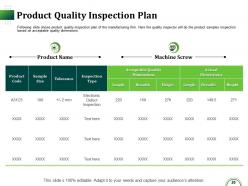
Slide 20: This slide presents the Product Quality Inspection Plan. Here the quality inspector will do the product samples inspection based on acceptable quality dimensions.
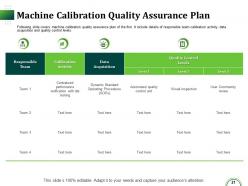
Slide 21: This slide presents the Machine Calibration Quality Assurance Plan. Here the quality inspector will do the product samples inspection based on acceptable quality dimensions.
Slide 22: This is a table of content slide showing the Maintenance and Audit Checklist. It includes - Machine Maintenance Checklist and Internal Audit Checklist.
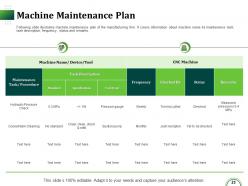
Slide 23: This slide presents the Machine Maintenance Plan. It covers information about the machine name its maintenance task, task description, frequency, status, and remarks.
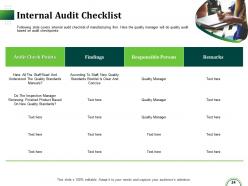
Slide 24: This slide presents the Internal Audit Checklist. Here the quality manager will do a quality audit based on audit checkpoints.
Slide 25: This is a table of content slide showing the Risk Management. It includes - Risk Identification and Mitigation Plan and Supplier Risk Assessment and Controlling Measures.
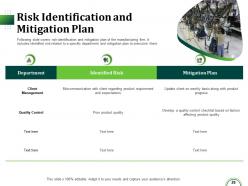
Slide 26: This slide presents the Risk Identification and Mitigation Plan.
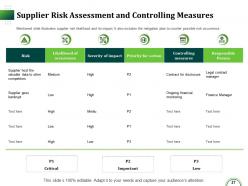
Slide 27: This slide presents the Supplier Risk Assessment and Controlling Measures. It illustrates supplier risk likelihood and its impact. It also includes the mitigation plan to counter possible risk occurrences.
Slide 28: This is a table of content slide showing the Business Performance Forecasting. It includes - Sales Performance, Revenue Generation, Customer Satisfaction, and Failure rate.
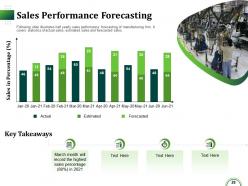
Slide 29: This slide presents the Sales Performance Forecasting. It illustrates the half-yearly sales performance forecasting of a manufacturing firm. It covers statistics of actual sales, estimated sales, and forecasted sales.
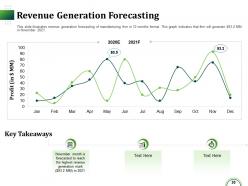
Slide 30: This slide presents the Revenue Generation Forecasting. It illustrates revenue generation forecasting of a manufacturing firm in 12 months format.
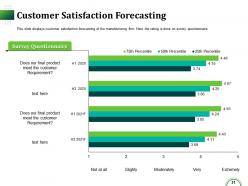
Slide 31: This slide presents the Customer Satisfaction Forecasting. It displays customer satisfaction forecasting of the manufacturing firm.
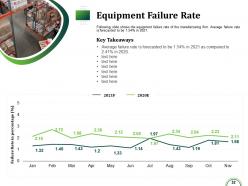
Slide 32: This slide presents the Equipment Failure Rate. It shows the equipment failure rate of the manufacturing firm.
Slide 33: This is a table of content slide showing the Dashboard for Performance Measurement.
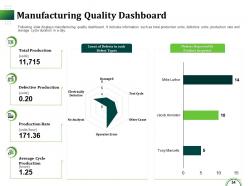
Slide 34: This slide presents the Manufacturing Quality Dashboard. It displays a manufacturing quality dashboard. It includes information such as total production units, defective units, production rate, and average cycle duration in a day.
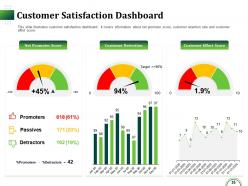
Slide 35: This slide presents the Customer Satisfaction Dashboard. It covers information about net promoter score, customer retention rate, and customer effort score.
Slide 36: This is the Icons Slide for Product Quality Management in Manufacturing Firm.
Slide 37: This slide introduces the Additional Slides.
Slide 38: This is a slide with a 30 60 90 Days Plan to set goals for these important intervals.
Slide 39: This slide contains Post It Notes that can be used to express any brief thoughts or ideas.
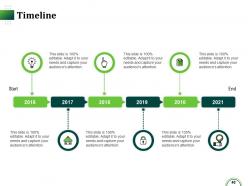
Slide 40: This slide is a Timeline template to showcase the progress of the steps of a project with time.
Slide 41: This slide contains the information about the company aka the ‘About Us’ section. This includes Creative, Talented, and Professional.
Slide 42: This slide provides the Mission for the entire company. This includes the vision, the mission, and the goal.
Slide 43: This slide shows the Comparison between the male and female progress based on a 2020 survey.
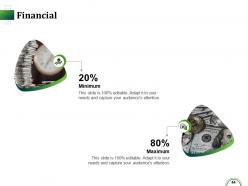
Slide 44: This slide presents the Financial with the data’s numbers at the minimum and maximum percentage.
Slide 45: This is a Thank You slide where details such as the address, contact number, email address are added.
Product quality management in manufacturing firm powerpoint presentation slides with all 45 slides:
Use our Product Quality Management In Manufacturing Firm Powerpoint Presentation Slides to effectively help you save your valuable time. They are readymade to fit into any presentation structure.







FAQs for Product quality management in manufacturing firm
Start by mapping out your current process - that's where you'll spot the weak points. Quality planning upfront is key, then build in checkpoints for testing and inspection throughout production. Documentation tracks everything (boring but necessary). Your team needs proper training because honestly, they can't hit targets they don't understand. Supplier quality control matters too since their problems become yours real quick. Risk management and continuous improvement loops keep everything running smooth. Oh, and clear standards from day one - can't stress that enough!
So basically, don't wait until the end to test everything - that's a nightmare I learned the hard way. Build quality checks into each phase instead. Get your acceptance criteria clear from day one, then do code reviews, automated tests, and show stakeholders demos regularly. Everyone needs to own quality, not just dump it on QA. Track your defect rates and customer feedback to catch patterns early. Oh, and set up alerts when things go sideways so you can fix stuff fast. Trust me, catching problems early beats scrambling at launch every time.
Think of customer feedback like having a bunch of free quality inspectors scattered everywhere. They'll catch stuff your internal team totally missed - weird bugs, confusing interfaces, you name it. The trick is actually collecting it systematically through surveys and support tickets, not just hoping people complain loud enough. What really matters though is closing the loop - taking that feedback and actually changing your processes based on it. Otherwise you're just collecting complaints for fun. Set up regular reviews of what customers are saying and let it drive your quality improvements. Trust me, they'll point out things you'd never think to test for.
Honestly, the monitoring stuff is a game changer - you'll catch problems in real-time instead of waiting around for manual checks. AI spots defects and patterns that people totally miss, which is pretty wild when you think about it. All those sensors collecting data means issues get flagged before they turn into expensive disasters. Your production lines stay way more consistent too. Oh, and the automated alerts? Total lifesaver. Your team finds out instantly when something's wrong rather than hearing about it from angry customers later. Makes everything faster and more accurate without the headaches.
Honestly, the worst part is people just hate change - your team will push back on any new process. Getting executives to keep funding things when money's tight? Good luck with that. Data silos are brutal too since departments never want to share info with each other. Oh, and don't get me started on picking software - there's like a million options and they all claim to be "the best." Training takes months, not weeks like everyone promises. Keeping things consistent across different shifts or locations will drive you crazy. Start with one small area though. Get some wins first, then expand.
So ISO 9001 is basically a roadmap for keeping quality consistent throughout your company. You'll document everything, track customer happiness, and keep improving - honestly feels like drowning in paperwork initially but pays off. Catches problems early, cuts waste, makes customers trust you more. Big clients often won't even talk to you without certification, which is annoying but whatever. The standard also helps build solid relationships since people prefer working with certified suppliers. I'd start with a gap analysis to see how your current stuff measures up against their requirements.
Honestly, start with customer satisfaction scores and defect rates - those are your bread and butter. Support ticket volume matters too. Return rates are clutch because like you said, people don't return stuff they actually like. I'd also track your Net Promoter Score to see if customers are telling their friends about you. Time-to-resolution is key for when things go sideways. Oh, and if you're doing anything digital, usage analytics are everything - shows whether people actually stick around after downloading or just ghost you immediately. These five will save your ass before problems explode.
Make quality everyone's job, not just something QA worries about. Leadership has to actually show they value quality over hitting deadlines fast - people pick up on that stuff. Set up regular times for the team to share wins and talk through mistakes without anyone getting thrown under the bus. Honestly, the best improvements I've seen came from those post-mortem chats where people felt comfortable being real. Train folks so they can build quality in from day one. Oh, and celebrate when someone spots an issue early instead of treating it like they're slowing things down.
Honestly, start with your biggest suppliers and nail down quality expectations in the actual contracts - don't just assume they know what you want. Audits are a pain but they're worth it, trust me. Set up some kind of scorecard system to track how they're doing over time. Here's what really works though: bring them into your quality planning meetings early on. Like, way earlier than you think you need to. Most companies just blame suppliers when stuff goes wrong, but joint improvement programs where you actually work together? That's where the magic happens. Oh, and put the quality metrics right in the contract language - learned that one the hard way!
Honestly, data analytics is a game-changer for QA stuff. Instead of just reacting to problems, you can actually see patterns coming and catch defects way earlier - like weeks before they'd normally surface. Set up alerts when your quality metrics start drifting, which saves so much headache later. The coolest part? Predictive models let you be smarter about testing. You don't waste time testing everything randomly; you focus on the spots where things usually break. I mean, who has time for blanket testing anymore? Plus you'll pinpoint exactly where your production line's having issues instead of guessing.
Dude, bad quality will absolutely wreck your reputation - sometimes for good. Customers bolt fast when they get crappy products, and they'll blast you all over social media too. I've watched companies spend literally years trying to bounce back from quality disasters that good processes could've stopped. You'll get buried in terrible reviews while your customers jump ship to competitors they can trust. Oh, and word travels stupid fast these days. Get some quality checks going now before you're stuck putting out fires and dealing with pissed off customers everywhere.
So regulatory stuff basically sets your baseline - like, you can't go below these standards but every industry's totally different. Pharma has crazy strict FDA rules while manufacturing is more about ISO standards and safety stuff. Honestly, it's kind of annoying how much these regs control your whole quality system design. Can't really ignore them though - they'll dictate everything from your docs to testing. I'd start by figuring out which regulatory bodies actually matter for your products first. Then build your quality framework around those requirements. Way easier than trying to retrofit later.
Honestly, use your actual screw-ups as training material - way more effective than generic examples. People need to understand WHY the standards exist, not just what they are. Role-playing angry customer calls is gold too, though some people hate it at first. Skip the massive training dumps. Better to do bite-sized sessions regularly and weave quality talk into normal team meetings. Oh, and create safe spaces where they can mess up and ask dumb questions without getting roasted. Practice makes it stick way better than just lecturing at them.
Start with getting crystal clear on what the defect actually is - sounds obvious but you'd be surprised how often people skip this. Grab data from production, QC, customer complaints, whatever you can find. Try the "5 Whys" method or those fishbone diagrams (they look scary but honestly work great). Get people from different departments involved since these things usually aren't just one team's fault. Could be manufacturing, design, suppliers - you name it. Write everything down as you investigate. Oh, and here's the thing everyone forgets - actually check that your fix worked after you implement it. I've seen too many "solutions" that didn't solve anything.
Dude, the AI stuff is seriously changing quality control right now. Instead of catching problems after they happen, companies are using predictive analytics to spot issues before they even start. IoT sensors are tracking everything in real-time during production - it's pretty crazy how much data they're collecting. Oh, and sustainability is becoming a big deal too. Companies are actually measuring environmental impact as part of their quality standards now. Customers want to know where everything comes from, so there's way more focus on traceability systems. You should probably look into what AI tools might work for your industry.
-
Amazing product with appealing content and design.
-
Top Quality presentations that are easily editable.
-
Out of the box and creative design.
-
Graphics are very appealing to eyes.
-
Really like the color and design of the presentation.
-
Very unique and reliable designs.
-
Innovative and attractive designs.