


Benefits of cultural diversity in the workplace




Try Before you Buy Download Free Sample Product
 Impress Your
 Audience
 100%
100% Editable
 Save Hours
 of Time


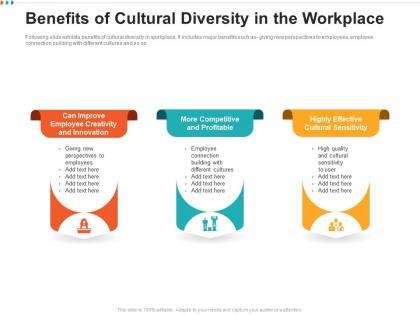
Following slide exhibits benefits of cultural diversity in workplace. It includes major benefits such as- giving new perspectives to employees, employee connection building with different cultures and so on.
People who downloaded this PowerPoint presentation also viewed the following :
Benefits of cultural diversity in the workplace with all 2 slides:
Use our Benefits Of Cultural Diversity In The Workplace to effectively help you save your valuable time. They are readymade to fit into any presentation structure.

FAQs for Benefits of cultural diversity
Key benefits of cultural diversity include enhanced creativity and innovation, improved problem-solving capabilities, broader market understanding, increased employee engagement, and stronger global competitiveness. These advantages streamline decision-making by incorporating varied perspectives, accelerate market expansion through cultural insights, and enhance customer experiences, with many organizations finding that diverse teams ultimately deliver superior business outcomes and sustained competitive advantage.
Cultural diversity enhances team dynamics by bringing varied perspectives, problem-solving approaches, communication styles, and creative thinking methods to collaborative efforts. While diverse teams may initially face coordination challenges, organizations across industries like technology, healthcare, and consulting find that multicultural collaboration ultimately delivers more innovative solutions, broader market insights, and stronger competitive advantage in increasingly global business environments.
Cultural diversity challenges include communication barriers, conflicting work styles, differing expectations around hierarchy and decision-making, potential for misunderstandings, and varying approaches to collaboration. While these differences can initially create friction, many organizations find that addressing them through inclusive training and clear communication protocols ultimately enhances creativity, problem-solving capabilities, and global market understanding.
Organizations create inclusive environments by implementing cultural awareness training, establishing employee resource groups, celebrating diverse holidays and traditions, providing multilingual resources, and fostering open dialogue about different perspectives. These initiatives enhance collaboration, creativity, and employee engagement across teams, with many companies finding that inclusive practices significantly improve retention rates, broaden market reach, and deliver stronger innovation outcomes in an increasingly global business landscape.
Leadership plays a pivotal role in promoting cultural diversity through strategic policy development, inclusive hiring practices, mentorship programs, and fostering environments where diverse perspectives are valued and heard. Effective leaders champion diversity initiatives by modeling inclusive behaviors, implementing comprehensive training programs, and ensuring diverse representation across all organizational levels, ultimately delivering enhanced innovation, broader market understanding, and sustained competitive advantage.
Cultural awareness training improves workplace relationships by enhancing communication skills, reducing unconscious bias, and fostering mutual respect among diverse team members. Through interactive workshops and real-world scenarios, organizations streamline collaboration, minimize cultural misunderstandings, and create more inclusive environments, with many companies finding that enhanced cultural competency ultimately delivers stronger team cohesion and improved employee retention rates.
Effective strategies include establishing clear communication protocols, implementing cultural competency training, creating inclusive decision-making processes, celebrating diverse perspectives, and fostering cross-cultural mentorship programs. These approaches streamline collaboration by reducing misunderstandings, enhancing creativity, and building stronger team cohesion, with many organizations finding that diverse teams ultimately deliver superior innovation and competitive market advantages.
Cultural diversity enhances creativity and innovation by bringing together varied perspectives, experiences, cognitive approaches, and problem-solving methodologies from different backgrounds. Teams with diverse cultural representation generate more innovative solutions, approach challenges from multiple angles, and develop products that resonate with broader markets, with many organizations finding that multicultural teams consistently outperform homogeneous groups in creative problem-solving.
Organizations can assess cultural diversity efforts using metrics like demographic representation across all levels, employee engagement scores by demographic groups, retention and promotion rates, pay equity analysis, and recruitment source diversity. These measurements enable companies to identify gaps in leadership representation, track progression equity, and monitor inclusive culture development, with many finding that comprehensive metric tracking ultimately delivers improved retention, enhanced innovation, and stronger competitive positioning in increasingly diverse markets.
Businesses can leverage cultural diversity to enhance customer engagement by incorporating multilingual customer service, culturally-informed marketing strategies, diverse product development teams, and region-specific communication approaches. These diverse perspectives enable organizations to better understand global markets, create more inclusive brand messaging, and deliver personalized experiences that resonate across different cultural segments, ultimately expanding market reach and building stronger customer loyalty.
Common workplace diversity misconceptions include believing it only involves race and ethnicity, assuming it creates communication barriers, thinking it leads to conflict, viewing it as a compliance requirement, and expecting immediate results. These misunderstandings overlook diversity's strategic value, with many organizations finding that inclusive teams enhance innovation, decision-making, and market reach, ultimately delivering competitive advantages and improved business performance.
Organizations can adopt targeted recruitment strategies, inclusive job descriptions, diverse hiring panels, mentorship programs, and bias-free evaluation processes to attract diverse talent. These practices streamline hiring by expanding candidate pools, enhancing workplace innovation, and improving retention rates, with many companies finding that diverse teams deliver better decision-making and ultimately stronger competitive advantage.
Cultural festivals and events enhance workplace inclusivity by celebrating different traditions, fostering cross-cultural understanding, and creating shared experiences that build connections across diverse teams. These celebrations enable employees to showcase their heritage while learning about colleagues' backgrounds, ultimately strengthening team cohesion, reducing cultural barriers, and creating more collaborative work environments where diverse perspectives are valued.
Remote work enhances cultural diversity by enabling organizations to hire talent globally, removing geographic barriers, and providing flexible arrangements that accommodate different cultural practices and time zones. This expanded reach allows companies to build more inclusive teams with varied perspectives, ultimately delivering richer innovation and better problem-solving capabilities while reducing traditional location-based hiring constraints.
Storytelling bridges cultural gaps by enabling personal narrative sharing, fostering empathy through shared experiences, and creating common ground among diverse teams. Through structured storytelling sessions, organizations like Unilever and IBM help employees understand different perspectives, break down stereotypes, and build authentic connections, ultimately enhancing collaboration and cultural integration across global workforces.
-
Nice and innovative design.
-
Informative design.
-
Excellent template with unique design.
-
Really like the color and design of the presentation.