


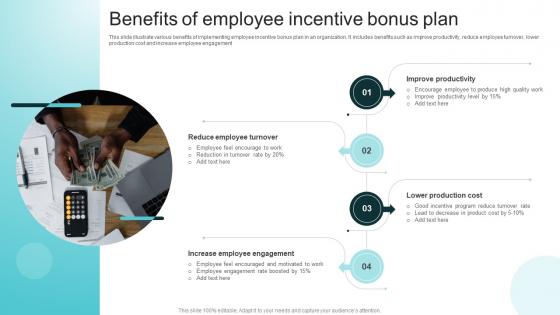
Benefits Of Employee Incentive Bonus Plan




Try Before you Buy Download Free Sample Product
 Impress Your
 Audience
 100%
100% Editable
 Save Hours
 of Time


This slide illustrate various benefits of implementing employee incentive bonus plan in an organization. It includes benefits such as improve productivity, reduce employee turnover, lower production cost and increase employee engagement.
People who downloaded this PowerPoint presentation also viewed the following :
Benefits Of Employee Incentive Bonus Plan with all 6 slides:
Use our Benefits Of Employee Incentive Bonus Plan to effectively help you save your valuable time. They are readymade to fit into any presentation structure.





FAQs for Benefits Of Employee
Effective employee incentive bonus plans include clear performance metrics, tiered reward structures, transparent communication protocols, regular assessment periods, and alignment with organizational objectives. These components work together by establishing measurable goals, creating motivation through achievable targets, and ensuring fairness across departments, with many organizations finding that strategic bonus structures enhance retention, boost productivity, and ultimately drive competitive advantage.
Incentive bonus plans align with strategic goals by linking employee rewards directly to key performance indicators, revenue targets, customer satisfaction metrics, and operational efficiency measures that drive business success. Through carefully structured bonus criteria, organizations across sectors like retail, manufacturing, and financial services can motivate teams to prioritize activities that enhance market share, streamline processes, and deliver competitive advantage, ultimately ensuring workforce efforts directly contribute to long-term strategic objectives.
Key metrics include employee engagement scores, productivity rates, retention percentages, goal achievement ratios, and revenue per employee. These measurements work together by tracking behavioral changes, performance improvements, and business outcomes, with many organizations finding that combining leading indicators like participation rates with lagging indicators like profitability delivers comprehensive program insights.
Employee performance directly influences bonus plan structure through performance-based tiers, individual achievement metrics, team contribution assessments, and goal-specific reward scales that align compensation with outcomes. Organizations increasingly design tiered bonus systems where top performers receive significantly higher payouts, while incorporating both quantitative targets and qualitative measures, ultimately creating competitive advantage through enhanced motivation and strategic talent retention across departments.
Communication serves as the foundation for successful incentive bonus plan implementation, ensuring employees understand eligibility criteria, performance metrics, payout structures, and timeline expectations from the outset. Effective communication strategies, including regular updates, transparent progress tracking, and clear feedback mechanisms, enable organizations to maintain employee engagement, address concerns proactively, and ultimately deliver higher participation rates and improved performance outcomes.
Organizations ensure fairness and transparency in bonus distribution by establishing clear performance criteria, conducting regular performance reviews, and maintaining open communication about bonus structures and evaluation processes. Through standardized metrics and documented procedures, companies across retail, manufacturing, and financial services deliver consistent recognition while building employee trust, ultimately enhancing workplace satisfaction and reducing turnover rates.
Incentive bonuses are typically taxed as ordinary income at federal, state, and local rates, often subject to higher withholding rates of 22% or more for federal taxes. Employees may face tax bracket bumps if bonuses push annual income higher, though strategic timing and retirement account contributions can help minimize impact, with many finding quarterly payments more tax-efficient than lump sums.
Different incentive structures significantly impact motivation by aligning rewards with performance goals, recognition preferences, and career aspirations, with monetary bonuses, equity options, and non-financial rewards each driving distinct behavioral outcomes. While financial incentives accelerate short-term productivity, comprehensive programs combining performance bonuses with professional development opportunities deliver sustained engagement, with many organizations finding that tailored incentive structures enhance retention and operational efficiency.
Strategies for personalizing bonus plans include role-specific performance metrics, tiered reward structures based on seniority levels, department-aligned incentives, individual goal integration, and flexible reward options like equity or professional development. These approaches enhance employee engagement by recognizing diverse contributions across sales, operations, and leadership roles, while enabling organizations to attract specialized talent, reduce turnover, and ultimately drive performance outcomes tailored to each position's strategic value.
Technology streamlines incentive bonus plan administration by automating calculations, tracking performance metrics in real-time, and integrating with existing HR systems for seamless data flow. Through cloud-based platforms and analytics tools, organizations enhance accuracy, reduce administrative overhead, and provide transparent dashboards for employees, ultimately delivering faster processing and improved engagement across teams.
Common pitfalls include setting unclear performance metrics, creating overly complex calculation methods, failing to align bonuses with company objectives, inadequate communication about plan details, and insufficient budget planning. These design flaws often result in employee confusion, reduced motivation, and misaligned priorities, with many organizations finding that simple, transparent bonus structures ultimately deliver better engagement and stronger business outcomes.
Employee feedback transforms incentive bonus programs by revealing engagement gaps, identifying valued reward types, and highlighting program inequities that leadership might overlook. Through regular surveys, focus groups, and performance discussions, organizations can adjust bonus criteria, introduce flexible reward options, and enhance program transparency, ultimately delivering higher participation rates and improved retention while ensuring the program evolves with workforce expectations.
Individual bonuses reward personal performance and achievements, team bonuses incentivize collaborative efforts and group objectives, while company-wide bonuses distribute profits based on overall organizational success. These strategic approaches enhance motivation through different mechanisms, with individual plans driving personal accountability, team structures fostering collaboration, and company-wide programs aligning all employees with broader business outcomes.
Incentive bonus plans enhance employee retention and engagement by directly linking compensation to performance, creating clear pathways for advancement, and demonstrating organizational investment in individual success. These strategic programs foster loyalty through financial recognition, competitive differentiation in talent markets, and psychological ownership of outcomes, with many companies finding that well-structured bonus systems significantly reduce turnover while boosting productivity and job satisfaction.
Company culture significantly influences incentive bonus plan effectiveness by shaping employee perceptions, trust levels, communication transparency, and alignment with organizational values. In cultures emphasizing collaboration and recognition, such as those in tech companies and progressive manufacturing firms, employees respond more positively to bonus structures, ultimately delivering higher engagement and performance outcomes.
-
Like always a great experience with you guys. Always there on the drop of hat to help.
-
Incredibly beautiful designs that will help you get noticed! These eye-catching templates are perfect for corporate presentations that can be altered to fit any occasion or taste.