


Biochips Applications Powerpoint Presentation Slides




Try Before you Buy Download Free Sample Product
 Impress Your
 Audience
 100%
100% Editable
 Save Hours
 of Time


Biochips contain millions of sensor components or biosensors in the gadget, allowing several experiments to run simultaneously for higher throughput in less time. Check out our competently designed Biochips Applications template that highlights details about its overview, advantages, working, application, use cases, etc. This PPT template displays principles of Biochips, US Biochips products market share, Biochips market share forecast, working of Biochips, etc. Moreover, this Biochips application template presents a block diagram of Biochips platform architecture, its components, transponder and four parts, reader details, and more. The PowerPoint presentation even exhibits the information regarding types of Biochips, DNA micro array, microfluidic chip, protein micro-array, Biochips market details from 1995-2022, etc. Furthermore, the bio micro-array device template highlights applications and use cases of Biochips, the timeline for Biochips, the roadmap, and more. One can even illustrate details for the dashboard to monitor Biochips pacemaker working, blood glucose monitoring dashboard, and more. Customize this 100 percent editable template based on your requirements. Download it now.
People who downloaded this PowerPoint presentation also viewed the following :
Content of this Powerpoint Presentation
Slide 1: This slide displays the title Biochips Applications.
Slide 2: This slide displays the title AGENDA.
Slide 3: This slide exhibit table of content.
Slide 4: This slide exhibit table of content- About biochips.
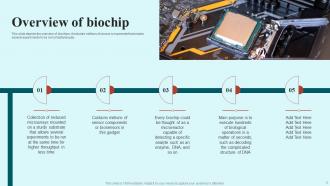
Slide 5: This slide depicts the overview of biochips; it includes millions of sensor components that enable several experiments to be run simultaneously.
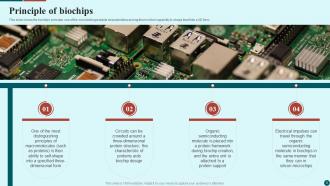
Slide 6: This slide shows the biochips’ principle, one of the most distinguishable characteristics among them is their capability to shape itself into a 3D form.
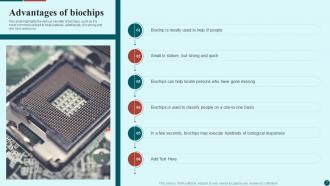
Slide 7: This slide highlights the various benefits of biochips.
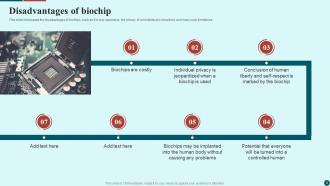
Slide 8: This slide showcases the disadvantages of biochips, such as it is very expensive; the privacy of an individual is breached, and many such limitations.
Slide 9: This slide exhibit table of content- Biochip market share.
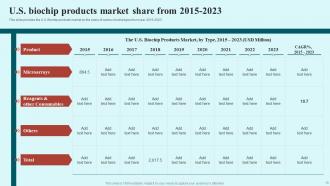
Slide 10: This slide provides the U.S. Biochip products market on the basis of various biochip types from year 2015-2023.
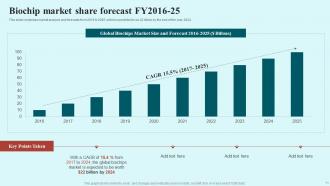
Slide 11: This slide comprises market analysis and forecasts from 2016 to 2025, which is predicted to be 22 billion by the end of the year 2024.
Slide 12: This slide exhibit table of content- Biochips architecture and working.
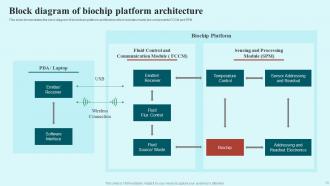
Slide 13: This slide demonstrates the block diagram of blockchain platform architecture which includes mainly two components FCCM and SPM.
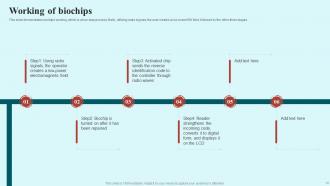
Slide 14: This slide demonstrates biochips' working, which is a four-step process; firstly, utilizing radio signals, the user creates a low power EM field, followed by the other three stages.
Slide 15: This slide exhibit table of content- Biochips components
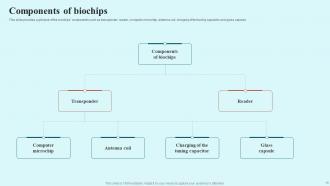
Slide 16: This slide provides a glimpse of the biochips’ components such as transponder, reader, computer microchip, antenna coil.
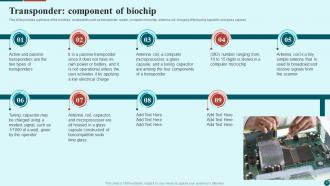
Slide 17: This slide provides a glimpse of the biochips’ components such as transponder, reader, computer microchip, antenna coil.
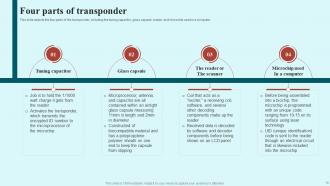
Slide 18: This slide depicts the four parts of the transponder, including the tuning capacitor, glass capsule, reader, and microchip used in a computer.
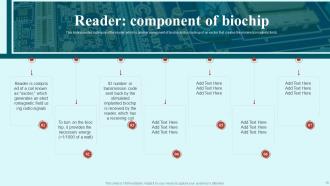
Slide 19: This slide provides a glimpse of the reader, which is another component of biochip and is made up of an exciter that creates the em(electromagnetic field).
Slide 20: This slide exhibit table of content- Various biochips.
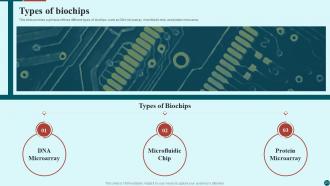
Slide 21: This slide provides a glimpse of three types of biochips: DNA microarray, microfluidic chip, and protein microarray.
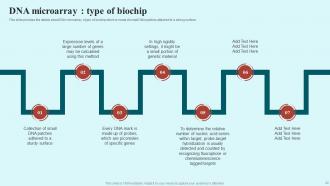
Slide 22: This slide provides the details about DNA microarray, a type of biochip which is made of small DNA patches attached to a strong surface.
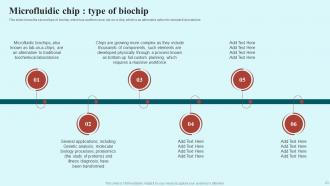
Slide 23: This slide shows the second type of biochip, which has another name, lab-on-a-chip, which is an alternative option for standard laboratories.
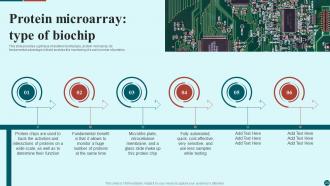
Slide 24: This slide provides a glimpse of another biochip type, protein microarray; its fundamental advantage is that it enables the monitoring of a vast number of proteins.
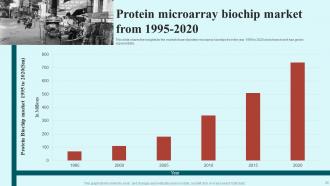
Slide 25: This slide shares the insights for the market share of protein microarray biochips from the year 1995 to 2020 and shows how it has grown exponentially.
Slide 26: This slide exhibit table of content- Applications and use cases of biochips
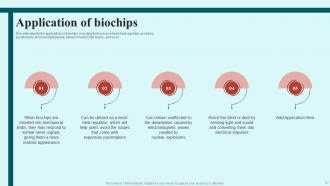
Slide 27: This slide depicts the applications of biochips.
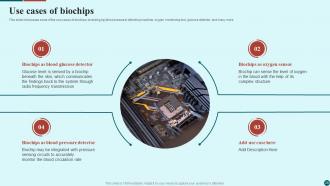
Slide 28: This slide showcases some of the use cases of biochips, including bp(blood pressure) detecting machine, oxygen monitoring tool, glucose detector, and many more.
Slide 29: This slide exhibit table of content- Timeline for biochip.
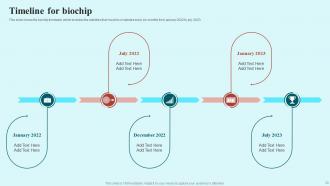
Slide 30: This slide shows the biochip timetable, which includes the activities that must be completed every six months from january 2022 to july 2023.
Slide 31: This slide exhibit table of content- Roadmap for biochip.
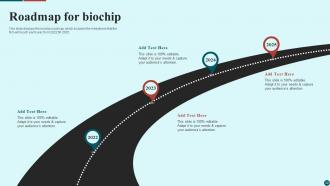
Slide 32: This slide displays the biochip roadmap, which includes the milestones that the firm will reach each year from 2022 till 2025.
Slide 33: This slide exhibit table of content- Dashboards.
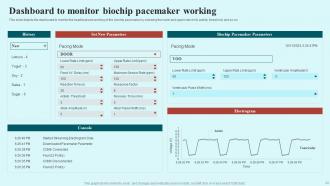
Slide 34: This slide depicts the dashboard to monitor the heartbeat and working of the biochip pacemaker.
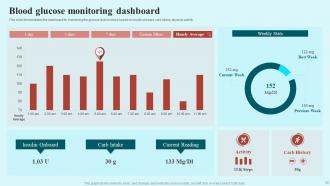
Slide 35: This slide demonstrates the dashboard for monitoring the glucose level in blood-based on insulin onboard, carb intake, physical activity.
Slide 36: This is the icons slide.
Slide 37: This slide presents title for additional slides.
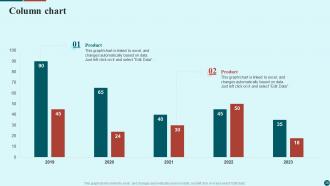
Slide 38: This slide showcase Column chart for different products.
Slide 39: This slide display Venn.
Slide 40: This slide depicts posts for past experiences of clients.
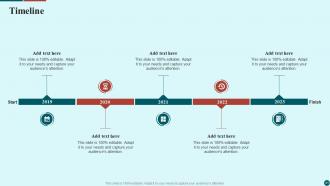
Slide 41: This slide exhibit Timeline.
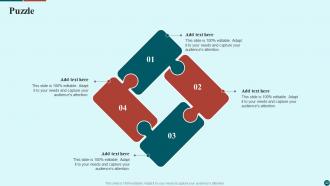
Slide 42: This slide shows puzzle for displaying elements of company.
Slide 43: This is thank you slide & contains contact details of company like office address, phone no., etc.
Biochips Applications Powerpoint Presentation Slides with all 48 slides:
Use our Biochips Applications Powerpoint Presentation Slides to effectively help you save your valuable time. They are readymade to fit into any presentation structure.











FAQs for Biochips Applications
So basically you've got the substrate - that's your silicon or glass base. Then there's biosensors that grab onto whatever molecules you're hunting for. Microfluidic channels move your samples around (think tiny pipes, but way cooler). The electronics convert all that biological stuff into actual readable data. It's like having a whole lab shrunk down to chip size, which honestly blows my mind every time. Everything works together for real-time analysis. Pro tip though - spend extra time on your sample prep because that's where most experiments go sideways. The engineering behind it is wild when you see it working.
So biochips are pretty wild - they can test your DNA, proteins, and other biomarkers all on one tiny device. It's like having a whole lab shrunk down to pocket size, which honestly sounds a bit sci-fi to me still. Doctors use them to figure out how you'll react to specific medications and what diseases you might be at risk for. Your treatment gets customized based on your actual biology instead of just guessing what works. Cancer therapy, drug dosing - they can tailor it all. Way better than the old approach where everyone got the same treatment and hoped for the best.
Honestly, biochips are a total game-changer for drug discovery. You can test thousands of compounds at once on a single chip instead of doing everything the slow way. The cool part? You're screening for interactions, toxicity, and how well stuff works all simultaneously. Sample sizes are tiny too, so you won't blow through your expensive compounds as fast. Timeline goes from years to months in some cases - which is nuts if you think about it. Data's way more reliable since conditions are super controlled. Oh, and if you're just getting into this, start with organ-on-chip platforms. They're the most practical for most labs.
So microarrays are more like detectors - they're awesome for spotting what's already in your sample, like gene expression stuff. Lab-on-a-chip is different though. It actually does things to your sample - mixes it, separates components, runs multiple tests. Basically one's just identifying targets you know are there, the other's like a mini lab doing actual sample prep. I saw one running once and honestly it's pretty wild watching it work. If you just need detection, microarray's fine. But if you're doing complex analysis with multiple steps? Definitely go lab-on-a-chip.
So basically, biochips have these DNA/RNA probes or antibodies that grab onto specific pathogens - bacteria, viruses, fungi, whatever you're looking for. You drop your sample on there and if the bad guys are present, they'll stick to their matching probes and light up fluorescently. The cool part? You can test for tons of different pathogens all at once instead of waiting days for those old-school culture tests. Plus you get actual numbers, not just positive/negative results. Oh, and if you're shopping around for diagnostic platforms, definitely check the sensitivity and specificity specs for your target bugs first.
The latest biochip tech has crazy good sensitivity now - we're talking femtomolar detection, which is insane. Nanoparticle amplification is doing most of the heavy lifting there, plus microfluidic sample prep that's way cleaner than before. AI signal processing helps filter out background noise too. Specificity got a major boost from better probe design - you can actually tell apart really similar targets now with decent multiplexing. Honestly, the integrated sample processing platforms are where it's at if you're shopping around. That's where you'll see the biggest jump in performance. Way less manual prep work.
So biochips are basically these crazy sensitive detectors for environmental stuff. You can toss them in water to check quality, spot pollutants, track contamination - all in real time. Way better than old-school testing that takes forever. They'll catch specific bacteria or toxins that regular tests miss completely. The instant results are a game changer, especially when you're dealing with health risks. Honestly, if you're doing any environmental work, check out the portable ones. They're getting cheaper and actually pretty easy to use now. My buddy swears by them.
So biochips are pretty much the workhorses for analyzing thousands of genes or proteins at once on one chip. DNA microarrays let you compare gene expression between samples - great for finding disease markers or seeing how treatments mess with cellular pathways. Protein arrays are clutch for biomarker screening too. Honestly they're total game-changers since traditional methods take forever. Oh and if you're doing comparative studies or have tons of samples to process, definitely check what array platforms your core facility has. Trust me, it'll save you so much headache.
Honestly, biochips are a total game-changer for biomarker research. Instead of testing samples one by one (which is painfully slow), you can screen thousands simultaneously. Think fire hose vs garden sprinkler in terms of speed. What's really cool is you can analyze protein expressions, gene patterns, or metabolite levels across entire patient groups in one go - stuff that used to take months. The standardization is huge too since all samples get identical conditions, so your data's way more reliable. I'd start by figuring out which biomarker types matter most for your project, then find chip platforms that focus on those areas.
Privacy and consent are the big ones - like, who actually owns your genetic info once it's digitized? Patients often don't really get what they're signing up for with these fancy diagnostic tools. Then you've got the discrimination stuff - imagine your insurance company getting hold of your DNA data, yikes. Wealthy people will obviously get access first while everyone else waits. Oh, and data breaches are legitimately scary when we're talking about your most personal biological info. Just be super clear with patients about what you're collecting and how long you're hanging onto it. Trust me, transparency goes a long way here.
So biochips basically become the mini-lab inside those portable diagnostic gadgets. Think glucose meters, pregnancy tests, COVID rapid tests - the chip does all the actual work processing your sample. Drop in blood or saliva, and it reads the biological reactions happening right on the chip surface. Takes minutes instead of waiting days for lab results. The chip has all the reagents and detection stuff built in, which is honestly pretty wild when you think about it. If you're shopping around for these devices, definitely go for ones that can test multiple biomarkers on one chip - way more bang for your buck.
Biochips are popping up everywhere now, not just healthcare. Agriculture companies use them to spot plant diseases early and boost crop yields. Water quality testing got way easier too - environmental agencies can monitor pollution in real time. But honestly, food safety is where it gets really cool. They're catching pathogens and allergens before stuff hits store shelves. Defense sectors are even using them to detect bioterrorism threats, which is kind of wild when you think about it. If you're in any of these fields, definitely worth checking out how they could speed up your current testing setup.
Honestly, the money thing kills most startups right away. Manufacturing costs are brutal and FDA approval? That's like a 5-year nightmare that'll drain your bank account. Your chips also need to actually work with messy real-world samples, not just the clean stuff you test in labs. Healthcare moves slower than molasses - hospitals hate change and want you to prove every penny of ROI before they'll even consider it. Oh, and the technical reliability stuff is way harder than it sounds. I'd probably start super niche where the benefits are obvious, then expand once you've got some wins.
Dude, biochips are like having a tiny lab on a chip - you can test genetic circuits and see how biological parts interact without waiting forever. Think of it as a biological breadboard, which honestly is a pretty solid analogy. The crazy part? You'll run hundreds of experiments at once instead of babysitting one at a time for weeks. Traditional methods are painfully slow by comparison. If you're doing any synthetic bio work, definitely check out microfluidic platforms. They're a total game-changer for rapid prototyping and testing engineered organisms at scale.
Biochips are about to be everywhere in healthcare - we're talking instant blood tests at CVS or your kitchen counter. The AI stuff is getting crazy good at spotting patterns too. Honestly, I think personalized medicine based on your DNA will be totally normal within like 5 years. These things keep getting tinier but way more powerful at the same time. Oh, and if you're thinking investments, definitely look into microfluidics companies. That's where the real money's gonna be made.
-
The customer care of SlideTeam is very responsive. I was having a payment issue and they fixed it for me in no time.
-
I can say with full confidence that all your business, academic, or professional work requirements will be sufficed with SlideTeam. Their gallery is as rich as 2Million+!!