


Biochips IT Powerpoint Presentation Slides




Try Before you Buy Download Free Sample Product
 Impress Your
 Audience
 100%
100% Editable
 Save Hours
 of Time


Biochips contain millions of sensor components or biosensors in the gadget, allowing several experiments to run simultaneously for higher throughput in less time. Check out our competently designed Biochips IT template that highlights details about its overview, advantages, working, application, use cases, etc. This PPT template displays principles of Biochips, US Biochips products market share, Biochips market share forecast, working of Biochips, etc. Moreover, this Biochips application template presents a block diagram of Biochips platform architecture, its components, transponder and four parts, reader details, and more. The PowerPoint presentation even exhibits the information regarding types of Biochips, DNA micro array, microfluidic chip, protein micro array, Biochips market details from 1995 to 2022, etc. Furthermore, the bio micro array device template highlights applications and use cases of Biochips, the timeline for Biochips, the roadmap, and more. One can even illustrate details for the dashboard to monitor Biochips pacemaker working, blood glucose monitoring dashboard, and more. Customize this 100 percent editable template based on your requirements. Download it now.
People who downloaded this PowerPoint presentation also viewed the following :
Content of this Powerpoint Presentation
Slide 1: This slide displays title i.e. 'Biochips (IT)' and your Company Name.
Slide 2: This slide presents agenda.
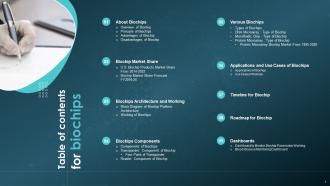
Slide 3: This slide exhibits table of contents.
Slide 4: This slide depicts title for four topics that are to be covered next in the template.
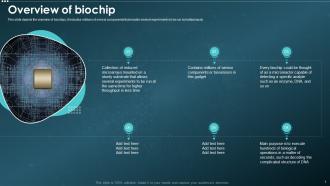
Slide 5: This slide depicts the overview of biochips; it includes millions of sensor components that enable several experiments to be run simultaneously.
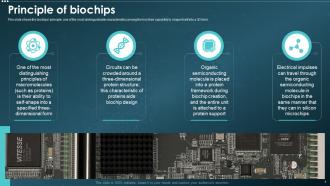
Slide 6: This slide shows the biochips’ principle, one of the most distinguishable characteristics among them is their capability to shape itself into a 3D form.
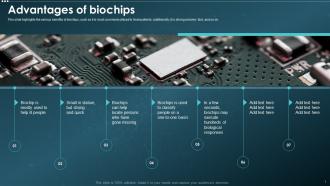
Slide 7: This slide highlights the various benefits of biochips, such as it is most commonly utilized to treat patients.
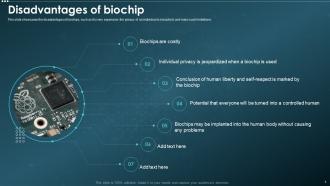
Slide 8: This slide showcases the disadvantages of biochips, such as it is very expensive; the privacy of an individual is breached, and many such limitations.
Slide 9: This slide depicts title for two topics that are to be covered next in the template.
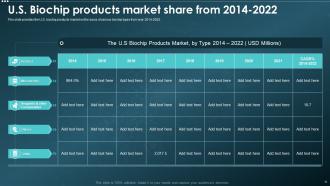
Slide 10: This slide provides the U.S. biochip products market on the basis of various biochip types from year 2014-2022.
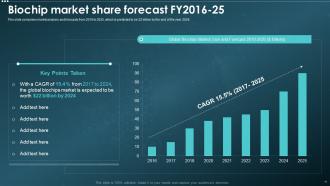
Slide 11: This slide comprises market analysis and forecasts from 2016 to 2025, which is predicted to be 22 billion by the end of the year 2024.
Slide 12: This slide depicts title for two topics that are to be covered next in the template.
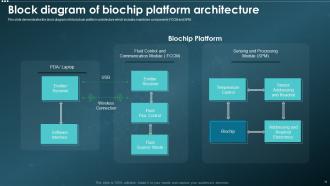
Slide 13: This slide demonstrates the block diagram of blockchain platform architecture which includes mainly two components FCCM and SPM.
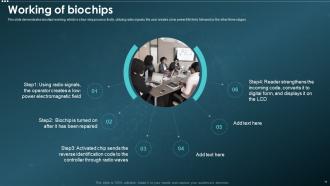
Slide 14: This slide demonstrates biochips' working, which is a four-step process; firstly, utilizing radio signals, etc.
Slide 15: This slide depicts title for four topics that are to be covered next in the template.
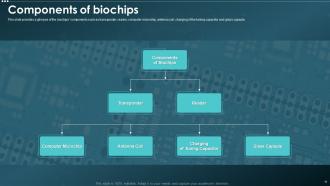
Slide 16: This slide provides a glimpse of the biochips’ components such as transponder, reader, computer microchip, antenna coil, etc.
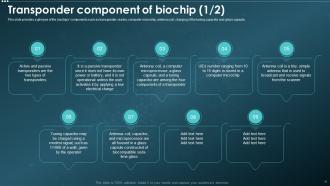
Slide 17: This slide provides a glimpse of the biochips’ components such as transponder, reader, computer microchip, etc.
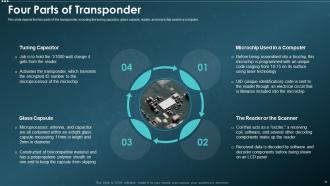
Slide 18: This slide depicts the four parts of the transponder, including the tuning capacitor, glass capsule, reader, and microchip used in a computer.
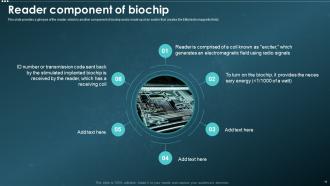
Slide 19: This slide provides a glimpse of the reader.
Slide 20: This slide depicts title for five topics that are to be covered next in the template.
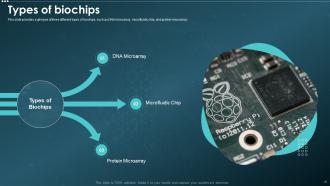
Slide 21: This slide provides a glimpse of three different types of biochips, such as DNA microarray, microfluidic chip, and protein microarray.
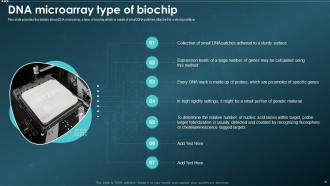
Slide 22: This slide provides the details about DNA microarray, a type of biochip which is made of small DNA patches attached to a strong surface.
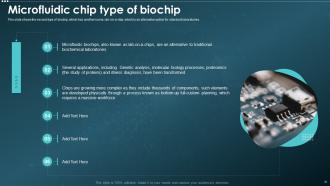
Slide 23: This slide shows the second type of biochip, which has another name, lab-on-a-chip, which is an alternative option for standard laboratories.
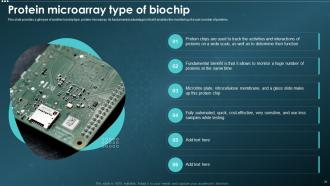
Slide 24: This slide provides a glimpse of another biochip type, protein microarray.
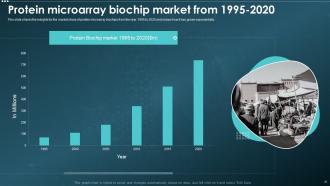
Slide 25: This slide shares the insights for the market share of protein microarray biochips from the year 1995 to 2020 and shows how it has grown exponentially.
Slide 26: This slide depicts title for two topics that are to be covered next in the template.
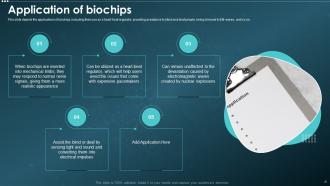
Slide 27: This slide depicts the applications of biochips, including their use as a heart-heat regulator, etc.
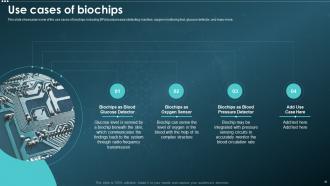
Slide 28: This slide showcases some of the use cases of biochips, including BP(blood pressure) detecting machine, oxygen monitoring tool, etc.
Slide 29: This slide depicts title for one topic that is to be covered next in the template.
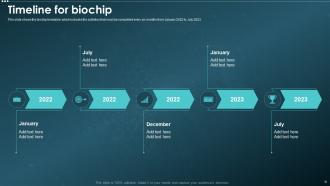
Slide 30: This slide shows the biochip timetable, which includes the activities that must be completed every six months from January 2022 to July 2023.
Slide 31: This slide depicts title for one topic that is to be covered next in the template.
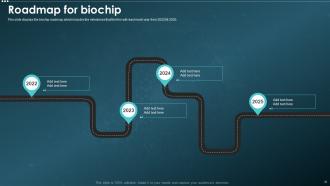
Slide 32: This slide displays the biochip roadmap, which includes the milestones that the firm will reach each year from 2022 till 2025.
Slide 33: This slide depicts title for two topics that are to be covered next in the template.
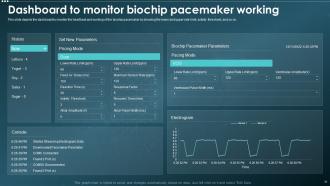
Slide 34: This slide depicts the dashboard to monitor the heartbeat and working of the biochip pacemaker by showing the lower and upper rate limit.
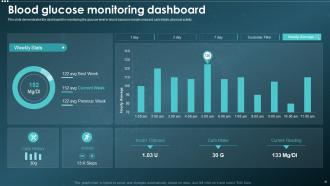
Slide 35: This slide demonstrates the dashboard for monitoring the glucose level in blood-based on insulin onboard, carb intake, physical activity.
Slide 36: This is the icons slide.
Slide 37: This slide shows about your company, target audience and its client's values.
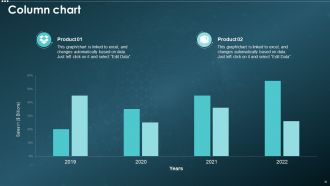
Slide 38: This slide exhibits yearly sales column charts for different products. The charts are linked to Excel.
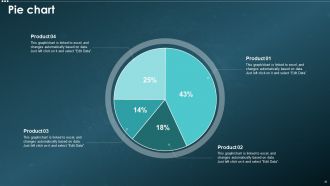
Slide 39: This slide exhibits pie charts for different products. The charts are linked to Excel.
Slide 40: This slide displays Venn.
Slide 41: This slide displays puzzle.
Slide 42: This slide depicts posts for past experiences of clients.
Slide 43: This slide depicts 30-60-90 days plan for projects.
Slide 44: This slide shows goals of the company.
Slide 45: This slide exhibits ideas generated.
Slide 46: This is thank you slide & contains contact details of company like office address, phone no., etc.
Biochips IT Powerpoint Presentation Slides with all 51 slides:
Use our Biochips IT Powerpoint Presentation Slides to effectively help you save your valuable time. They are readymade to fit into any presentation structure.







FAQs for Biochips IT
Biochips are miniaturized devices that integrate biological molecules with electronic components to detect, analyze, and process biological data, unlike traditional silicon chips that handle only electronic information. These biotechnology tools enable rapid DNA sequencing, protein analysis, and medical diagnostics by combining biological recognition elements with digital processing, ultimately delivering faster diagnostic results, personalized medicine capabilities, and enhanced research efficiency across healthcare institutions.
Biochips in medical diagnostics include DNA sequencing, protein analysis, disease biomarker detection, pathogen identification, and drug screening applications. These technologies streamline clinical workflows by enabling rapid point-of-care testing, personalized treatment protocols, and high-throughput screening processes, with hospitals and diagnostic laboratories finding that biochips deliver faster results and enhanced diagnostic accuracy.
Biochips facilitate personalized medicine by analyzing individual genetic profiles, protein expressions, and biomarker patterns to identify optimal treatment pathways for each patient. Through molecular diagnostics and genomic sequencing, healthcare providers can predict drug responses, minimize adverse reactions, and customize therapeutic protocols, with oncology and cardiology departments increasingly finding that targeted treatments deliver better patient outcomes while reducing overall healthcare costs.
Key technologies in biochip manufacturing include photolithography, microfluidics fabrication, surface chemistry modification, electrochemical deposition, and nanoimprinting techniques. These advanced manufacturing processes enable precise biomolecule placement, microscale channel creation, and sensitive detection capabilities, with medical device companies and pharmaceutical firms finding that these technologies streamline diagnostic testing while reducing costs and improving patient outcomes.
Biochips revolutionize genomics by enabling high-throughput DNA sequencing, gene expression analysis, and genetic variation detection with unprecedented speed and precision. These miniaturized platforms streamline processes like SNP identification, biomarker discovery, and personalized medicine development, with pharmaceutical companies and research institutions finding they can analyze thousands of genetic samples simultaneously, ultimately accelerating drug discovery and enhancing diagnostic capabilities.
Biochip development faces challenges including manufacturing complexity, standardization gaps, regulatory hurdles, high development costs, and integration difficulties with existing systems. While these present obstacles, many biotechnology companies and research institutions are finding that strategic partnerships, improved fabrication techniques, and streamlined regulatory pathways increasingly enable faster commercialization and broader adoption across healthcare sectors.
Biochips revolutionize drug discovery through high-throughput screening, toxicity testing, genomic analysis, protein interaction studies, and personalized medicine research. These devices enable pharmaceutical companies to accelerate compound evaluation, reduce animal testing, and identify potential drug candidates more efficiently, while biotechnology firms leverage biochips for targeted therapy development, ultimately delivering faster drug development timelines and improved treatment outcomes.
Biochips enhance disease outbreak monitoring by enabling rapid pathogen detection, real-time data collection, and automated sample analysis across multiple locations simultaneously. These miniaturized diagnostic tools streamline surveillance processes by delivering faster test results, reducing laboratory bottlenecks, and facilitating immediate response coordination, with public health agencies increasingly finding that integrated biochip networks significantly accelerate containment strategies.
Biochips enhance food safety by rapidly detecting bacterial pathogens, chemical residues, allergens, toxins, and pesticide contamination through advanced biosensors and microarray technology. These devices streamline quality control processes in food processing facilities, restaurants, and regulatory laboratories, enabling faster contamination identification, reducing testing costs, and ultimately delivering safer food products while minimizing health risks for consumers.
Data analysis on biochip results involves signal processing, statistical analysis, pattern recognition, and machine learning algorithms to interpret complex biological data. Specialized software tools like GenePix, ArrayStar, and R/Bioconductor enable researchers to identify biomarkers, detect disease patterns, and predict treatment responses, with pharmaceutical companies and diagnostic laboratories finding these platforms streamline drug discovery timelines while enhancing precision medicine capabilities.
Biochips in healthcare raise ethical considerations including patient privacy and data security, informed consent for biological monitoring, equitable access across socioeconomic groups, and potential discrimination based on genetic information. While these technologies enhance diagnostic accuracy and personalized treatment, healthcare institutions must balance innovation with patient rights, ensuring transparent data governance and fair implementation policies that protect vulnerable populations while delivering improved medical outcomes.
Biochips are being integrated into smartwatches, fitness trackers, and medical patches through miniaturized sensors that continuously monitor glucose levels, heart rhythms, and biomarkers in real-time. These devices streamline patient care by enabling remote monitoring, reducing hospital visits, and providing predictive health insights, with healthcare providers and chronic disease patients finding that continuous biometric tracking ultimately delivers personalized treatment and improved outcomes.
The next decade promises enhanced biochip sensitivity, miniaturization, wireless connectivity, AI-powered analytics, and multiplexing capabilities for simultaneous biomarker detection. These advancements will revolutionize personalized medicine, enable real-time health monitoring, and streamline diagnostic processes across healthcare systems, with hospitals and research institutions finding that integrated biochip platforms deliver faster patient outcomes and reduced operational costs.
Biochips significantly reduce laboratory testing costs by enabling parallel analysis of multiple samples, minimizing reagent consumption, and automating complex procedures. Through miniaturized technology, hospitals and diagnostic centers achieve faster turnaround times, lower material expenses, and enhanced throughput capacity, with many clinical laboratories finding that biochip integration delivers up to 70% cost savings while improving diagnostic accuracy.
Biochip production presents both challenges and opportunities regarding environmental impact, including energy-intensive manufacturing processes, chemical waste generation, material sourcing sustainability, and end-of-life disposal concerns. Many biotechnology companies are increasingly adopting green manufacturing practices, biodegradable materials, and recycling programs, ultimately delivering reduced carbon footprints while maintaining device performance and regulatory compliance.
-
The designs by SlideTeam are honestly the best I have seen so far. Will be definitely coming back for more.
-
I was able to find the right choice of PPT template for my thesis with SlideTeam. Thank you for existing.