


Computational science it powerpoint presentation slides




Try Before you Buy Download Free Sample Product
 Impress Your
 Audience
 100%
100% Editable
 Save Hours
 of Time


The use of computer science and software engineering ideas to address scientific issues is known as computational science. It entails using computer hardware, networking, algorithms, programming, databases, and other domain-specific knowledge to create computer-based simulations of physical processes. Here is a professionally designed Computational Science IT template that gives a brief idea about the computational science program provider and the critical principles of their approach. In this PowerPoint Presentation, we have covered the need for computational science and how enterprises can use computational science for businesses. In addition, this Scientific Computing PPT contains a slide depicting a career in computational science, computational science program, and fee structure. Also, the PPT presentation provides an introduction to computational science, including components of computational science, pillars, applications, and a comparison between computational science and data science. Lastly, this Scientific Computing deck comprises a roadmap, a 30-60-90 days plan for the computational science program, and a dashboard. Customize this 100 percent editable template based on your needs by getting assistance from our highly-efficient research team. Get access now.
People who downloaded this PowerPoint presentation also viewed the following :
Content of this Powerpoint Presentation
Slide 1: This slide introduces Computational Science (IT). State Your Company Name and begin.
Slide 2: This slide shows Agenda for Computational Science.
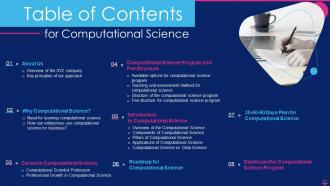
Slide 3: This slide presents Table of Content for the presentation.
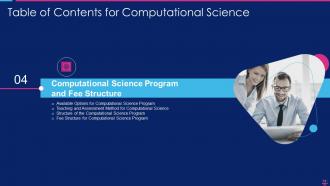
Slide 4: This slide shows title for topics that are to be covered next in the template.
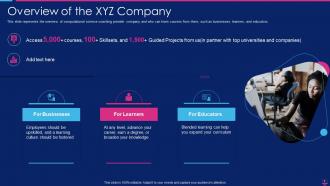
Slide 5: This slide represents the overview of computational science coaching provider company.
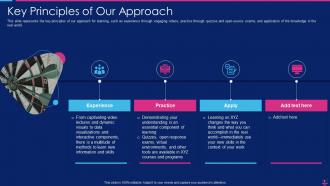
Slide 6: This slide displays key principles of our approach for learning, such as experience through engaging videos.
Slide 7: This slide shows title for topics that are to be covered next in the template.
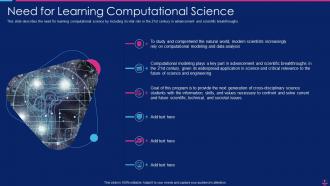
Slide 8: This slide showcases Need for Learning Computational Science.
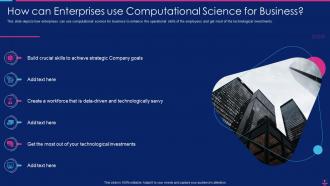
Slide 9: This slide presents How can Enterprises use Computational Science for Business.
Slide 10: This slide shows title for topics that are to be covered next in the template.
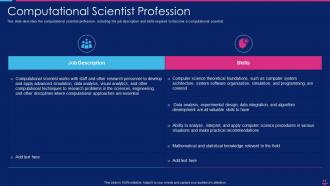
Slide 11: This slide describes the computational scientist profession, including the job description and skills required.
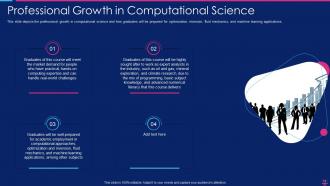
Slide 12: This slide depicts the professional growth in computational science and how graduates will be prepared for optimization.
Slide 13: This slide shows title for topics that are to be covered next in the template.
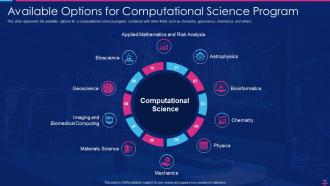
Slide 14: This slide presents Available Options for Computational Science Program.
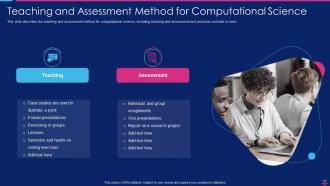
Slide 15: This slide displays Teaching and Assessment Method for Computational Science.
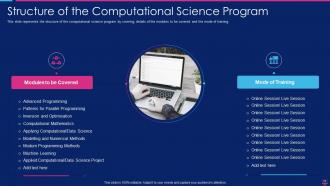
Slide 16: This slide represents Structure of the Computational Science Program.
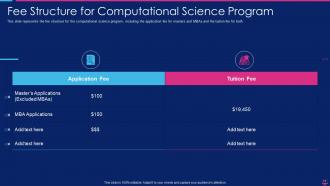
Slide 17: This slide showcases Fee Structure for Computational Science Program.
Slide 18: This slide shows title for topics that are to be covered next in the template.
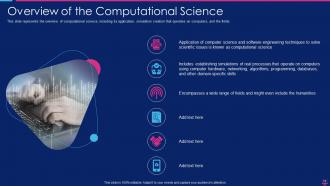
Slide 19: This slide presents Overview of the Computational Science.
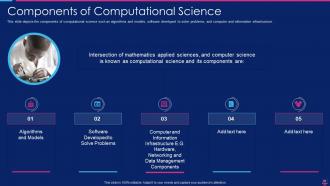
Slide 20: This slide depicts the components of computational science such as algorithms and models, software developed to solve problems, etc.
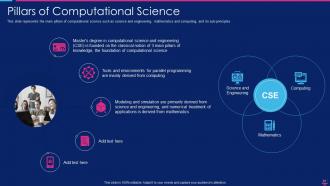
Slide 21: This slide represents the main pillars of computational science such as science and engineering, mathematics and computing, etc.
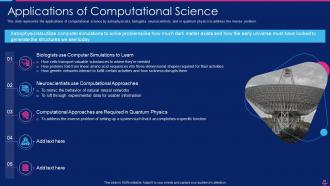
Slide 22: This slide showcases applications of computational science by astrophysicists.
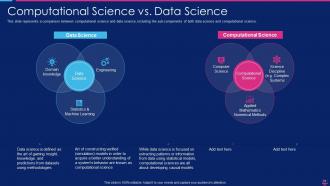
Slide 23: This slide presents comparison between computational science and data science.
Slide 24: This slide shows title for topics that are to be covered next in the template.
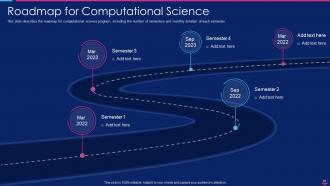
Slide 25: This slide describes the roadmap for computational science program.
Slide 26: This slide shows title for topics that are to be covered next in the template.
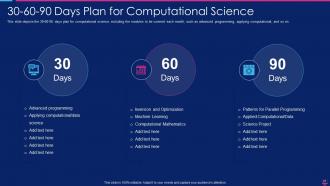
Slide 27: This slide presents 30-60-90 Days Plan for Computational Science.
Slide 28: This slide shows title for topics that are to be covered next in the template.
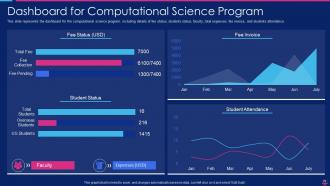
Slide 29: This slide presents Dashboard for Computational Science Program.
Slide 30: This slide displays Icons for Computational Science (IT).
Slide 31: This slide is titled as Additional Slides for moving forward.
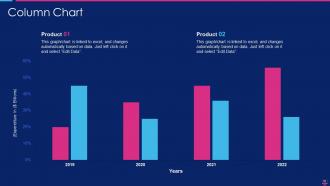
Slide 32: This slide displays Column chart with two products comparison.
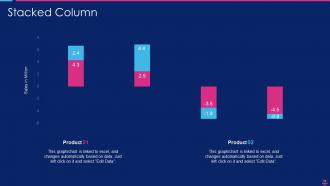
Slide 33: This slide represents Stacked Column chart with two products comparison.
Slide 34: This is About Us slide to show company specifications etc.
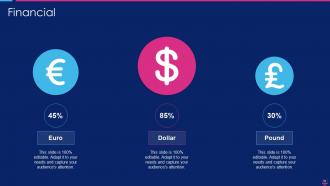
Slide 35: This is a Financial slide. Show your finance related stuff here.
Slide 36: This is a Timeline slide. Show data related to time intervals here.
Slide 37: This slide shows Post It Notes. Post your important notes here.
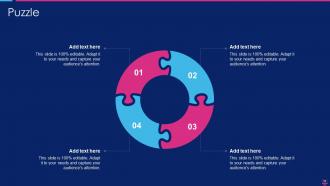
Slide 38: This slide contains Puzzle with related icons and text.
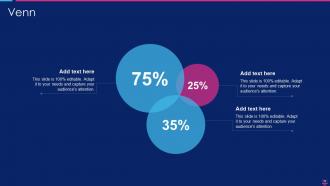
Slide 39: This slide depicts Venn diagram with text boxes.
Slide 40: This is Our Team slide with names and designation.
Slide 41: This is a Thank You slide with address, contact numbers and email address.
Computational science it powerpoint presentation slides with all 46 slides:
Use our Computational Science IT Powerpoint Presentation Slides to effectively help you save your valuable time. They are readymade to fit into any presentation structure.








FAQs for Computational science it
Math and programming are the big ones - Python or C++ are good starting points. Most science people I know struggle with the coding part at first, but honestly it just takes practice. Pick one language and stick with it until you're solid. You'll also need to know whatever field you're working in - could be physics, finance, biology, whatever. Problem-solving skills are huge too. Oh, and being able to explain technical stuff to people who aren't technical? That's basically half the job. Start with one programming language though - everything else builds from there.
So computational science is like being a translator between math/coding and real science problems. You're running simulations and crunching data for stuff that's way too complicated or pricey to test in real life. Biology folks use it for protein folding or genomic work - honestly saves them months in the lab. Physics people do climate models, particle stuff, you name it. The trick is you can't just be good at coding - you need to actually understand whatever field you're diving into. I'd say pick one area that doesn't bore you to death and figure out what problems they're trying to solve.
Dude, big data totally changed the game for computational science. You can't just dump everything into memory anymore - that's ancient history. Now you need streaming algorithms and stuff like Spark for distributed computing. Machine learning helps you find patterns in these crazy massive datasets. Honestly, statistical sampling used to feel like cheating, but now it's basically required. The whole field shifted from "I have a hypothesis" to "let me see what this data tells me." Oh, and definitely learn MapReduce if you haven't. Cloud platforms are pretty much unavoidable at this point.
Honestly, ML is like having a superpower for science stuff. It speeds up simulations that used to take forever, finds patterns in huge messy datasets, and can replace costly experiments with predictions. Drug discovery and climate research have gotten crazy fast because of it. What's cool is how it connects theoretical models to real-world chaos - you know how data never looks like textbook examples? ML handles that gap perfectly. My advice though? Don't go big right away. Find something boring you do repeatedly and try automating it first.
Honestly, simulation models are lifesavers when you need to test stuff without blowing your budget or accidentally breaking things. Think climate modeling, drug testing, traffic patterns - basically anything that's either too risky or way too expensive to mess with in real life. You can run thousands of scenarios in a few hours instead of waiting years for results. My professor always said start simple though - test your model against data you already know works, then gradually make it more complex. The whole point is figuring out how systems behave so you don't screw up when you actually implement something. Pretty neat concept, right?
Dude, start with data privacy - get proper consent before touching anyone's personal info. Bias in your models is massive, especially when real people are affected by the results. Document everything for reproducibility (honestly, it's just basic science at this point). Those GPU farms you're using? Total energy hogs, so maybe think twice about computational waste. Oh and when you publish, just be upfront about what your methods can and can't do. I always ask myself "who could this screw over?" before hitting run. Sounds paranoid but it's saved me from some seriously awkward conversations later.
Honestly, cloud computing totally changed the game for computational science. Instead of begging for time on some university cluster (ugh, the worst), you just spin up whatever you need on AWS or Google Cloud. Scale up for big simulations, then kill everything when you're done. No hardware headaches either - someone else deals with that mess. Your team can collaborate from anywhere now, which is pretty sweet. I'd start with the free tiers to mess around first. Way better than waiting months just to run a simple test.
MATLAB's pretty solid for beginners - tons of built-in stuff, but it costs a fortune. Python with NumPy/SciPy is where most people end up these days. Free, does everything, massive community when you get stuck. R's weird but amazing for stats work, though the syntax takes getting used to. For heavy computational stuff, you'll probably need C++ or Fortran eventually. I'd say start with Python though - my professor always said it covers like 80% of computational work, and honestly he wasn't wrong. You can do data analysis, machine learning, whatever. Just don't expect it to be as polished as MATLAB right away.
Climate modeling basically runs on computational science - it's how we simulate Earth's systems to predict future changes. Ocean currents, atmospheric stuff, carbon cycles, ice melting... all gets modeled through crazy differential equations (honestly the math can be brutal). These simulations are the only way to understand feedback loops that are too complex to study in real life. Environmental researchers use them for pollution tracking, ecosystem predictions, weather extremes. Python or R are good starting points if you want to mess around with climate data yourself. Way more accessible than I thought it'd be.
Ugh, scale mismatches are the absolute worst. Your model's running at microsecond precision while your lab equipment barely catches milliseconds. Then you've got experimental noise making everything messy - sometimes I wonder if half my data is just fancy random numbers. Real experiments never match those clean simulation boundary conditions either. The tricky part? You can't tell if differences come from your model being wrong or just crappy measurements. I'd start with figuring out your measurement uncertainties first, then work backwards to see what resolution you actually need from the model.
Dude, open-source stuff is seriously a lifesaver for computational science. You get incredible tools like NumPy and TensorFlow without dropping thousands of dollars. The collaboration part is pretty amazing too - researchers everywhere can jump in, fix bugs, and share what they've learned. I mean, there's something cool about transparent code that anyone can tinker with. Makes your research way more reproducible, which honestly looks good when you're publishing. Oh, and definitely start contributing to projects you're already using. It'll sharpen your coding skills while helping everyone else out.
Dude, you've got some solid options here. The Human Genome Project is probably your best bet - computational algorithms literally made DNA sequencing possible in a reasonable timeframe. Climate modeling is massive too, plus those weather apps we all obsess over? That's computational science right there. Drug discovery has been completely transformed - DeepMind's AlphaFold just cracked protein folding after decades of scientists banging their heads against it. NASA's Mars missions depend on computational sims for landing, navigation, all that stuff. Honestly, any of these examples will convince leadership that this field actually drives innovation, not just burns through budget.
Honestly, computational science is a total game-changer for drug discovery. Instead of spending months in the lab testing compounds that might flop, you can simulate molecular interactions first. AI predicts which compounds will actually bind to your target proteins. Pretty cool stuff. Machine learning sifts through huge chemical databases to find promising candidates, and molecular dynamics shows exactly how drugs behave in biological systems. The crazy part? You'll test thousands of compounds virtually in the time it used to take to make one. Definitely pick up some basic cheminformatics tools - they're worth it.
So there's a few ways to work around tech limits. First thing - profile your code to find bottlenecks before buying fancy hardware. Algorithmic optimization can squeeze way more performance out of what you already have. Parallel computing helps too by splitting work across multiple processors. Cloud computing is honestly a lifesaver when you need serious computational power your laptop can't handle. When exact solutions are too expensive computationally, scientists create approximate methods instead. Oh, and here's something counterintuitive - sometimes it's smarter to design experiments that work WITH your constraints rather than fighting them constantly.
Honestly, I think computational science is splitting into three big areas. AI/ML is getting baked into everything - not just running models, but actually designing better workflows. Quantum's finally gonna tackle problems we can't solve classically (though probably not the sexy stuff everyone hypes). Edge computing matters more now since you can't always dump huge datasets in the cloud. Here's the thing though - working solo as a pure computational person is getting harder. You really need to pick up some domain knowledge. Biology, materials, climate, whatever. That's where the jobs are. I'd start dabbling in something now if I were you.
-
Excellent work done on template design and graphics.
-
Really like the color and design of the presentation.
-
Great designs, Easily Editable.
-
The Designed Graphic are very professional and classic.