

Quantum Computation Powerpoint Presentation Slides




Try Before you Buy Download Free Sample Product
 Impress Your
 Audience
 100%
100% Editable
 Save Hours
 of Time


Quantum Computing is the process of developing computers based on the principles of quantum physics. Todays computers can only work on the values of 0s and 1s. This is why it takes a considerable time to solve complex problems, but these challenging problems can be solved instantly with quantum computers. Here is a competently designed Quantum Computation PowerPoint presentation. It provides significant assistance in learning about quantum computing and presents details on the same. In this deck, we have covered the problems faced by the company and the gap analysis, along with the difference between traditional computing and quantum computing. Furthermore, this quantum computing template includes the definition of qubits, their two properties, superposition and entanglement, and the working of quantum computers and their need. Lastly, the quantum mechanics presentation represents how quantum computers can help businesses, a roadmap to integrate quantum computing in business, 30 60 90 days plan, and commercialization of quantum use cases. Download our 100 percent editable and customizable template, which is also compatible with Google Slides.
People who downloaded this PowerPoint presentation also viewed the following :
Content of this Powerpoint Presentation
Slide 1: This slide introduces Quantum Computation. State Your Company Name and begin.
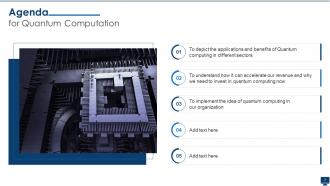
Slide 2: This slide states Agenda of the presentation.
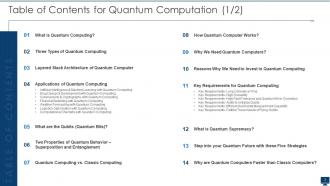
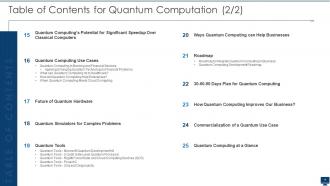
Slide 3: This slide presents Table of Content for the presentation.
Slide 4: This is another slide continuing Table of Content for the presentation.
Slide 5: This slide highlights title for topics that are to be covered next in the template.
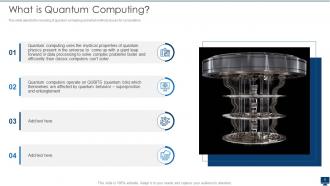
Slide 6: This slide depicts the meaning of quantum computing and what methods it uses for computation.
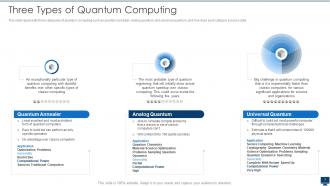
Slide 7: This slide represents three categories of quantum computing.
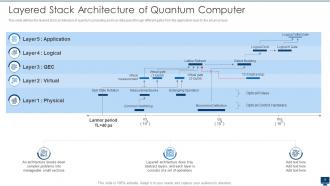
Slide 8: This slide shows Layered Stack Architecture of Quantum Computer.
Slide 9: This slide highlights title for topics that are to be covered next in the template.
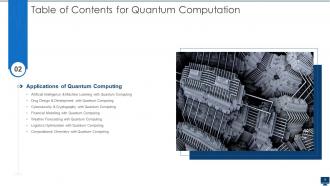
Slide 10: This slide presents Quantum computing applications in different sectors.
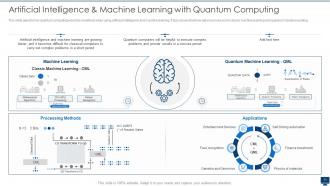
Slide 11: This slide displays how quantum computing would be beneficial when using artificial intelligence.
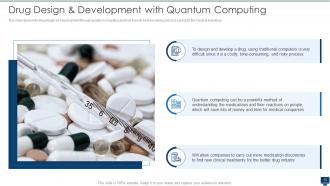
Slide 12: This slide represents Drug Design & Development with Quantum Computing.
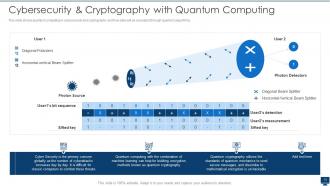
Slide 13: This slide showcases Cybersecurity & Cryptography with Quantum Computing.
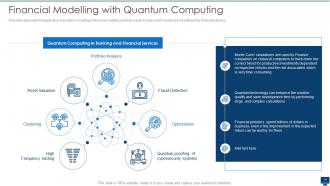
Slide 14: This slide shows Financial Modelling with Quantum Computing.
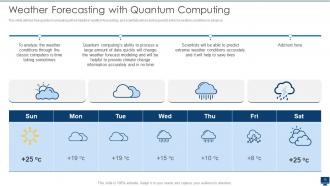
Slide 15: This slide presents Weather Forecasting with Quantum Computing.
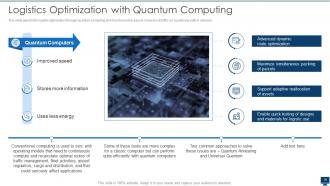
Slide 16: This slide displays Logistics Optimization with Quantum Computing.
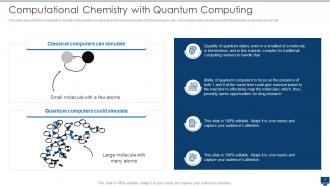
Slide 17: This slide represents Computational Chemistry with Quantum Computing.
Slide 18: This slide highlights title for topics that are to be covered next in the template.
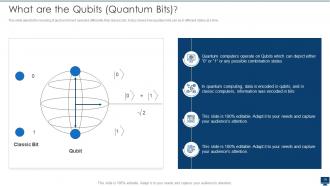
Slide 19: This slide depicts the meaning of qubit and how it operates differently than classic bits.
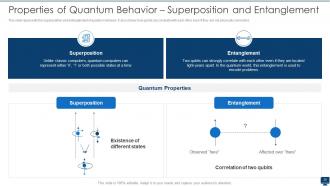
Slide 20: This slide represents the superposition and entanglement of quantum behavior.
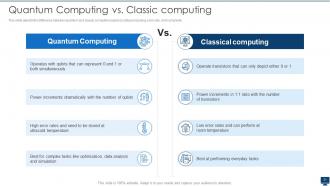
Slide 21: This slide showcases difference between quantum and classic computers.
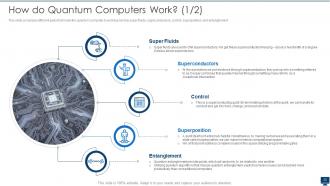
Slide 22: This slide comprises different parts that make the quantum computer working.
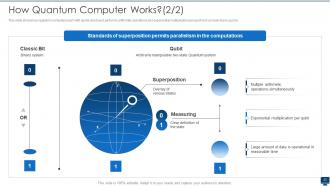
Slide 23: This slide shows how quantum computers work with qubits.
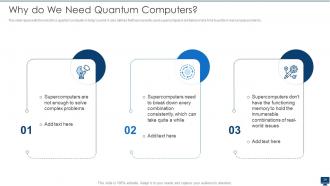
Slide 24: This slide presents need for a quantum computer in today’s world.
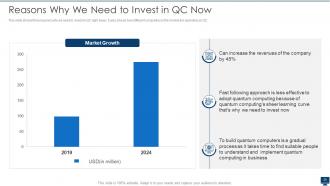
Slide 25: This slide displays Reasons Why We Need to Invest in QC Now.
Slide 26: This slide highlights title for topics that are to be covered next in the template.
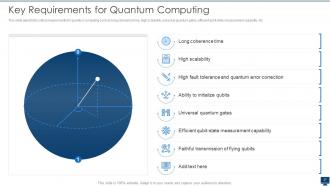
Slide 27: This slide represents Key Requirements for Quantum Computing.
Slide 28: This slide defines the long coherence time under essential requirements of quantum computing.
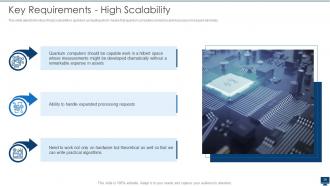
Slide 29: This slide depicts the idea of high scalability in quantum computing.
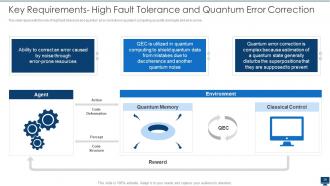
Slide 30: This slide represents the role of high fault tolerance and quantum error correction in quantum computing.
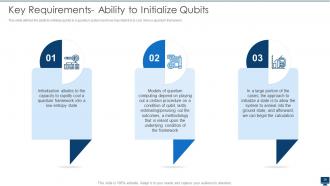
Slide 31: This slide defines the ability to initialize qubits in a quantum system.
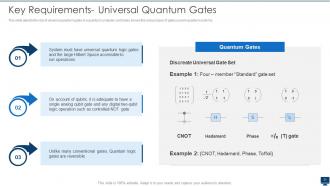
Slide 32: This slide depicts the role of universal quantum gates in a quantum computer.
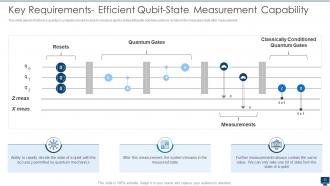
Slide 33: This slide represents how a quantum computer should be able to measure qubit’s states efficiently.
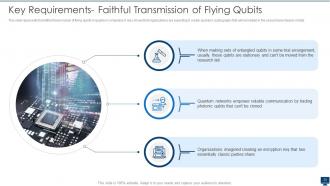
Slide 34: This slide showcases the faithful transmission of flying qubits in quantum computers.
Slide 35: This slide highlights title for topics that are to be covered next in the template.
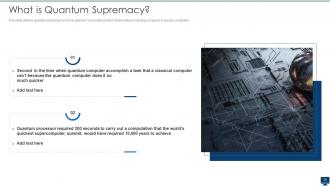
Slide 36: This slide defines quantum supremacy and how quantum computers perform faster data processing.
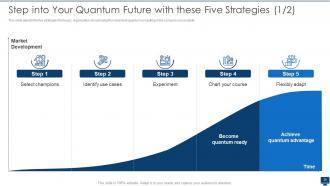
Slide 37: This slide shows five strategies that every organization should adopt to implement quantum computing.
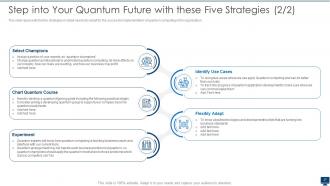
Slide 38: This is another slide continuing five strategies in detail needed to adopt for the successful implementation of quantum computing.
Slide 39: This slide highlights title for topics that are to be covered next in the template.
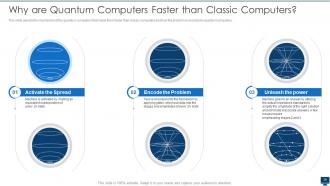
Slide 40: This slide depicts the mechanism of the quantum computers that made them faster than classic computers.
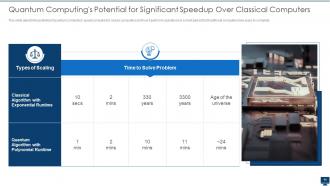
Slide 41: This slide represents potential of quantum computers’ speed compared to classic computers.
Slide 42: This slide highlights title for topics that are to be covered next in the template.
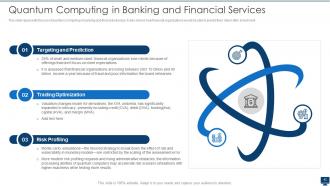
Slide 43: This slide showcases Quantum Computing in Banking and Financial Services.
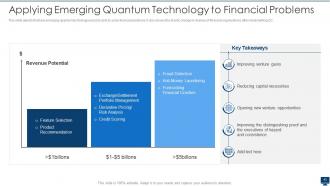
Slide 44: This slide depicts that how emerging quantum technology would be able to solve financial problems.
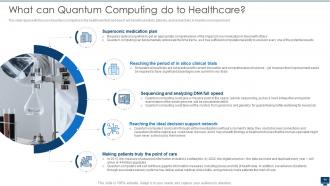
Slide 45: This slide represents the use of quantum computers in the healthcare field.
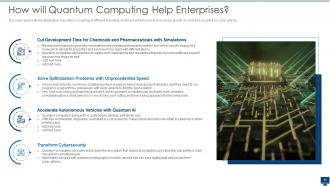
Slide 46: This slide showcases application of quantum computing in different industries.
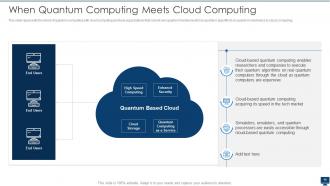
Slide 47: This slide shows When Quantum Computing Meets Cloud Computing.
Slide 48: This slide highlights title for topics that are to be covered next in the template.
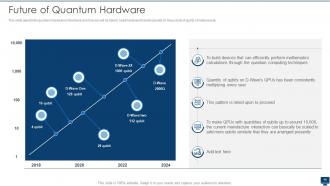
Slide 49: This slide displays Future of Quantum Hardware.
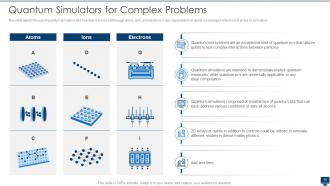
Slide 50: This slide showcases Quantum Simulators for Complex Problems.
Slide 51: This slide highlights title for topics that are to be covered next in the template.
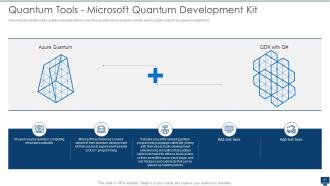
Slide 52: This slide shows Microsoft’s quantum development kit.
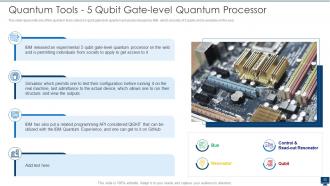
Slide 53: This slide presents quantum tools called a 5-qubit gate level quantum processor released by IBM.
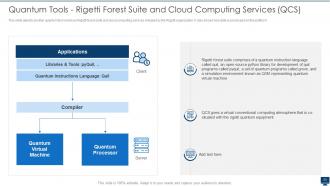
Slide 54: This slide depicts another quantum tool known as Rigetti forest suite.
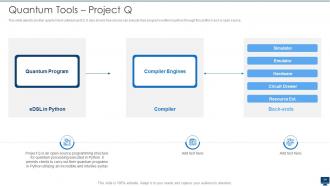
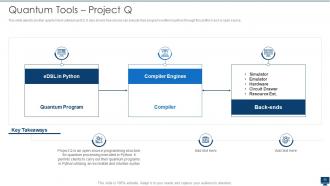
Slide 55: This slide displays another quantum tool called project Q.
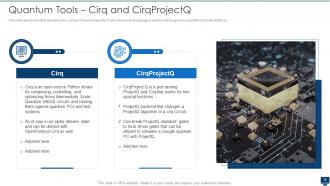
Slide 56: This slide represents two other quantum tools, namely Cirq and CirqprojectQ.
Slide 57: This slide highlights title for topics that are to be covered next in the template.
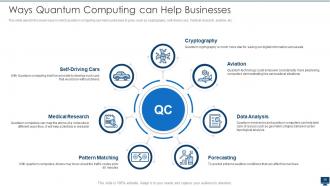
Slide 58: This slide shows Ways Quantum Computing can Help Businesses.
Slide 59: This slide highlights title for topics that are to be covered next in the template.
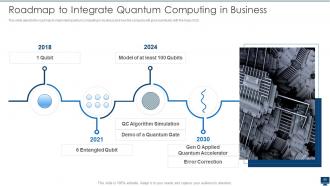
Slide 60: This slide presents Roadmap to Integrate Quantum Computing in Business.
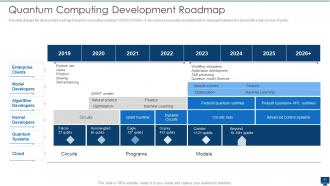
Slide 61: This slide displays Quantum Computing Development Roadmap.
Slide 62: This slide provides 30 60 90 Days Plan with text boxes.
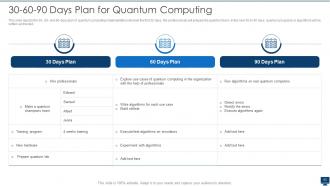
Slide 63: This slide shows 30-60-90 Days Plan for Quantum Computing.
Slide 64: This slide highlights title for topics that are to be covered next in the template.
Slide 65: This slide depicts the expected improvement in the organization after implementing quantum computing.
Slide 66: This slide highlights title for topics that are to be covered next in the template.
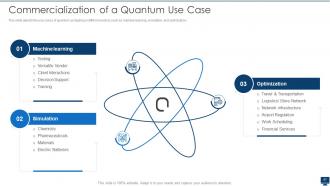
Slide 67: This slide represents the use cases of quantum computing in different sectors.
Slide 68: This slide highlights title for topics that are to be covered next in the template.
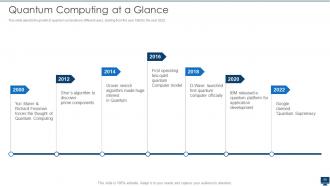
Slide 69: This slide depicts the growth of quantum computers in different years.
Slide 70: This slide displays Icons for Quantum Computation.
Slide 71: This slide is titled as Additional Slides for moving forward.
Slide 72: This is Our Goal slide. State your firm's goals here.
Slide 73: This slide shows Post It Notes. Post your important notes here.
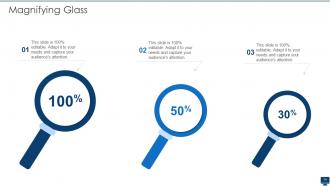
Slide 74: This slide showcases Magnifying Glass to highlight information, specifications, etc.
Slide 75: This slide provides 30 60 90 Days Plan with text boxes.
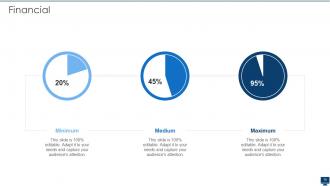
Slide 76: This is a Financial slide. Show your finance related stuff here.
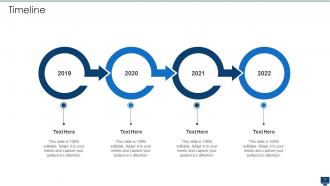
Slide 77: This is a Timeline slide. Show data related to time intervals here.
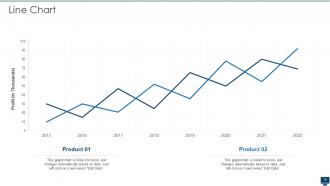
Slide 78: This slide describes Line chart with two products comparison.
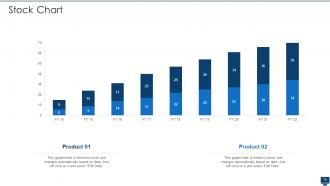
Slide 79: This slide presents Stock chart with two products comparison.
Slide 80: This is a Thank You slide with address, contact numbers and email address.
Quantum Computation Powerpoint Presentation Slides with all 85 slides:
Use our Quantum Computation Powerpoint Presentation Slides to effectively help you save your valuable time. They are readymade to fit into any presentation structure.







FAQs for Quantum Computation
So regular computers use bits that are either 0 or 1, right? Quantum computers use qubits that can somehow be both 0 AND 1 at the same time - it's called superposition and honestly still blows my mind. They can also "entangle" qubits so they're weirdly connected, plus do this interference thing that boosts right answers while killing wrong ones. What this means: they could potentially solve certain problems way faster than today's computers. Worth thinking about where you're hitting computational walls that might benefit from this stuff down the road.
So basically, regular computer bits are either 0 or 1, right? But qubits can be both at the same time - it's called superposition. Sounds trippy but it means quantum computers can test tons of solutions simultaneously instead of going one by one. There's also this weird thing called entanglement where qubits get linked and affect each other instantly, even across huge distances. Honestly blows my mind every time I think about it. These tricks make quantum computers insanely powerful for stuff like breaking codes, optimization problems, and drug research. Your MacBook isn't going anywhere though - they're only good for very specific tasks right now.
Okay so superposition is basically when qubits can be in multiple states at once - like 0 AND 1 simultaneously instead of just one or the other like regular bits. It's the whole reason quantum computers are so powerful. Think about it - while your laptop crunches through calculations one by one, quantum computers can explore tons of solution paths at the same time. That's where the crazy speed boost comes from. I still find it kind of mind-bending honestly. But yeah, if you're diving into quantum computing, nail down superposition first. Everything else you'll learn builds on that concept.
Ok so entanglement is basically when quantum particles get weird and connected - measure one and you instantly change the other, even if they're super far apart. Einstein called it "spooky action at a distance" which honestly is a perfect description. With quantum computers, you can use this to create way more computational power. Your qubits can represent tons of different states at once across the whole system. That's how algorithms like Shor's work so well for factoring - they're exploring exponentially more solution paths than regular computers ever could. Instead of just individual operations, you're coordinating this crazy collective behavior.
Drug discovery and financial modeling are the big ones right now. IBM and Google are going hard on optimization stuff - supply chain logistics, portfolio management, that kind of thing. Pharma companies are super excited about simulating molecules since quantum naturally handles that quantum-level weirdness. Oh, and cryptography is massive because these computers could theoretically crack current encryption someday (scary thought). Most of it's still experimental though. If you're thinking career-wise, I'd probably look at optimization problems first - seems like that's where we'll actually see results before everything else.
So basically your qubits are super fragile and lose their quantum weirdness crazy fast - we're talking microseconds here. Any tiny disturbance kills the computation. Heat, vibrations, random electromagnetic stuff, whatever. That's why they need those insane cooling setups (liquid helium is expensive btw). You'll need error correction built in because these things mess up constantly. The trick is catching errors before they spread everywhere and wreck your whole algorithm. Honestly the sensitivity is annoying but you just gotta work around it. Always design with decoherence limits in mind.
So quantum gates are like the building blocks for quantum algorithms - they mess with qubits the same way classical gates handle regular bits. The crazy part? Classical gates just flip between 0 and 1, but quantum gates can put qubits in superposition (both states at once) and create entanglement. That's honestly where all the quantum magic happens for solving certain problems. Also, classical gates throw away information, but quantum ones are reversible. If you're getting into this stuff, definitely start with the basics like X, H, and CNOT gates first.
So quantum computers can basically explore tons of solution paths at once instead of going through them one by one. It's like walking through every maze path simultaneously - honestly still blows my mind how that works. This gives crazy speedups for stuff like breaking encryption (Shor's algorithm) or searching databases (Grover's). But here's the catch - it only helps with certain types of problems, not everything. Short sentences work better sometimes. If you're doing optimization or crypto work though, definitely worth checking if quantum approaches could help your specific situation.
So you've got a few main options here. Qiskit is IBM's thing - Python-based and probably where I'd start since the docs are solid and you can run stuff on actual IBM quantum computers. Google has Cirq, also Python. Then there's Microsoft's Q
-
Amazing product with appealing content and design.
-
I'm happy to discover your PowerPoint presentations and templates. They met my expectations precisely. Very innovative!