

Quantum computing vs classic computing quantum computing it ppt powerpoint file




Try Before you Buy Download Free Sample Product
 Impress Your
 Audience
 100%
100% Editable
 Save Hours
 of Time


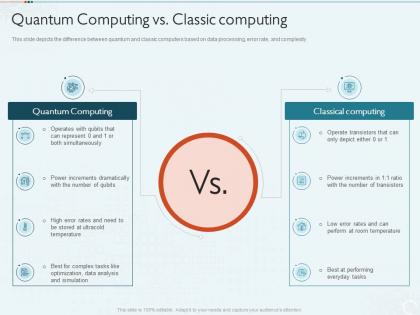
This slide depicts the difference between quantum and classic computers based on data processing, error rate, and complexity.
People who downloaded this PowerPoint presentation also viewed the following :
Quantum computing vs classic computing quantum computing it ppt powerpoint file with all 2 slides:
Use our Quantum Computing Vs Classic Computing Quantum Computing IT Ppt Powerpoint File to effectively help you save your valuable time. They are readymade to fit into any presentation structure.
FAQs for Quantum computing vs classic computing quantum computing it
So basically, regular computer bits are just 0 or 1, right? But qubits can be both at the same time - it's called superposition and yeah, it's weird as hell when you first wrap your head around it. This lets quantum computers process way more info in parallel than regular ones. There's also this thing called entanglement where qubits get linked together in ways normal bits can't. Honestly, the whole field moves so fast I can barely keep up sometimes. You should check out IBM's quantum simulator though - you can mess around with actual quantum circuits yourself.
So qubits are like regular computer bits but on steroids. Normal bits are either 0 or 1, that's it. But qubits can be both at the same time until you actually look at them - yeah, it's weird quantum physics stuff. This means quantum computers can crunch through tons of possibilities all at once instead of one by one. They also get "entangled" which sounds made up but basically links them together for crazy processing power. Oh and here's the thing - more qubits doesn't automatically mean better performance. Quality matters way more than just cramming in numbers.
Dude, quantum computing is gonna be wild for both areas. So current encryption like RSA? Quantum computers will crack that stuff easily - kinda scary tbh. But then we'll get quantum cryptography that's basically unbreakable. The medical side is where it gets really cool though. Drug discovery will be insane - simulating protein interactions and chemical reactions that regular computers would choke on for years. We're talking about modeling stuff at the molecular level that's just impossible right now. Oh, and if your company deals with sensitive data, you should probably start looking into quantum-resistant encryption soon. Don't wait until everyone's panicking.
So quantum entanglement is this weird thing where qubits can instantly share info with each other. Measure one qubit? The others react right away - I still can't totally wrap my head around it tbh. Classical computers have to check solutions one at a time, but quantum ones explore tons of paths simultaneously because of this entanglement stuff. That's where the crazy speed comes from. If you're doing optimization work or anything with cryptography, this parallel approach could completely change your game. Way more efficient than the old step-by-step method.
Dude, quantum error rates are brutal right now. Qubits lose their properties the second they touch anything in the environment - we're talking temperatures colder than space just to keep them stable. Scaling up is where it gets really messy though. Going from 50 to thousands of qubits means you need exponentially better error correction, which honestly feels impossible some days. The control systems have to be perfect, and we're still not sure which hardware approach will actually work long-term. My advice? Don't get sucked into the hype. Focus on understanding why it's so damn hard first.
So quantum supremacy is basically when quantum computers beat regular computers at solving problems. Google hit this milestone in 2019 - their machine did some calculation in 200 seconds that would've taken a supercomputer like 10,000 years. IBM called BS on those numbers but still, pretty wild. Here's why you should care: this stuff is gonna transform cryptography, drug research, finance, AI - all of it. Right now it's mostly just proving the concept works, but real applications are coming fast. Honestly, I'd start thinking about how quantum might shake up whatever field you're in. Better to be ahead of the curve, you know?
So basically, quantum computers can try tons of solutions at the same time instead of going through them one by one like normal computers do. Shor's algorithm is insane - it can crack RSA encryption in hours when regular computers would need thousands of years. There's also Grover's algorithm that speeds up database searches by a lot. The whole thing works because of quantum weirdness like superposition and entanglement (still wraps my head around that honestly). If you're into crypto or optimization stuff, this is gonna totally change everything. Worth learning about now before it becomes mainstream.
So gate-based quantum computing is basically the full package - you can build any quantum algorithm by chaining together different gates. Pretty flexible stuff. Annealing is way more narrow, though honestly it's not bad at what it does. D-Wave uses this approach and they're solid for optimization problems where you're hunting for the lowest energy state. IBM and Google? They went the gate-based route instead. If you're just getting into quantum algorithms generally, I'd probably lean gate-based. But for specific optimization headaches, annealing might actually work better right now.
Honestly, quantum computing is going to be insane for ML training once it actually works. Right now classical computers choke on massive datasets and complex optimization - quantum could handle that stuff exponentially faster. Neural networks, pattern recognition, searching through crazy solution spaces... all that becomes way more doable. Though we're still probably 5-10 years out from anything you can actually use (maybe longer, who knows). But seriously, start learning quantum algorithms now because when this tech finally matures, it's gonna flip AI development completely upside down. You don't want to be scrambling to catch up later.
Look, quantum computing's gonna mess with encryption big time - banks, governments, personal data, all of it becomes vulnerable once these machines get powerful enough. That's terrifying if you ask me. Only rich countries and mega-corps will have access at first, so we're looking at some serious power gaps. Jobs in cybersecurity will probably take a hit too, though new ones might pop up. Honestly, your company should start prepping quantum-resistant security stuff now instead of scrambling later. I keep reading about this and it feels like we're sleepwalking into chaos.
So basically quantum error correction spreads one logical qubit across tons of physical qubits and watches for problems without actually measuring the quantum stuff directly. Qubits are super fragile - literally cosmic rays can screw them up, which is wild. The trick is measuring "syndrome" info that spots errors without killing your quantum data. Without this protection, your computation dies in microseconds from all the noise. I'd start with learning about surface codes since that's what most companies are betting on. Though honestly the whole field moves so fast it's hard to keep up sometimes.
So quantum computers are incredible at simulating how molecules actually interact - way beyond what regular computers can handle. Drug discovery could be revolutionized since you'd model how compounds bind to proteins before even making them in a lab. Same with materials science. Instead of years of trial and error, you might just run simulations to design new superconductors or whatever. Though honestly, we're still in pretty early stages. IBM and Google are pushing hard on real applications, but it'll probably be a few more years before this stuff really takes off. The potential is mind-blowing though.
So IBM, Google, and Amazon are the big names you'll hear about constantly. Google got all that attention with their "quantum supremacy" thing - though honestly, people still argue about whether it was legit. IBM's your best bet if you actually want to mess around with quantum programming since they have this free cloud platform. MIT and Oxford are doing crazy research too. There are smaller companies like Rigetti and IonQ doing interesting stuff with different approaches. Oh, and D-Wave's been around forever. Start with IBM's Qiskit tutorials - they're free and won't make your brain hurt too much.
So basically it's speed vs stability. IBM and Google's superconducting qubits are crazy fast - perfect for getting quantum advantage soon on specific problems. But they're fragile as hell and need those insane cooling systems. Trapped ions? Totally different story. Way more stable, better coherence times, higher gate fidelities. They're honestly like the tortoise in this race. Problem is they're slower and scaling them up is a nightmare right now. If I had to pick? Superconducting will probably hit the headlines first with breakthrough demos. But trapped ions might actually win the long game for real fault-tolerant computers. Wild how different the approaches are.
You'll want to nail down linear algebra and complex numbers first - quantum states are all math-based. Python is pretty much mandatory since that's what Qiskit and most frameworks run on. Physics background helps but honestly you can learn the quantum stuff as you dive in. Probability theory matters a lot too because everything's probabilistic in quantum computing. Some basic algorithms and complexity theory from CS won't hurt either. Oh, and definitely check out IBM's free Qiskit textbook online - it's actually really well done and walks through everything without being boring.
-
Excellent design and quick turnaround.
-
Thanks for all your great templates they have saved me lots of time and accelerate my presentations. Great product, keep them up!