


Quantum computing it properties of quantum behavior superposition and entanglement ppt icon




Try Before you Buy Download Free Sample Product
 Impress Your
 Audience
 100%
100% Editable
 Save Hours
 of Time


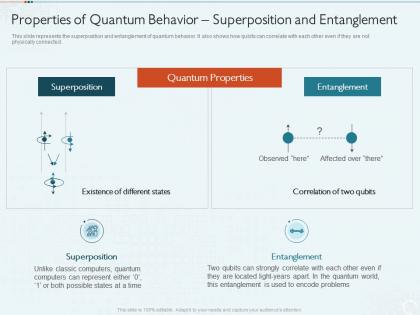
This slide represents the superposition and entanglement of quantum behavior. It also shows how qubits can correlate with each other even if they are not physically connected.
People who downloaded this PowerPoint presentation also viewed the following :
Quantum computing it properties of quantum behavior superposition and entanglement ppt icon with all 2 slides:
Use our Quantum Computing IT Properties Of Quantum Behavior Superposition And Entanglement Ppt Icon to effectively help you save your valuable time. They are readymade to fit into any presentation structure.


FAQs for Quantum computing it properties of quantum behavior superposition and
So basically, regular computers use bits that are just 0 or 1. Quantum ones? Their qubits can be both at the same time - sounds weird but that's what makes them crazy powerful. Your laptop checks solutions one by one, but quantum computers can test tons simultaneously. They're incredibly fragile though, need to stay colder than space (like why??). Classical computers handle our daily stuff perfectly fine. But quantum could solve problems that'd take regular computers literally millions of years. IBM's got online simulators you can mess around with if you want to see how they work.
So regular bits are stuck being either 0 or 1, but qubits? They can be both at the same time through this thing called superposition. Mind-bending stuff honestly. Your qubit processes multiple possibilities all at once instead of just one state. There's also this entanglement thing where qubits affect each other instantly, even from super far away - sounds like sci-fi but it's real. This is why quantum computers absolutely crush certain problems way faster than regular ones. For your projects, I'd look at optimization or crypto stuff first since that's where you'll actually see the huge speed boost over normal computing.
So basically quantum entanglement is this weird phenomenon where two particles get linked up and measuring one instantly changes the other - doesn't matter if they're on opposite sides of the universe. Einstein called it "spooky action at a distance" and honestly, that's still the best description. Here's the thing though - this is what makes quantum computers actually work. Regular computers use bits that are either 0 or 1, but entangled qubits can all talk to each other at once, which lets them crunch way more data. Without it, quantum computers would just be... well, really overpriced regular computers that don't do much.
Okay so basically superposition means qubits can be in multiple states at once - like that spinning coin analogy but way weirder. Classical bits are stuck being either 0 or 1, but qubits? They're both until you actually measure them. That's what makes quantum algorithms so crazy powerful. Take Grover's search - instead of checking database entries one by one like we're stuck doing, it checks a bunch simultaneously. I still think it's kind of wild honestly. But yeah, that's the whole point - this parallel processing thing could eventually make quantum computers insanely faster for specific problems.
Honestly, quantum computing is still pretty experimental right now. Finance companies like JPMorgan are testing it for portfolio stuff and risk analysis - basically trying to crunch huge datasets way faster. Drug discovery is another area where it might actually work since quantum systems can model molecular interactions that would take classical computers forever. Pretty cool concept. But most of this is still proof-of-concept territory, so if you want to mess around with it today you'd probably need to go through IBM or Google's cloud services. Not exactly plug-and-play yet, you know?
Okay so quantum teleportation is kinda misleading - you're not actually moving particles around. What happens is you've got these entangled qubits, and you can transfer the quantum state from one to another. You measure one qubit along with whatever data you want to send, then use those results to recreate the original state on the distant qubit. Wild concept, honestly. The catch? You still need regular communication to make it work. But here's the cool part - it'd create insanely secure networks because if anyone tries to peek at the quantum data, they'd destroy it just by measuring. So you'd know immediately if someone's snooping.
Honestly, the main issue is that qubits are ridiculously fragile - they lose their quantum magic the second anything disturbs them. Error rates are brutal right now. You'll need like thousands of physical qubits just to get one that actually works reliably, which is pretty insane if you think about it. Keeping everything at near absolute zero gets way harder as you scale up too. The connectivity thing is annoying since qubits can't all talk to each other directly. When you're looking at quantum tech, don't get fooled by flashy qubit numbers - coherence times and error rates matter way more.
So quantum algorithms are pretty crazy - they use superposition and entanglement to check tons of possibilities at the same time. Shor's algorithm can crack RSA encryption that would take regular computers like thousands of years to break. Grover's lets you search databases way faster too, only needing to check the square root of entries instead of everything. I still can't totally wrap my head around how that works tbh. But yeah, once we get reliable quantum computers, a lot of optimization problems you're dealing with could become stupidly easy to solve.
So basically qubits are super delicate and fall apart crazy fast from any little disturbance. Think of it like trying to keep a soap bubble intact during an earthquake - that's what you're dealing with. Error correction works by using bunches of physical qubits to make one "logical" qubit, so there's backup when things go wrong. Without this stuff, your quantum computer just turns into expensive random noise in microseconds. Honestly, if you're getting into this field, figure out your platform's error rates first - that'll save you headaches later. The whole thing is basically a constant battle against physics trying to mess up your computation.
Honestly, quantum computers are gonna mess up current encryption like RSA in the next 10-20 years. Your passwords are safe for now though - we don't have the fault-tolerant quantum machines yet that could actually crack them. But once they show up? Today's encryption will be useless. Like putting a paper lock on Fort Knox, basically. Good thing is, crypto experts are already working on quantum-proof algorithms. You should probably start planning how to switch your systems over now. That kind of migration takes forever - we're talking years, not a few months of work.
Honestly, quantum hardware has gotten way better lately. IBM's new processors hold quantum states so much longer now - coherence times are finally decent. Google's error correction actually works in real applications, which is wild. The qubit connectivity improvements alone solved a massive bottleneck we've had forever. IonQ's trapped-ion systems are more stable too, though I still think cloud access is your best bet for trying stuff out. AWS Braket and IBM Quantum let you mess around without buying actual hardware. Worth checking out if you're curious about quantum applications.
Alright so basically there are two main types. Quantum annealers (like D-Wave) are really specialized - they're amazing at finding the lowest energy solutions for optimization stuff like scheduling or logistics. Gate-based quantum computers from IBM or Google? Those can handle pretty much any quantum algorithm you want, similar to how regular computers use logic gates. Annealers are way more limited but honestly they might be more useful right now for actual problems. Gate-based ones are super versatile but scaling them up is a nightmare. If you're dealing with optimization problems, I'd definitely check if an annealer could work first.
Dude, the security stuff keeps me up at night sometimes. Quantum computers could crack all our current encryption - bank accounts, medical records, everything we think is private right now. Then there's the inequality angle, which is huge. Only rich countries and mega-corps will have this tech at first, so they'll basically have superpowers while everyone else is stuck with regular computers. Pretty wild gap, right? Your company should definitely start looking into quantum-resistant encryption now though. Don't wait until hackers are already using quantum machines to break into stuff.
Schools really should be adding quantum stuff to their CS and physics programs right now. Most students have zero clue these jobs even exist! They need to teach quantum algorithms and programming languages like Qiskit. Math departments should push linear algebra and probability harder - that's your foundation right there. Cross-disciplinary programs work best, mixing physics with CS and engineering. Honestly, partnering with IBM, Google, or local quantum startups is huge for internships. Error correction is another big one. Reach out and ask what skills they're actually looking for.
So the big things coming up - quantum computers that can actually solve real problems (not just Google's 2019 flex), plus fault-tolerant systems that won't crash every five minutes. IBM's pushing for 1000+ qubits by 2030, which seems crazy ambitious but hey, they've hit their targets before. We'll probably see quantum networking take off too, maybe even a "quantum internet" for super secure stuff. The real breakthrough will be when error correction actually works at scale - that's when things get interesting. Oh and definitely follow IBM's roadmap, they're pretty good about sharing timelines.
-
Informative presentations that are easily editable.
-
Perfect template with attractive color combination.
-
Best way of representation of the topic.
-
Very well designed and informative templates.
-
Top Quality presentations that are easily editable.