


Quantum Computing Vs Classic Computing Quantum Computation




Try Before you Buy Download Free Sample Product
 Impress Your
 Audience
 100%
100% Editable
 Save Hours
 of Time


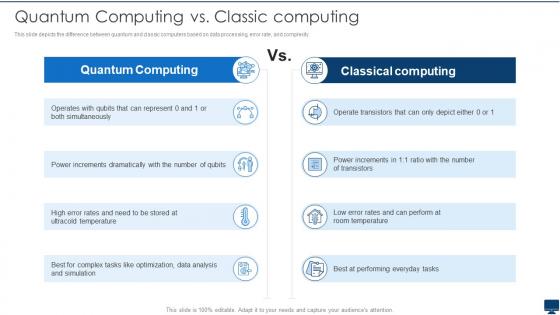
This slide depicts the difference between quantum and classic computers based on data processing, error rate, and complexity.
People who downloaded this PowerPoint presentation also viewed the following :
Quantum Computing Vs Classic Computing Quantum Computation with all 6 slides:
Use our Quantum Computing Vs Classic Computing Quantum Computation to effectively help you save your valuable time. They are readymade to fit into any presentation structure.






FAQs for Quantum Computing Vs Classic
So basically, regular computers use bits that are either 0 or 1 - pretty straightforward. Quantum computers? They use qubits that can be both at the same time through this weird thing called superposition. It's like they're exploring tons of possibilities simultaneously instead of going step by step. Then there's entanglement where qubits get mysteriously linked together. Einstein called it "spooky action at a distance" which honestly cracks me up every time. They also use quantum interference to boost the right answers. The crazy part is this could solve certain problems way faster than any normal computer ever could.
So qubits are like regular bits but way weirder - they can be 0 AND 1 at the same time through this thing called superposition. That's what makes quantum computers so crazy powerful, you're processing tons of possibilities all at once. The annoying part? They're super fragile and collapse the moment you try to measure them. Quantum algorithms work by using special gates to mess with these qubits, letting you explore multiple solution paths simultaneously. Then you measure and hope you get something useful lol. They're honestly best for problems where you need to search through massive amounts of data - that's where they absolutely destroy regular computers.
Okay so quantum bits can be both 0 and 1 at the same time - weird right? That's superposition. Regular computers check each possibility one by one, but quantum ones explore multiple solutions simultaneously. Each qubit you add doubles the processing power, which gets insane pretty quickly. That's honestly why tech companies are throwing billions at this stuff. Once you measure the qubit though, it "collapses" into just one state. The whole thing feels like sci-fi but the math actually works.
So quantum entanglement is basically when two particles get weirdly connected - measure one and it instantly messes with the other, even across huge distances. Pretty wild, right? But here's the catch: you can't actually send messages faster than light (I know, disappointing). The real magic happens in quantum computing though. Entangled qubits can create these crazy correlations that regular computer bits just can't do. That's what lets quantum algorithms solve certain problems way faster than normal computers. Think of it like having this insane parallel processing setup that classical systems can't touch.
Honestly, the error rates are killer right now. These qubits are so damn sensitive - literally any tiny vibration or temperature shift screws everything up. Picture trying to balance spinning coins while someone's bouncing the table around you. Adding more qubits? The errors just stack up exponentially, which is a nightmare. Oh, and everything has to run colder than space, so we're talking serious money and complexity. I'd say if you're looking into this field, error correction is where the real action is. That's the bottleneck we've gotta crack first.
So basically, Shor's algorithm can crack encryption by factoring huge numbers way faster than anything we have now - which is pretty scary if you think about it. Grover's is different though, it speeds up database searches from O(N) to O(√N). Both use quantum weirdness like superposition to get these crazy speedups. The thing is, they're super specialized - only work for certain problems, not everything. But honestly? If you're doing anything with crypto or optimization, you should probably start paying attention to this stuff now because it's going to flip those entire fields upside down.
So quantum error correction is honestly what's gonna make or break quantum computing. Your qubits are super fragile - environmental noise constantly screws them up. It's like autocorrect for quantum states, except way more complicated because just measuring a qubit changes it (quantum physics is wild like that). Scientists have to use these sneaky indirect methods to catch errors without destroying the data. Still pretty experimental right now, but once we figure out efficient error correction? That's when quantum computers will actually be reliable enough for real-world stuff you'd trust.
Look, quantum computers are gonna completely wreck current encryption - like, most of it will be useless. Companies are already scrambling to build quantum-resistant security systems. But honestly? The pharmaceutical stuff is way cooler. These machines can simulate molecular interactions that regular computers can't even touch. Drug discovery could go from 10+ years down to maybe 2-3 years, which is insane. They'll be able to model how specific drugs work with your individual genetic makeup too. My cousin works in biotech and she's losing her mind over the possibilities. Just heads up - whatever industry you're in, the encryption changes are coming fast.
Dude, the quantum stuff is actually getting really good lately. IBM just dropped their Condor chip with 1000+ qubits, which is wild. Error rates have improved by like orders of magnitude compared to a few years back. Google's making serious progress on error correction too. The processors stay coherent way longer now, so you can actually run decent algorithms without everything crashing immediately. IonQ's trapped-ion systems are super stable these days. Honestly, if you're curious about quantum for your projects, might be worth messing around with the cloud platforms now. Way better timing than before.
So basically you've gotta isolate those qubits from any environmental crap - super cold temps, vacuum chambers, the whole shebang. Error correction is massive too. You're encoding logical qubits across multiple physical ones to catch mistakes before they wreck everything. Dynamical decoupling helps as well - it's like hitting pause on the decoherence with pulse sequences. Honestly feels like fighting the universe sometimes lol. But yeah, keep your gate operations fast and get real-time error correction running. Speed's everything here, plus you need that constant monitoring going.
Quantum computing's biggest issue is honestly the security nightmare it'll create. Current encryption becomes useless overnight - your bank info, government secrets, everything's vulnerable. Then there's the whole power imbalance thing where whoever gets there first basically wins the internet. Job losses too since these machines can solve crazy complex problems humans do now. I keep forgetting how fast this is all moving tbh. You should probably look into post-quantum cryptography stuff because our current security is gonna be toast soon.
Yeah, Google hit quantum supremacy back in 2019 with their Sycamore chip. It crushed some random problem in 200 seconds that would've taken regular computers thousands of years. IBM threw shade at the claim (shocking, I know), but most people accept it happened. Don't get too excited though - this doesn't mean quantum computers are suddenly amazing at everything. They just proved they could beat classical computers at one specific task, even if it was pretty useless. It's more like a proof of concept. We're still years out from anything that'll actually change how you work day-to-day.
Honestly, quantum computing could be huge for AI training - think cutting those week-long neural network sessions down to hours, maybe less. The whole "processing multiple possibilities at once" thing is perfect for optimization problems that make regular computers chug along painfully slow. Pattern recognition, massive dataset searches - that's where it'll really shine. Though I'm probably getting ahead of myself here since we're still pretty early in the game. Your GPU setup isn't going obsolete tomorrow, but those hybrid quantum-classical systems starting to pop up? Worth watching for sure.
So basically it's all about the cooling system - these things need to stay at almost absolute zero temps, which means running massive industrial freezers nonstop. That's where most of the energy waste happens. There's also the rare materials they need, but honestly that's nothing compared to the electricity bill. Oh and all the regular computers and infrastructure around it too. I mean, if quantum computing actually works out for climate stuff like they're promising, it might be worth the trade-off? But yeah, right now they're pretty energy-hungry beasts.
So basically, quantum networks work by linking particles together - when you mess with one, its partner instantly reacts no matter how far apart they are. Pretty wild stuff. The cool thing is that if anyone tries to spy on the signal, it automatically scrambles the quantum state, so you'd know right away someone's snooping. Makes it impossible to hack without getting caught. IBM and Google are working on this tech, though we're still years out from mainstream use. Honestly worth watching quantum key distribution developments if you're planning ahead security-wise.
-
Really like the color and design of the presentation.
-
Unique and attractive product design.