


Data science it powerpoint presentation slides




Try Before you Buy Download Free Sample Product
 Impress Your
 Audience
 100%
100% Editable
 Save Hours
 of Time


Data science is an area of study that combines domain experience, computer abilities, and mathematical and statistical understanding to extract valuable insights from data. Grab our insightfully designed Data Science IT template that will be of great assistance for companies to present an overview of their current scenario and assess the need for data science adoption. Further, this data science module showcases the gap analysis of the company and the introduction of data science. In addition, it contains information on the requirements of the data science adoption, life cycle and phases of data science, and critical components of the data science. Furthermore, this data mining template includes the data science tools such as SAS, Apache Spark, Excel, Tableau, NLP, and TensorFlow, along with this role of data science in decision making. Moreover, this module highlights the difference between data science and other tools, data science workflow, job roles in data science, and top data science applications such as healthcare, logistic, finance, airlines, and business. Lastly, our template comprises a checklist, a timeline, a roadmap, a 30-60-90-day plan, a dashboard, and impacts of the data science integration on the organization. Get access to the data science ppt templates now.
People who downloaded this PowerPoint presentation also viewed the following :
Content of this Powerpoint Presentation
Slide 1: This slide introduces Data Science. State Your Company Name and begin.
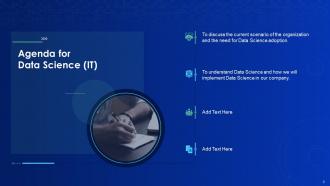
Slide 2: This is an Agenda slide. State your agendas here.
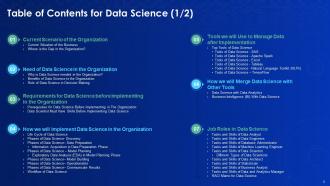
Slide 3: This slide shows Table of Content for the presentation.
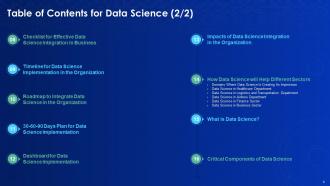
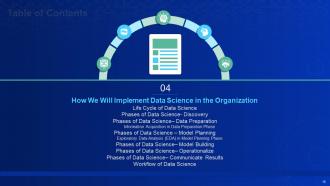
Slide 4: This is another slide continuing Table of Content for the presentation.
Slide 5: This is another slide continuing Table of Content for the presentation.
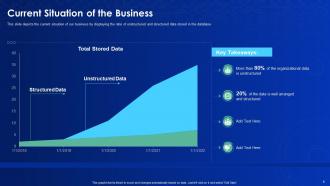
Slide 6: This slide presents current situation of our business by displaying the ratio of unstructured and structured data stored in the database.
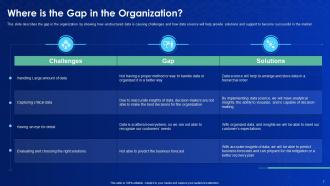
Slide 7: This slide shows how unstructured data is causing challenges and how data science will help provide solutions.
Slide 8: This slide displays Table of Content for the presentation.
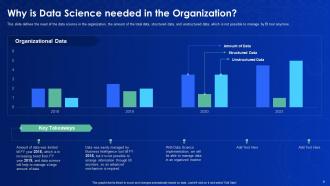
Slide 9: This slide represents the need of the data science in the organization.
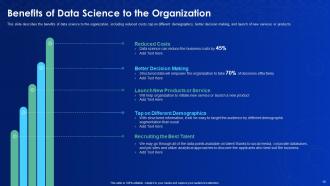
Slide 10: This slide shows Benefits of Data Science to the Organization.
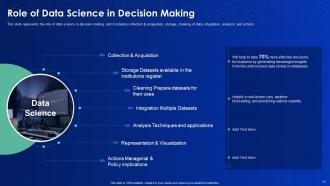
Slide 11: This slide presents the role of data science in decision making, and it includes collection & acquisition, storage, cleaning of data, etc.
Slide 12: This slide shows Table of Content for the presentation.
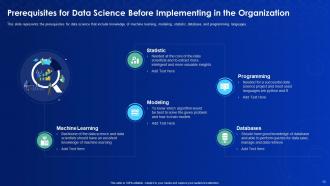
Slide 13: This slide displays the prerequisites for data science that include knowledge of machine learning, modeling, statistic, database, and programming languages.
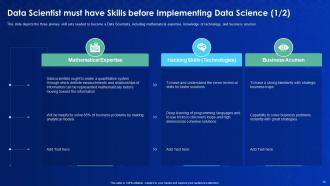
Slide 14: This slide represents Data Scientist Must Have Skills Before Implementing Data Science.
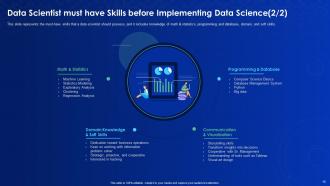
Slide 15: This is another slide showing Data Scientist must have Skills before Implementing Data Science.
Slide 16: This slide presents Table of Content for the presentation.
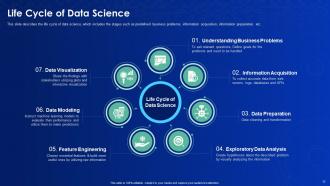
Slide 17: This slide describes the life cycle of data science, which includes the stages such as predefined business problems, information acquisition, etc.
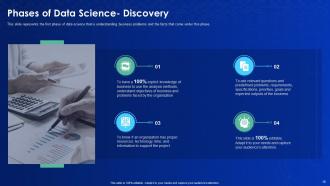
Slide 18: This slide displays the first phase of data science that is understanding business problems and the facts that come under this phase.
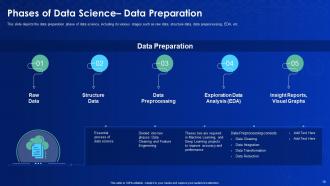
Slide 19: This slide represents the data preparation phase of data science, including its various stages such as raw data, structure data, data preprocessing, EDA, etc.
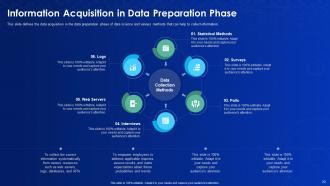
Slide 20: This slide shows Information Acquisition in Data Preparation Phase.
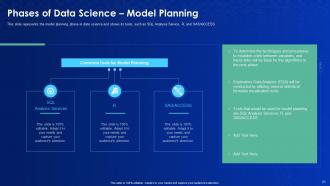
Slide 21: This slide presents model planning phase in data science and shows its tools, such as SQL Analysis Service, R, and SAS/ACCESS.
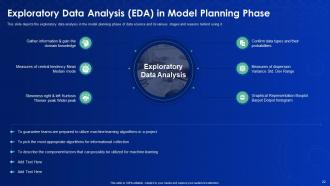
Slide 22: This slide shows exploratory data analysis in the model planning phase of data science and its various stages and reasons.
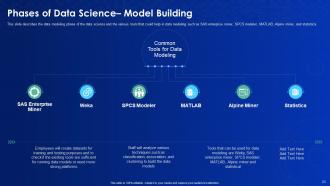
Slide 23: This slide displays various tools that could help in data modeling such as SAS enterprise miner, SPCS modeler, MATLAB, etc.
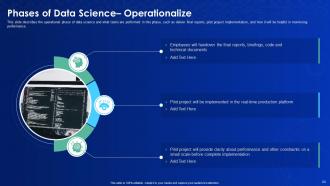
Slide 24: This slide represents operational phase of data science and what tasks are performed in this phase.
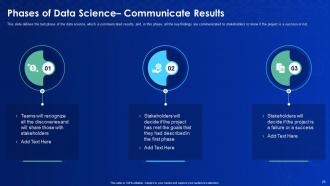
Slide 25: This slide shows last phase of the data science and in this phase, all the key findings are communicated to stakeholders.
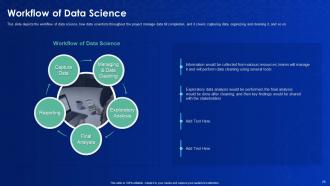
Slide 26: This slide presents how data scientists throughout the project manage data till completion.
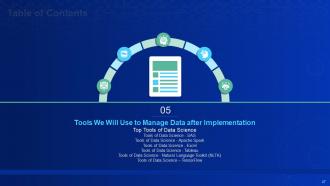
Slide 27: This slide shows Table of Content for the presentation.
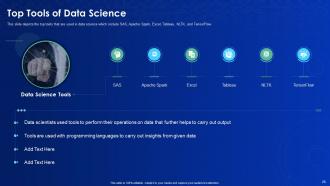
Slide 28: This slide displays top tools that are used in data science which include SAS, Apache Spark, Excel, etc.
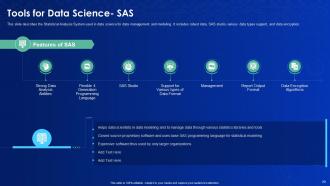
Slide 29: This slide represents Statistical Analysis System used in data science for data management and modeling.
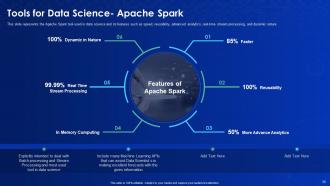
Slide 30: This slide shows Apache Spark tool used in data science and its features such as speed, reusability, advanced analytics, etc.
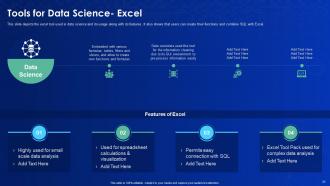
Slide 31: This slide presents excel tool used in data science and its usage along with its features.
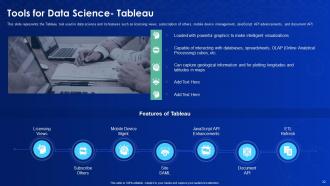
Slide 32: This slide shows tool used in data science and its features such as licensing views, subscription of others, etc.
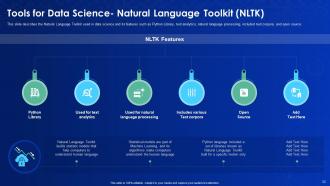
Slide 33: This slide displays Tools for Data Science- Natural Language Toolkit (NLTK).
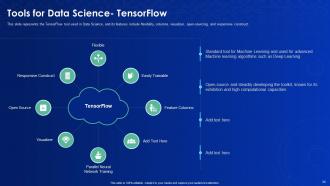
Slide 34: This slide represents TensorFlow tool used in Data Science, and its features include flexibility, columns, visualizer, etc.
Slide 35: This slide shows Table of Content for the presentation.
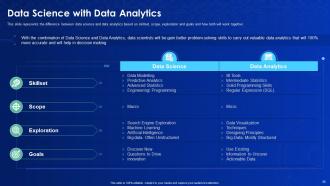
Slide 36: This slide presents difference between data science and data analytics based on skillset, scope, exploration and goals.
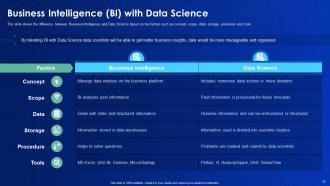
Slide 37: This slide shows difference between Business Intelligence and Data Science based on the factors such as concept, scope, data, etc.
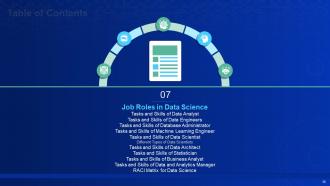
Slide 38: This slide displays Table of Content for the presentation.
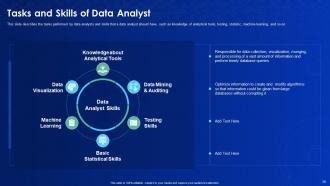
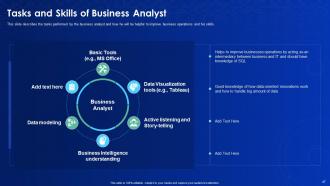
Slide 39: This slide represents tasks performed by the business analyst and how he will be helpful to improve business operations.
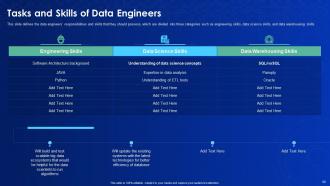
Slide 40: This slide shows data engineers’ responsibilities and skills that they should possess.
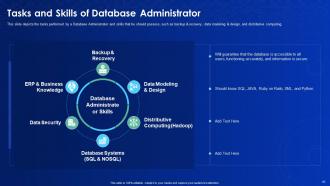
Slide 41: This slide presents tasks performed by a Database Administrator and skills that he should possess.
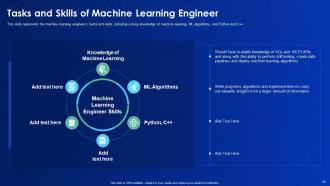
Slide 42: This slide shows machine learning engineer’s tasks and skills, including a deep knowledge of machine learning, ML algorithms, and Python and C++.
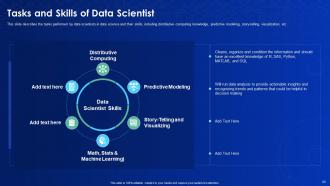
Slide 43: This slide displays the tasks performed by data scientists in data science and their skills.
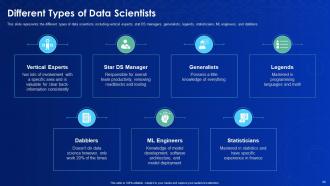
Slide 44: This slide represents the different types of data scientists, including vertical experts, stat DS managers, generalists, etc.
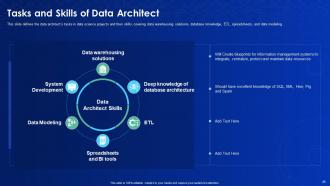
Slide 45: This slide shows data architect’s tasks in data science projects and their skills.
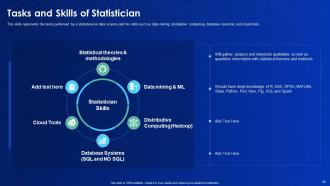
Slide 46: This slide presents tasks performed by a statistician in data science and his skills such as data mining, distributive computing, etc.
Slide 47: This slide shows tasks performed by the business analyst and how he will be helpful to improve business operations.
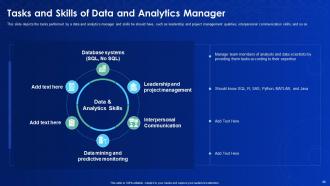
Slide 48: This slide displays tasks performed by a data and analytics manager and skills he should have.
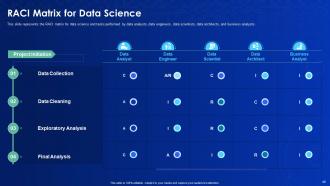
Slide 49: This slide represents RACI matrix for data science and tasks performed by data analysts, data engineers, data scientists, etc.
Slide 50: This slide shows Table of Content highlighting Checklist for Effective Data Science Integration in Business.
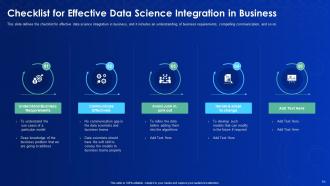
Slide 51: This slide presents Checklist for Effective Data Science Integration in Business.
Slide 52: This slide shows Table of Content highlighting Timeline for Data Science Implementation in the Organization.
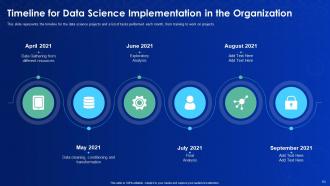
Slide 53: This slide displays Table of Content highlighting Timeline for Data Science Implementation in the Organization.
Slide 54: This slide represents Table of Content highlighting Roadmap to Integrate Data Science in the Organization.
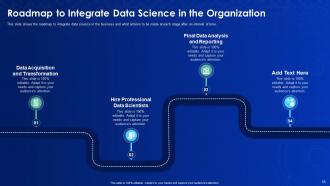
Slide 55: This slide shows Roadmap to Integrate Data Science in the Organization.
Slide 56: This slide presents Table of Content highlighting 30-60-90 Days Plan for Data Science Implementation.
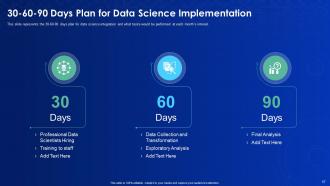
Slide 57: This slide shows 30-60-90 Days Plan for Data Science Implementation.
Slide 58: This slide displays Dashboard for Data Science Implementation.
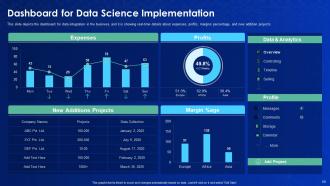
Slide 59: This slide represents dashboard for data integration in the business, and it is showing real-time details about expenses, profits, margins percentage, etc.
Slide 60: This slide shows Table of Content highlighting Impacts of Data Science Integration in the Organization.
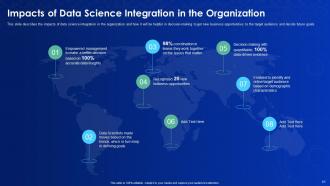
Slide 61: This slide presents Impacts of Data Science Integration in the Organization.
Slide 62: This slide shows Table of Content for the presentation.
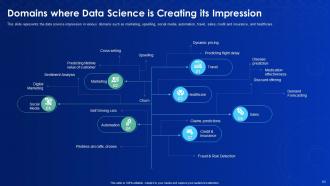
Slide 63: This slide displays Domains where Data Science is Creating its Impression.
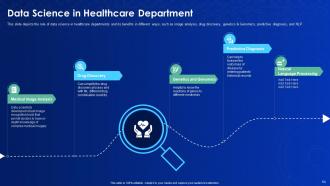
Slide 64: This slide represents data science in healthcare departments and its benefits in different ways.
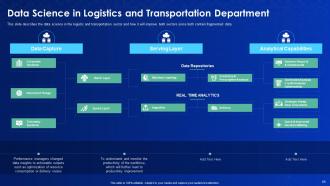
Slide 65: This slide shows Data Science in Logistics and Transportation Department.
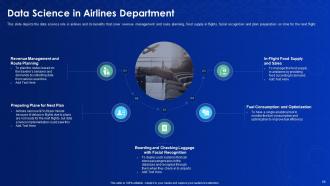
Slide 66: This slide presents data science role in airlines and its benefits that cover revenue management and route planning.
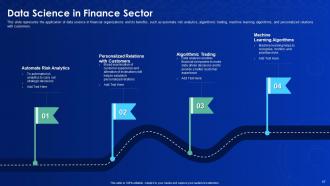
Slide 67: This slide shows application of data science in financial organizations and its benefits.
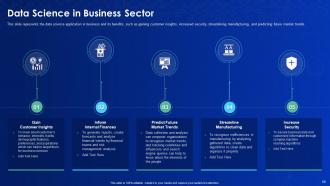
Slide 68: This slide displays the data science application in business and its benefits.
Slide 69: This slide represents Table of Content for the presentation.
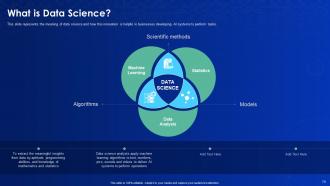
Slide 70: This slide shows the meaning of data science and how this innovation is helpful in businesses developing AI systems.
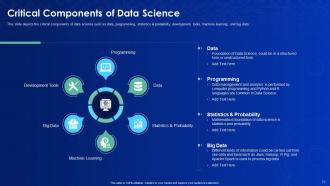
Slide 71: This slide presents critical components of data science such as data, programming, statistics & probability, etc.
Slide 72: This slide shows Icons for Mood Board for Data Science.
Slide 73: This slide is titled as Additional Slides for moving forward.
Slide 74: This is About Us slide to show company specifications etc.
Slide 75: This is Our Mission slide with related imagery and text.
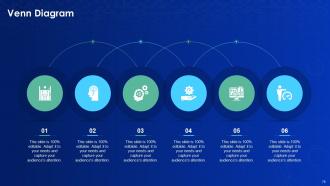
Slide 76: This slide presents Venn diagram with text boxes.
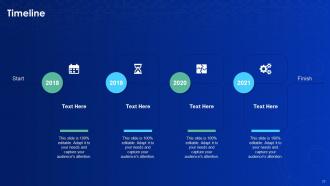
Slide 77: This is a Timeline slide. Show data related to time intervals here.
Slide 78: This is a Thank You slide with address, contact numbers and email address.
Data science it powerpoint presentation slides with all 78 slides:
Use our Data Science IT Powerpoint Presentation Slides to effectively help you save your valuable time. They are readymade to fit into any presentation structure.



FAQs for Data science it
So basically, supervised learning needs labeled training data - like you're showing the algorithm emails already marked "spam" or "not spam." It learns from those examples to classify new stuff. Unsupervised learning? Totally different. You just dump raw data in and let it find patterns you didn't even know were there. Like grouping customers by shopping habits when you have zero clue what groups might exist. Honestly, supervised is way more straightforward if you know what you're trying to predict. Go unsupervised when you're just exploring and seeing what shakes out.
Dude, feature engineering is honestly where the magic happens. I've watched models go from terrible to actually useful just because someone took time to create better features. Like, you take your raw data and transform it - maybe split timestamps into day/week components, or create interaction terms between variables. Plot everything against your target first though, that'll show you what's actually correlated. Sometimes I spend way too much time on this part but it's usually worth it. Much better than just throwing more algorithms at crappy features. Domain knowledge helps too - if you understand the problem you'll spot patterns others miss.
Dude, you NEED data visualization - trust me on this one. Raw spreadsheets are basically useless for spotting patterns. Charts make everything click instantly. I spent way too long staring at numbers before I figured this out lol. Graphs help you catch trends and weird outliers that you'd totally miss otherwise. Plus when you're presenting to your boss or whoever, visuals are way easier for non-data people to understand. Just start with basic bar charts and line graphs. You can get fancy later, but honestly simple usually works better anyway.
So basically you take your old data and use it to predict what's coming next - stuff like which customers might bail, sales patterns, inventory shortages, whatever. Way better than just guessing, right? I mean, everyone's doing this now so you kinda have to keep up. Start with really clean data though (garbage in, garbage out and all that). Pick one thing to focus on first - maybe figure out who's about to cancel their subscription. Once you nail that, you can branch out to other areas. Honestly beats flying blind on business decisions.
Oh man, privacy stuff is such a minefield but super crucial. First thing - always get consent before grabbing people's data. Strip out anything that could identify someone (anonymization) and don't collect random info you won't use. Be upfront about what you're doing with their data too. Watch out for bias in your models - they can accidentally discriminate against groups if you're not paying attention. GDPR compliance is annoying but necessary. Honestly, I'd start with auditing whatever datasets you're already using. That'll show you where the gaps are.
Figure out if you're doing classification or regression first. For smaller datasets, linear models are solid - especially when you need to explain your results later. Random Forest is my go-to for messy data though, it just handles weird stuff better. Deep learning? Skip it unless you've got massive amounts of data. Seriously seen too many people throw neural nets at tiny datasets lol. Also think about whether your features are mostly numbers or categories since some algorithms are picky. Honestly just start with logistic regression or Random Forest, then upgrade if you actually need to.
Honestly, the worst mistake is jumping straight into cleaning without actually looking at your data first. I made this error once and spent forever "fixing" outliers that were totally legit edge cases - felt pretty dumb afterward. Check distributions and weird values before you touch anything. Document everything when you remove data, and automated scripts can mess you up with hidden bias. Keep your original dataset pristine no matter what. Test on small samples first, then go bigger once you know your process works.
Oh man, real-time data processing is huge for both those industries. Finance uses it to catch fraud instantly and nail those perfect trade timings - no more finding out about disasters hours too late. Healthcare's even crazier though. Doctors get alerts the second a patient's vitals go sideways, plus immediate drug interaction warnings. Medical imaging analysis happens right away too. Honestly, when delays can cost someone their life or tank millions in losses, you'd be nuts not to prioritize this infrastructure. Time really is everything here.
So basically, the curse of dimensionality is when your data becomes super sparse as you pile on more features. Picture this: in 2D you've got decent coverage, but throw in 50 dimensions? Your data points are now floating around in this huge empty space like tiny islands. Everything starts looking the same distance apart, which totally screws with your models - they can't spot real patterns anymore. That's why I'm always obsessing over feature selection first. PCA helps too. Honestly, just plot your correlations and be ruthless about cutting the fluff before you even think about training.
So basically, traditional ML makes you do all the feature engineering yourself - like you're spoon-feeding the algorithm what to notice. Deep learning? It just figures that out automatically through multiple neural network layers, which is honestly pretty amazing when you think about it. Downside is it's hungry for data and computing power. Images, audio, text stuff? Go deep learning for sure. But if you've got nice structured data, sometimes the old-school methods work just as well and they're way faster to train. Really depends on what you're working with.
Start with Python - trust me on this one. Pandas handles data manipulation, NumPy does the math stuff, and matplotlib/seaborn make pretty charts. Jupyter notebooks are where you'll spend most of your time (I'm literally in one right now lol). Scikit-learn is perfect for machine learning basics since the documentation doesn't suck. Oh, and learn SQL too because you're always pulling data from somewhere. My advice? Don't try cramming everything at once. Get decent at one thing, then move to the next. Way less overwhelming that way.
So you're basically taking a bunch of mediocre models and combining them - like getting opinions from different friends before making a decision. Each model picks up on different stuff in your data, so when you average their guesses together, you end up with something way more accurate. Random forests are probably the go-to example here. The trick is making sure your models are actually different from each other - if they're all screwing up the same way, you're just amplifying the mistakes. I'd start with something basic like bagging and see how much better it does than your best single model.
Dude, AutoML is absolutely crazy right now - it's making model building so much easier for everyone. Explainable AI is another big one, especially if you're in finance or healthcare where people actually need to understand what's happening under the hood. Edge computing, MLOps, generative AI... honestly there's almost too much to keep up with. Oh, and everyone's obsessing over responsible AI and bias detection lately. My advice? Just pick whatever connects to your job and go deep on it. Don't try to learn everything at once or you'll burn out.
Look, pick metrics that actually fit what you're trying to do. Accuracy seems obvious for classification but precision/recall are way more important with imbalanced data. I've seen so many people get excited about 90% accuracy when their dataset is literally 90% one class - total rookie mistake. RMSE or MAE work fine for regression stuff. But here's the thing - you gotta validate on data your model hasn't seen before. Cross-validation or train/test splits, whatever works. The real trick is figuring out what "good" actually means for your specific problem instead of just chasing numbers.
Honestly, big data changed everything about data science. You can't just work with clean datasets on your laptop anymore - now you need Spark, cloud platforms, all that distributed computing stuff. The volume and speed of data means way more complex pipelines. Your models can learn from millions of data points instead of thousands though, which is pretty sick. Real-time analytics at scale is actually possible now. The toolkit feels overwhelming sometimes (like, do we really need another framework?), but the opportunities are insane. Definitely master at least one big data platform - it's not optional anymore if you want to stay competitive.
-
Designs have enough space to add content.
-
Topic best represented with attractive design.
-
Great quality product.
-
Awesome use of colors and designs in product templates.