

Data Privacy IT Powerpoint Presentation Slides




Try Before you Buy Download Free Sample Product
 Impress Your
 Audience
 100%
100% Editable
 Save Hours
 of Time


Data privacy, also known as information privacy, is a subset of data protection that deals with the correct handling of sensitive data and other sensitive information, such as certain financial records and intellectual property data. Grab our insightfully designed Data Privacy IT template that gives an overview of the data privacy provider firm, automated data privacy services provided, and its past track record. In addition, this PPT gives a brief introduction to data privacy, its elements, and its five rules, it also shows different privacy laws, such as GDPR law and CCPA law, which govern data privacy. Moreover, this Information Privacy presentation represents Data privacy in various industries, including healthcare and financial institutions. Further, the Data Privacy template caters to how the company helps with data privacy and an implementation process, including a checklist, training program, and estimated budget. This PowerPoint presentation outlines the challenges businesses face to protect the privacy of users data, demonstrates the difficulties faced by users, and more. Lastly, the Information Privacy deck comprises a 30-60-90-days plan, a roadmap, a risk evaluating dashboard, etc. Customize this 100 Percent editable template now.
People who downloaded this PowerPoint presentation also viewed the following :
Content of this Powerpoint Presentation
Slide 1: This slide introduces Data Privacy. State Your Company Name and begin.
Slide 2: This is an Agenda slide. State your agendas here.
Slide 3: This slide presents Table of Content for the presentation.
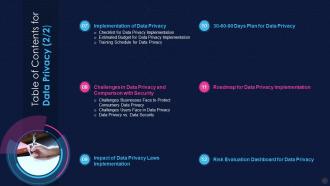
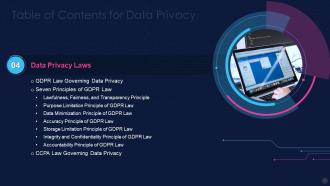
Slide 4: This is another slide continuing Table of Content for the presentation.
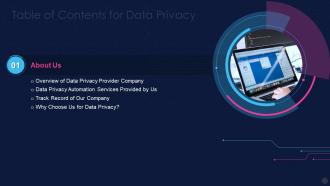
Slide 5: This is About Us slide to show company specifications etc.
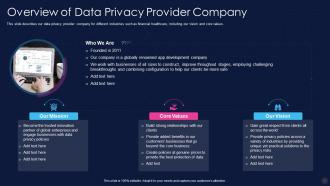
Slide 6: This slide shows Overview of Data Privacy Provider Company.
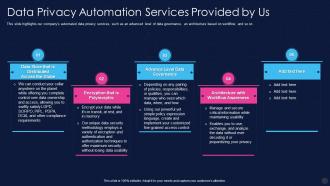
Slide 7: This slide presents Data Privacy Automation Services Provided by Us.
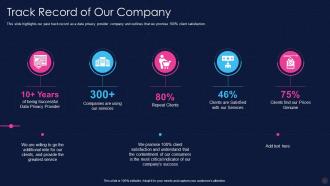
Slide 8: This slide highlights our past track record as a data privacy provider company.
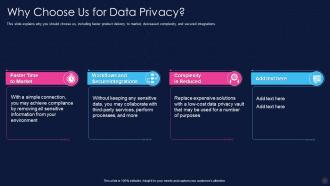
Slide 9: This slide explains why you should choose us, including faster product delivery to market.
Slide 10: This slide highlights title for topics that are to be covered next in the template.
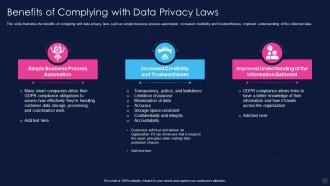
Slide 11: This slide shows Benefits of Complying with Data Privacy Laws.
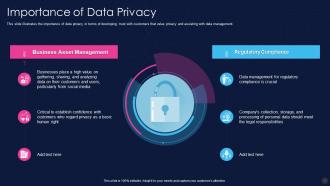
Slide 12: This slide illustrates the importance of data privacy in terms of developing trust.
Slide 13: This slide highlights title for topics that are to be covered next in the template.
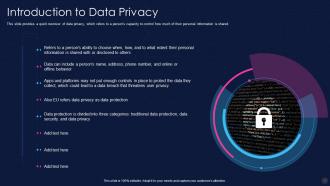
Slide 14: This slide provides a quick overview of data privacy, which refers to a person's capacity.
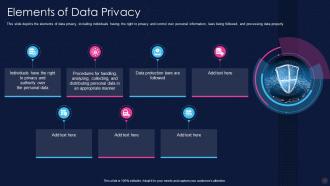
Slide 15: This slide depicts the elements of data privacy, including individuals having the right to privacy.
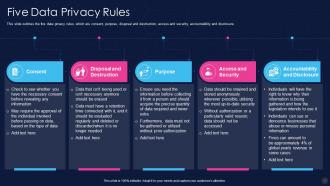
Slide 16: This slide outlines the five data privacy rules, which are consent, purpose, disposal and destruction.
Slide 17: This slide highlights title for topics that are to be covered next in the template.
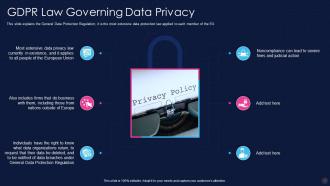
Slide 18: This slide explains the General Data Protection Regulation; it is the most extensive data protection law applied.
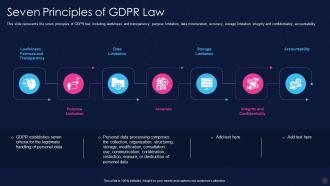
Slide 19: This slide represents the seven principles of GDPR law, including lawfulness and transparency.
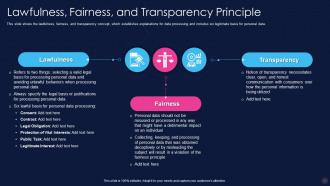
Slide 20: This slide presents Lawfulness, Fairness, and Transparency Principle.
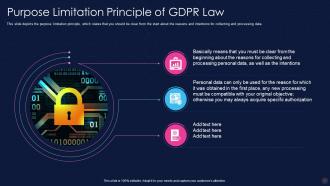
Slide 21: This slide depicts the purpose limitation principle, which states that you should be clear from the start.
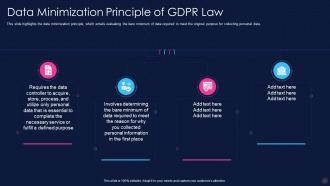
Slide 22: This slide represents Data Minimization Principle of GDPR Law.
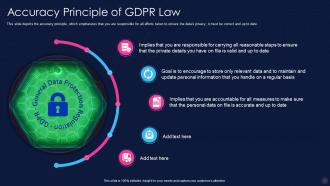
Slide 23: This slide depicts the accuracy principle, which emphasizes that you are responsible for all efforts taken to ensure the data's privacy.
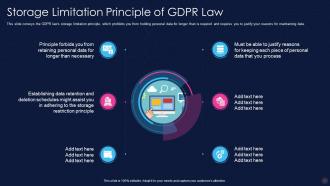
Slide 24: This slide conveys the GDPR law's storage limitation principle, which prohibits you from holding personal data.
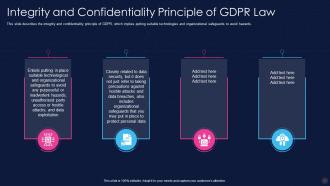
Slide 25: This slide represents Integrity and Confidentiality Principle of GDPR Law.
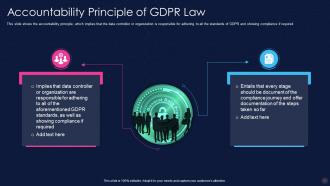
Slide 26: This slide shows the accountability principle, which implies that the data controller or organization.
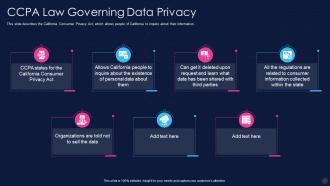
Slide 27: This slide describes the California Consumer Privacy Act, which allows people of California to inquire about their information.
Slide 28: This slide highlights title for topics that are to be covered next in the template.
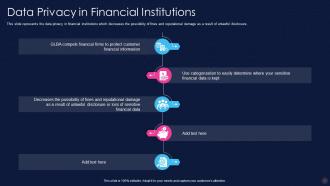
Slide 29: This slide presents Data Privacy in Financial Institutions.
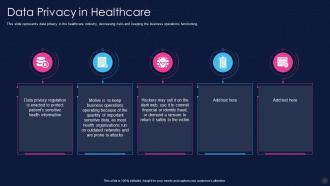
Slide 30: This slide represents data privacy in the healthcare industry, decreasing risks and keeping the business operations functioning.
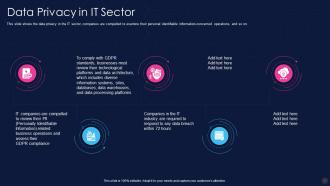
Slide 31: This slide shows the data privacy in the IT sector, companies are compelled to examine their personal identifiable information.
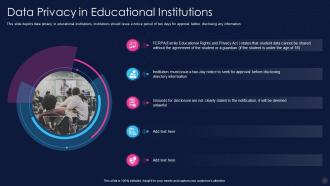
Slide 32: This slide presents Data Privacy in Educational Institutions.
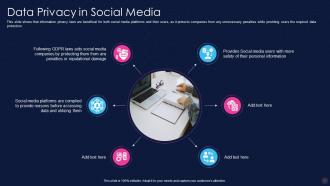
Slide 33: This slide shows that information privacy laws are beneficial for both social media platforms and their users.
Slide 34: This slide highlights title for topics that are to be covered next in the template.
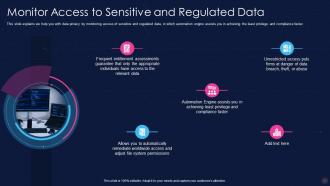
Slide 35: This slide presents Monitor Access to Sensitive and Regulated Data.
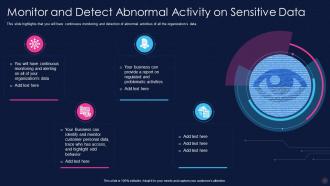
Slide 36: This slide displays Monitor and Detect Abnormal Activity on Sensitive Data.
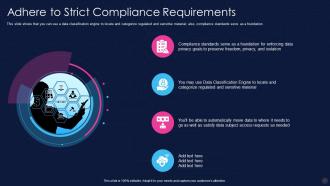
Slide 37: This slide shows that you can use a data classification engine to locate and categorize regulated and sensitive material.
Slide 38: This slide highlights title for topics that are to be covered next in the template.
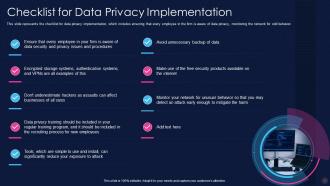
Slide 39: This slide presents Checklist for Data Privacy Implementation.
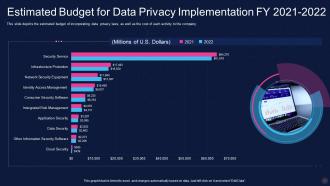
Slide 40: This slide displays Estimated Budget for Data Privacy Implementation FY 2021-2022.
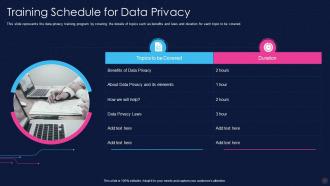
Slide 41: This slide represents the data privacy training program by covering the details of topics.
Slide 42: This slide highlights title for topics that are to be covered next in the template.
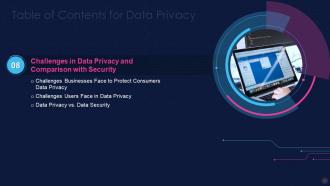
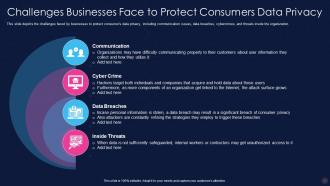
Slide 43: This slide showcases Challenges Businesses Face to Protect Consumers Data Privacy.
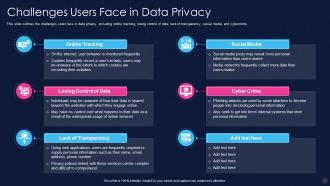
Slide 44: This slide outlines the challenges users face in data privacy, including online tracking, losing control of data, etc.
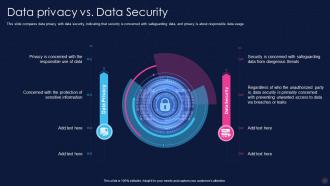
Slide 45: This slide compares data privacy with data security, indicating that security is concerned with safeguarding data.
Slide 46: This slide highlights title for topics that are to be covered next in the template.
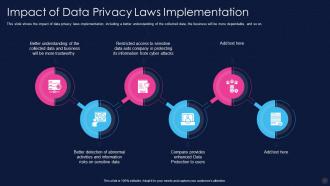
Slide 47: This slide shows the impact of data privacy laws implementation, including a better understanding of the collected data.
Slide 48: This slide highlights title for topics that are to be covered next in the template.
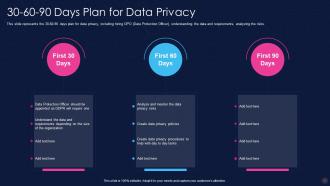
Slide 49: This slide represents the 30-60-90 days plan for data privacy.
Slide 50: This slide highlights title for topics that are to be covered next in the template.
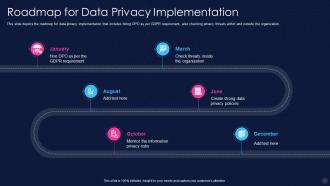
Slide 51: This slide showcases Roadmap for Data Privacy Implementation.
Slide 52: This slide highlights title for topics that are to be covered next in the template.
Slide 53: This slide shows Risk Evaluation Dashboard for Data Privacy.
Slide 54: This slide displays Icons for Data Privacy (IT).
Slide 55: This slide is titled as Additional Slides for moving forward.
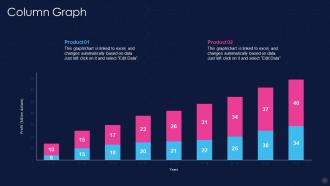
Slide 56: This slide displays Column chart with two products comparison.
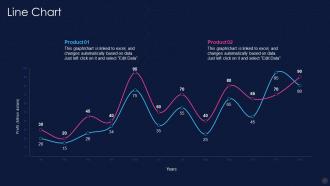
Slide 57: This slide describes Line chart with two products comparison.
Slide 58: This slide depicts Venn diagram with text boxes.
Slide 59: This is a Timeline slide. Show data related to time intervals here.
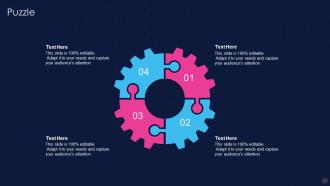
Slide 60: This slide contains Puzzle with related icons and text.
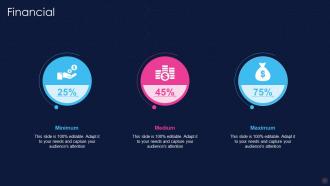
Slide 61: This is a Financial slide. Show your finance related stuff here.
Slide 62: This slide contains Puzzle with related icons and text.
Slide 63: This slide displays Mind Map with related imagery.
Slide 64: This slide shows Post It Notes. Post your important notes here.
Slide 65: This is a Thank You slide with address, contact numbers and email address.
Data Privacy IT Powerpoint Presentation Slides with all 70 slides:
Use our Data Privacy IT Powerpoint Presentation Slides to effectively help you save your valuable time. They are readymade to fit into any presentation structure.










FAQs for Data Privacy IT
Ok so basically you can only grab data legally and people gotta know what you're doing with it - that's the transparency bit. Don't use their info for random stuff you never mentioned (purpose limitation). Only collect what you actually need instead of hoarding everything like some digital packrat. Keep it accurate, obviously. Here's where companies mess up though - you can't store data forever, there are time limits. Oh, and you need proper security plus ways to prove you're following the rules. Honestly I'd start by checking what data you're already collecting and making sure you have real consent for it all.
So GDPR made everyone way more paranoid about personal data - which honestly isn't a bad thing. Healthcare and finance were already locked down tight, but retail, marketing, and tech companies? Total scramble. They had to rebuild everything from scratch: consent forms, data mapping, breach protocols. Even my friend's tiny cookie business (actual cookies lol) needs privacy policies now. The real trick is mapping out what personal data you're actually collecting - then you need solid reasons for processing every single piece of it. Way more paperwork than before.
Zero-trust stuff is everywhere right now - treats everything like a potential threat until it proves itself safe. There's this wild encryption called homomorphic that lets you crunch data while it's still encrypted (sounds like sci-fi but it's real). Differential privacy throws statistical noise into datasets to mask personal info. Oh, and federated learning trains AI without actually moving your sensitive data around - pretty clever. Multi-party computation is getting way more practical too. Honestly though? Start with zero-trust frameworks first since they're easiest to roll out. The other tech is cool but zero-trust you can actually implement tomorrow.
Honestly, start with figuring out what data you're actually collecting and where it all lives - most companies don't even know this basic stuff. Run privacy assessments whenever you're doing something new with data. Train your people because, real talk, they're usually the weak link in data security. Set up some monitoring to catch weird access patterns. Oh, and get outside auditors in sometimes - they'll spot things you miss. The biggest mistake is treating this like a yearly thing instead of ongoing work. If you haven't done a full data inventory lately, that's your starting point.
So here's the deal with user consent - it's literally the foundation for most privacy laws like GDPR and CCPA. You need explicit permission before collecting anyone's personal data. Can't use sneaky pre-checked boxes or bury it in those marathon terms of service (though honestly, who reads those anyway?). The consent has to be specific and freely given. People should know exactly what they're agreeing to. Here's the kicker - they need to withdraw it just as easily as they gave it. Always document when and how you got permission. Trust me, you'll thank yourself later when regulators come knocking.
Here's what I'd do: audit everything you're collecting right now - bet you'll be surprised how much random stuff is in there. Only grab data that actually helps your business, not just because you can. Birthday for software sales? Hard pass, that's creepy. Give people real choices with clear opt-in buttons, none of those pre-checked garbage boxes. Build privacy stuff into your systems from the start instead of trying to patch it later (trust me on this one). The whole thing should feel like a fair trade - they share something, they get clear value back. Make it obvious what's in it for them.
Honestly, the biggest thing you need to worry about is data breaches - both when your stuff's moving around and sitting on their servers. Plus you're basically giving up control over where your data actually lives geographically, which can be sketchy. There's always the question of who can peek at your files too. Could be hackers, could be their own employees having a bad day. If you're in something like healthcare or finance, compliance gets messy real quick. My advice? Encrypt everything before it leaves your building and actually read through their security certs.
So data anonymization strips out all the personally identifiable stuff - names, addresses, phone numbers, you know the drill. Pretty straightforward privacy win honestly. Your team can still spot trends and analyze patterns without exposing anyone's personal info. Here's the thing though - it's not foolproof. Smart attackers sometimes piece together different datasets to re-identify people anyway. Kinda scary when you think about it. That's why you'll want to run a risk assessment first and maybe throw in some data masking too, especially with the really sensitive stuff.
First thing - audit what employee data you actually have and ditch anything unnecessary. Lock down access so only the right people can see sensitive stuff, and encrypt everything (seriously, this isn't optional anymore). Your privacy policy should be readable by humans, not just lawyers - nobody reads that dense legal crap anyway. Train your team on proper data handling, set clear retention schedules, and get real consent before collecting personal info. Regular security audits help catch problems early. Oh, and be upfront about what you're doing with their data. Trust goes a long way.
Oh man, data breaches are seriously bad news for any business. Your customers feel totally violated when their personal info gets stolen, and honestly, can you blame them? Trust just evaporates overnight. You'll deal with people jumping ship, awful press coverage, maybe even lawsuits. New customers won't touch you once word spreads - and trust me, it always spreads. Companies like Equifax are still dealing with reputation issues years later. I'd throw money at cybersecurity now rather than trying to fix your image after everything's already gone to hell.
Yeah, so vendors still have to follow all the same privacy rules when handling your customer data. They can't just do whatever they want with it. Problem is, most companies think "oh the vendor's got this handled" and then get burned later. You're still responsible if they screw up though - learned that one the hard way. Make your contracts super specific about what they can/can't do with the data. Require security audits and give yourself an easy out if they violate anything. Also, actually check them out before signing anything. Saves headaches later.
Dude, privacy audits are like getting your car inspected - annoying but they catch problems before you're stranded on the highway. Do them quarterly to spot where your data practices might be sketchy. Maybe your consent forms are outdated, or you're handling customer info in ways that'll make GDPR lawyers salivate. I learned this the hard way when a client got hit with fines they could've avoided. Check for security holes, risky data handling, all that stuff. The key part though? Actually fix what you find. Don't just shove the report in a drawer and call it done.
Okay so first things first - get some decent passwords and turn on two-factor auth everywhere you can. Most people never mess with their social media privacy settings and they're honestly garbage by default, so fix those. Don't post stuff like your full birthday or exact location either. Public WiFi is sketchy for anything important, so maybe just stick to secure networks when you're doing sensitive stuff. Oh and definitely check what apps have access to your data - I did this last month and was genuinely horrified at how much random stuff I'd given permission to.
Honestly, AI is making data privacy laws a total mess right now. The whole consent thing we're used to? Doesn't really work when algorithms are constantly analyzing and predicting what you'll do next. GDPR wasn't written with this stuff in mind. You've got algorithmic bias, automated decisions that nobody can explain, and data crossing borders left and right. The "right to explanation" is becoming huge since most AI is basically a black box. My advice? Audit your AI systems like, yesterday - and make sure you can actually walk someone through how they handle personal data, because regulators are catching up fast.
Look, you've gotta build privacy in from the start - don't just slap it on later. Do privacy impact assessments during planning, then keep data collection minimal and focused. Your engineers should default to encryption and only grabbing what you actually need (trust me, legal will thank you later). Make consent flows clear - none of that shady dark pattern stuff. Build easy data deletion from day one. Oh, and schedule regular privacy check-ins with product, engineering, and legal. Catching issues early beats expensive fixes down the road every single time.
-
Perfect template with attractive color combination.
-
Excellent work done on template design and graphics.