

Data Privacy Implementation Powerpoint Presentation Slides




Try Before you Buy Download Free Sample Product
 Impress Your
 Audience
 100%
100% Editable
 Save Hours
 of Time


Data privacy, also known as information privacy, is a subset of data protection that deals with the correct handling of sensitive data and other sensitive information, such as certain financial records and intellectual property data. Grab our insightfully designed Data Privacy Implementation template that gives an overview of the data privacy provider firm, automated data privacy services provided, and its past track record. In addition, this PPT gives a brief introduction to data privacy, its elements, and its five rules it also shows different privacy laws, such as GDPR law and CCPA law, which govern data privacy. Moreover, this Information Privacy presentation represents Data privacy in various industries, including healthcare and financial institutions. Further, the Data Privacy template caters to how the company helps with data privacy and an implementation process, including a checklist, training program, and estimated budget. This PowerPoint presentation outlines the challenges businesses face to protect the privacy of users data, demonstrates the difficulties faced by users, and more. Lastly, the Information Privacy deck comprises a 30-60-90-days plan, a roadmap, a risk evaluating dashboard, etc. Customize this 100 percent editable template now.
People who downloaded this PowerPoint presentation also viewed the following :
Content of this Powerpoint Presentation
Slide 1: This slide introduces Data Privacy Implementation. State your company name and begin.
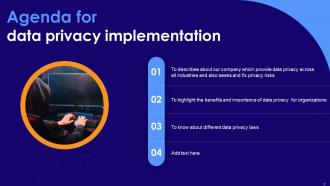
Slide 2: This slide states Agenda of the presentation.
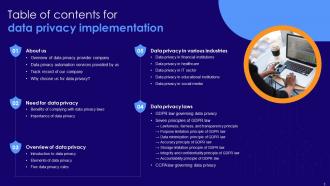
Slide 3: This slide presents Table of Content for the presentation.
Slide 4: This is another slide continuing Table of Content for the presentation.
Slide 5: This slide highlights title for topics that are to be covered next in the template.
Slide 6: This slide shows Overview of Data Privacy Provider Company.
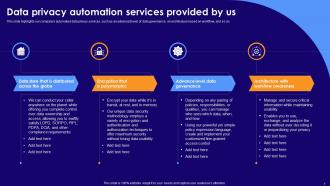
Slide 7: This slide presents Data Privacy Automation Services Provided by Us.
Slide 8: This slide highlights our past track record as a data privacy provider company.
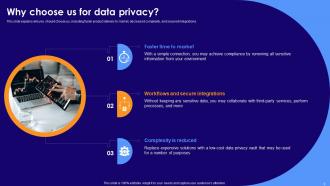
Slide 9: This slide explains why you should choose us, including faster product delivery to market.
Slide 10: This slide highlights title for topics that are to be covered next in the template.
Slide 11: This slide shows Benefits of Complying with Data Privacy Laws.
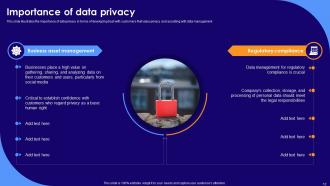
Slide 12: This slide illustrates the importance of data privacy in terms of developing trust.
Slide 13: This slide highlights title for topics that are to be covered next in the template.
Slide 14: This slide provides a quick overview of data privacy, which refers to a person's capacity.
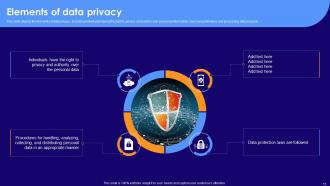
Slide 15: This slide depicts the elements of data privacy, including individuals having the right to privacy.
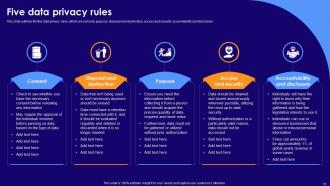
Slide 16: This slide outlines the five data privacy rules, which are consent, purpose, disposal and destruction.
Slide 17: This slide highlights title for topics that are to be covered next in the template.
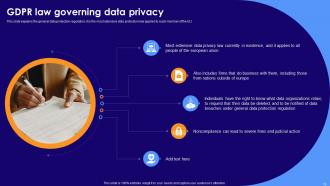
Slide 18: This slide explains the General Data Protection Regulation; it is the most extensive data protection law applied.
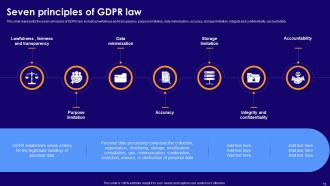
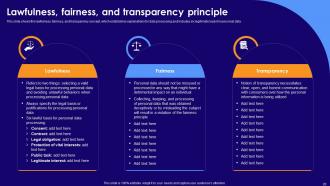
Slide 19: This slide represents the seven principles of GDPR law, including lawfulness and transparency.
Slide 20: This slide presents Lawfulness, Fairness, and Transparency Principle.
Slide 21: This slide depicts the purpose limitation principle, which states that you should be clear from the start.
Slide 22: This slide represents Data Minimization Principle of GDPR Law.
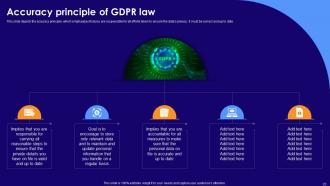
Slide 23: This slide depicts the accuracy principle, which emphasizes that you are responsible for all efforts taken to ensure the data's privacy.
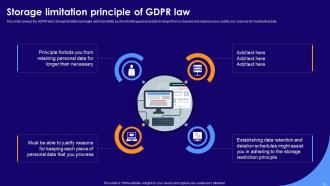
Slide 24: This slide conveys the GDPR law's storage limitation principle, which prohibits you from holding personal data.
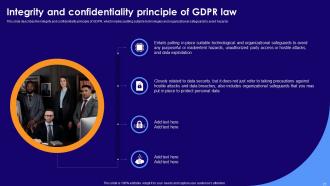
Slide 25: This slide represents Integrity and Confidentiality Principle of GDPR Law.
Slide 26: This slide shows the accountability principle, which implies that the data controller or organization.
Slide 27: This slide describes the California Consumer Privacy Act, which allows people of California to inquire about their information.
Slide 28: This slide highlights title for topics that are to be covered next in the template.
Slide 29: This slide presents Data Privacy in Financial Institutions.
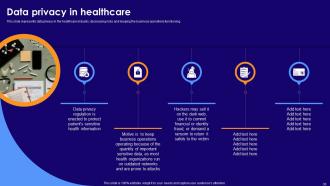
Slide 30: This slide represents data privacy in the healthcare industry, decreasing risks and keeping the business operations functioning.
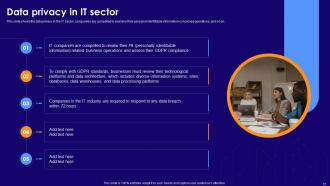
Slide 31: This slide shows the data privacy in the IT sector, companies are compelled to examine their personal identifiable information.
Slide 32: This slide presents Data Privacy in Educational Institutions.
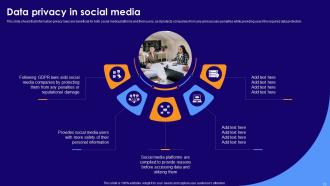
Slide 33: This slide shows that information privacy laws are beneficial for both social media platforms and their users.
Slide 34: This slide highlights title for topics that are to be covered next in the template.
Slide 35: This slide presents Monitor Access to Sensitive and Regulated Data.
Slide 36: This slide displays Monitor and Detect Abnormal Activity on Sensitive Data.
Slide 37: This slide shows that you can use a data classification engine to locate and categorize regulated and sensitive material.
Slide 38: This slide highlights title for topics that are to be covered next in the template.
Slide 39: This slide presents Checklist for Data Privacy Implementation.
Slide 40: This slide displays Estimated Budget for Data Privacy Implementation FY 2021-2022.
Slide 41: This slide represents the data privacy training program by covering the details of topics.
Slide 42: This slide highlights title for topics that are to be covered next in the template.
Slide 43: This slide showcases Challenges Businesses Face to Protect Consumers Data Privacy.
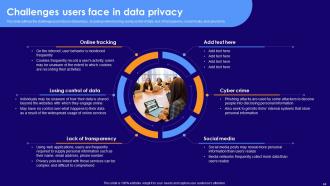
Slide 44: This slide outlines the challenges users face in data privacy, including online tracking, losing control of data, etc.
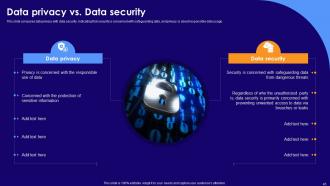
Slide 45: This slide compares data privacy with data security, indicating that security is concerned with safeguarding data.
Slide 46: This slide highlights title for topics that are to be covered next in the template.
Slide 47: This slide shows the impact of data privacy laws implementation, including a better understanding of the collected data.
Slide 48: This slide highlights title for topics that are to be covered next in the template.
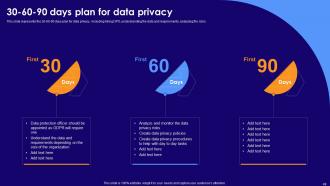
Slide 49: This slide represents the 30-60-90 days plan for data privacy.
Slide 50: This slide highlights title for topics that are to be covered next in the template.
Slide 51: This slide showcases Roadmap for Data Privacy Implementation.
Slide 52: This slide highlights title for topics that are to be covered next in the template.
Slide 53: This slide shows Risk Evaluation Dashboard for Data Privacy.
Slide 54: This slide contains all the icons used in this presentation.
Slide 55: This slide is titled as Additional Slides for moving forward.
Slide 56: This slide displays Column chart with two products comparison.
Slide 57: This slide shows Post It Notes. Post your important notes here.
Slide 58: This slide depicts Venn diagram with text boxes.
Slide 59: This is a Timeline slide. Show data related to time intervals here.
Slide 60: This is Our Goal slide. State your firm's goals here.
Slide 61: This is an Idea Generation slide to state a new idea or highlight information, specifications etc.
Slide 62: This is a Comparison slide to state comparison between commodities, entities etc.
Slide 63: This slide contains Puzzle with related icons and text.
Slide 64: This is a Thank You slide with address, contact numbers and email address.
Data Privacy Implementation Powerpoint Presentation Slides with all 69 slides:
Use our Data Privacy Implementation Powerpoint Presentation Slides to effectively help you save your valuable time. They are readymade to fit into any presentation structure.






























FAQs for Data Privacy Implementation
So basically you want data minimization - just grab what you actually need. Purpose limitation means stick to what you told people you'd do with their info. Accuracy and storage limits matter too, obviously. Be transparent about everything! Getting real consent is key (not those sketchy terms nobody reads). Security's probably the biggest one though. Look, I know it sounds like a lot but honestly? Just don't be shady about it. Be upfront with people and protect whatever you collect. I'd start by checking what data you're even gathering right now.
Honestly? Just drop all that legal gibberish and talk to people normally. Start with the big stuff upfront - what data you collect, why you need it. Then let people click through for the nitty-gritty details if they care. Put it everywhere too - your site, app settings, those confirmation emails nobody reads. I mean, some of these policies are just painful to get through. Visual icons help a lot, btw. But here's the real test - show it to actual customers first. If they're squinting and re-reading sentences, you've lost them. Simple language wins every time.
So you've got two main ways to protect personal data - encryption and anonymization. Encryption scrambles everything so intercepted data looks like gibberish without the decryption key. Pretty solid defense there. Anonymization strips out identifying info so you can't link data back to actual people, though honestly it's not bulletproof since clever folks can sometimes reverse-engineer it. Always encrypt your data when it's moving around AND when it's just sitting there. Oh, and definitely anonymize datasets before handing them off to third parties - learned that one the hard way.
Ok first things first - map out every piece of personal data you guys collect and store. That's your starting point. Set up proper consent systems and make sure you can actually delete stuff when people ask (harder than it sounds tbh). The paperwork is going to suck but you need privacy policies and processing agreements documented. Train your team regularly since most screw-ups are just people making mistakes, not anything shady. Honestly? Get someone dedicated to handle this full-time. They can track regulation changes and run compliance checks so you're not scrambling later.
Only collect the PII you actually need - seriously, companies go overboard with this stuff. Encrypt everything when it's stored and when you're moving it around. Set up proper access controls so random employees can't peek at sensitive data. Get real consent too, not that buried-in-fine-print nonsense. You'll want a solid retention policy because hoarding data forever is just begging for problems. Oh and definitely audit what you're collecting right now - I bet you'll find tons of unnecessary stuff. Honestly, if you treat personal data like it could blow up in your face, you're on the right track.
Be upfront about what data you're grabbing and why - skip the legal mumbo jumbo nobody reads anyway. Let people actually opt out easily instead of making it some ridiculous maze. Honestly, buying those third-party lists is kinda sketchy these days. Stick with first-party stuff from your own site interactions. You can still run solid campaigns using anonymized data instead of creepy individual tracking. Here's the thing though - when you're transparent, customers don't feel like you're being shady. They'll often share more info voluntarily if they trust you. It's way better than trying to sneak around and collect everything behind their backs.
Oh man, data breaches are brutal for trust. Customers feel totally betrayed when their info gets stolen - like, you had ONE job, right? It's crazy hard to bounce back from that kind of betrayal. The ripple effect is the worst part though. Even people who weren't affected hear about it and start questioning your security. I've seen companies still dealing with reputation damage years later. Honestly, spending big on prevention upfront is way smarter than trying to rebuild trust after everything falls apart. You'll also want that crisis plan ready because the financial hit is just the beginning.
So AI can scan through all your data and automatically flag the sensitive stuff - way faster than doing it manually. You get better anonymization too, where it strips out personal info but keeps the data actually useful. Blockchain's pretty cool for this because it creates these permanent audit trails. Nobody can mess with them later, so you know exactly who accessed what. Plus there's no single failure point since it's decentralized. Honestly though, don't try to implement everything at once - that's how projects die. Pick one privacy thing and start there.
Start by figuring out what data each team actually works with - that's your foundation. Interactive training is where it's at, none of that death-by-PowerPoint stuff. I'd do quarterly refreshers using scenarios they deal with every day. Gamification sounds cheesy but honestly works great - people love competing for badges. Quick quizzes help too. The whole point is making it feel relevant to their actual job, not just another compliance thing to suffer through. Oh, and track who's completing it so you know where the gaps are.
Dude, privacy laws are all over the place depending on where you are. Europe's super strict with GDPR - they're big on protecting individual rights. Meanwhile the US lets businesses figure it out more, with different rules for different industries. Asian countries? They're usually trying to balance privacy with economic growth, though some definitely put national security first. Oh and collective benefits too - that's a big thing there. If you're dealing with global stuff, you gotta check what each region expects. What seems totally normal to users in one place might freak out people somewhere else.
Honestly, start with your passwords - get a password manager because trying to remember unique ones for everything is impossible. Check your privacy settings on social media and apps pretty regularly since they love sneaking in changes. Two-factor authentication is a pain to set up but totally worth it. Don't post super personal stuff publicly, and be picky about what info you hand over to random websites. Oh, and stop clicking suspicious links or downloading weird apps - I learned that one the hard way. Just tackle your main accounts first, then work from there.
Dude, the fines are brutal. GDPR alone can slap you with 4% of your entire annual revenue - that's potentially millions. CCPA has its own nasty penalty structure too. Then there's the class action lawsuits from pissed off customers, which honestly might be worse than the government fines. Your reputation gets absolutely wrecked. I know a company that spent three times more on damage control than compliance would've cost them. Makes no sense. You should probably audit what you're doing now and fix the obvious gaps before something hits the fan.
So basically a data privacy impact assessment is like doing a pre-emptive strike against privacy disasters. You go through all your data processing stuff and figure out where things could go sideways for people's privacy. Think of it as preventive maintenance but for data handling. The whole process makes you catch vulnerabilities and compliance issues before they blow up in your face. Honestly, regulators eat this proactive approach up - they love seeing you're not just winging it. Start with whatever data activities seem sketchiest first. It'll give you a solid game plan for actually fixing problems.
Honestly, start with a good DLP tool like Microsoft Purview or Symantec - they'll catch most data movement issues. OneTrust handles compliance stuff pretty well if you're dealing with regulations. Basic encryption is a must, obviously. Okta's solid for access management. Privacy impact assessments are clutch but everyone seems to forget about them until it's too late (been there). Network monitoring helps spot weird data flows. Database activity monitoring too. My advice? Don't try to build everything at once. Get DLP and encryption running first, then add pieces based on what you're actually protecting. Way less overwhelming that way.
Ugh, remote work totally flips data privacy on its head. People are logging in from their kitchen WiFi, personal laptops, random Starbucks locations - it's chaos honestly. Your IT team is probably pulling their hair out right now. You'll need way better endpoint protection and make everyone use VPNs. Also figure out policies for what data can actually be accessed remotely (spoiler: probably not everything). The whole security approach shifts from protecting your office perimeter to checking every single login attempt. Start by mapping out what remote workers really need access to.
-
Been using SlideTeam for some time now…can’t imagine why I wasted all that time in front of the screen trying to make the perfect presentation.
-
SlideTeam is the best in the business. Their templates are engaging and customizable. You can rely on them.