


Information Privacy Powerpoint Presentation Slides
Data privacy, also known as information privacy, is a subset of data protection that deals with the correct handling of sensitive data and other sensitive information, such as certain financial records and intellectual property data. Grab our insightfully designed Information Privacy IT template that gives an overview of the data privacy provider firm, the automated data privacy services provided, and its past track record. In addition, this PPT gives a brief introduction to data privacy, its elements, and its five rules it also shows different privacy laws, such as GDPR law and CCPA law, which govern data privacy. Moreover, this Information Privacy presentation represents Data privacy in various industries, including healthcare and financial institutions. Further, the Data Privacy template caters to how the company helps with data privacy and an implementation process, including a checklist, training program, and estimated budget. This PowerPoint presentation outlines the challenges businesses face to protect the privacy of users data, demonstrates the difficulties faced by users, and more. Lastly, the Information Privacy deck comprises a 30-60-90-days plan, a roadmap, a risk-evaluating dashboard, etc. Customize this 100 percent editable template now.





































You must be logged in to download this presentation.


Do you want to remove this product from your favourites?
 Impress your
 audience
 100%
100% Editable
 Save Hours
 of Time
PowerPoint presentation slides
This complete deck covers various topics and highlights important concepts. It has PPT slides which cater to your business needs. This complete deck presentation emphasizes Information Privacy Powerpoint Presentation Slides and has templates with professional background images and relevant content. This deck consists of total of sixty four slides. Our designers have created customizable templates, keeping your convenience in mind. You can edit the color, text and font size with ease. Not just this, you can also add or delete the content if needed. Get access to this fully editable complete presentation by clicking the download button below.

People who downloaded this PowerPoint presentation also viewed the following :
Content of this Powerpoint Presentation
Slide 1: This slide displays the title Information Privacy.
Slide 2: This slide displays the title Agenda for information privacy.
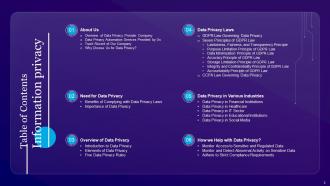
Slide 3: This slide exhibit table of content.
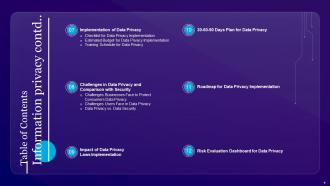
Slide 4: This slide exhibit table of content.
Slide 5: This slide exhibit table of content- About Us.
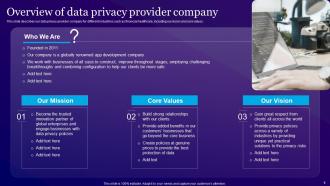
Slide 6: This slide describes our data privacy provider company for different industries such as financial healthcare, including our vision and core values.
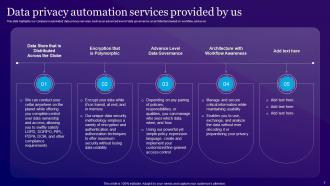
Slide 7: This slide highlights our company's automated data privacy services, such as an advanced level of data governance, an architecture based on workflow, and so on.
Slide 8: This slide highlights our past track record as a data privacy provider company and outlines that we promise 100% client satisfaction.
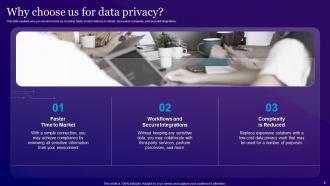
Slide 9: This slide explains why you should choose us, including faster product delivery to market, decreased complexity, and secured integrations.
Slide 10: This slide exhibit table of content- Need for Data Privacy.
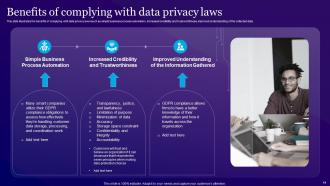
Slide 11: This slide illustrates the benefits of complying with data privacy laws.
Slide 12: This slide illustrates the importance of data privacy in terms of developing trust with customers that value privacy and assisting with data management.
Slide 13: This slide exhibit table of content- Overview of Data Privacy.
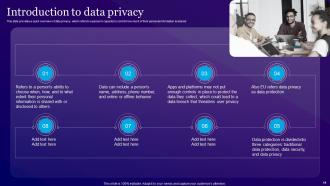
Slide 14: This slide provides a quick overview of data privacy, which refers to a person's capacity to control how much of their personal information is shared.
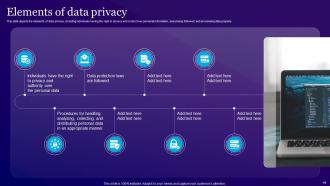
Slide 15: This slide depicts the elements of data privacy.
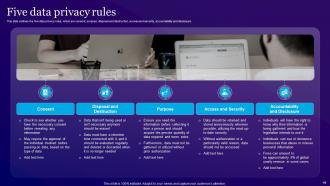
Slide 16: This slide outlines the five data privacy rules, which are consent, purpose, disposal and destruction, access and security, accountability and disclosure.
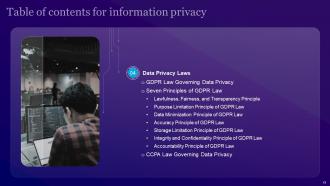
Slide 17: This slide exhibit table of content- Data Privacy Laws.
Slide 18: This slide explains the General Data Protection Regulation; it is the most extensive data protection law applied to each member of the EU.
Slide 19: This slide represents the seven principles of GDPR law.
Slide 20: This slide shows the lawfulness, fairness, and transparency concept.
Slide 21: This slide depicts the purpose limitation principle.
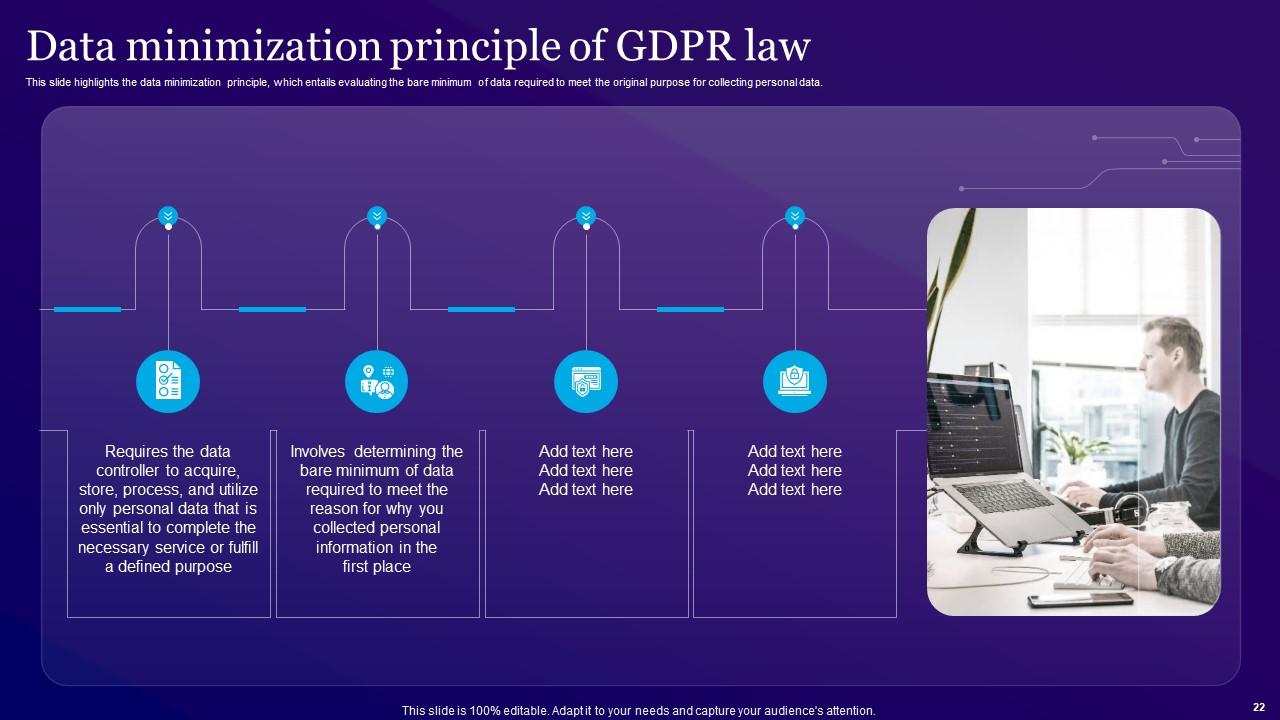
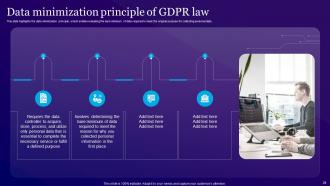
Slide 22: This slide highlights the data minimization principle.
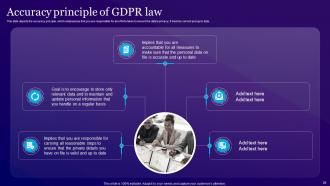
Slide 23: This slide depicts the accuracy principle, which emphasizes that you are responsible for all efforts taken to ensure the data's privacy.
Slide 24: This slide conveys the GDPR law's storage limitation principle.
Slide 25: This slide describes the integrity and confidentiality principle of GDPR.
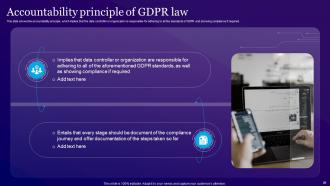
Slide 26: This slide shows the accountability principle of GDPR law.
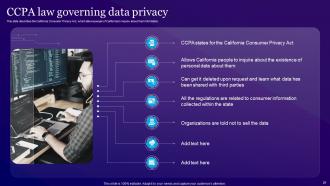
Slide 27: This slide describes the California Consumer Privacy Act, which allows people of California to inquire about their information.
Slide 28: This slide exhibit table of content- Data Privacy in Various Industries.
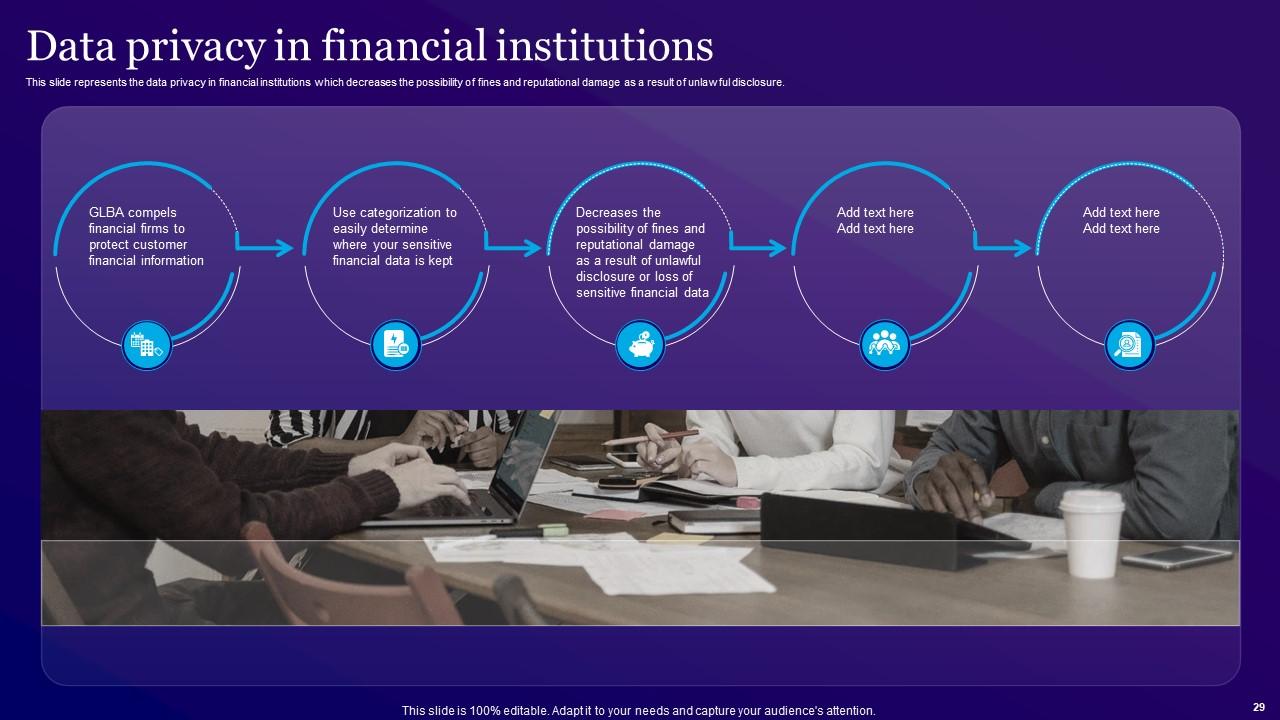
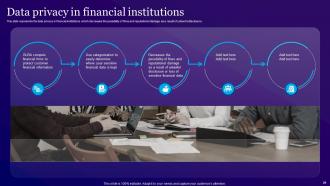
Slide 29: This slide represents the data privacy in financial institutions.
Slide 30: This slide represents data privacy in the healthcare industry, decreasing risks and keeping the business operations functioning.
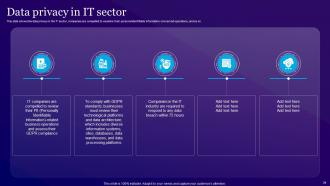
Slide 31: This slide shows the data privacy in the IT sector, companies are compelled to examine their personal identifiable information-concerned operations, and so on.
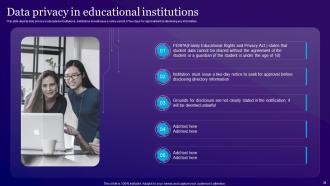
Slide 32: This slide depicts data privacy in educational institutions, institutions should issue a notice period of two days for approval before disclosing any information.
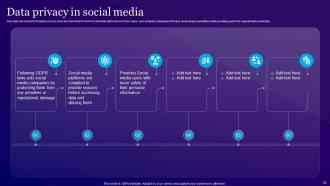
Slide 33: This slide shows that information privacy laws are beneficial for both social media platforms.
Slide 34: This slide exhibit table of content- How we Help with Data Privacy?
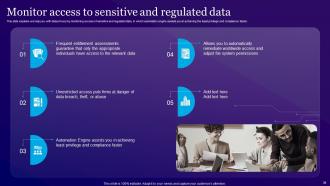
Slide 35: This slide explains we help you with data privacy by monitoring access of sensitive and regulated data.
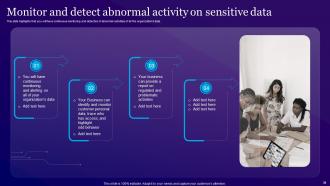
Slide 36: This slide highlights that you will have continuous monitoring and detection of abnormal activities of all the organization’s data.
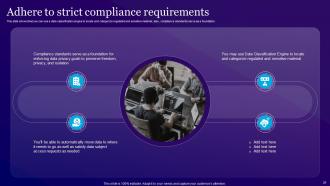
Slide 37: This slide shows that you can use a data classification engine to locate and categorize regulated and sensitive material.
Slide 38: This slide exhibit table of content- Implementation of Data Privacy.
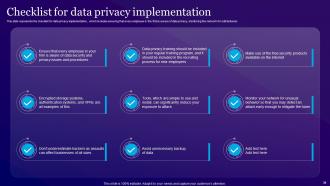
Slide 39: This slide represents the checklist for data privacy implementation.
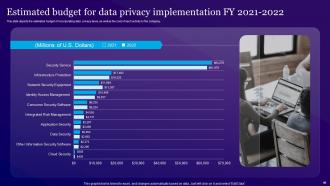
Slide 40: This slide depicts the estimated budget of incorporating data privacy laws, as well as the cost of each activity to the company.
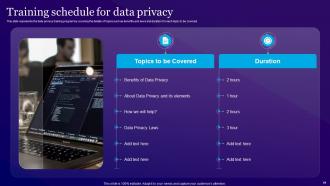
Slide 41: This slide represents the data privacy training program by covering the details of topics such as benefits and laws and duration for each topic to be covered.
Slide 42: This slide exhibit table of content- Challenges in Data Privacy and Comparison with Security.
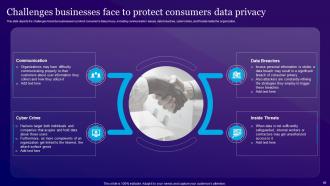
Slide 43: This slide depicts the challenges faced by businesses to protect consumer's data privacy.
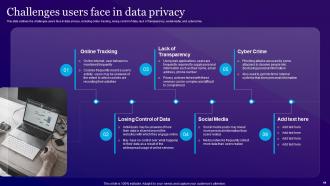
Slide 44: This slide outlines the challenges users face in data privacy.
Slide 45: This slide compares data privacy with data security, indicating that security is concerned with safeguarding data, and privacy is about responsible data usage.
Slide 46: This slide exhibit table of content- Impact of Data Privacy Laws Implementation.
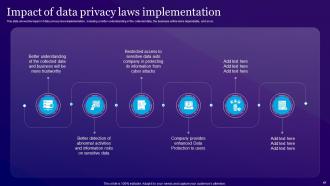
Slide 47: This slide shows the impact of data privacy laws implementation.
Slide 48: This slide exhibit table of content: 30-60-90 Days Plan for Data Privacy.
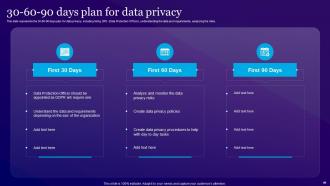
Slide 49: This slide represents the 30-60-90 days plan for data privacy.
Slide 50: This slide exhibit table of content- Roadmap for Data Privacy Implementation.
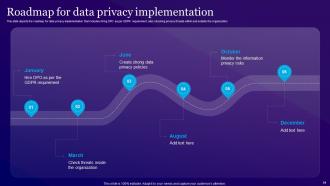
Slide 51: This slide depicts the roadmap for data privacy implementation.
Slide 52: This slide exhibit table of content- Risk Evaluation Dashboard for Data Privacy.
Slide 53: This slide depicts the risk evaluation dashboard for data privacy.
Slide 54: This is the icons slide.
Slide 55: This slide presents title for additional slides.
Slide 56: This slide shows puzzle for displaying elements of company.
Slide 57: This slide display Venn diagram.
Slide 58: This slide depicts posts for past experiences of clients.
Slide 59: This slide display Magnifying glass.
Slide 60: This slide depicts 30-60-90 days plan for projects.
Slide 61: This slide exhibits yearly timeline of company.
Slide 62: This slide display Target.
Slide 63: This slide exhibits ideas generated.
Slide 64: This is thank you slide & contains contact details of company like office address, phone no., etc.
Information Privacy Powerpoint Presentation Slides with all 69 slides:
Use our Information Privacy Powerpoint Presentation Slides to effectively help you save your valuable time. They are readymade to fit into any presentation structure.
FAQs
Our company provides automated data privacy services, such as an advanced level of data governance, an architecture based on workflow, and continuous monitoring and detection of abnormal activities of all organization’s data.
You should choose us for faster product delivery to market, decreased complexity, and secured integrations, and we promise 100% client satisfaction with our past track record as a data privacy provider company.
The five data privacy rules are consent, purpose, disposal and destruction, access and security, and accountability and disclosure.
GDPR is the most extensive data protection law applied to each member of the EU, and it emphasizes the lawfulness, fairness, and transparency concept, purpose limitation principle, data minimization principle, accuracy principle, storage limitation principle, integrity and confidentiality principle, and accountability principle.
Data security is concerned with safeguarding data, while data privacy is about responsible data usage, i.e., how much of personal information is shared with others.
-
SlideTeam just saved my project! Thank you so much. The variety of templates helped me showcase multiple perspectives easily.
-
Appreciate the research and its presentable format.
