


ITIL Powerpoint Presentation Slides





Try Before you Buy Download Free Sample Product
 Impress Your
 Audience
 100%
100% Editable
 Save Hours
 of Time


ITIL is a best-practices framework for delivering IT services. ITILs systematic approach to IT service management may help organizations manage risk, improve customer relationships, implement cost-effective practices, and create a stable IT environment that allows growth, scale, and change. This PowerPoint presentation gives a brief idea about the business problems, their effect on business, ITIL Implementation, and post-implementation impact on the company. In this ITIL PowerPoint presentation, we have discussed the current situation of the company and the need for ITIL in the company by covering how ITIL will improve business performance, its importance, and business benefits. Furthermore, this template includes a budget and training program to implement ITIL in the company. Moreover, this Information Technology Infrastructure Library PPT caters to an ITIL implementation checklist, 30-60-90 days plan, roadmap, and a dashboard. Lastly, this ITIL deck comprises the post-implementation impact on business and financial savings. Download our 100 percent editable and customizable template, which is also compatible with Google Slides.
People who downloaded this PowerPoint presentation also viewed the following :
Content of this Powerpoint Presentation
Slide 1: This slide introduces ITIL. State your company name and begin.
Slide 2: This slide states Agenda of the presentation.
Slide 3: This slide shows Table of Content for the presentation.
Slide 4: This slide highlights title for topics that are to be covered next in the template.
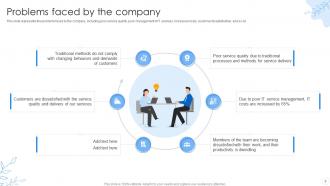
Slide 5: This slide represents the problems faced by the company, including poor service quality, poor management of IT services, etc.
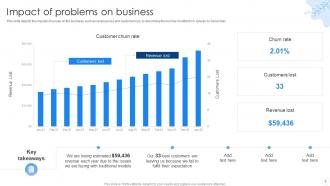
Slide 6: This slide depicts the impacts of issues on the business, such as revenue loss and customer loss.
Slide 7: This slide highlights title for topics that are to be covered next in the template.
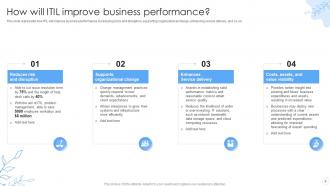
Slide 8: This slide represents how ITIL will improve business performance by reducing risks and disruption.
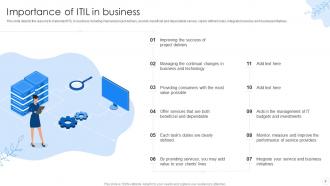
Slide 9: This slide depicts the reasons to implement ITIL in business including improved project delivery, provide beneficial and dependable service, etc.
Slide 10: This slide represents the benefits of ITIL implementation in business based on business agility, service excellence, system integration, etc.
Slide 11: This slide highlights title for topics that are to be covered next in the template.
Slide 12: This slide showcases Information Technology Infrastructure Library (ITIL) Introduction.
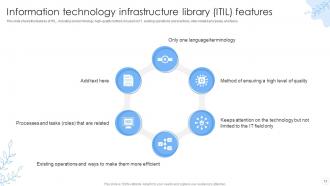
Slide 13: This slide presents Information Technology Infrastructure Library (ITIL) Features.
Slide 14: This slide represents the ITIL service value overview and its various parts such as opportunity, guiding principles, governance, etc.
Slide 15: This slide represents the 9 guiding principles of ITIL4, including a focus on value, starting where you are, iteratively growing with feedback, etc.
Slide 16: This slide highlights title for topics that are to be covered next in the template.
Slide 17: This slide showcases Information Technology Infrastructure Library (ITIL) Framework.
Slide 18: This slide describes the service strategy stage of the ITIL life cycle.
Slide 19: This slide represents the servicer strategy process of the ITIL, including service management, service portfolio management, etc.
Slide 20: This slide displays roles and responsibilities for service strategy, including business relationship manager, demand manager, financial manager, etc.
Slide 21: This slide highlights title for topics that are to be covered next in the template.
Slide 22: This slide depicts the overview of ITIL service design, including easy-to-use services, to obtain ROI, balanced functionality, etc.
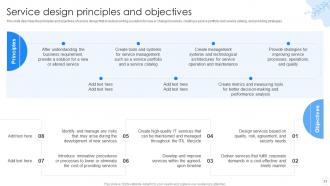
Slide 23: This slide describes the principles and objectives of service design.
Slide 24: This slide represents the four Ps of the service design stage, such as people, processes, products, etc.
Slide 25: This slide describes the service design processes, including design collaboration, service catalog management, service level management, etc.
Slide 26: This slide highlights title for topics that are to be covered next in the template.
Slide 27: This slide gives the overview of ITIL service transition, including the method of creating a strategy to deliver services.
Slide 28: This slide describes the principles and objectives of service transition, including creating clear policies, execution of needed services, etc.
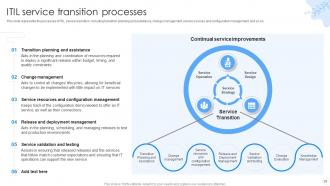
Slide 29: This slide represents the processes of ITIL service transition, including transition planning and assistance, change management, etc.
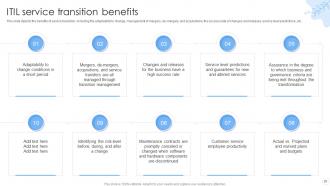
Slide 30: This slide depicts the benefits of service transition, including the adaptability to change, management of mergers, etc.
Slide 31: This slide highlights title for topics that are to be covered next in the template.
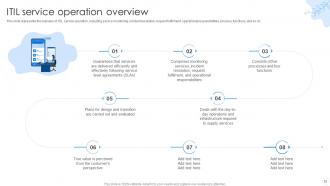
Slide 32: This slide represents the overview of ITIL service operation, including service monitoring, incident resolution, etc.
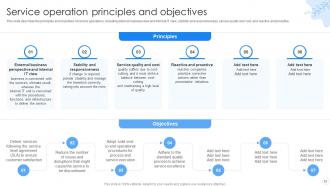
Slide 33: This slide describes the principles and objectives of service operations, including external business view and internal IT view.
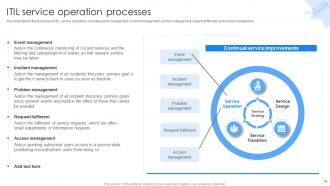
Slide 34: This slide depicts the processes of ITIL service operations, including event management, incident management, problem management, etc.
Slide 35: This slide describes the functions of ITIL service operation, including service desk, technical management, IT operation management, etc.
Slide 36: This slide highlights title for topics that are to be covered next in the template.
Slide 37: This slide defines the overview of ITIL's continual service improvement, including tracking and assessing IT service performance.
Slide 38: This slide represents the activities of continual service improvement that include a thorough analysis of procedures and operations.
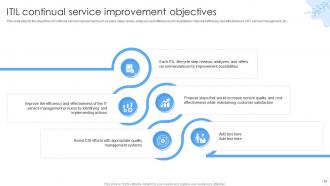
Slide 39: This slide depicts the objectives of continual service improvement such as every steps review, analyses and offering recommendations.
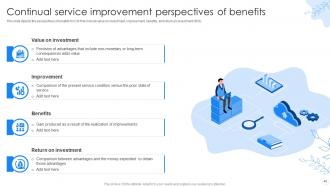
Slide 40: This slide showcases Continual Service Improvement Perspectives of Benefits.
Slide 41: This slide highlights title for topics that are to be covered next in the template.
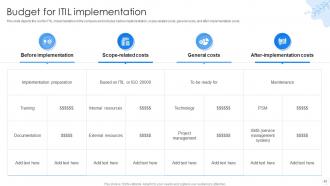
Slide 42: This slide depicts the cost for ITIL implementation in the company and includes before implementation, scope-related costs, general costs, etc.
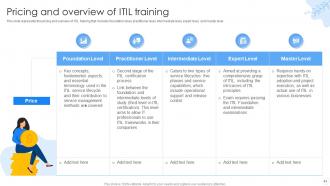
Slide 43: This slide represents the pricing and overview of ITIL training that includes foundation level, practitioner level, intermediate level, etc.
Slide 44: This slide highlights title for topics that are to be covered next in the template.
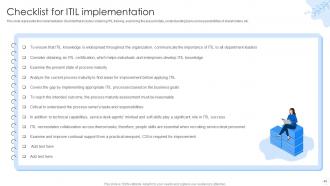
Slide 45: This slide represents the implementation checklist that includes obtaining ITIL training, examining the present state, etc.
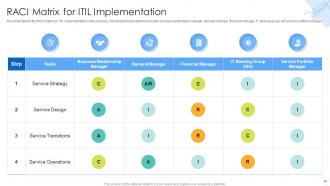
Slide 46: This slide depicts the RACI matrix for ITIL implementation in the company.
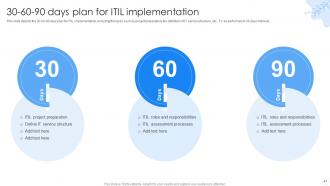
Slide 47: This slide showcases 30-60-90 Days Plan for ITIL Implementation.
Slide 48: This slide depicts the ITIL implementation roadmap, including the steps to be performed, such as the definition of process interfaces.
Slide 49: This slide depicts the implementation dashboard that covers the details of pending tickets.
Slide 50: This slide highlights title for topics that are to be covered next in the template.
Slide 51: This slide represents the ITIL impact on business, including service quality improvement, higher customer satisfaction, etc.
Slide 52: This is another slide continuing Post Implementation Impact of ITIL.
Slide 53: This slide contains all the icons used in this presentation.
Slide 54: This slide is titled as Additional Slides for moving forward.
Slide 55: This slide describes the post-implementation savings to the company through reducing help desk calls, IT maintenance, business-critical incidents, etc.
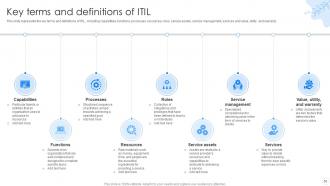
Slide 56: This slide represents the key terms and definitions of ITIL, including capabilities, functions, processes, etc.
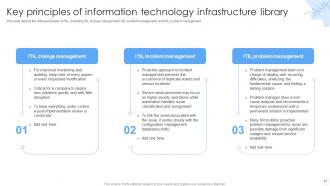
Slide 57: This slide showcases Key Principles of Information Technology Infrastructure Library.
Slide 58: This slide describes the most significant updates in the IT infrastructure library version 4.
Slide 59: This slide represents the difference between ITIL v2 and ITIL v3, based on focus, approach, security management, number of processes, etc.
Slide 60: This slide describes Line chart with two products comparison.
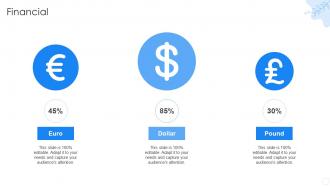
Slide 61: This is a Financial slide. Show your finance related stuff here.
Slide 62: This slide contains Puzzle with related icons and text.
Slide 63: This slide depicts Venn diagram with text boxes.
Slide 64: This slide displays Mind Map with related imagery.
Slide 65: This is Our Target slide. State your targets here.
Slide 66: This is an Idea Generation slide to state a new idea or highlight information, specifications etc.
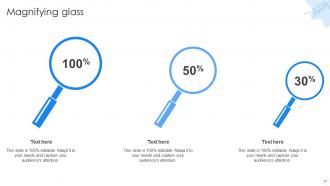
Slide 67: This slide showcases Magnifying Glass to highlight information, specifications etc
Slide 68: This is a Thank You slide with address, contact numbers and email address.
ITIL Powerpoint Presentation Slides with all 73 slides:
Use our ITIL Powerpoint Presentation Slides to effectively help you save your valuable time. They are readymade to fit into any presentation structure.





























FAQs for ITIL
ITIL's got seven principles that actually work. Focus on value first - does this help users or just create busywork? Start with what you already have instead of rebuilding everything (learned this the hard way). Progress step by step, get teams talking to each other, think about the big picture. Keep things simple and optimize before you automate - I've seen so many places automate broken processes and wonder why it's still a mess. The value question is probably where I'd start though. Seriously, just asking "does this actually matter?" kills like half the unnecessary work most teams do.
ITIL basically makes your IT services actually work for the business instead of just putting out fires all day. First thing - figure out what your company's really trying to accomplish, then build your service strategy around that. The cool part is you start measuring stuff that actually matters, like whether customers are happy, not just "did the server crash today." Way better than the old break-fix mentality, honestly. Once your services connect to real business value, even boring stuff like change management suddenly makes sense strategically. Oh and definitely map what you're doing now to actual business outcomes first.
So basically ITIL 4 ditched those rigid 26 processes for 34 flexible practices that actually work with Agile and DevOps. Way less memorization, thank god. Instead of just following steps, you get guiding principles to help make decisions. They added this four dimensions model too - covers organizations, tech, suppliers, and value streams. Oh and there's the whole Service Value System framework now. The practices are way more outcome-focused than the old process-heavy approach. If you're still stuck on v3, start thinking about how to make those processes more adaptable. Much better for how we actually work these days.
Honestly? Just pick one process first - maybe incident management since that's usually a mess everywhere. Don't go crazy trying to implement everything at once, you'll burn out your team. Get your leadership on board early, that's non-negotiable. Those official ITIL training courses are kinda boring tbh, but the concepts are solid. Way better to adapt stuff to how your company actually works rather than forcing some textbook approach. Oh, and start measuring results from day one - you'll need those numbers later to prove it's working. Master one thing, then move on to the next.
CSI stops ITIL from getting stuck in the past - you're always measuring and tweaking services based on real data and feedback. It weaves through every other ITIL process, so when you're fixing incidents or rolling out changes, there's this constant "how can we do this better?" mentality. Honestly, the whole thing falls apart without it. Don't try to boil the ocean though. Pick one process, get some solid metrics going, then make changes based on what the numbers actually show you. The "never settle" approach really does pay off once you get into the rhythm.
So ITIL 4 actually gets digital transformation now - way better than the old rigid stuff. It's all about value streams and teams working together instead of following boring processes. The cool part? It plays nice with DevOps and Agile finally, so you're not juggling competing frameworks anymore. Focus on agility and continuous improvement - that's where it shines. Customer experience is huge too. Oh, and their service value system thing is actually useful for mapping how digital changes mess with your whole delivery chain, not just the tech side. Much more practical than I expected honestly.
So ITIL breaks down into five stages - Service Strategy (figuring out what services you actually want to offer), Service Design (mapping out new or changed services), Service Transition (building and rolling stuff out), Service Operation (the daily grind of keeping things running), and Continual Service Improvement (basically making everything suck less over time). It's set up like a cycle where each piece connects to the next. Honestly, if you're just getting into this whole ITIL thing, start with Service Operation since your team's probably already doing most of that work anyway. The big idea is you're always improving instead of just treading water.
ITIL's honestly a game-changer for this stuff. You'll get proper escalation paths and priority matrices so nothing gets lost when everything's on fire. Service requests become way more manageable too - standardized workflows mean no more random "quick favor" interruptions that totally derail your focus. The tracking alone is worth it. You can actually spot patterns instead of just putting out fires all day. Priority matrices sound boring but they're clutch for keeping management happy. I'd start by comparing what you're doing now against ITIL's incident flow and see what's missing.
So the Service Value System is ITIL 4's way of looking at the whole picture - how everything in your org actually creates value together. Gone are the days of just rigid processes. Now you've got guiding principles, governance, practices, and improvement stuff all working as one system. It's like your service management operating system, honestly. What I love about it is the flexibility - you can actually adapt it to fit your situation instead of cramming yourself into some cookie-cutter approach. Oh, and definitely start by figuring out how your current stuff maps to the SVS pieces.
Honestly, ITIL v4 works surprisingly well with agile and DevOps now. Way more flexible than the old version. You can map your DevOps pipelines to ITIL's service value streams - helps you see if you're actually delivering value or just shipping code for the sake of it. The framework's big on continuous improvement and collaboration now, which fits agile perfectly. One thing I really like is how ITIL's incident management keeps things stable while you're moving fast. Pure agile can be a bit chaotic sometimes. I'd start by mapping what you're already doing to see where you need better visibility.
Honestly, the worst thing companies do is treat ITIL like some sacred rulebook they can't touch. Don't try implementing everything at once - learned that the hard way! Start with maybe two processes max. People will push back hard if you don't get them on board early, and most places totally underestimate how much the culture has to shift. Oh, and here's something that drives me nuts: organizations get so obsessed with fancy tools and perfect documentation that they forget actual humans have to use this stuff daily. Pick what works for your team first, then build from there.
ITIL basically gets your whole team speaking the same language, which honestly makes such a huge difference. No more of those awkward "wait, what?" moments during incident calls. Everyone follows the same procedures and knows exactly who handles what - way less chaos. The regular service reviews are clutch too because info actually flows between teams instead of getting trapped in weird departmental bubbles. I'd say pick just one process to start with (don't go crazy trying to do everything at once). You'll be shocked how much smoother conversations get once people aren't constantly talking past each other.
Track incident resolution times and first-call resolution rates - those show quick wins. Customer satisfaction scores matter too, obviously. Here's the thing though - you HAVE to get baseline measurements before starting anything (trust me on this one, I've seen people skip it and regret it). Change success rates and cost per ticket are solid metrics. Don't go crazy with too many at once. Pick 3-4 that your stakeholders actually care about. Service availability and employee productivity round out the basics. Check in quarterly and tweak what you're measuring based on results.
So ITIL basically forces you to get your act together with change management. No more cowboy updates - everything needs a formal request and risk assessment first. Minor changes can zip through pretty quick, but big stuff goes to the Change Advisory Board for the full review. Honestly, it sounds like overkill until you've dealt with a 2am production outage because someone "just quickly deployed a hotfix." The whole thing categorizes changes by risk level and makes you plan rollback procedures. Documentation is huge too - trust me, you'll thank yourself later when you're not scrambling to figure out what broke.
Look, service design is where you map out how your IT services will work before building anything. Really important stuff - helps you nail down requirements, processes, and dependencies upfront instead of fixing disasters later. You're creating a blueprint for services that actually meet business needs. Honestly, I've seen too many teams skip this and regret it big time. The design phase hits everything: capacity planning, security requirements, support once it goes live. Oh and here's the key - figure out what the business truly needs first, not just what they're asking for. Those are usually two different things.
-
SlideTeam provides PPTs on every single topic. Their templates suit my job very well. I am very grateful!
-
SlideTeam has helped me take my presentation to the next level. Everyone at the office is impressed! I’ll be using their designs for a long-long time.