


Data Center IT Powerpoint Presentation Slides




Try Before you Buy Download Free Sample Product
 Impress Your
 Audience
 100%
100% Editable
 Save Hours
 of Time


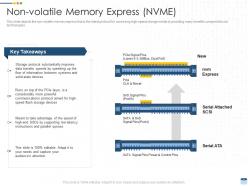
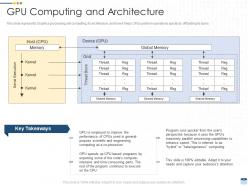
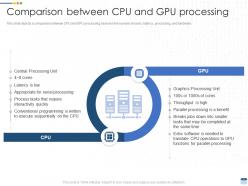
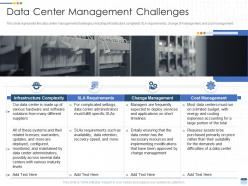
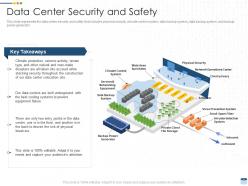
A data center is a geographic place where businesses keep their mission critical programs and data. The architecture of a data center is built on a network of computer and storage capabilities that help share data and applications to be delivered. This PowerPoint presentation gives a brief idea about a data center company, its values, and the reason for choosing it as a data center provider. In this Data Center PowerPoint Presentation, we have covered the importance of the data center, its architecture, and architectural components. In addition, this Information Center PPT contains four data center infrastructure tiers and various components of data centers. Also, the PPT presentation covers different types of data centers such as colocation, enterprise, edge, cloud, and so on. Furthermore, this Data Center template includes multiple technologies that are used in data centers such as HCI, containers, microservices, NVMe, SDN, GPU, etc. It also caters working of data centers, data center management challenges, and data center infrastructure management and monitoring. Lastly, this Information Center deck comprises data center security, a comparison between a data center and other technologies, a 30-60-90 days plan, a timeline, and a roadmap to an autonomous data center. Download our 100 percent editable and customizable template which is also compatible with Google Slides.
People who downloaded this PowerPoint presentation also viewed the following :
Content of this Powerpoint Presentation
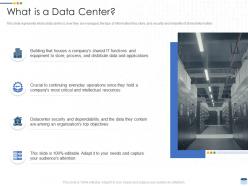
A company depends on huge files and heavy applications stored in a data center. A data center enables the business to protect the proprietor's systems and files, centralize IT and data processing, apply security controls to systems and data, and store all sensitive systems in one place.
Are you looking to relocate your data and assets from one data center to another? Explore these custom-ready PowerPoint Templates on Data Center Relocation For IT Systems Evaluation.
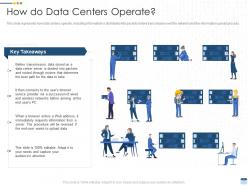
Initially, computer hardware was difficult to operate and maintain. It consumed large amounts of power and needed cooling to prevent overheating. Hence, data centers emerged in the 1940s. These mainframes were then placed in data centers to manage pain points. With time, the data became more complex, and the design of data centers also evolved. From small server rooms, they are now geographically scattered buildings, and private and public clouds.
We at SlideTeam have curated these PowerPoint Slides on a data center that will effectively inform the reader of its values, importance, architecture, etc. These slides are pre-designed, 100% editable and customizable. They provide you with much needed structure for your presentation.
Let’s explore a few of the templates from the bundle!
Template 1: Values of the Data Center
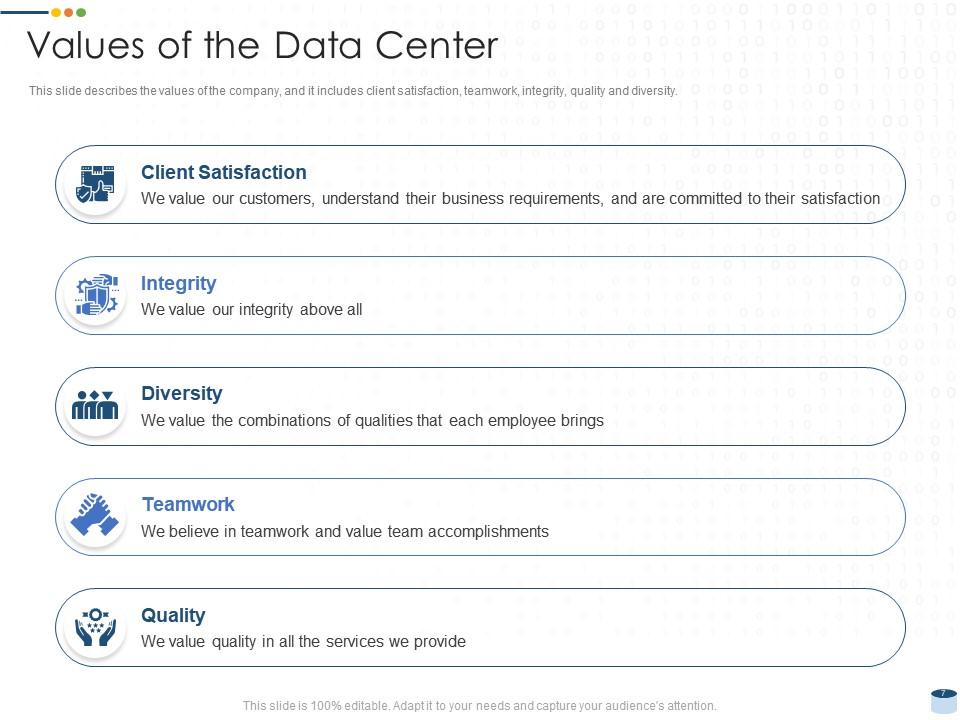
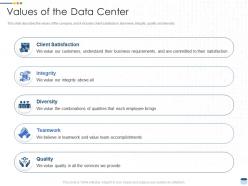
The mentioned slide describes the values of the data center or company and their respective icons. These values include client satisfaction, integrity, diversity, teamwork, and quality. Including this slide in the presentation fosters transparency and trust in the company.
Template 2: Why are Data Centers Important to Business?
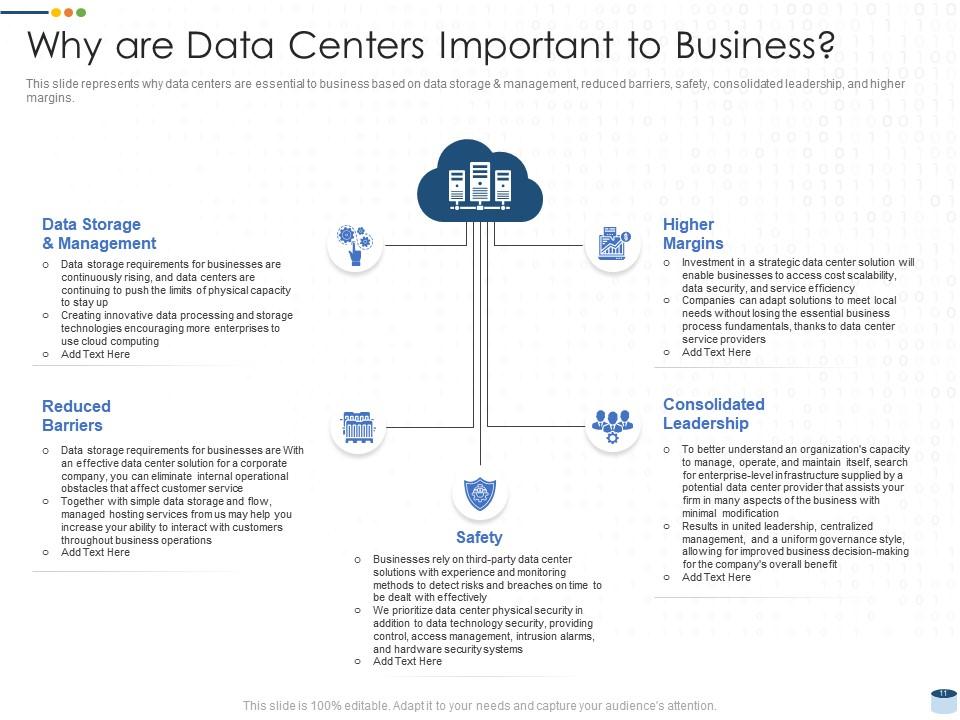
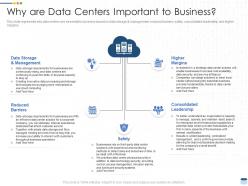
This Template design highlights the importance of data centers to a business. It showcases the information in the form of a diagram with icons. The points of importance highlighted in this slide are data storage and management, reduced barriers, higher margins, consolidated leadership, and safety.
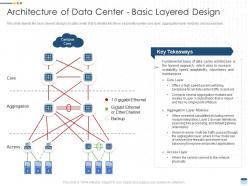
Template 3: Architecture of the Data Center- Basic Layered Design
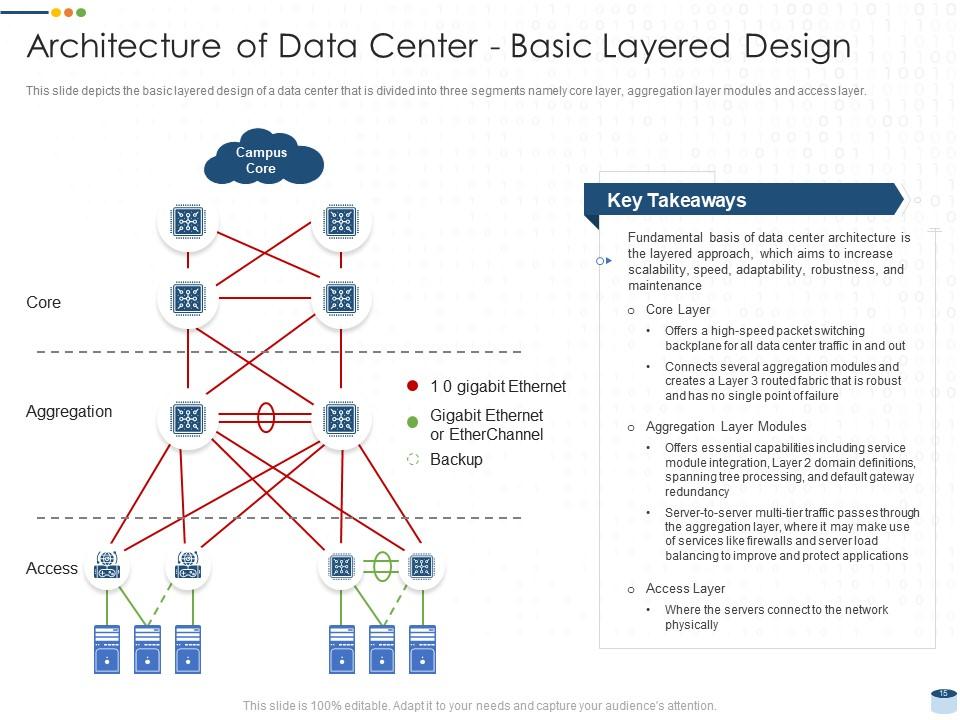
The given PPT Template depicts the basic layered design of the data center, which is divided into three-segments: core layer, aggregation layer modules and access layer. The red lines in the illustration represent 1 0 gigabit ethernet, the green one shows EtherChannel and the dotted green represents backup lines. There is also a section to highlight the key takeaways of every layer.
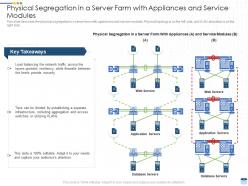
Template 4: Physical Segregation in a Server Farm with Appliances and Service Modules
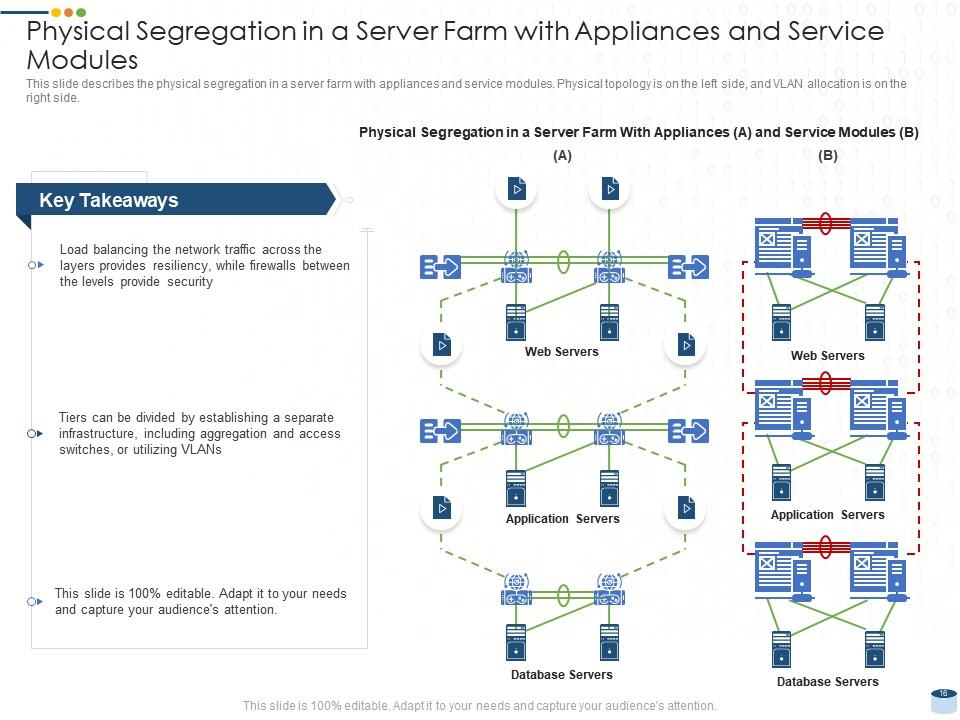
The following Slide illustrates physical segregation in a server farm. The physical topology is on the left side, and VLAN allocation is on the right. It includes elements like web servers, application servers, and database servers. This slide has a separate column where you can add the key takeaways.
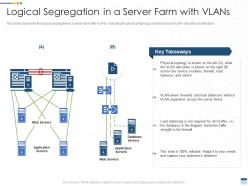
Template 5: Legal Segregation in a Server Farm with VLANs
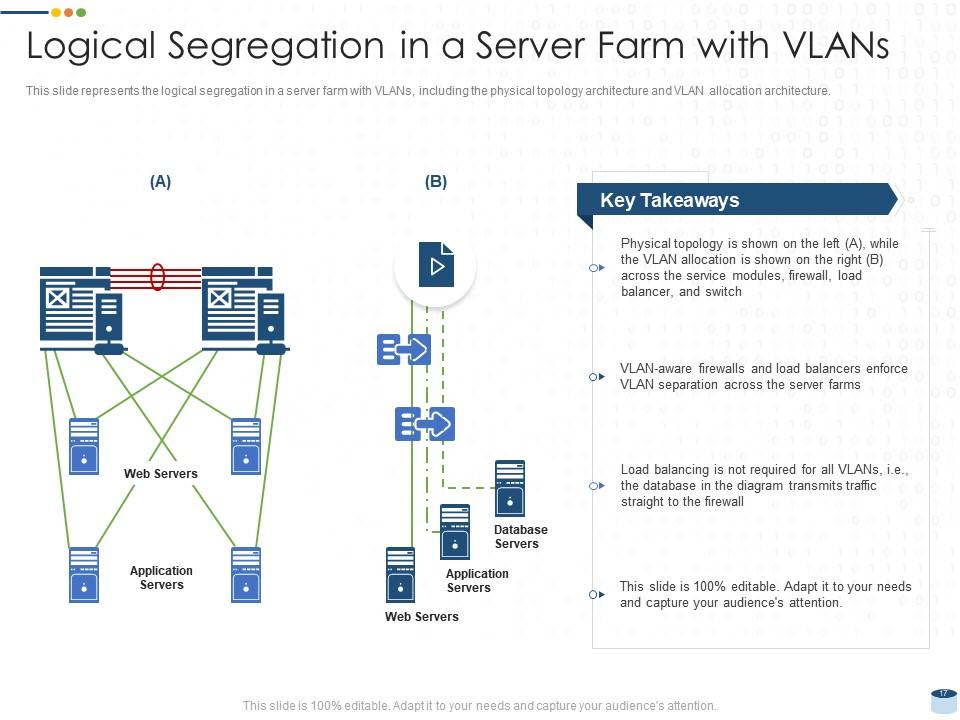
This Template showcases how Virtual Local Area Networks (VLANs) allow isolation inside a server farm. The key takeaways included in this slide are shown with the help of 2 graphics, A and B. It shows the physical topology design with VLAN allocation architecture, depicting how VLANs divide network traffic to boost security and optimize resource allocation.
Template 6: Core Components of Data Centers
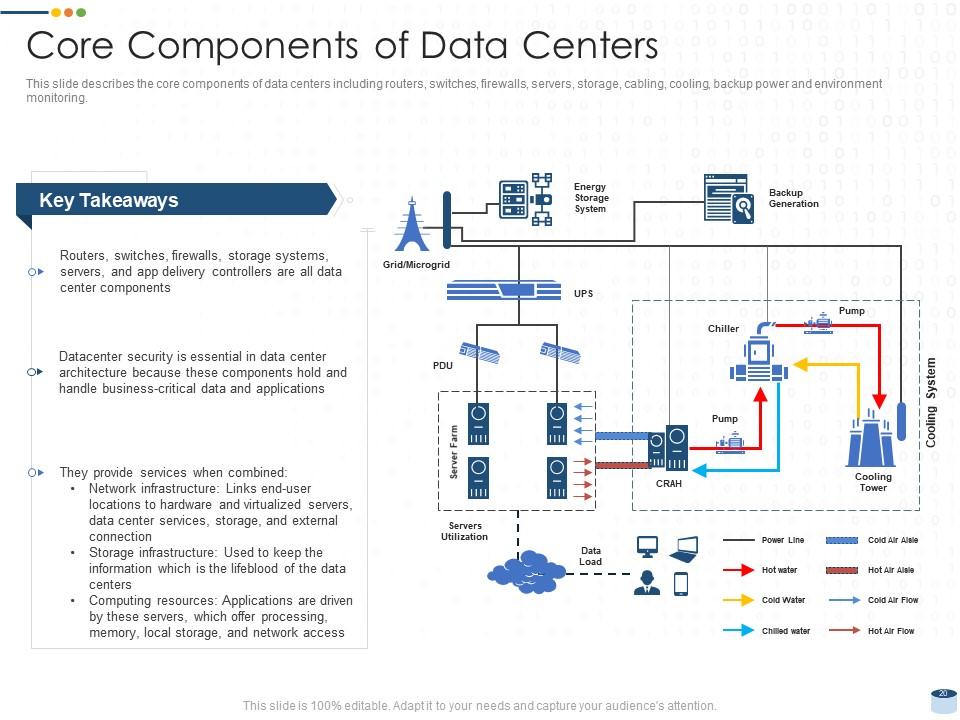
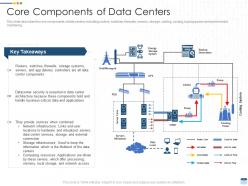
This Slide showcases fundamental features important for the smooth functioning of the data center. The graphic included in this template highlights routers, switches, and firewalls for managing networks, servers, and storage for data processing, cabling for connectivity, backup power for uninterrupted operations, and more. The brief overview enables stakeholders to understand the basic infrastructure supporting data center operations.
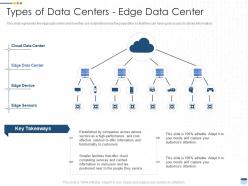
Template 7: Types of Data Centers- Edge Data Center
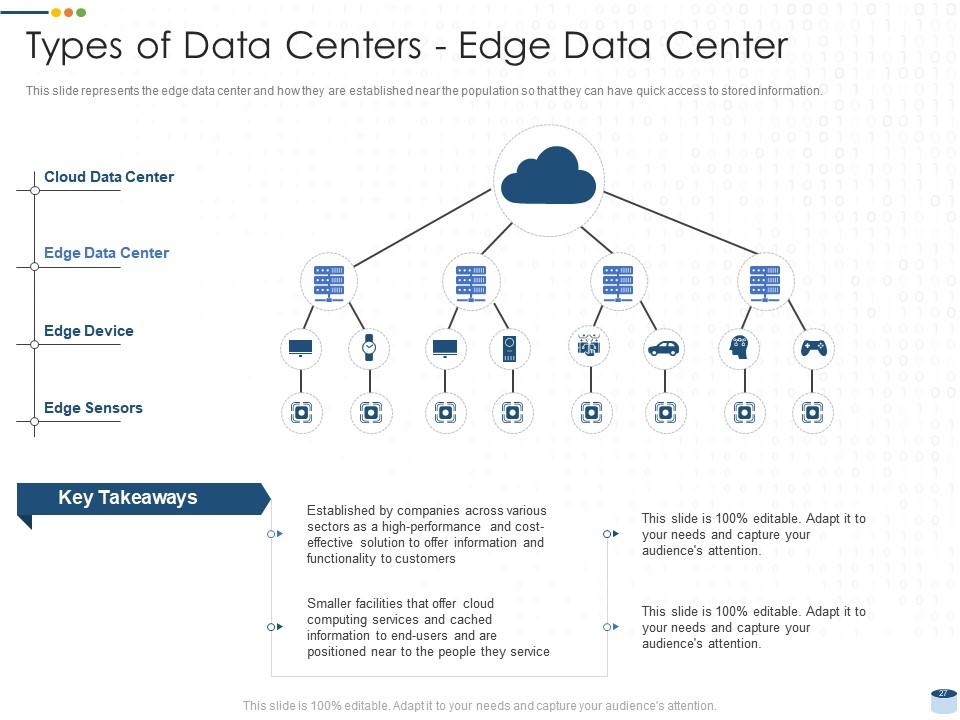
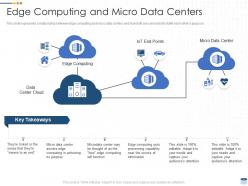
This Template showcases data centers purposefully positioned near people to decrease delay and increase data access speed. The slide includes visually engaging graphics with key takeaways for easier comprehension. Further, these data centers highlight the role of delivering fast and effective access to stored information for users closer to the data source.
Template 8: What is a Virtual Data Center?
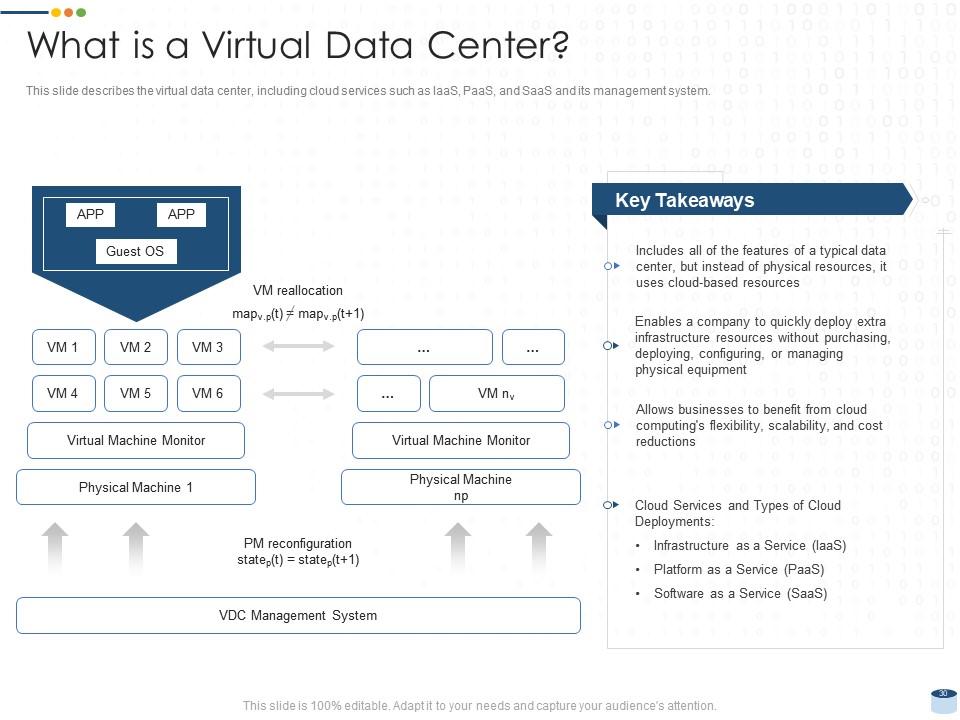
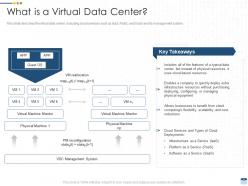
This Slide showcases a virtualized architecture that resembles traditional data centers in a cloud environment. It includes cloud services such as Infrastructure as a Service(IaaS), which offers processing resources; Platform as a Service (PaaS), which develops platforms; and Software as a Service (SaaS), which delivers software applications.
Template 9: Software-defined Networking (SDN)
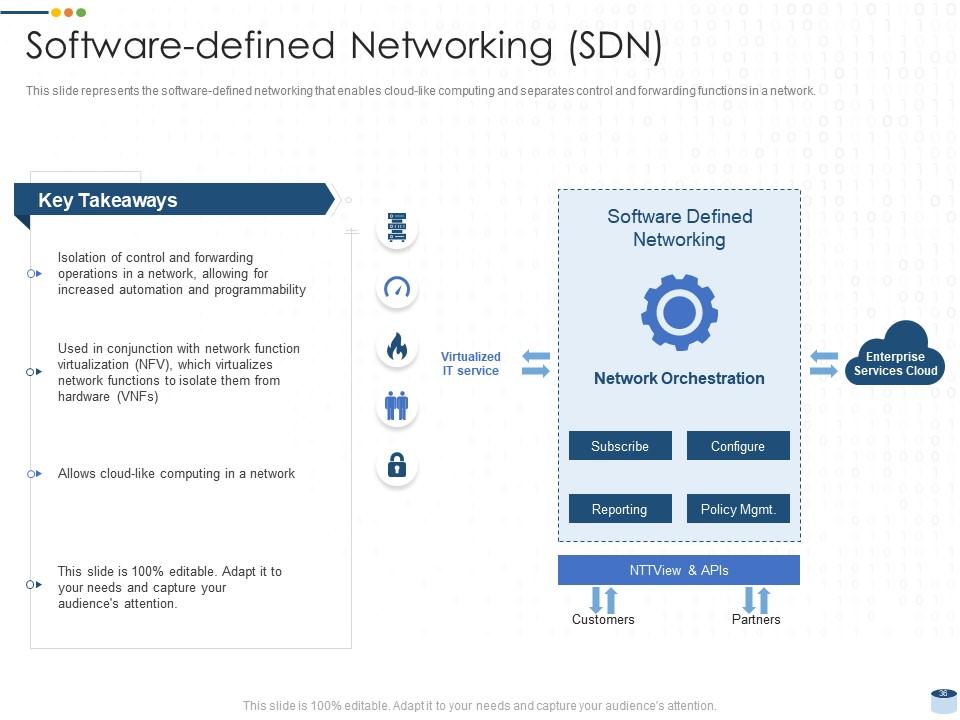
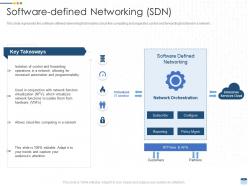
This Slide showcases the innovative concept of separating network control and forwarding operations, allowing for shifting programmable network management. It highlights how SDN alters traditional networking designs to provide cloud-like computing environments with better agility and flexibility. The template includes unique icons and key takeaways, enhancing its visual appeal.
Template 10: Data Center Infrastructure Management and Monitoring
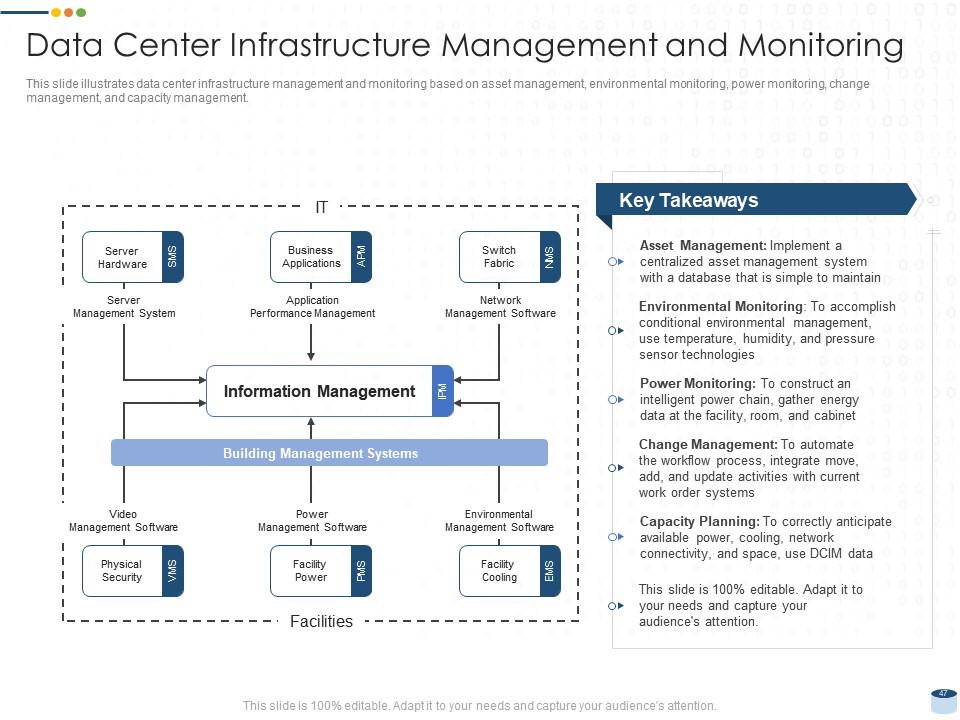
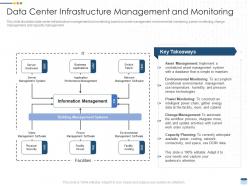
This Slide showcases a comprehensive overview of important features relevant to functional data center operations. This template includes a graph explaining information management. In addition, key takeaways like asset management, environmental monitoring, power monitoring, change management, and capacity planning are also included.
Reliability and Security
In the IT world, data centers are designed to support multiple business applications and activities, such as email sharing, customer relationship management, big data, machine learning and artificial intelligence. Employ these slides for an impactful design and flawless communication of the complex details of data centers.
Are you looking to modernize the infrastructure of your data center? Streamline the process using these PPT Slides, which guide the process and management solution.
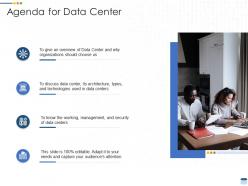
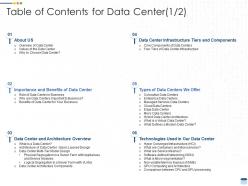
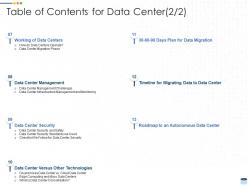
Data Center IT Powerpoint Presentation Slides with all 73 slides:
Use our Data Center IT Powerpoint Presentation Slides to effectively help you save your valuable time. They are readymade to fit into any presentation structure.
FAQs for Data Center IT
Honestly, start with the basics: servers for compute power, storage systems, and networking to connect everything. Power and cooling are huge - learned that the hard way when our AC died last summer! You'll need monitoring tools to catch issues before they explode, plus decent backup systems. Security can't be an afterthought either. Virtualization is pretty much standard now for getting more out of your hardware. Built-in redundancy saves your butt when things go sideways. I'd audit what you have first, then tackle your worst bottlenecks.
Oh dude, virtualization is seriously where it's at. You know how you've got servers just sitting there barely doing anything? Like 15% usage tops? Well, you can cram 10-20 virtual machines on one physical box and actually hit 70-80% capacity. Back in the day we had so much hardware just collecting dust - kinda wasteful honestly. The cool part is moving stuff around when traffic spikes, which makes everything way more efficient. I'd start with whatever servers are doing the least work and virtualize those first. Trust me on this one.
Honestly, start with the boring stuff first - good physical security like biometric locks and mantraps. Network segmentation is huge too, you want to isolate your critical systems. Most companies I've worked with totally botch this part. Get 24/7 monitoring set up and do regular vulnerability scans. Zero-trust architecture sounds fancy but it's basically just "trust nobody." Role-based access controls help with insider threats, which are way more common than people think. The trick is making sure all these layers actually work together instead of against each other. I'd audit what you have now first.
So basically you're switching from owning all your servers to just renting what you actually use. Way better than having expensive hardware sitting around doing nothing most of the time. You can scale up instantly when you need it, then back down - finance teams love this since it's operational costs instead of big upfront purchases. Sure, you lose some control and might get stuck with one vendor, but honestly? For most stuff the savings are worth it. Oh and you don't deal with those annoying hardware refresh cycles anymore. I'd start by figuring out which apps have the most unpredictable workloads first.
Dude, you literally can't run a modern data center without automation anymore. We're talking thousands of servers here - no way you're doing that by hand. Tools like Ansible, Terraform, and Kubernetes handle everything from spinning up new instances to monitoring and patches. Way fewer screwups than when humans were doing it all manually, plus deployments are lightning fast now. Honestly, infrastructure-as-code was a total game changer. If you're not automating yet, just start with something easy like backups or routine maintenance. Trust me on this one.
Start with cooling - that's where you're bleeding the most energy. Most data centers are freezing cold for no reason, so try liquid cooling or hot aisle setups and crank up those temps a bit. Server virtualization cuts down your hardware needs big time. When you're replacing stuff anyway, go for energy-efficient options. Oh and definitely get a renewable energy contract if you can swing it. Track your PUE first though - you can't improve what you don't measure, right? That baseline will show you if this stuff actually works.
Look, you absolutely need a solid backup plan, but here's the thing - test your recovery stuff constantly or you're screwed when things break. Get your data replicated offsite to multiple spots. Write down step-by-step instructions your team can actually follow during chaos (trust me on this one). Don't set crazy ambitious recovery targets just to impress executives. RPO and RTO should match what your business actually needs. Run practice drills because you'll find holes you never expected. Oh, and figure out your most critical systems first, then work backwards from there.
So data centers basically build redundancy into everything - dual power feeds, backup network paths, failover clusters at each level. Most use leaf-spine or three-tier setups where traffic just reroutes automatically if a switch dies. Think of it like having multiple escape routes in a building, you know? They'll also run separate internet connections from different ISPs plus geographically spread backup sites. Oh, and here's the thing - always design assuming stuff WILL break. Seriously, plan at least two workarounds for everything. Way better to be paranoid upfront than scrambling later.
Honestly, liquid cooling is finally having its moment - way better than air cooling for those crazy high-density setups. Edge computing's probably the biggest game changer though, gets your processing right where users need it. Software-defined infrastructure lets you virtualize pretty much everything now. Oh and AI monitoring tools? They're getting weirdly accurate at catching stuff before it breaks - kinda freaky but useful. I'd just pick whatever fixes your worst headache first. Heat issues? Go liquid cooling. Latency driving you nuts? Edge computing's your answer.
So basically you put mini data centers closer to where your stuff actually happens - like near your IoT devices or wherever you need super fast responses. Your main data center still does the heavy work and storage, but these edge spots handle the quick decisions locally. Cuts down on that back-and-forth data shuffling which honestly gets expensive fast. Way less latency too since everything's not traveling across the country. Figure out what actually needs those crazy-fast millisecond responses first - that's where edge computing really shines. Most workloads don't need it but when you do, it's a game changer.
Start with PUE and uptime dashboards - those'll give you the most useful info right off the bat. Server utilization rates and cooling effectiveness are huge too. Temperature and humidity monitoring is a must because fried servers aren't fun to explain to your boss. Network latency, storage performance, and how much rack space you're burning through matter for capacity planning. MTBF and MTTR help you track hardware reliability - honestly wish more people paid attention to those. Oh, and don't sleep on monitoring overall power efficiency since that's where costs can really spiral.
Dude, AI is completely changing data centers right now. Predictive maintenance is huge - it'll actually tell you when equipment's about to fail so you're not scrambling with emergency repairs. The power management stuff is honestly pretty wild too. It automatically tweaks cooling based on heat maps and server loads in real time. Oh, and workload placement - the AI just figures out which servers are most efficient for whatever you're running. Though honestly, I'd start with something simple like temperature monitoring first. Don't jump into full automation right away, that's asking for trouble.
Honestly, start with your cooling setup - hot/cold aisle containment will save you so much headache later. PDU placement is huge too, make sure you've got redundant power feeds mapped out. Most people totally blow the floor space calculation and regret it when they need to expand. I learned this the hard way at my last job. Security zones matter, plus you need clear paths for cables and emergency access. Oh, and check your ceiling height early - you'll need room for cable trays and HVAC stuff. Really though, don't even touch rack layouts until you've done a proper power and cooling assessment first.
Honestly, get a cloud management platform first - something that works across AWS, Azure, whatever you're using. That way you're not constantly switching between different dashboards (which will drive you insane). Set up proper tagging and governance right from the start because I've seen people try to fix that mess later and it's brutal. Standardize your monitoring and security stuff early too. Automate the provisioning where you can to keep everything consistent. Oh, and make sure your whole team actually knows how to use whatever tool you pick - sounds obvious but you'd be surprised.
Honestly, compliance is going to dictate pretty much everything about your data center setup. First thing - figure out which regulations hit you. HIPAA if you're dealing with health data, SOX for financial stuff, GDPR for anything EU-related. Each one has its own headache-inducing requirements for security controls and documentation. I swear the paperwork alone will drive you nuts, but you can't skip it. Your whole infrastructure gets shaped by this - encryption standards, who can access what, how long you keep backups, incident response plans. Map out these technical requirements early or you'll be scrambling later.
-
I want a power point presentation about data center
-
Amazing product with appealing content and design.
-
Very unique, user-friendly presentation interface.