


Biotech pitch deck ppt template




Try Before you Buy Download Free Sample Product
 Impress Your
 Audience
 100%
100% Editable
 Save Hours
 of Time


Biotech firm is focusing on enhancing efficacy and safety profile for each therapy. Here is a professionally designed pitch deck on Biotech Company that caters for information about an emerging firm and focuses on raising capital through potential investors. It caters for slides about chronic disease patients face, disease relevancy across the globe, pain points associated with disease treatment, solutions rendered for effective treatment, etc. The deck presents the firms value proposition associated with the biotech firms product, addressable market size opportunity, profitable business model, success drivers, etc. One can also exhibit a competitive landscape for significant players existing, biotech firm growth over the years in a timeline format, capital requirements, financial projections, and more. The template guides you in displaying clients associated, people involved in the biotech firms executive management, board members and advisors related to the platform, and future initiatives. The templates are fully editable and compatible with Google slides. Book a free demo with our research or design team and customize this pitch deck based on your specific needs. Download it now.
People who downloaded this PowerPoint presentation also viewed the following :
Content of this Powerpoint Presentation
Slide 1: This slide introduces Biotech Pitch Deck. State Your Company Name and begin.
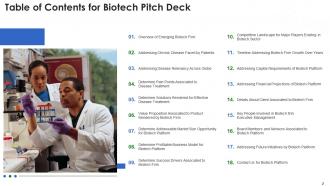
Slide 2: This slide shows Table of Contents for Biotech Pitch Deck.
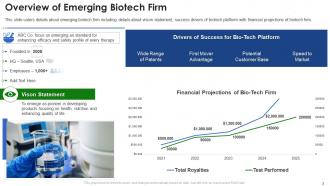
Slide 3: This slide presents emerging biotech firm including details about vision statement, success drivers, etc.
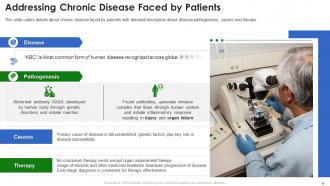
Slide 4: This slide shows chronic disease faced by patients with detailed description about disease pathogenesis, causes and therapy.
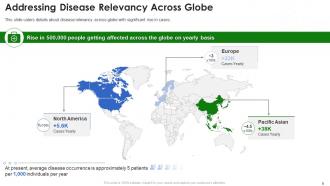
Slide 5: This slide displays details about disease relevancy across globe with significant rise in cases.
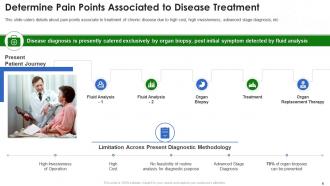
Slide 6: This slide represents details about pain points associate to treatment of chronic disease due to high cost, high invasiveness, advanced stage diagnosis, etc
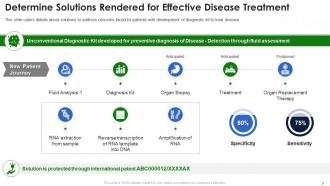
Slide 7: This slide caters details about solutions to address concerns faced by patients with development of diagnostic kit to treat disease.
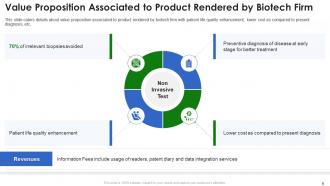
Slide 8: This slide presents Value Proposition Associated to Product Rendered by Biotech Firm.
Slide 9: This slide shows Determine Addressable Market Size Opportunity for Biotech Platform.
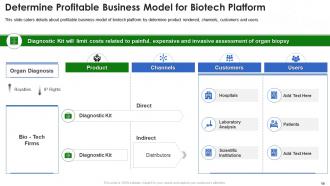
Slide 10: This slide displays Determine Profitable Business Model for Biotech Platform.
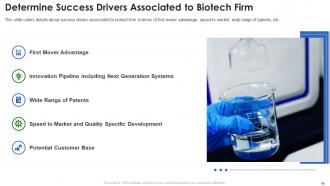
Slide 11: This slide represents Determine Success Drivers Associated to Biotech Firm.
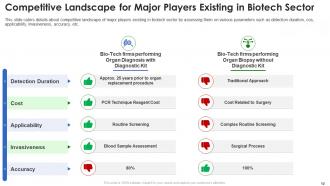
Slide 12: This slide shows Competitive Landscape for Major Players Existing in Biotech Sector.
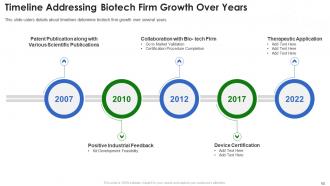
Slide 13: This slide presents details about timelines determine biotech firm growth over several years.
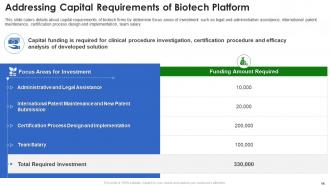
Slide 14: This slide caters details about capital requirements of biotech firms by determine focus areas of investment.
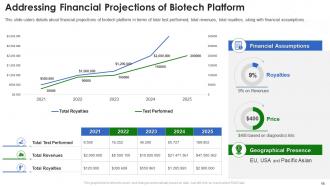
Slide 15: This slide displays financial projections of biotech platform in terms of total test performed, total revenues, etc.
Slide 16: This slide represents details about clients associated to biotech platform in terms of major clients and client testimonials.
Slide 17: This slide shows Key People Involved in Biotech Firm Executive Management.
Slide 18: This slide presents details about board of members and advisors associated to Biotech platform.
Slide 19: This slide caters details about future initiatives by Biotech platform that will focus on leveraging connections.
Slide 20: This slide displays Contact Us for Biotech Platform.
Slide 21: This slide represents Icons for Biotech Pitch Deck.
Slide 22: This slide is titled as Additional Slides for moving forward.
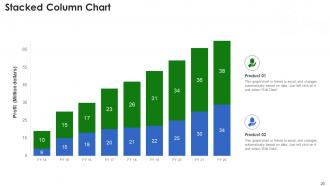
Slide 23: This slide presents Stacked Column Chart with two products comparison.
Slide 24: This is an Idea Generation slide to state a new idea or highlight information, specifications etc.
Slide 25: This slide displays Venn diagram with text boxes.
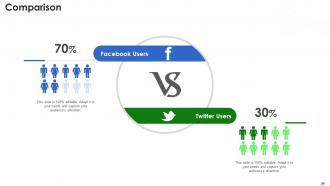
Slide 26: This is a Comparison slide to state comparison between commodities, entities etc.
Slide 27: This slide shows Roadmap with additional textboxes.
Slide 28: This slide presents Magnifying Glass to highlight information, specifications etc
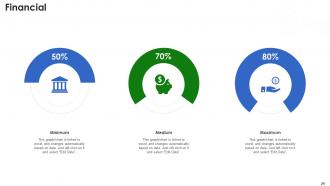
Slide 29: This is a Financial slide. Show your finance related stuff here.
Slide 30: This is a Thank You slide with address, contact numbers and email address.
Biotech pitch deck ppt template with all 30 slides:
Use our Biotech Pitch Deck Ppt Template to effectively help you save your valuable time. They are readymade to fit into any presentation structure.


FAQs for Biotech pitch
For your biotech deck, hit the essentials: the medical problem you're solving, your tech solution, market size, competition, and development timeline with milestones. Regulatory pathway matters too. Definitely include your IP status and any clinical data - even early stuff impresses investors way more than just theory. Team slide is critical since biotech execution is brutal and VCs know it. Stick to 10-12 slides but prep backup slides for the inevitable technical deep-dive. Oh, and don't forget financials with your funding ask - sounds obvious but you'd be surprised how many people rush through that part.
Visual charts are clutch for biotech pitches - they turn your messy data into something VCs can actually digest. Raw spreadsheets make people's brains shut off immediately. Heat maps work well for genomic stuff, bar charts are perfect for dose-response data. You're basically translating science without making it feel like kindergarten, which is trickier than it sounds. Market projections and clinical outcomes hit way harder when they're visual. Oh, and always lead with your strongest data point - don't bury the good stuff. The whole goal is telling a story they can follow.
Honestly? The biggest mistake is drowning them in jargon. Yeah, your science is complex, but explain it clearly without making it sound like a textbook. Skip the market slide and you're dead - VCs need to see huge opportunities, not just cool tech. I get it, you want to show off every data point (trust me, been there), but resist cramming everything in. Be realistic about regulatory stuff and timelines. Nobody likes surprises later. Oh, and nail your value prop in those first few slides. Confuse them early and they'll check out mentally.
Start with the patient problem, not your fancy science. Work backwards from there - just give enough technical stuff to seem credible. I always tell people to use analogies that actually make sense... like comparing drug delivery to how Amazon gets packages to your door or whatever resonates. Most founders I know totally bomb this part. They dive into molecular mechanisms and watch investors' eyes glaze over. Keep it visual - simple diagrams beat walls of text every time. Here's the real test: explain your core tech in 30 seconds without any jargon. If your mom doesn't get it, you're screwed.
Okay so market analysis is your reality check - shows investors you actually get the business side, not just the science. Break down market size, growth potential, who you're competing against. Proves real demand exists for what you're building. Honestly, I've seen way too many biotech pitches that are pure science with zero business logic - instant red flag. You need to show people will actually pay for this stuff and justify your valuation. Don't just throw around those crazy big TAM numbers either. Break it into realistic segments you can actually reach. That's what matters.
Dude, start with the human story first - like an actual patient dealing with whatever condition you're tackling. Way more powerful than jumping into your tech specs right away. Investors might love data, but they're still human, you know? Paint the picture of what daily life looks like for these patients, then boom - here's how your science swoops in to change everything. Show that before/after transformation clearly. Oh and definitely circle back to real patient outcomes throughout your pitch. Makes all those numbers actually mean something instead of just looking fancy on slides.
Map out your competition first - direct ones hitting the same disease with similar tech, plus indirect players using different approaches. Big pharma too if they're lurking around. But honestly, just listing competitors is pretty useless. Show what makes you different instead. Maybe it's your mechanism, patient focus, safety data, or timing advantages. Don't sugarcoat their strengths, but make your edge crystal clear. A simple matrix works great here - position yourself well but keep it believable, not fantasy.
Honestly, just dump your strongest data right up front - lab results, animal studies, whatever actual proof you've got. Skip the fancy graphics and show real screenshots from your experiments instead. Investors see through the BS pretty quick. Got any partnerships with universities or pharma companies? That's gold - means someone else already thinks you're legit. Be super honest about where you're at though. Don't oversell stuff you haven't proven yet, it'll bite you later. Oh, and definitely map out your next few milestones so they know you've thought this through.
Hey! So you'll want 3-5 year revenue projections - the usual stuff. Show your big milestones tied to funding rounds, plus when you'll actually turn a profit. R&D spend is huge in biotech, so break down clinical trial costs and regulatory expenses. Honestly, that's where most of your cash will disappear anyway. Market size assumptions matter too - how much can you realistically grab once your product hits? Keep numbers ambitious but not crazy. Have a detailed backup model ready because investors will absolutely grill you on everything during due diligence. Oh, and make sure you can actually defend your assumptions!
Start with your scientific creds right away - investors need proof you can actually pull this off. Show them your PhD, any big journal publications, biotech experience, plus regulatory stuff if you've got it. But here's the thing - don't just dump a list of titles. Connect each person's background to your exact problem. Working on cancer drugs? Emphasize that oncology research history, not random biology work. Definitely include some respected advisors too since a good KOL really validates what you're doing. Make it obvious why your specific team can solve this particular puzzle.
Focus on your regulatory pathway first - that's what investors really care about. Show them your FDA meetings, IND status, any fast track designations. Map out Phase I/II/III timelines with actual milestones, not vague dates. The regulatory piece is honestly boring as hell but it makes or breaks everything. Don't forget international strategy if you're going global later. What investors want is proof you're not just winging it. They need to see you've got a realistic shot at approval, not some pipe dream that falls apart at the first FDA hurdle.
Dude, I can't stress this enough - your deck's design actually matters way more than people realize. Yeah, the science is everything, but these investors are drowning in presentations every week. A polished look shows you're detail-oriented and serious about your company. I've literally watched amazing research get passed over because the slides looked like garbage. You don't need some fancy designer or anything, but clean fonts, decent charts, and colors that don't make people's eyes bleed? That stuff adds up. Even basic design work will set you apart from the mess most founders submit.
Start with patient stories and hard numbers - that's what actually moves people. Like "affects 50 million patients" or "current treatments fail 40% of the time." Show a cascade slide too, where solving one rare disease opens up ten others (investors eat that up honestly). Side-by-side visuals work great for current vs. your approach. The economic piece matters more than you'd think - payers want to see cost savings potential. Oh, and definitely include a timeline showing when patients could actually see benefits from your work. Real-world data beats fancy projections every time.
Don't hide the risks - investors already know biotech is messy. Frame them as problems you're actively tackling instead. Like "yeah, regulatory approval usually takes forever, but we've got pre-IND meetings locked in and just hired FDA's former division head." That's way better than pretending everything's smooth sailing. Honestly, what makes founders stand out isn't having zero risks - it's proving you actually get what you're up against. Always pair each challenge with real proof you're handling it. Partnerships, data, whatever shows you're not just crossing your fingers and hoping things work out.
Focus on your clinical stuff first - trial phases, how many patients you've enrolled, regulatory wins. FDA submission dates and data readouts are what investors actually care about. Financial-wise, it's burn rate and runway to your next big milestone, not revenue (obviously lol). Market size matters but honestly partnership deals and grants hit different - shows real validation. Don't forget patent status and any big-name scientist hires. The whole point is showing how each win makes you less risky and worth more money.
-
Easily Editable.
-
Great quality product.
-
Attractive design and informative presentation.