


Financial pitch deck ppt template





Try Before you Buy Download Free Sample Product
 Impress Your
 Audience
 100%
100% Editable
 Save Hours
 of Time


Raising capital from investors is a difficult task and requires a great pitch, even the founders are well experienced. Here is a competently designed pitch deck on Financials that will be beneficial to the company seeking funding of a few thousand dollars or several million dollars. The structure covered in the presentation starts from a company overview slide that company can use to highlight its business covering vision, mission, and financials. The company overview slide is followed by the founding members of the company slide, which the company can use to tell investors about the key members. The company can use slides to highlight funding, milestones, and market projections, namely financing history, milestones achieved to date, and market growth projections. The company can use slides addressing pain points and solutions to highlight significant issues and solutions offered. The company can handle the potential investors business model and growth through slides, namely business model and key metrics highlighting traction. Strategies for business growth and critical financial projections slides will help the company address its business growth strategies and future financial estimations. Download it now.
People who downloaded this PowerPoint presentation also viewed the following :
Content of this Powerpoint Presentation
Slide 1: This slide introduces Financial Pitch Deck. State Your Company Name and begin.
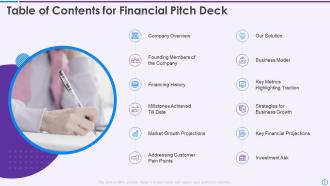
Slide 2: This slide shows Table of Contents for Financial Pitch Deck.
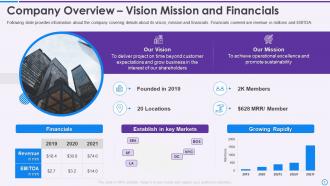
Slide 3: This slide presents information about the company covering details about its vision, mission and financials.
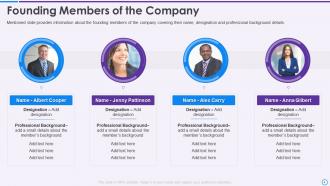
Slide 4: This slide displays founding members of the company covering their name, designation and professional background details.
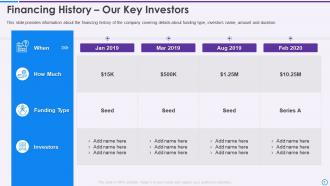
Slide 5: This slide represents financing history of the company covering details about funding type, investors name, amount, etc.
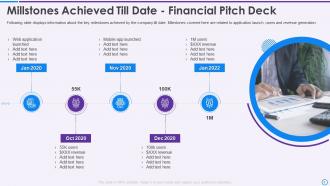
Slide 6: This slide showcases key milestones achieved by the company till date.
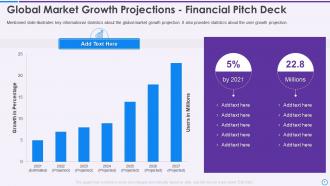
Slide 7: This slide shows Global Market Growth Projections Financial Pitch Deck.
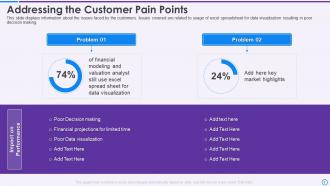
Slide 8: This slide presents Addressing the Customer Pain Points with information about the issues faced by the customers.
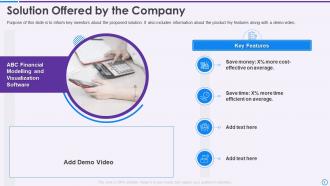
Slide 9: This slide displays key investors about the proposed solution offered by the company.
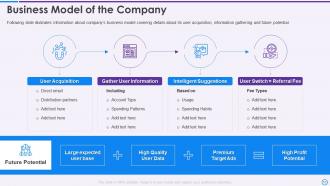
Slide 10: This slide represents company’s business model covering details about its user acquisition.
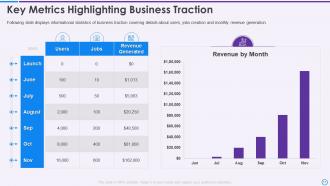
Slide 11: This slide showcases Key Metrics Highlighting Business Traction.
Slide 12: This slide shows strategies that company will implement in order to grow its business.
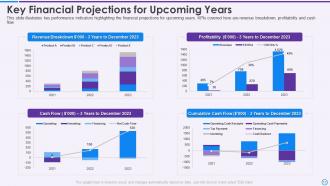
Slide 13: This slide presents Key Financial Projections for Upcoming Years.
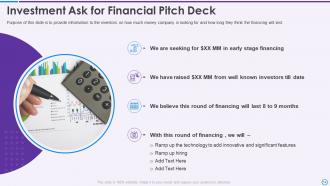
Slide 14: This slide displays investors on how much money company is looking for.
Slide 15: This slide is titled as Additional Slides for moving forward.
Slide 16: This is Our Mission slide with related imagery and text.
Slide 17: This is About Us slide to show company specifications etc.
Slide 18: This is Our Team slide with names and designation.
Slide 19: This is an Idea Generation slide to state a new idea or highlight information, specifications etc.
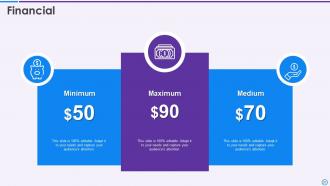
Slide 20: This is a Financial slide. Show your finance related stuff here.
Slide 21: This is an Idea Generation slide to state a new idea or highlight information, specifications etc.
Slide 22: This is a Comparison slide to state comparison between commodities, entities etc.
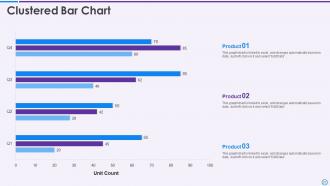
Slide 23: This slide displays Clustered Bar chart with two products comparison.
Slide 24: This slide shows Post It Notes. Post your important notes here.
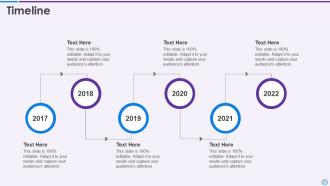
Slide 25: This is a Timeline slide. Show data related to time intervals here.
Slide 26: This is a Thank You slide with address, contact numbers and email address.
Financial pitch deck ppt template with all 34 slides:
Use our Financial Pitch Deck Ppt Template to effectively help you save your valuable time. They are readymade to fit into any presentation structure.
















FAQs for Financial pitch
Okay so you need the basics covered: problem you're solving, your solution, market size, how you make money, and any traction you've got so far. Financial projections for 3-5 years are huge - investors want realistic growth numbers, not pie-in-the-sky stuff. Include customer acquisition cost and lifetime value if you have those metrics. Be super specific about your funding ask and where every dollar goes. Team backgrounds matter too, plus competitive landscape. Honestly, 10-12 slides max or you'll lose them. Practice until you can tell the story naturally without just reading off slides - that's where most people blow it.
Look, most pitch decks are just boring spreadsheet dumps that make investors zone out completely. You need a story instead. Start with some customer's actual problem - something relatable that makes people go "oh yeah, I've felt that frustration too." Then walk through why current solutions suck and how you're gonna fix it differently. Honestly, investors sit through like 20 pitches a day, so yours needs to stick. When you wrap your data in a narrative, they actually remember you afterward. They can picture the opportunity instead of just staring at charts. Stories make them feel invested in your journey - and that's when they want to be part of your success.
Dude, the worst thing you can do is throw out crazy optimistic numbers without backing them up. Don't just say "we'll get 1% of this huge market" - explain HOW. Hockey stick projections are fine but you need to talk about what could go wrong too. Multiple scenarios are your friend here. Oh and here's something that drives me nuts - people obsess over revenue but totally ignore when cash actually comes in or whether each sale even makes money. Look at what similar companies did and be conservative with your estimates. Trust me, investors have seen enough pie-in-the-sky decks to last a lifetime.
Honestly, just turn those spreadsheet numbers into something people can actually read. Charts make trends pop out immediately - way better than staring at endless rows of data. Bar charts work great for comparisons, line graphs for showing growth over time. Pie charts are fine but don't go crazy with them. Keep your colors consistent (sounds obvious but you'd be surprised). Here's the thing though - pick maybe 2 or 3 key metrics that really matter and highlight those. Don't try cramming everything onto one slide because people's attention spans are terrible. If someone can't scan your financials in 10 seconds, you've lost them.
Revenue growth, gross margins, and burn rate - that's what they'll look at first. CAC to LTV ratio is critical too, especially for subscription businesses. Monthly recurring revenue always catches their eye if it's relevant. The specific metrics really depend on where you're at stage-wise, but don't dump 20 different numbers on them. Pick maybe 4-5 that actually tell your growth story and prove you get your unit economics. Oh, and definitely know your numbers inside out because they'll grill you on everything. I've seen pitches fall apart when founders couldn't explain their own metrics.
Dude, seriously - don't underestimate how much your deck's design matters. I've watched investors mentally check out the second they see sloppy formatting or charts that look like garbage. It's kinda brutal actually. Your financial projections could be genius, but if the whole thing looks like you slapped it together last minute? They'll assume you're not detail-oriented enough to handle their money. Clean fonts, consistent colors, readable graphs - that stuff lets them actually focus on your numbers instead of squinting at messy slides. Grab a decent template if you're not a design person. Your data's probably solid, so make it look that way too.
So market analysis is basically showing investors there's real money here. You're proving the market size, who you're up against, and why people will actually pay for your thing. Without it, you're just guessing there's a problem worth solving. Include your TAM, SAM, SOM numbers but don't be that founder who's like "it's a trillion dollar market!" without explaining how you'll get even 0.01% of it. The whole point is positioning yourself against competitors and showing you actually get the space. Think of it as your "here's why this matters right now" pitch section.
Build from real data - your current metrics, industry benchmarks, comparable companies. Don't just guess at numbers (seriously, investors can smell BS from miles away). Create three scenarios: conservative, realistic, optimistic. This shows you've actually thought things through. Work bottom-up from unit economics, customer acquisition costs, retention rates. Way better than the classic "we'll grab 1% of this huge market" pitch that makes everyone's eyes roll. Be ready to defend every assumption because they'll definitely dig into your numbers. Oh, and be transparent about your methodology - it builds way more trust than trying to sound overly polished.
Honestly, just use PowerPoint or Google Slides - investors are used to seeing those formats. Canva's pretty solid too if you want something that looks more polished without paying a designer. Oh, and there's this tool called Pitch.com that's actually made for pitch decks specifically. The collaboration stuff is nice if you're working with a team. But here's the thing - don't get caught up in making it super fancy. Investors literally hate when you go overboard with animations and transitions. Focus on getting your story and numbers right first. You can always make it prettier later, but a boring deck with great content beats a flashy one that says nothing.
Look, pick 3-4 real competitors and be honest about them. Don't do that "we have no competition" thing - investors will think you're clueless. Position yourself in whatever category makes you look strongest. Yeah, the magic quadrant slide is kinda overdone but it still works if your differentiation actually makes sense. Just acknowledge the other players exist but explain why your timing or approach gives you an edge. Maybe you're going after a different slice of the market, maybe your tech is better - whatever. Stay confident but don't get defensive about it. Badmouthing competitors makes you look amateur.
Don't just dump spreadsheet data on them - tell the story behind your numbers. Charts work way better than tables, so use bar graphs for growth trends and pie charts when you're breaking down market share. Round everything ($2.1M sounds cleaner than $2,087,432, trust me). Lead with why they should care about each number before diving into the details. Break complicated stuff into smaller pieces they can actually follow. Oh, and definitely practice explaining each slide out loud first - you'll catch yourself going down rabbit holes that'll lose everyone. The "so what" matters more than being perfectly precise with every decimal point.
Honestly, you've gotta tailor those financial slides depending on your audience. VCs want the nitty-gritty - unit economics, LTV/CAC ratios, all that technical stuff. Angels are different though. They're more interested in the big revenue picture and market potential. Strategic partners? They only care about synergies and how you'll boost their business. The key is keeping your core numbers the same across all versions - just shift what you emphasize. I'd make like 2-3 templates so you're not constantly redoing everything last minute. Trust me, it saves so much stress when you're already nervous about the pitch.
Investors hate BS projections - they can spot fake hockey stick graphs instantly. Show them 3-5 years with real logic behind every number. Break down revenue by customer segments, not just one massive figure. Your assumptions about acquisition costs and growth rates? Better be rock solid because they'll grill you hard during Q&A. I swear, some founders just pull numbers from thin air and wonder why they get torn apart. Map out different revenue streams clearly. Oh, and customer acquisition costs are usually way higher than you think, so don't lowball those.
Start with the problem and make them actually *feel* it - not just understand it intellectually. Real customer stories hit way harder than charts ever will. I swear, half the decks I see are just data dumps with zero personality. Your team slide matters tons here too. Show what personally drives you beyond just the money aspect. Mix these human moments between your market stuff and financials - don't clump all the emotional bits together. Oh, and try opening with an actual story instead of diving straight into TAM numbers. Way more engaging that route.
Shoot them a thank-you email right away with your deck and main points. Don't wait around - follow up within 48 hours while you're still top of mind. Write down any questions they asked so you can prep solid answers next time. Try to nail down that follow-up meeting before walking out the door, because once people hit their inbox it's game over. Keep tracking your pipeline (I know, boring but necessary) and set those check-in reminders. The best part though? Use their feedback to tweak your pitch. Every presentation shows you what actually clicks with investors versus what totally bombs.
-
Commendable slides with attractive designs. Extremely pleased with the fact that they are easy to modify. Great work!
-
Thanks for all your great templates they have saved me lots of time and accelerate my presentations. Great product, keep them up!
-
Innovative and Colorful designs.
-
Topic best represented with attractive design.