Startup financial pitch deck template business model of the company

Rating:
80%
Startup financial pitch deck template business model of the company
Slide 1 of 6
Favourites Favourites

Try Before you Buy Download Free Sample Product

Audience Impress Your
Audience
Editable 100%
Editable
Time Save Hours
of Time
The Biggest Sale is ending soon in
0
0
:
0
0
:
0
0
Rating:
80%
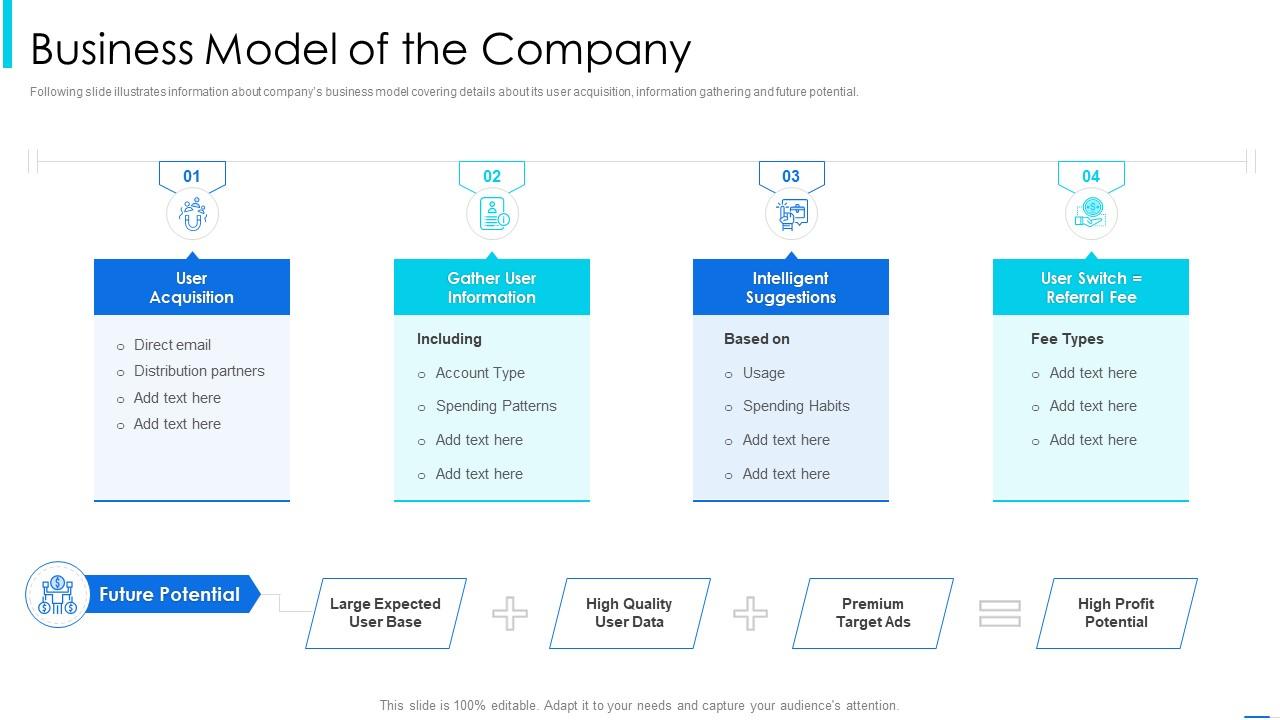
Following slide illustrates information about companys business model covering details about its user acquisition, information gathering and future potential.Increase audience engagement and knowledge by dispensing information using Startup Financial Pitch Deck Template Business Model Of The Company This template helps you present information on four stages. You can also present information on Gather User Information, Intelligent Suggestions, Spending Habits using this PPT design. This layout is completely editable so personaize it now to meet your audiences expectations.

FAQs for Startup financial pitch deck template business model

So you'll want to nail the basics first - problem/solution, market size, your business model, and 3-5 year projections. Include your funding ask with specifics on how you'll spend it, plus why your team rocks. Here's the thing though: don't get crazy with unrealistic numbers. Investors have seen it all and will call out bullshit immediately. Make your unit economics actually work and show how you'll turn a profit. Keep it tight - maybe 10-12 slides tops. Oh, and practice explaining each slide in under 2 minutes because they'll definitely interrupt with questions. Trust me on that one.

So with financial projections, honestly just keep it simple and tell a story. Show 3-5 years but don't dump raw spreadsheet data on people - that's brutal to sit through. Walk them through your assumptions: customer acquisition numbers, deal sizes, growth rates, all that stuff. I swear half the founders I see get completely lost in these crazy complex models that make zero sense to anyone else. Stick to the big picture narrative instead. Make sure your numbers actually back up that market opportunity you talked about earlier. Oh and definitely throw in a slide about your key assumptions - investors are gonna pick those apart anyway, so might as well get ahead of it.

Don't be that founder with the insane hockey stick projections - investors spot BS revenue curves from a mile away. Also, skip the spreadsheet maze. I've watched people completely lose their audience rambling about CAC/LTV ratios when honestly? Stick to what actually moves the needle. Your assumptions need to be rock solid and transparent. Show a few scenarios if you can swing it, and yeah - be ready to back up every number with real data when they inevitably grill you on it.

For your pitch deck, go with 3-5 years of projections - revenue, main expenses, cash flow. High-level stuff that shows your growth story without getting too detailed. Truth is, investors barely look at the actual numbers during your presentation anyway. They want to see you're not completely delusional and there's potential for serious growth. The nitty-gritty financial models? Save those for due diligence when they're actually interested. Make everything digestible and be ready to defend your assumptions when they ask. Because they will ask - probably about the one number you hoped they'd skip over.

Dude, bar charts for revenue growth are clutch. Line graphs work great for projections too. I'd throw in pie charts for market breakdown - keeps things visual. Clean tables can actually be super effective if you highlight the important numbers. God, I've seen so many pitches where founders just copy-paste their Excel mess and expect investors to figure it out themselves. Before/after comparisons hit different though. Same with competitive benchmarking charts. You want that financial stuff to make sense immediately. Stick to maybe 2-3 chart types max and don't go crazy with colors.

Show investors real numbers, not fluffy projections. Start with your TAM (total addressable market) but don't go crazy with it - they've seen way too many "billion dollar market" pitches that mean nothing. Break it down to what you can actually capture in 3-5 years. I always tell people to work bottom-up from actual customer data instead of just quoting some industry report. Include your customer acquisition costs and lifetime value too. Growth rates matter, but honestly? Being conservative makes you look way more credible than claiming you'll own 10% of everything.

Look, your break-even slide basically shows investors when you'll stop hemorrhaging money and actually turn a profit. Map out fixed costs, variable costs, and revenue projections to find that sweet spot where income beats expenses. Investors eat this stuff up because it gives them a timeline for returns. Just don't get too optimistic with your numbers - I've seen founders tank their credibility with unrealistic projections. Oh, and throw in a sensitivity analysis showing how different scenarios affect your timeline. Trust me, it makes you look way more prepared than most people walking in there.

So basically you gotta completely flip your approach depending on who's in the room. VCs are all about that massive scale - show them your TAM and how they'll get their 10x return. Angels? Way more personal. They actually care about your story and want to see some early wins. Strategic investors are honestly the weirdest - they're hunting for ways your thing fits with their existing stuff, but good luck figuring out what they really want half the time. Oh and if you're going for debt financing, forget all the growth projections. Those guys just want boring stuff like steady cash flow and collateral. Always stalk your audience first and reorganize your deck to lead with whatever gets them excited.

Definitely throw in market size stuff and what your competitors are pulling in revenue-wise. Growth rates for your industry too. Customer acquisition costs versus lifetime value is massive - VCs love seeing how you stack up against similar companies. Show them you actually get your competitive landscape because honestly, they sit through terrible pitches all day. Burn rate benchmarks for companies at your stage help a lot. Just don't go crazy with projections that are like 10x above industry norms unless you've got solid reasoning. PitchBook and CB Insights are good for pulling real data to back everything up.

Dude, this is literally the make-or-break moment of your whole deck. All that stuff about your problem and traction needs to connect directly to your ask. Don't just throw out "$2M" without showing where every dollar goes - investors will call BS instantly. I watched this one founder completely bomb because they had these super vague "marketing expenses" line items. Actually, it was painful to watch. Break down your burn rate and show exactly what milestones you'll hit. Make them think "of course they need this amount" instead of wondering why you picked that number.

Lead with your unit economics - how much each customer's worth vs what you spend to get them. Investors will dig into this stuff anyway, so get ahead of it. Show your burn rate and runway too (like, when do you actually run out of cash?). Most founders are crazy optimistic about growth projections - don't just say you'll go from 100 to 10K customers, explain HOW. Break down those assumptions on actual slides, not buried in tiny footnotes. Revenue drivers and churn rates need to be upfront as well. Honestly, being realistic here will set you apart from all the pie-in-the-sky pitches they see.

Start with the numbers that actually matter - MRR, customer acquisition costs, growth rates. That's what tells your story. Show investors the full timeline: where you started, what's happening right now, and realistic projections ahead. Don't get fancy with pie-in-the-sky forecasts though - they'll see right through that BS. Your unit economics need to prove the model works when you scale up. Then demonstrate how their money speeds up that growth. Every chart should answer "so what?" Connect those numbers to your bigger vision. Oh, and make sure your market opportunity actually makes sense with the data you're showing.

Honestly, simpler is always better with pitch deck financials. Investors want to get your story fast, not decode some crazy spreadsheet maze. Pick 3-5 metrics that actually matter for your business and show them growing nicely. Charts beat tables every time - nobody's trying to read tiny numbers in a dark conference room. Split complicated stuff across multiple slides instead of shoving it all together. Oh, and definitely lead with your assumptions because they'll grill you on those anyway. Each financial slide should have one clear point that backs up your main pitch.

Okay so definitely drill the brutal questions first - unit economics, customer acquisition costs, churn, profitability timeline. Know your burn rate and runway backwards and forwards. Seriously, I've watched founders completely tank because they fumbled basic metrics. It's painful to see. Have extra slides ready for when they want to dig deep into your assumptions or ask about worst-case stuff. Don't try to dodge the risky parts either - they'll respect you more if you're upfront about challenges. Oh and find some other founders who'll absolutely roast you in practice sessions beforehand.

Dude, just use Canva or Pitch - they've got startup templates that don't suck. PitchBook and CB Insights are clutch for industry data so your numbers seem legit. Excel works fine for the financial stuff, or LivePlan if you want something fancier. Honestly? Most founders way overthink this. Keep it simple and realistic - investors spot fake projections instantly. I'd rather see a clean, honest deck than some over-designed mess any day. Focus on your story first, then worry about making it pretty. Oh, and don't spend weeks perfecting slide transitions... nobody cares about that stuff.

Ratings and Reviews

80% of 100
Review Form
Write a review
Most Relevant Reviews
  1. 80%

    by Dennis Stone

    Excellent design and quick turnaround.
  2. 80%

    by Noah Hernandez

    Awesomely designed templates, Easy to understand.

2 Item(s)

per page: