


Food startup pitch deck ppt template




Try Before you Buy Download Free Sample Product
 Impress Your
 Audience
 100%
100% Editable
 Save Hours
 of Time


There is no surprise that the food and beverage industry is rapidly evolving. Many successful tech-based food startups are currently operational worldwide, along with several upcoming and promising ones. Check out our efficiently designed pitch deck on Food Start-up that will be suitable for the entrepreneurs having a food startup idea but unable to secure funding. To begin, companies can use the company overview slide to showcase their growth, and the founders slide illustrates information about its vision, mission, funding history, sales growth, and critical founders. Problem and solution slides will help the businesses address the significant bottlenecks of the food industry and the proposed solution to overcome them. To illustrate audience, business model, competitors, and revenue generation sources, the company can use slides such as target audience, business model, sources of revenue, and competitive landscape. Why invest with us slide will help the companies address potential investors about the benefits of investing in their startup ideas. At last, organizations can inform investors about their future goals and the funding they are looking for through the investment ask slide. Book a free demo with our expert team and grab a 100 percent editable ppt for startup pitch deck. Get access now.
People who downloaded this PowerPoint presentation also viewed the following :
Content of this Powerpoint Presentation
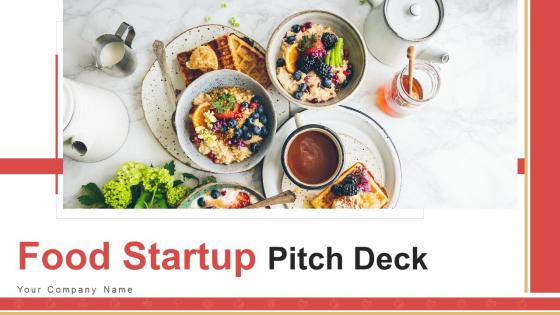
Slide 1: This slide introduces Food Startup Pitch Deck. State Your Company Name and begin.
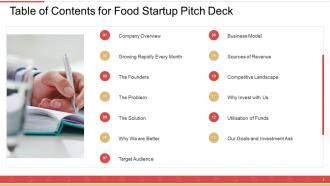
Slide 2: This slide shows Table of Content for the presentation.
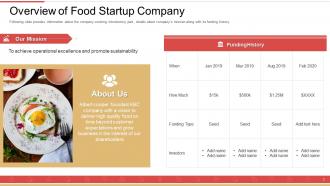
Slide 3: This slide presents about the company covering introductory part , details about company’s mission along with its funding history.
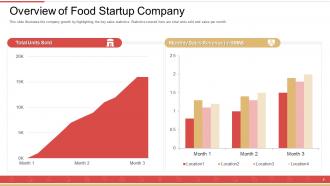
Slide 4: This slide shows company growth by highlighting the key sales statistics.
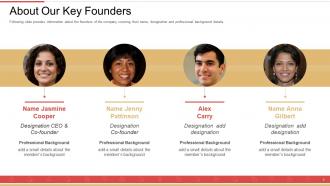
Slide 5: This slide displays founders of the company covering their name, designation and professional background details.
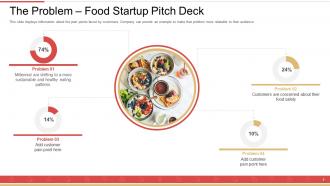
Slide 6: This slide represents pain points faced by customers.
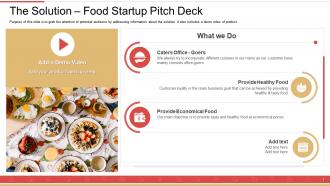
Slide 7: This slide shows grab the attention of potential audience by addressing information about the solution.
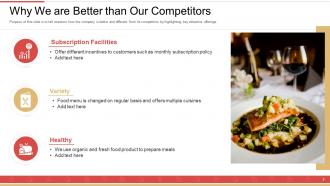
Slide 8: This slide presents how the company is better and different from its competitors by highlighting key attractive offerings.
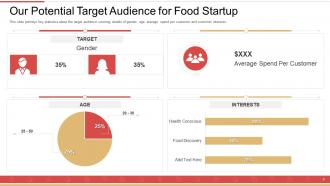
Slide 9: This slide shows target audience covering details of gender, age, average spend per customer and customer interests.
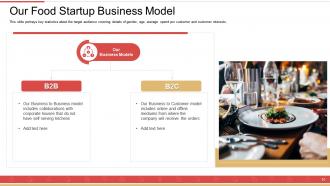
Slide 10: This slide displays Our Food Startup Business Model.
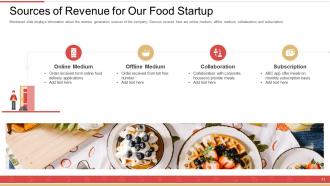
Slide 11: This slide represents revenue generation sources of the company.
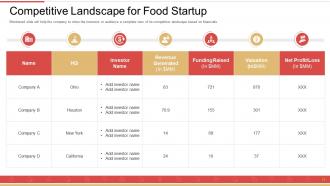
Slide 12: This slide shows investors or audience a complete view of its competitive landscape based on financials.
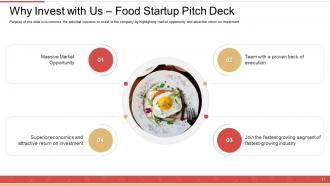
Slide 13: This slide presents potential investors to invest in the company by highlighting market opportunity and attractive return on investment.
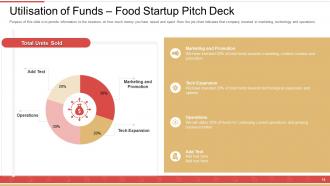
Slide 14: This slide shows investors on how much money you have raised and spent.
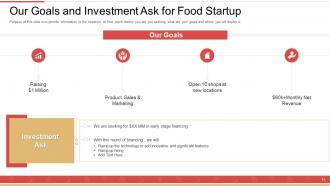
Slide 15: This slide displays Our Goals and Investment Ask for Food Startup.
Slide 16: This slide represents Contact Us – Food Startup Pitch Deck.
Slide 17: This slide shows Icons for Food Startup Pitch Deck.
Slide 18: This slide is titled as Additional Slides for moving forward.
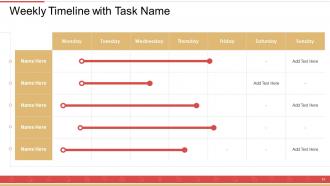
Slide 19: This slide shows Weekly Timeline with Task Name.
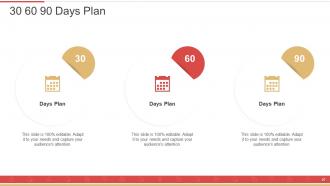
Slide 20: This slide displays 30 60 90 Days Plan with text boxes.
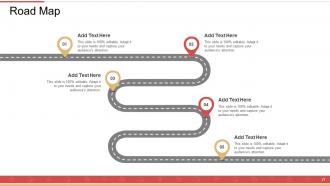
Slide 21: This slide represents Roadmap with additional textboxes.
Slide 22: This is Our Target slide. State your targets here.
Slide 23: This slide presents Venn diagram with text boxes.
Slide 24: This slide shows Puzzle with related icons and text.
Slide 25: This is a Thank You slide with address, contact numbers and email address.
Food startup pitch deck ppt template with all 25 slides:
Use our Food Startup Pitch Deck Ppt Template to effectively help you save your valuable time. They are readymade to fit into any presentation structure.


FAQs for Food startup pitch
Hey! So you'll want all the standard stuff - problem/solution, market size, team, financials. But food startups are different. Show gorgeous photos of your actual product because honestly, investors are visual creatures with food. Your supply chain strategy matters huge here, plus all the FDA regulatory headaches (ugh). Unit economics are critical since food margins can be brutal. What makes your product different from what's already out there? That's your hook right there. Cover your go-to-market plan and any distributor partnerships you've got lined up. Oh, and don't bury the lead on profitability timeline.
Honestly, focus on three core things: the problem, your solution, and actual proof it works. Find a genuine pain point in food that customers are already frustrated about - not just tech for tech's sake. Show how you solve it differently than everyone else. Here's where it gets real though: you need hard evidence. Customer feedback, pilot results, early revenue - something that proves people will actually open their wallets. Don't get caught up in buzzwords. One killer stat up front will grab their attention way better than a bunch of industry jargon.
Three slides you absolutely need: market size (TAM/SAM stuff), target customers with real data, and who you're up against. Honestly, skip the bullet point hell - charts and visuals are way better. Investors zone out otherwise. Always throw in one stat that makes people's jaws drop, something they've never heard before. Oh, and source everything properly - IBISWorld, Mintel, actual research companies. Not some random Medium article your cousin shared. The big thing though? Don't just dump market data and walk away. Connect it to why YOUR startup is gonna crush it in this space.
Use 1-2 slides for your product development story - show the messy prototypes with photos! Investors actually love seeing the ugly early versions because it proves you're building something real. Talk through your specific problems like shelf life or taste issues and how you fixed them. Throw in any taste test results or feedback that made you pivot. Oh, and definitely mention food safety certs or regulatory stuff you've gotten approved. The visual storytelling is key here - people want to see the journey from random idea to something they'd actually want to eat. Wrap up with where you are now and what's next in development.
Hey! So investors want to see five main things: revenue forecasts broken down by product lines, your unit economics (like cost of goods and margins), cash flow projections, customer acquisition costs, and when you'll actually turn a profit. Food margins are brutal though - don't sugarcoat the numbers because investors have seen way too many pie-in-the-sky presentations. Your revenue assumptions need to connect to real market data. Oh, and definitely throw in a sensitivity analysis with best/worst case scenarios since supply chain costs can get crazy volatile in food.
Dude, storytelling is everything for pitches. Skip the boring market charts - nobody cares about that stuff upfront. Tell them about finding those gross leftovers in your fridge and realizing everyone deals with this. That's way more powerful than just saying "we solve food waste." Investors want to feel something, you know? Build it like a story arc - here's the problem, here's why it sucks, boom here's our solution. Your personal journey matters too. I've seen so many founders nail their pitch just by being real about how they got started. Practice it until it doesn't sound rehearsed though.
Dude, branding can make or break your pitch deck honestly. Investors see hundreds of these things - yours needs to stick. Show them you've got a solid visual identity and actually understand your customer connection. The food space is brutal competitive, so they want proof you're thinking beyond just "my product tastes good." Your brand story should weave through everything - problem slide, market strategy, all of it. Oh and make sure your deck actually looks like your brand! Don't pitch organic baby food with some dark edgy design that screams Red Bull energy drink vibes.
Yeah, definitely don't act like you're the only game in town - investors hate that BS. Make a slide showing who else is out there, both direct competitors and anyone solving similar problems. Then hammer home what makes you different. Could be your secret sauce recipe, better suppliers, or maybe you're targeting a slice of the market others ignore. Food's brutally competitive honestly, so this part really matters. Explain why someone would pick your product over the big established brands already on shelves. Wrap up by showing what protects you long-term - your defensible advantage that's hard to copy.
Honestly, just stick to the metrics that actually matter - revenue growth, CAC, and LTV. Those are what investors want to see. Monthly recurring revenue too if you've got subscriptions. Gross margins are huge in food (since they can be pretty rough in this space). Don't sleep on retention rates either. You'll also want to track operational stuff like inventory turnover and fulfillment costs - food businesses are so logistics-heavy it's not even funny. The whole point is proving you can get customers cheaply and keep them around. Pick maybe 4-5 solid metrics for your deck and tell a real growth story with actual numbers, not just follower counts or whatever.
Dude, your photos need to make investors actually drool - no blurry iPhone shots allowed. I'm talking professional food photography that screams "invest in me." Throw in some action shots of your process, maybe before/after comparisons, plus clean charts showing market size (investors eat that stuff up). Colors should match your brand but still look appetizing. Oh, and skip the random stock photos of people pretending to enjoy kale - every image needs to earn its spot. Each slide should flow into the next one naturally. Trust me, visuals tell the story when your pitch deck can't.
Definitely hit the big regulatory stuff - FDA compliance, food safety certs, permits. Investors freak out if you haven't figured out the legal nightmare that food production is. Labeling requirements are huge, especially with health claims. Supply chain liability protections too. Alcohol, supplements, organic? Those are their own special hell with extra requirements. Oh, and don't stick this boring stuff in your appendix slides - put the key compliance items right in your main presentation. Last thing you want is investors thinking regulators will shut you down before you even get started. Trust me on this one.
Don't dump all your sustainability stuff on one slide - spread it throughout the whole pitch. Talk specifics about your sourcing, like local partnerships or regenerative farming. Production waste reduction is solid too. Packaging is honestly where a lot of investors focus right now, so if you've got compostable options, definitely mention those. Skip the generic "we're eco-friendly" nonsense and use real numbers instead. Something like "cuts water usage by 30%" hits way harder. Most importantly though, connect it back to money - show how being sustainable either saves costs or opens up new markets. That's what actually moves the needle with investors.
So food influencers are honestly your best bet - people actually listen when someone they follow recommends something to eat. Get your product into people's mouths through farmers markets, grocery demos, maybe partner with local cafes for samples. Email campaigns are clutch for keeping customers coming back, especially if you do some kind of loyalty thing. Content marketing around recipes works great for SEO too. Oh and definitely nail down your customer acquisition costs and lifetime value numbers before you pitch investors - they'll ask anyway. The sampling strategy is probably where I'd put most of my energy first.
Make a simple spreadsheet to track what each VC says after your pitch. Look for patterns - if three investors question your market size, that slide's probably broken. Some feedback will totally contradict other feedback (which is annoying as hell), but focus on what keeps coming up. Got multiple people doubting your revenue projections? Time to update those numbers. Slides seem confusing? Simplify them. I'd also test any changes with advisors first before pitching to real investors again. Way better to catch issues early than bomb another meeting.
Look, investors don't give a damn about your grandmother's recipe or how many spices you use. They want numbers. Skip the "food industry is worth trillions" nonsense - show them your actual slice. You'll tank if you ignore the boring stuff like food safety and supply chains (learned this the hard way watching friends' startups crash). Pick 2-3 things that actually make you different, not some generic "farm-to-table" BS. Get real customer data, not just your mom saying it's delicious. Unit economics matter more than taste, honestly.
-
Understandable and informative presentation.
-
I discovered this website through a google search, the services matched my needs perfectly and the pricing was very reasonable. I was thrilled with the product and the customer service. I will definitely use their slides again for my presentations and recommend them to other colleagues.
-
Graphics are very appealing to eyes.
-
Informative presentations that are easily editable.