

Food product pitch deck ppt template




Try Before you Buy Download Free Sample Product
 Impress Your
 Audience
 100%
100% Editable
 Save Hours
 of Time


This food product pitch deck is a presentation for businesses to showcase their brand or product to investors or business partners. Here is an efficiently designed Food Product Pitch Deck that can help motivate the person listening and convince them to accept the offer, invest in the development, support its growth. The most efficient elevator pitch decks have between 10 and 20 slides. The food product pitch deck falls under this cap. A product pitch deck is a collection of slides showing the problem your product addresses, the market for it, and the revenue possibilities. Each of its slides illustrates a few key facts to explain them in a brief but precise way. In this PPT, every fact shows precisely why the product will be successful and how much money it can bring. This product pitch deck is a helpful tool to visualize the companys vision. This presentation also covers the mission statement, target audience or marketing strategies, product offerings and services offered, financials marketing budget breakdown, a timeline of progress toward goals and milestones reached throughout the year. Get access now.
People who downloaded this PowerPoint presentation also viewed the following :
Content of this Powerpoint Presentation
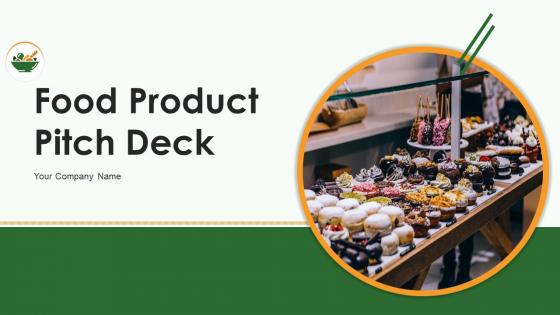
Slide 1: This slide introduces Food Product Pitch Deck. State Your Company Name and begin.
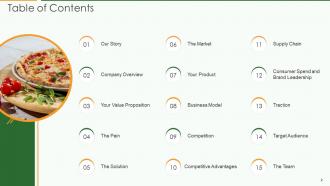
Slide 2: This slide presents Table of Content for the presentation.
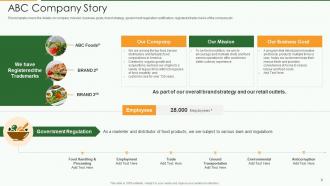
Slide 3: This slide covers the details on company mission, business goals, brand strategy, etc.
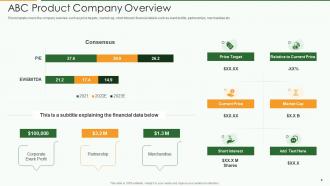
Slide 4: This slide covers the company overview such as price targets, market cap, etc.
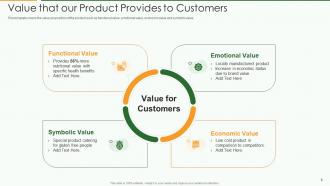
Slide 5: This slide covers the value proposition of the product such as functional value, etc.
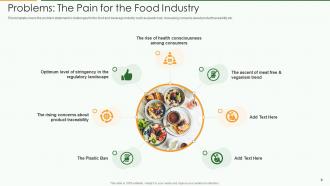
Slide 6: This slide covers the problem statement or challenges for the food and beverage industry.
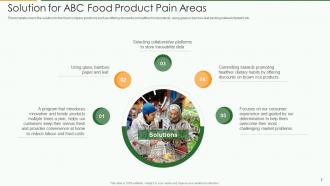
Slide 7: This slide presents solution for the food company problems such as offering discounts on healthier food products, etc.
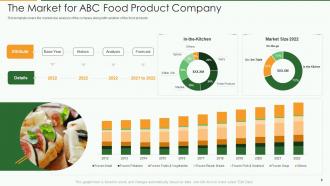
Slide 8: This slide exhibits market size analysis of the company along with variation of the food products.
Slide 9: This slide shows details and description about the food products of the company.
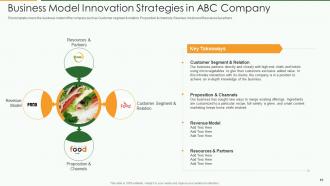
Slide 10: This slide depicts business model of the company such as Customer segment & relation, Proposition & channels, etc.
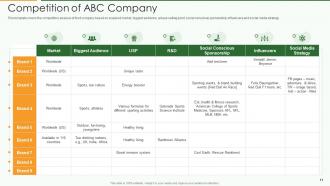
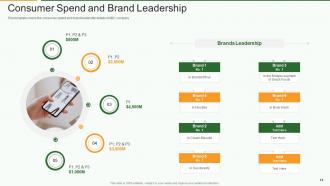
Slide 11: This slide explains competitors analysis of food company based on acquired market, biggest audience, etc.
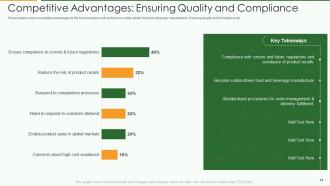
Slide 12: This slide displays competitive advantages to the food company.
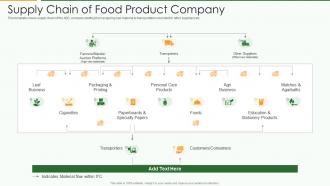
Slide 13: This slide highlights supply chain of the ABC company starting from acquiring raw material to transportation and stent to other suppliers etc.
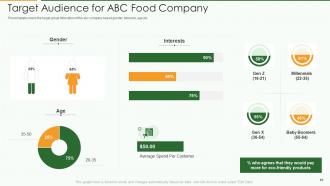
Slide 14: This slide illustrates target group bifurcation of the ABC company based gender, interests, age etc.
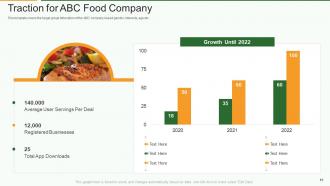
Slide 15: This slide presents traction for ABC food company.
Slide 16: This slide exhibits target group bifurcation of the abc company based gender, interests, age etc.
Slide 17: This slide shows food company team name, designation and qualification,
Slide 18: This slide displays Icons for Food Product Pitch Deck.
Slide 19: This slide is titled as Additional Slides for moving forward.
Slide 20: This is Our Team slide with names and designation.
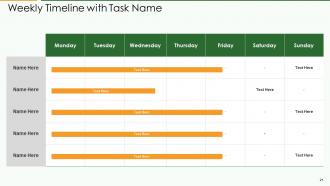
Slide 21: This slide shows Weekly Timeline with Task Name.
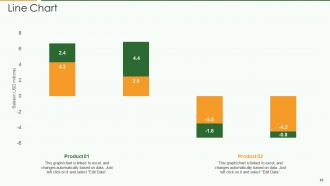
Slide 22: This slide describes Line chart with two products comparison.
Slide 23: This is a Timeline slide. Show data related to time intervals here.
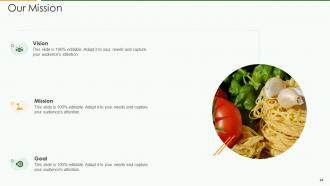
Slide 24: This is Our Mission slide with related imagery and text.
Slide 25: This is About Us slide to show company specifications etc.
Slide 26: This is a Thank You slide with address, contact numbers and email address.
Food product pitch deck ppt template with all 31 slides:
Use our Food Product Pitch Deck Ppt Template to effectively help you save your valuable time. They are readymade to fit into any presentation structure.






FAQs for Food product pitch
Cover the basics: your problem/solution, target market, competition, business model, and financials. Food investors obsess over scalability and shelf life (both kinds lol). Show any traction you've got so far. Include your go-to-market plan and team background - food industry experience is gold here. Keep it under 12 slides or you'll lose them. Oh, and definitely bring samples if it's in-person! Honestly, nothing beats letting people actually taste your product. End with a clear funding ask and exactly how you'll spend their money. Visuals matter too since food is so visual.
Honestly, stories are way more memorable than just listing ingredients or whatever. People won't remember that your sauce has "premium this" or "organic that" - but they'll totally remember if you tell them about your grandma's recipe that started it all. Investors want to feel something, not just hear stats. Open with a quick story about why you created the product in the first place. Then build everything around that. Like, what problem were you actually trying to solve? Stories help them picture your brand taking off and actually care about what you're doing.
Look, investors are so tired of seeing "the food industry is worth $2 trillion" - it's basically meaningless at this point. What you actually need is three things: real market size for your specific niche (not the whole industry), solid data on who's buying and why they want YOUR thing specifically, and a breakdown of what competitors are charging. Consumer surveys help too if you've got them. The key is showing why right now makes sense for launching - like maybe there's a trend shift or gap you can hit. Don't go too broad with the stats.
Lead with your strongest differentiator right away - don't hide it on slide 5. Nobody gives a damn about your "proprietary fermentation" unless you explain how it actually makes things taste better. Use concrete numbers instead of vague claims. "30% less sugar than Coca-Cola" hits way harder than "reduced sugar content." Before/after photos work amazing too, or maybe taste test results. I always tell people to focus on benefits customers actually want, not features you think are impressive. Keep everything simple and tie it back to solving whatever annoying problem your customers deal with every day.
Dude, just make your nutrition info visual - nobody wants to read a wall of numbers. Colorful bar charts work great for showing protein vs competitors. Those traffic light systems are clutch too (green good, red bad, you know the drill). Most people zone out at nutrition labels anyway, so spotlight your 2-3 biggest wins. Maybe do an infographic thing that tells the story of your ingredients? Way better than boring lists. Oh and keep it scannable - people literally spend like 3 seconds looking at this stuff. Focus on what makes your product actually different.
Definitely put food safety front and center - like a whole slide dedicated to it. Investors freak out about recalls since they can destroy companies overnight (honestly can't blame them). Show off your HACCP plans, FDA approvals, third-party testing results. Quality control processes are huge too. If you're using co-packers, make sure their certifications are solid and mention those. Traceability systems matter a lot - how you track everything from ingredients to final product. Oh and don't forget contamination risk protocols. The goal is showing you're not messing around with this stuff because one screw-up can sink everything.
Look, trends are what make investors believe your product actually matters right now. You're not creating demand from nothing - you're catching a wave that's already building. Plant-based stuff, gut health crazes, quick meals for stressed millennials, whatever fits your product. Lead with 2-3 solid ones backed by real numbers, not just random stats you googled. Here's the thing though - don't just mention trends and move on. Weave them through your whole pitch so it's obvious you get why timing matters. Makes your opportunity feel legit instead of just another random food idea.
So for the competitive landscape slide, grab 3-5 competitors - mix of big players and newer startups in your space. Set up a simple chart comparing price, where they sell, ingredients, who they're targeting, stuff like that. Here's the thing though - don't trash talk them because that just looks bad. Actually mention what they do well, then show where you're different and better. Oh and make sure you can back up your claims if investors grill you on it later. I've seen founders get caught off guard when VCs ask why customers would switch to them instead.
Food investors are obsessed with unit economics - they'll dig into your gross margins, customer acquisition costs, and lifetime value immediately. Revenue growth is cool but repeat purchase rates matter just as much. Distribution breadth counts too (how many stores you're in vs actual sales volume). The margins in food are honestly terrible, so proving profitable scale is everything. Track velocity per store location early - that metric will totally make or break your Series A pitch. Oh and market penetration in your target demo is crucial. I learned this the hard way watching other founders get crushed on these numbers.
Don't just slap sustainability onto the end of your pitch - make it central to your story. Start with real numbers like "30% less water usage" or "carbon-neutral supply chain." Skip the vague green buzzwords, investors see right through that stuff now. Photos of your actual facilities help too. Here's the thing - you've got to connect your green story to profits AND consumer trends. Show them how being sustainable saves money while attracting conscious buyers. Include your packaging innovations, local partnerships, waste reduction stats. Basically prove you're not just greenwashing but actually building a better business model.
Look, investors don't just want to see you can make a product - they need proof you can actually sell it. Food retail is brutal (those Whole Foods shelf fees are insane). You've got to map out your exact path: farmers markets first? Direct online sales? Which retail partnerships are realistic? Honestly, without clear distribution channels and pricing strategy, you're basically showing them a recipe with no plan to get it to customers. Include real timelines and sales projections. They want to see you understand how tough this market is and that you've got a solid game plan anyway.
Don't just dump all your testimonials on one slide - that's boring as hell. Scatter them throughout your deck instead. When you're talking about the problem, throw in a customer quote that backs up the pain point. Got a chef endorsement? Perfect for your market validation section. Screenshots from social media work way better than fancy quotes anyway - people can smell fake marketing from a mile away. If you've got any big names, definitely put those up front, maybe even on your opening slide. Keep everything short and punchy. Always include names and titles or nobody will believe it's real. Oh, and tie each testimonial back to why your product rocks.
White space is your best friend - don't cram everything together. Get decent food photos, even if you have to pay someone. Those blurry phone pics? They'll torpedo your whole pitch, trust me. One message per slide, and make the font big enough so people in the back can actually read it. Bold colors work great if they match your brand. Skip the crazy animations though - they're just distracting. Oh, and show your packaging mockups early so investors can picture your stuff in stores. End each section with what you want them to remember.
Dude, you've gotta totally change your pitch depending on who you're talking to. VCs want those hockey stick growth numbers and your Series A roadmap - show them the massive market potential. Angels? They actually care about your story since most of them built companies too. Retail buyers couldn't care less about your vision - just hit them with margins and demand data. Oh and family offices are all about steady returns, not crazy growth. I learned this the hard way honestly. Do your homework on what each group actually funds, then flip your whole presentation to match what keeps them up at night.
Dude, don't be vague about market size - saying "food is huge" kills your pitch instantly. Narrow it down to your actual slice. Skip the wall-of-text slides too, nobody's reading paragraphs about your "game-changing" sauce (seriously, everyone uses that word). Get specific with your financials early. Food safety and regulatory stuff? Cover that upfront or you're dead in the water. Oh, and supply chain issues will come up so address them. Use real product photos, keep it visual. End with exactly how much you need and when - investors hate guessing games.
-
Attractive design and informative presentation.
-
Understandable and informative presentation.
-
The Designed Graphic are very professional and classic.