


Startup Pitch Deck For Fast Food Restaurant Ppt Template





Try Before you Buy Download Free Sample Product
 Impress Your
 Audience
 100%
100% Editable
 Save Hours
 of Time


There is no surprise that the food and beverage industry is rapidly evolving. Many successful tech based food startups are currently operational worldwide, along with several upcoming and promising ones. Check out our efficiently designed Startup Pitch Deck For Fast Food Restaurant that will be suitable for the entrepreneurs having a food startup idea but unable to secure funding. To begin, companies can use the company overview slide to showcase their growth, and the founders slide illustrates information about its vision, mission, funding history, sales growth, and critical founders. Problem and solution slides will help the businesses address the significant bottlenecks of the food industry and the proposed solution to overcome them. To illustrate audience, business model, competitors, and revenue generation sources, the company can use slides such as target audience, business model, sources of revenue, and competitive landscape. Why invest with us slide will help the companies address potential investors about the benefits of investing in their startup ideas. At last, organizations can inform investors about their future goals and the funding they are looking for through the investment ask slide. Book a free demo with our expert team and grab a 100 percent editable ppt for startup pitch deck. Get access now.
People who downloaded this PowerPoint presentation also viewed the following :
Content of this Powerpoint Presentation
Slide 1: This slide displays title i.e. 'Startup Pitch Deck For Fast Food Restaurant' and your Company Name.
Slide 2: This slide presents table of contents.
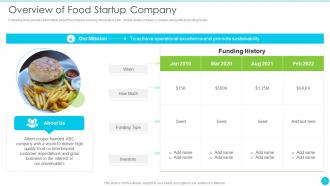
Slide 3: This slide provides information about the company covering introductory part , details about company’s mission along with its funding history.
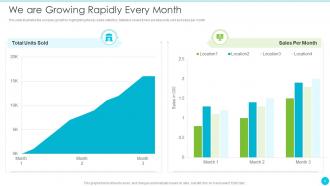
Slide 4: This slide illustrates the company growth by highlighting the key sales statistics. Statistics covered here are total units sold and sales per month.
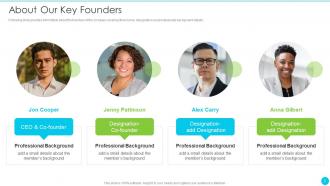
Slide 5: This slide provides information about the founders of the company covering their name, designation and professional background details.
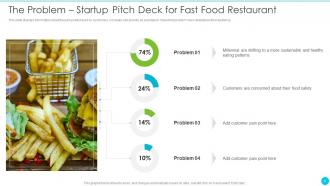
Slide 6: This slide displays information about the pain points faced by customers.
Slide 7: This slide grab the attention of potential audience by addressing information about the solution. It also includes a demo video of product.
Slide 8: This slide will tell investors how the company is better and different from its competitors by highlighting key attractive offerings.
Slide 9: This slide portrays key statistics about the target audience covering details of gender, age, average spend per customer and customer interests.
Slide 10: This slide illustrates information about company’s business model covering details about both B2b and B2c models.
Slide 11: This slide displays information about the revenue generation sources of the company.
Slide 12: This slide will help the company to show the investors or audience a complete view of its competitive landscape based on financials.
Slide 13: This slide convince the potential investors to invest in the company by highlighting market opportunity and attractive return on investment.
Slide 14: This slide provide information to the investors on how much money you have raised and spent.
Slide 15: This slide provide information to the investors on how much money you are you seeking, what are your goals and where you will deploy it.
Slide 16: This slide exhibits contact details of company.
Slide 17: This is the icons slide.
Slide 18: This slide presents title for additional slides.
Slide 19: This slide exhibits monthly line charts for different products. The charts are linked to Excel.
Slide 20: This slide shows yearly profits stacked column charts for different products. The charts are linked to Excel.
Slide 21: This slide shows about your company, target audience and its client's values.
Slide 22: This slide presents your company's vision, mission and goals.
Slide 23: This slide depicts posts for past experiences of clients.
Slide 24: This slide exhibits ideas generated.
Slide 25: This slide displays puzzle.
Slide 26: This slide displays Venn.
Slide 27: This slide shows details of team members like name, designation, etc.
Slide 28: This slide depicts 30-60-90 days plan for projects.
Slide 29: This is thank you slide & contains contact details of company like office address, phone no., etc.
Startup Pitch Deck For Fast Food Restaurant Ppt Template with all 34 slides:
Use our Startup Pitch Deck For Fast Food Restaurant Ppt Template to effectively help you save your valuable time. They are readymade to fit into any presentation structure.
-

Startup Pitch Deck for Fast Food Restaurant
-

Table of Contents for Startup Pitch Deck for Fast Food Restaurant
-
Overview of Food Startup Company
-
We are Growing Rapidly Every Month
-
About Our Key Founders
-
The Problem Startup Pitch Deck for Fast Food Restaurant
-
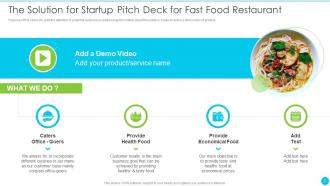
The Solution for Startup Pitch Deck for Fast Food Restaurant
-
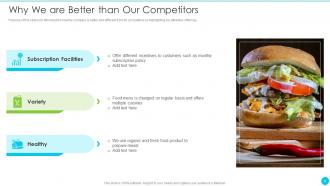
Why We are Better than Our Competitors
-
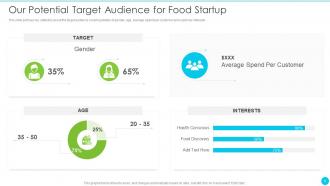
Our Potential Target Audience for Food Startup
-

Our Food Startup Business Model
-
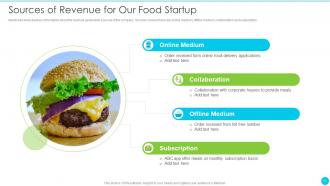
Sources of Revenue for Our Food Startup
-

Competitive Landscape for Food Startup
-
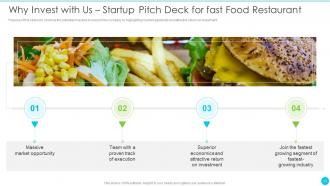
Why Invest with Us Startup Pitch Deck for Fast Food Restaurant
-

Utilisation of Funds Startup Pitch Deck for Fast Food Restaurant
-
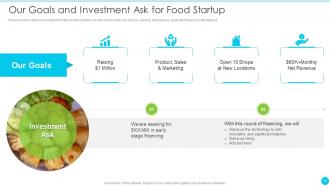
Our Goals and Investment Ask for Food Startup
-
Contact Us Startup Pitch Deck for Fast Food Restaurant
-
Icons Slide Startup Pitch Deck for fast Food Restaurant
-

Additional Slides
-
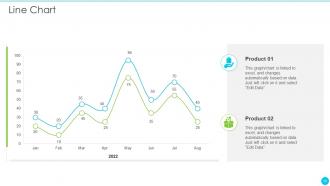
Line Chart
-
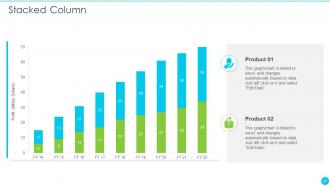
Stacked Column
-
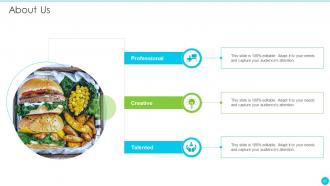
About Us
-
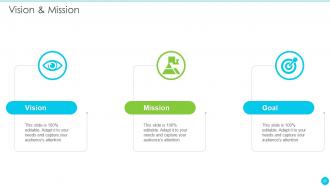
Vision Mission
-
Post it Notes
-
Idea Generation
-
Puzzle
-
Venn
-
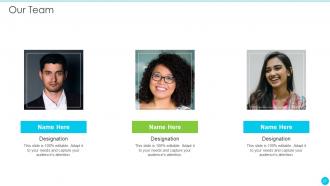
Our Team
-
30 60 90 Days Plan
-
Thank You
-

-

-

-

-

FAQs for Startup Pitch Deck For Fast Food
Okay so your deck needs the usual suspects: problem, solution, market size, business model, traction, team, financials, and funding ask. Start with the problem though - seriously, if investors don't get why this matters, you're done. One key message per slide, don't cram a novel on there. Oh and definitely include competition even if you swear you don't have any (trust me, you do). The whole thing should flow like a story from problem to opportunity. Practice a 10-minute version first, then cut it down. Way easier than trying to expand a short pitch.
Dude, storytelling completely changes the game for pitch decks. Nobody wants to sit through slide after slide of boring features and stats. What works is showing the actual customer journey - their problem, your solution, where they end up. Think of it like this: would you rather read a product manual or watch a good movie? Same concept here. Structure it so each slide builds naturally. Problem becomes your villain, solution is the hero, then show the transformation. Honestly, this approach makes even the most complex stuff memorable. Plus investors can actually picture your vision working in real life instead of just nodding politely at charts.
Keep it clean with tons of white space - people shouldn't have to squint. Big fonts only (24pt minimum) and max 2-3 colors. I swear, some presentations look like a crayon factory explosion. One idea per slide, bullet points instead of walls of text. Your charts need clear labels and simple designs. Oh, and definitely test it on an actual projector first - learned that the hard way when my "beautiful" blue text turned invisible on the conference room screen. Colors always look different than your laptop.
Honestly, you've gotta tailor your pitch to whoever's sitting across from you. VCs are all about that massive scale - hit them with your TAM and growth projections right away. Angels? They're way more into the founder story and your personal vision, so spend time there. Corporate strategic investors are weird - they mostly care if you fit into their existing business somehow. Family offices are probably the most straightforward since they just want steady returns, not some crazy moonshot. I'd definitely stalk their LinkedIn and portfolio before each meeting so you know what to lead with. Sounds obvious but most people don't actually do it.
Show them the numbers that actually matter - monthly recurring revenue, how fast you're getting new users, customer lifetime value. Revenue growth month-over-month is honestly the holy grail if you've got it. Skip the fluff metrics like total signups unless your retention is actually decent too. Market size stuff is fine but investors want to see real traction, not just "look how big this could be" slides. I'd stick to maybe 3-5 metrics that tell your story without overwhelming them. Oh and be ready to explain any weird dips - they'll definitely ask about those.
Dude, get your value prop up front - like slides 2-3 max. Don't make investors hunt for it. Open with a problem that hits them personally, something where they're like "fuck, I deal with this every week." Then boom - your solution right after. Skip the jargony nonsense and just say what you actually do. Honestly, if your mom wouldn't get it, you're overcomplicating things. Show a quick demo or real example instead of theory. The whole point is making it obvious why they'd pick you over... well, nothing. Or your competitors. Oh and test this on people outside tech first - they'll catch the confusing parts.
Honestly, the worst thing you can do is jam everything onto each slide. One point per slide, seriously. Nobody's reading paragraphs during your pitch anyway. Make sure they instantly understand the problem you're solving - that's where most people lose investors right away. Oh, and don't throw around those "trillion dollar market" numbers without explaining how you'll actually get a piece of it. Sounds lazy. Test your demo beforehand because I've seen presentations completely tank when the tech doesn't work. Stick to 10-12 slides tops and time yourself so there's space for questions at the end.
Dude, charts and infographics will save your life here. Clean visuals for market size and financials - skip the blurry spreadsheet screenshots that make everyone's eyes hurt. Your business model? Turn it into an infographic instead of bullet points. I swear, half the pitch decks I've seen are just walls of text that could cure insomnia. Stick with your brand colors and make sure each chart tells one clear story. Oh, and here's the thing - if it takes you more than 10 seconds to explain a visual, it's way too busy for investors who've already seen twelve decks today.
Your executive summary? It's basically do-or-die time. Most VCs decide if they're interested within 30 seconds of this slide, so you need to nail it. Start with the problem that's driving your customers crazy, then boom - hit them with your solution. Skip the fancy business speak and just tell them what you do and why people care right now. I always think of it like texting someone about your startup - you'd get straight to the point, right? Two or three sentences max. If you can't explain it simply, you probably don't understand it well enough yet.
Keep it to 10-12 slides tops - any more and you'll lose them. Aim for 10-15 minutes of talking because honestly, the Q&A is where things get interesting anyway. Don't try cramming your whole life story in there (I see this mistake all the time). Hit the big stuff: problem, solution, market size, how you make money, any traction you've got, your team, and what you need funding-wise. Each slide should be super clean. Practice the timing beforehand so you're not speed-talking through your financial projections at the end like a maniac.
Honestly, just start by filming yourself pitching - feels super weird but you'll catch so many bad habits. Get brutally honest feedback from other founders or mentors who won't sugarcoat it. Pitch competitions are gold for testing your deck on real people. Here's what trips everyone up: those awkward pauses between slides. Practice those transitions until they're smooth. Time yourself obsessively and have a 30-second elevator version ready. Oh, and definitely prep for hostile questions beforehand - have someone really grill you so you're not caught off guard later.
Dude, you absolutely need solid market research - I can't stress this enough. Investors will literally pass on great products if founders can't prove they actually understand their market. You've gotta have real data backing up your claims about market size and customer problems. Talk to actual customers, not just your friends who say "yeah that sounds cool." Show genuine demand exists. I've watched too many founders bomb pitch meetings because they were basically just telling stories with zero proof anyone wants what they're building. Cite your sources and know your competition inside out.
Focus on experience that actually relates to your problem and market. Don't just throw around job titles - investors see tons of those. Show specific wins, exits, or domain knowledge that matters. Why is THIS exact group perfect for your opportunity? Drop some quick credibility stuff like company names or metrics you've hit. Missing key people? Just say so and explain your hiring plan. Honestly, complementary skills matter more than impressive backgrounds sometimes. The whole point is proving you're not just another smart team - you're the RIGHT team for this specific thing. Make it clear why this combination of people makes sense together.
Stick to 3-5 year projections and focus on what investors actually care about - revenue growth, margins, burn rate, path to profitability. Tell the story behind your numbers though. What's driving growth? Customer acquisition? Pricing changes? Market expansion? That narrative matters way more than just dumping spreadsheets on them. Be conservative but show ambition - everyone knows these are educated guesses anyway. Definitely include best/worst case scenarios. Oh, and prepare to defend every single assumption because they'll grill you on the details. I learned that one the hard way.
Send a personalized thank-you within 48 hours - not some generic fluff, but actually include whatever docs they asked for. Executive summary, financials, demo access, whatever. I've seen too many founders blow it by just saying "thanks for your time" and forgetting the materials. Log everything in your CRM and maybe ping them weekly if they go quiet, but don't be annoying about it. Here's the thing though - keep talking to other investors while you wait. Seriously don't just sit there assuming their "maybe" is gonna turn into a yes.
-
Great quality slides in rapid time.
-
Visually stunning presentation, love the content.