


Startup financial pitch deck template ppt template





Try Before you Buy Download Free Sample Product
 Impress Your
 Audience
 100%
100% Editable
 Save Hours
 of Time


Raising capital from investors is a difficult task and requires a great pitch; even the founders are well experienced. Check out our competently designed Startup Financial Pitch Deck that will benefit the company seeking funding of a few thousand dollars or several million dollars. The structure covered in the presentation starts from a company overview slide that company can use to highlight its business covering vision, mission, and financials. The company overview slide is followed by the founding members of the company slide, which the company can use to tell investors about the key members. The company can use slides to highlight funding, milestones, and market projections, namely financing history, milestones achieved to date, and market growth projections. The company can use slides addressing pain points and solutions to highlight significant issues and solutions offered. The company can handle the potential investors business model and growth through slides, namely business model and key metrics highlighting traction. Strategies for business growth and critical startup financial projections slides will help the company address its business growth strategies and future startup financial estimations. Get access now.
People who downloaded this PowerPoint presentation also viewed the following :
Content of this Powerpoint Presentation
Slide 1: This slide introduces Startup Financial Pitch Deck Template. State Your Company Name and begin.
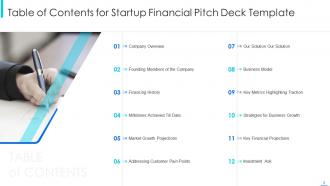
Slide 2: This slide shows Table of Contents for Startup Financial Pitch Deck Template.
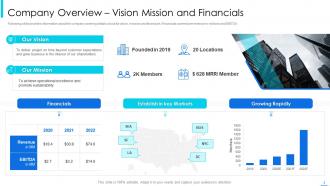
Slide 3: This slide presents information about the company covering details about its vision, mission and financials.
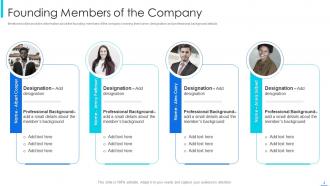
Slide 4: This slide displays founding members of the company covering their name, designation and professional background details.
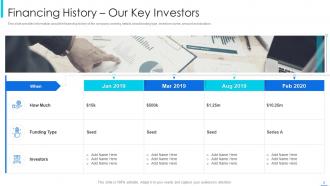
Slide 5: This slide represents financing history of the company covering details about funding type, investors name, amount, etc.
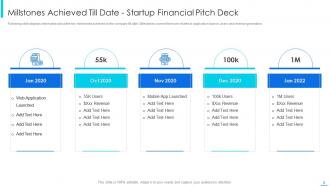
Slide 6: This slide showcases key milestones achieved by the company till date.
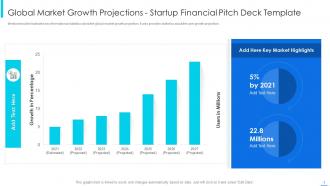
Slide 7: This slide shows Global Market Growth Projections Financial Pitch Deck.
Slide 8: This slide presents Addressing the Customer Pain Points with information about the issues faced by the customers.
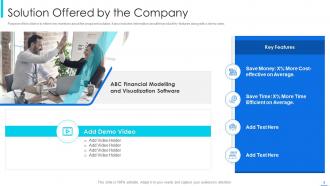
Slide 9: This slide displays key investors about the proposed solution offered by the company.
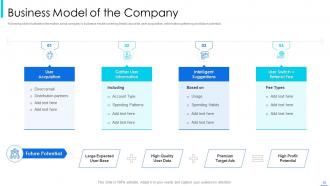
Slide 10: This slide represents company’s business model covering details about its user acquisition.
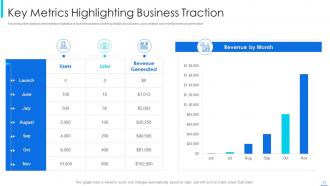
Slide 11: This slide showcases Key Metrics Highlighting Business Traction.
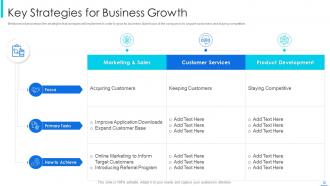
Slide 12: This slide shows strategies that company will implement in order to grow its business.
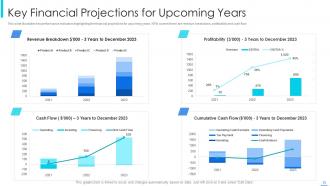
Slide 13: This slide presents Key Financial Projections for Upcoming Years.
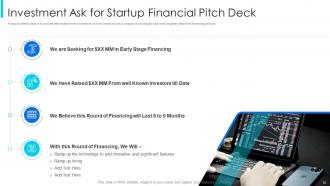
Slide 14: This slide displays investors on how much money company is looking for.
Slide 15: This slide displays Icons for Startup Financial Pitch Deck Template.
Slide 16: This slide is titled as Additional Slides for moving forward.
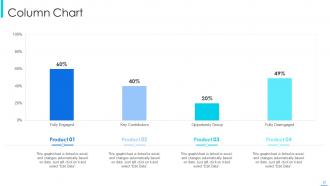
Slide 17: This slide displays Column chart with four products comparison.
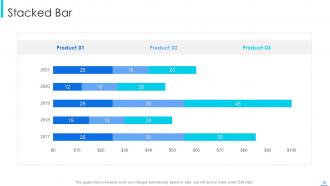
Slide 18: This slide represents Stacked Bar chart with three products comparison.
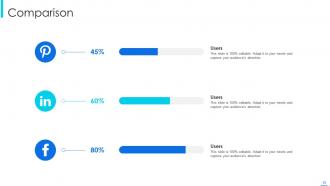
Slide 19: This is a Comparison slide to state comparison between commodities, entities etc.
Slide 20: This slide provides 30 60 90 Days Plan with text boxes.
Slide 21: This is a Timeline slide. Show data related to time intervals here.
Slide 22: This slide shows Post It Notes. Post your important notes here.
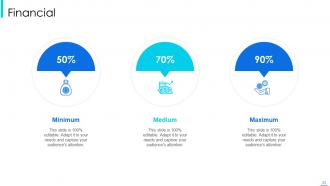
Slide 23: This is a Financial slide. Show your finance related stuff here.
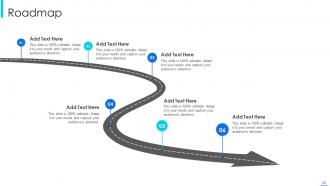
Slide 24: This slide presents Roadmap with additional textboxes.
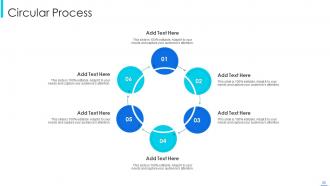
Slide 25: This slide shows Circular Diagram with additional textboxes.
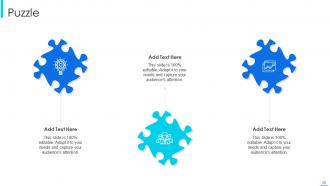
Slide 26: This slide contains Puzzle with related icons and text.
Slide 27: This is a Thank You slide with address, contact numbers and email address.
Startup financial pitch deck template ppt template with all 32 slides:
Use our Startup Financial Pitch Deck Template Ppt Template to effectively help you save your valuable time. They are readymade to fit into any presentation structure.









FAQs for Startup financial pitch deck
You need the usual suspects: problem, solution, market size, business model, traction, team, financials, and funding ask. But here's what kills me - so many founders bury the problem or make it too generic. Lead with pain that makes investors go "ugh yes, I hate that too." Then boom, here's how you fix it. Market size can't be some ridiculous "we just need 1% of this massive market" BS. Be real about it. Oh, and if you've got traction, don't save it for slide 10 - put that upfront. Draft something rough first, then get people to poke holes in it. Way better than perfecting it in isolation.
Honestly, visuals are a game changer - they stop people from drowning in text walls. When you show a chart with your growth trajectory, investors can actually *see* that hockey stick instead of just hearing "we're doing great." Product screenshots make everything feel real rather than some vague concept floating around. I've watched way too many founders bomb with decks that read like textbooks. People's eyes glaze over instantly. Team photos help too - puts faces to the business and builds trust. Just make sure each visual actually pushes your story forward. Random pretty pictures won't save you. Always ask: does this move things along or is it just filler?
Dude, the worst thing you can do is cram every detail onto your slides - investors' eyes just glaze over. Focus on the actual problem you're solving first. Also, don't throw around those massive market numbers like "trillion dollar opportunity" without showing what piece you can realistically grab. I've sat through way too many pitches where founders spend half their time on product demos. Honestly? Skip most of that and talk about your traction instead. How you'll make money matters more than fancy features. Practice your timing too - nothing's worse than rushing through the important stuff because you ran out of time.
Stick to 10-12 slides, trust me on this. I've sat through way too many pitch meetings where someone drags out 25 slides and half the room checks out. Hit your main stuff: problem, solution, market size, how you make money, any traction you've got, team, numbers, and what you're asking for. Each slide should take about a minute to get through. The whole point isn't to tell your life story - it's getting them interested enough to want another meeting. Save the really detailed stuff for later conversations. Short sentences work. Don't try to cram everything in there or you'll just overwhelm people instead of making them curious about what you're building.
Honestly, stick to 10-12 slides max. I've sat through way too many pitches that drag on forever - investors zone out after slide 15, trust me. Hit the basics: problem, solution, market size, how you make money, any traction you've got, your team, financials, and what you're asking for. Competition slide only if you really need it. Each slide should make one clear point. Practice your timing too - maybe 1-2 minutes per slide so you're not rushing through your ask at the end. The best part of any pitch is usually the Q&A anyway, so don't eat up all your time rambling through slides.
Honestly, you've gotta tailor that pitch deck to whoever you're talking to. VCs are all about massive scale and growth metrics - show them the huge market opportunity. Angels? They're betting on YOU, so lean into your founder story and early wins. I learned this the hard way lol. Strategic investors want to see how you fit into their world - like, how does partnering with you make them more competitive? Do your homework on each investor first. Figure out what gets them excited, then lead with that instead of whatever you think sounds impressive. Short version: their priorities, not yours.
Dude, you absolutely need solid market research or your pitch will fall flat. Investors can spot lazy founders who just made up numbers - trust me on this one. Your research should pop up in multiple slides: market size, customer validation, competitive analysis. Don't just dump charts everywhere though. Weave actual data into your story naturally. When someone inevitably grills you about those numbers (and they will), you better have real sources ready. It's what separates the serious entrepreneurs from people just throwing ideas at the wall.
Make your value prop dead simple - one clear sentence on your problem/solution slides. Start with the pain point, then hit them with your approach: "while everyone else does X, we do Y because Z." Don't hide behind fancy jargon or make investors decode what you're saying (spoiler: they won't bother). A quick demo helps if you can swing it. Here's the thing though - being different isn't enough. You need to show why customers actually care about that difference. Test it on random people first. If your neighbor doesn't immediately get it, you're overcomplicating things.
Look, VCs basically live and breathe the CAC to LTV ratio - that's your golden metric if you have revenue. MRR/ARR obviously matters too. User stuff like retention rates and monthly actives are huge, especially churn numbers. But here's the thing - less is more. Pick maybe 3-5 metrics max that actually tell your story. Don't overwhelm them with every damn spreadsheet you've got. If you're still pre-revenue, pivot to user growth and engagement metrics instead. Whatever you show, make sure there's a clear upward trend. Flat lines are death in pitch decks.
Look, design definitely matters for first impressions with investors. Clean visuals that don't steal focus from your story? Yes. But here's the thing - I've actually seen some pretty rough-looking decks get funded because the core idea was killer. Bad design does make you look sloppy though, like maybe you don't sweat the details elsewhere. Keep your branding consistent throughout, use fonts people can actually read, and don't go crazy with flashy stuff. Honestly, just invest in something decent but don't lose sleep perfecting every pixel. Clarity wins over fancy graphics any day.
Honestly, investors can spot bullshit projections immediately - don't make yours look like some magical hockey stick. Break down your main revenue streams for 3-5 years and actually know how you got those numbers. I'd focus more on your revenue model than getting super detailed with every little spreadsheet cell (that stuff just distracts anyway). Yeah, be ambitious but keep it grounded in reality. They're not expecting perfection - they want to see you understand your business and the market opportunity. Oh, and definitely have a backup scenario ready that's more conservative.
Dude, tell a story instead of just reading slides - that's what hooks people. Practice timing so you're not rushing through everything in like 20 minutes (10-15 max is perfect). Eye contact and gestures help tons, plus throw in some rhetorical questions to keep them engaged. Tech will probably fail at some point so have backups ready. Know your numbers inside and out because they'll definitely grill you on financials. Honestly, the passion thing matters more than perfect slides - if you don't sound excited about your idea, why should they be? Run through it with friends first, helps you nail the flow.
Skip the boring stats and open with a real customer problem story instead. Your deck should flow like any good story - problem, solution, proof it's working, then where you're headed. Honestly, investors eat up a solid origin story every time. Drop the fake personas and use actual customer examples. Show your progress like plot points building to something bigger. Your traction isn't just numbers - it's momentum toward the big moment. Wrap up with what's next so they'll want in on the sequel, you know?
Honestly, record yourself on your phone first - you'll catch so many "ums" you didn't realize you were doing. Practice way more than feels necessary, but do it in front of actual people who won't just smile and nod. I always use a mirror too because the awkwardness forces you to work on eye contact. Time everything religiously since most pitches are super strict about limits. The whole point is getting comfortable enough that if someone interrupts with questions, you don't completely lose your train of thought. Oh, and friends are better than colleagues for feedback - they'll actually tell you when something sounds terrible.
Every pitch is basically free market research - don't waste it. Watch where investors zone out and what confuses them. Seriously, write notes right after each meeting or you'll totally blank on the details later. One investor hating your slide? Whatever. Three investors asking the same confused question about market size? Yeah, that's your problem right there. Look for the patterns instead of tweaking everything after one conversation. Then use all that feedback to clean up your story and fix the parts that aren't landing before you pitch again.
-
Awesome presentation, really professional and easy to edit.
-
Perfect template with attractive color combination.
-
Best way of representation of the topic.
-
Professional and unique presentations.