


Startup Business Financial Planning And Projections Graph




Try Before you Buy Download Free Sample Product
 Impress Your
 Audience
 100%
100% Editable
 Save Hours
 of Time


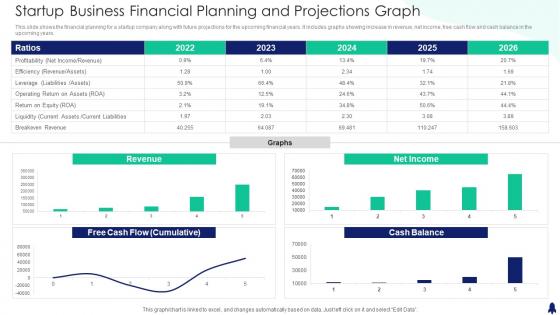
This slide shows the financial planning for a startup company along with future projections for the upcoming financial years. It includes graphs showing increase in revenue, net income, free cash flow and cash balance in the upcoming years.
People who downloaded this PowerPoint presentation also viewed the following :
Startup Business Financial Planning And Projections Graph with all 7 slides:
Use our Startup Business Financial Planning And Projections Graph to effectively help you save your valuable time. They are readymade to fit into any presentation structure.






FAQs for Startup Business Financial Planning
Key components of startup financial projections include revenue forecasts, expense budgets, cash flow statements, profit and loss projections, and break-even analyses. These financial elements work together by providing comprehensive visibility into operational costs, market opportunities, and growth trajectories, with many investors and entrepreneurs finding that detailed projections ultimately deliver strategic clarity and enhanced funding credibility.
Startup financial projections typically span three to five years, with many investors expecting detailed monthly forecasts for the first year and quarterly projections thereafter. While early-stage startups often focus on 18-24 month projections for immediate funding needs, established startups extend to five years to demonstrate long-term viability and scalability, ultimately providing investors with comprehensive growth trajectories and strategic milestones.
Assumptions form the foundation of financial projections by defining key variables like market growth rates, customer acquisition costs, pricing strategies, and operational expenses. These underlying estimates directly impact revenue forecasts, cash flow timing, and resource requirements, with many startups finding that regularly revisiting and refining assumptions based on real market data significantly improves projection accuracy and investor confidence.
Startups can effectively estimate revenue streams by analyzing market size, pricing models, customer acquisition costs, sales cycles, and historical industry data. Through comprehensive market research, competitive analysis, and customer validation surveys, startups can project realistic growth trajectories while accounting for seasonal variations and market penetration rates, ultimately delivering more accurate financial forecasting and strategic planning.
Expense forecasting methods include historical industry data analysis, competitor benchmarking, bottom-up budgeting, scenario planning, and percentage-of-sales modeling. These approaches enable startups to anticipate operational costs, staffing expenses, and market entry investments by examining sector-specific patterns, with many emerging businesses finding that combining multiple forecasting techniques delivers more accurate financial planning and strategic resource allocation.
Startups should integrate market research by analyzing target customer segments, competitive pricing strategies, market size data, and industry growth trends to inform revenue assumptions. This research enables realistic sales forecasting, proper pricing models, and accurate demand projections, with many emerging companies finding that data-driven projections significantly enhance investor credibility and strategic planning accuracy.
Optimistic projections assume best-case scenarios with higher revenues and lower costs, pessimistic projections plan for worst-case outcomes with reduced sales and increased expenses, while realistic projections balance historical data with market conditions. These three scenarios enable startups to prepare comprehensive business plans, secure appropriate funding levels, and develop contingency strategies, with many investors finding that realistic projections demonstrate stronger strategic planning and risk management capabilities.
Startups should revise financial projections monthly during early stages and quarterly once established, with additional updates triggered by major market shifts, funding rounds, or strategic pivots. This regular revision enables founders to track performance against assumptions, adjust resource allocation based on actual data, and maintain investor confidence through transparent, data-driven forecasting that reflects current business realities.
Investor interest significantly influences financial projection practices by demanding more rigorous forecasting methodologies, detailed scenario planning, comprehensive market analysis, and transparent assumption documentation. Startups seeking funding increasingly develop conservative base cases alongside optimistic projections, with many finding that investor-ready models require deeper financial controls, quarterly milestone tracking, and clearer path-to-profitability narratives, ultimately delivering enhanced strategic planning capabilities.
Financial projections demonstrate to investors a startup's growth potential, revenue forecasts, and path to profitability through detailed cash flow analysis, market penetration estimates, and scalability metrics. These comprehensive models enable investors to assess risk versus return while showcasing the startup's strategic understanding of their market, ultimately delivering credibility and competitive advantage in funding negotiations.
Common startup financial projection mistakes include overly optimistic revenue forecasts, underestimating operational costs, ignoring seasonal fluctuations, inadequate cash flow planning, and unrealistic market penetration assumptions. These errors often stem from insufficient market research and limited operational experience, with many startups finding that conservative projections with multiple scenarios ultimately deliver better investor credibility and strategic planning outcomes.
Including a cash flow statement in financial projections is absolutely critical, as it tracks actual money movement, identifies potential cash shortages, and demonstrates operational sustainability to investors. This statement enables startups to plan for seasonal fluctuations, manage working capital strategically, and make informed decisions about funding timing, with many investors finding that detailed cash flow projections indicate stronger financial planning capabilities and reduced investment risk.
Financial projection tools include Excel and Google Sheets for customizable modeling, QuickBooks and Xero for accounting integration, PlanGuru and LivePlan for comprehensive forecasting, and Cube and Anaplan for advanced analytics. These platforms streamline budgeting, automate calculations, and generate investor-ready reports, with many startups finding that integrated solutions ultimately deliver faster decision-making and enhanced financial transparency.
Financial projections influence operational planning by establishing resource allocation frameworks, identifying cash flow timing, and setting performance benchmarks that guide hiring, inventory, and expansion decisions. These projections enable startups to strategically plan operational capacity, anticipate funding needs, and align day-to-day activities with growth targets, with many entrepreneurs finding that detailed financial modeling ultimately delivers more disciplined execution and sustainable scaling.
Best practices for presenting financial projections include using clear visual formats, providing multiple scenarios, explaining key assumptions, highlighting revenue drivers, and demonstrating realistic timelines. These approaches enhance stakeholder confidence by showcasing thorough planning, risk assessment, and growth potential, with many investors finding that transparent, well-documented projections ultimately deliver stronger funding outcomes and strategic partnerships.
-
Content of slide is easy to understand and edit.
-
Amazing slides! Unique, attractive, and easy to understand.