


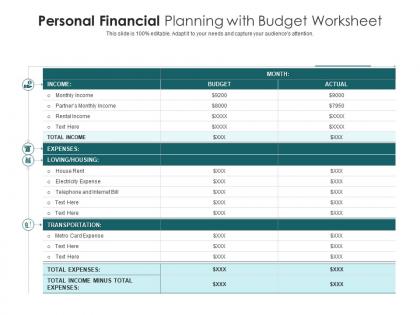
Personal financial planning with budget worksheet




Try Before you Buy Download Free Sample Product
 Impress Your
 Audience
 100%
100% Editable
 Save Hours
 of Time


Our Personal Financial Planning With Budget Worksheet are topically designed to provide an attractive backdrop to any subject. Use them to look like a presentation pro.
People who downloaded this PowerPoint presentation also viewed the following :
Personal financial planning with budget worksheet with all 2 slides:
Use our Personal Financial Planning With Budget Worksheet to effectively help you save your valuable time. They are readymade to fit into any presentation structure.
FAQs for Personal financial planning
Honestly, most people dive straight into budgeting without tracking where their money actually goes first - that's why they fail. Write down your fixed stuff like rent and utilities, then handle groceries and gas. But here's what nobody tells you: you HAVE to budget for fun money or you'll crack within like two weeks (learned this the hard way). I use the 50/30/20 thing - needs, wants, savings. Review it monthly because life's messy and things change. Oh, and start small! Don't go crazy trying to budget every penny right away.
Pay your bills on time - that's huge. Keep credit card balances under 30% of your limit. Don't close old accounts either, the length of your credit history actually matters a lot. I made that mistake once and regretted it. Opening too many new accounts at once makes you look desperate to lenders, so avoid that. Set up autopay for at least minimums so you never accidentally miss a payment. Check your credit report once a year and fight any errors you find. Honestly, if you just nail the payment timing and keep balances reasonable, you'll see improvement pretty quickly.
Honestly, flip that 50/30/20 thing - cover your needs first, then force yourself to save even if it's just 20 bucks. Track everything you spend for like a week, trust me you'll find money leaking everywhere. Meal prepping saves me so much compared to grabbing takeout constantly. Free stuff is everywhere - library events, hiking, whatever beats dropping $15 on movies. You definitely have subscriptions you forgot about, we all do. Here's what actually works though: set up automatic transfers, maybe $25 weekly straight to savings. If you don't see it, you won't spend it.
Honestly, just treat it like any other bill you can't skip - pay yourself first. Even $50/month is better than nothing. I set up automatic transfers so I literally forget about it until I randomly check my account and think "oh cool, money!" Don't try squeezing savings from leftovers. Build your whole budget around saving something first. If you're broke, at least grab that employer match - it's literally free money and people leave thousands on the table. Bump it up 1% whenever you get a raise. Small steady amounts crush those random big deposits you'll never actually make.
Insurance is basically your backup plan when life goes sideways. One medical emergency or car accident can destroy years of saving if you're not covered. Health, auto, and home/renters insurance are must-haves. Don't sleep on disability insurance either - most people skip it but it's honestly crucial for protecting your paycheck. Once you've got kids or a mortgage, life insurance becomes way more important too. Check what you already get through work first, then figure out what gaps you need to fill. Trust me, it's cheaper than starting over financially.
Honestly, just start with whatever you can swing - even $25 a month adds up. I'd set up an auto-transfer so you don't have to remember (because let's be real, you won't). Put it somewhere you can access but not TOO easily, like a high-yield savings account. Not your checking where you'll blow it on takeout. Everyone says 3-6 months of expenses but that's intimidating as hell. Focus on hitting $500 first - that covers most random emergencies like car stuff or urgent care visits. Treat it like any other bill you can't skip. Pay yourself before anything else and you'll actually stick with it.
Honestly, stocks are way more exciting but also way more stressful - like, your money could jump up or down 20% without warning. Bonds are super boring but they're consistent, which is nice when everything else is going crazy. I always think of bonds as my safety net, even though the returns aren't amazing. You'll want to mix both depending on when you need the money. Got 20+ years? Go heavier on stocks since you can ride out the crazy swings. But if you're buying a house soon or whatever, definitely lean more toward bonds for that stability.
Dude, definitely hit those high-interest loans first while paying minimums on the rest. That avalanche method actually works - saves you a ton in the long run. Those interest rates are honestly insane if you don't stay on top of them. List out everything with rates and balances so you know what you're dealing with. If federal loans are killing your budget, look into income-driven plans. Also set up autopay for the rate discount (every bit helps). Got good credit? Maybe refinance. Oh, and any random money like tax refunds - throw it straight at the principal instead of buying stuff you don't need.
Ok so first thing - track literally everything you spend for a month. I know it's annoying but trust me, you'll be shocked where your money goes. Build up that emergency fund next (3-6 months expenses) before doing anything else. List all your debts by interest rate and go after the expensive ones first while paying minimums on the rest. The debt thing honestly blows but you gotta do it. Auto-transfer money to savings each month so you actually save something. Oh and get specific with goals - like "save $500K by 55" instead of just "retire someday" or whatever.
Honestly, apps have been a game changer for my finances. I started with Mint for budgeting - it automatically pulls from all your accounts so you don't have to log every purchase like some kind of spreadsheet psycho. Banking apps are pretty solid now too, they'll ping you when you spend money and some do the round-up thing where spare change goes to savings. For investing, there's apps that let you check your portfolio obsessively (guilty) and set up automatic contributions. My advice? Pick one area that's driving you crazy first. Don't download five apps at once or you'll just get overwhelmed and abandon them all.
Ugh, lifestyle inflation is the worst savings killer. You get a raise and suddenly you "need" the nicer apartment or those daily lattes. Happens to everyone honestly. Your spending just creeps up to match whatever you're making, so you never actually get ahead. The tricky part? It feels totally reasonable because hey, you earned it! But then your savings rate stays stuck while your income grows. Here's what actually works - set up automatic transfers the second you get that raise, before you even think about upgrading anything. Beat yourself to the spending basically.
Max out your 401k and IRA contributions first - that's like free money. HSA too if you've got one. I keep a little folder for receipts throughout the year (medical stuff, donations, work expenses if you freelance). Makes April way less stressful. TurboTax is actually pretty decent now at finding deductions, but don't just auto-pilot through it. Got a mortgage or big medical bills? Definitely look into itemizing instead of standard deduction. Honestly, if your taxes get weird with multiple income sources or whatever, just bite the bullet and pay a CPA. Worth every penny.
Interest rates are obviously the main thing to check - fixed vs variable makes a difference too. Don't forget about minimum balance requirements though, some are ridiculous. Monthly fees will kill your gains if you're not careful, and banks love hiding those details. I learned that the hard way lol. Online banks beat traditional ones for rates almost every time. How often you need access matters - some accounts limit transfers. Honestly just throw the top few options in a spreadsheet with rates, fees, and rules. Makes it way easier to see what's actually worth it.
So inflation is basically this sneaky thing that makes your money worth less over time. Your grocery bill from 5 years ago? Yeah, that same cart costs way more now. When you're budgeting, just assume everything's gonna get more expensive - housing, food, all that stuff. Cash sitting in savings actually loses value because of this, which honestly sucks but it's reality. That's why people invest in stocks and real estate - they tend to beat inflation over time. I-bonds are solid too. The earlier you start investing, the better chance you have of your money actually keeping up with rising costs.
Okay so financial literacy is literally the difference between being broke and actually having your shit together. Like, once you understand compound interest and how to read your credit report, you stop making those dumb money mistakes we all make. I spent my twenties wondering where my paycheck went every month - turns out budgeting actually works, who knew? You'll avoid those sketchy debt traps and can start building real wealth. Credit cards aren't evil if you know how they work. Pick whatever you suck at most (probably budgeting let's be real) and start there.
-
Great quality product.
-
Perfect template with attractive color combination.