

Financial Plan For Startup Business With Profit And Loss Assumption





Try Before you Buy Download Free Sample Product
 Impress Your
 Audience
 100%
100% Editable
 Save Hours
 of Time


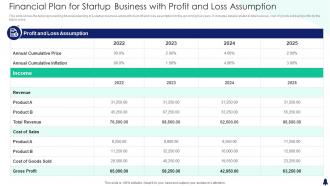
This slide shows the table representing financial planning of a startup business along with its profit and loss assumption for the upcoming four years. It includes details related to total revenue, cost of goods sold and profits for the future years.
People who downloaded this PowerPoint presentation also viewed the following :
Financial Plan For Startup Business With Profit And Loss Assumption with all 6 slides:
Use our Financial Plan For Startup Business With Profit And Loss Assumption to effectively help you save your valuable time. They are readymade to fit into any presentation structure.





FAQs for Financial Plan For Startup Business With Profit
A comprehensive financial plan includes budgeting and cash flow analysis, investment strategy, retirement planning, insurance coverage, and tax optimization strategies. These components work together by establishing clear financial goals, managing risk exposure, and maximizing wealth accumulation, with many organizations finding that integrated planning ultimately delivers better resource allocation and long-term financial stability.
Individuals can assess their current financial health by calculating their net worth, analyzing monthly cash flow, reviewing debt-to-income ratios, evaluating emergency fund adequacy, and examining investment portfolio performance. This comprehensive evaluation enables better financial decision-making, identifies areas needing improvement, and establishes benchmarks for future goals, with many finding that regular assessments ultimately deliver greater financial stability and strategic wealth-building opportunities.
Budgeting serves as the foundation for long-term financial planning by tracking income, controlling expenses, identifying savings opportunities, and establishing clear spending priorities. Through systematic budget management, individuals and organizations can allocate resources toward retirement funds, emergency reserves, and investment portfolios, ultimately delivering financial stability and enabling strategic wealth building in an increasingly complex economic landscape.
**INPUT**: How can one prioritize financial goals based on personal values and circumstances? **OUTPUT**: Financial goal prioritization involves assessing personal values, current circumstances, time horizons, and risk tolerance to create a strategic hierarchy of objectives. Through value-based planning, individuals streamline their financial decisions by aligning short-term needs with long-term aspirations, ultimately delivering greater financial clarity and more efficient resource allocation across their priority areas. [Word count: 53 words]
Common financial planning mistakes include failing to create emergency funds, underestimating retirement needs, carrying high-interest debt, lacking diversified investments, and avoiding regular plan reviews. These oversights significantly impact long-term wealth building, with many individuals finding that addressing budgeting gaps, insurance coverage, and tax optimization early ultimately delivers greater financial security and peace of mind.
Technology enhances personal finance management through automated budgeting tools, AI-driven investment advice, real-time expense tracking, predictive analytics, and integrated financial dashboards. These solutions streamline financial decision-making by providing personalized insights, automating savings transfers, and delivering comprehensive portfolio analysis, ultimately enabling individuals to optimize their financial health and achieve long-term planning goals more efficiently.
Tax implications in financial planning include income tax rates, capital gains treatment, retirement account contributions, estate tax planning, and tax-advantaged investment strategies. These considerations enable individuals and businesses to optimize their financial strategies by minimizing tax burdens, maximizing deductions, and timing income recognition strategically, ultimately delivering enhanced wealth accumulation and improved long-term financial outcomes.
Financial plans should be reviewed annually at minimum, with major life events like marriage, career changes, or market volatility triggering immediate updates. Many financial advisors recommend quarterly check-ins for active investors and semi-annual reviews for conservative portfolios, with institutions like banks and investment firms finding that regular updates enhance client outcomes and long-term wealth accumulation.
Investment strategies vary by life stage, with young adults focusing on aggressive growth through stocks and index funds, middle-aged investors balancing growth with stability via diversified portfolios, and pre-retirees emphasizing capital preservation through bonds and conservative assets. These strategic combinations enable individuals to maximize long-term wealth accumulation while managing risk appropriately, ultimately delivering financial security and retirement readiness across changing life circumstances.
Risk tolerance can be assessed through comprehensive questionnaires evaluating time horizons, income stability, investment experience, and emotional responses to market volatility. Financial advisors increasingly use scenario-based assessments and behavioral finance tools to gauge client comfort levels, with many investment firms finding that combining quantitative metrics with qualitative discussions delivers more accurate risk profiles and suitable portfolio allocations.
Best retirement practices include starting early, maximizing employer matches, diversifying investments, increasing contributions annually, and automating savings to ensure consistency. Financial advisors recommend beginning in your twenties when compound interest delivers maximum impact, with many professionals finding that even small initial contributions, combined with strategic increases during career advancement, ultimately create substantial wealth accumulation and financial security.
Economic factors significantly influence personal financial planning through inflation rates, interest rates, employment trends, and market volatility, which directly impact investment returns, borrowing costs, and purchasing power. These conditions require individuals to adjust their budgeting strategies, retirement contributions, and asset allocation approaches, with many financial advisors recommending diversified portfolios and flexible planning frameworks to navigate changing economic landscapes effectively.
Financial planning software includes Mint, YNAB, Quicken, Personal Capital, and Tiller, along with comprehensive platforms like eMoney and MoneyGuidePro. These tools streamline budgeting, investment tracking, and retirement planning by automating expense categorization, portfolio analysis, and goal monitoring, with many financial advisors and institutions finding that integrated platforms ultimately deliver enhanced client experiences and more accurate long-term projections.
Individuals can prepare for unexpected expenses by establishing an emergency fund covering three to six months of living expenses, maintaining comprehensive insurance coverage, and creating flexible budget categories for unforeseen costs. This strategic combination enables financial resilience through automated savings, diversified protection, and careful resource allocation, with many finding that consistent emergency planning ultimately delivers peace of mind and prevents debt accumulation during financial surprises.
Estate planning serves as a cornerstone of comprehensive financial strategy by preserving wealth, minimizing tax liabilities, ensuring smooth asset transfers, and protecting family financial security. Through strategic wills, trusts, and beneficiary designations, individuals and business owners streamline wealth distribution while reducing estate taxes and probate costs, ultimately delivering long-term financial stability for beneficiaries.
-
“Easy to use. I always wanted to have a quick search for products and SlideTeam has helped me have it.”
-
Great quality product.