

Financial Planing Powerpoint Presentation Slides





Try Before you Buy Download Free Sample Product
 Impress Your
 Audience
 100%
100% Editable
 Save Hours
 of Time


Showcase the role of financial management with this content ready Financial Planning PowerPoint Presentation Slides. The ready-to-use Financial Management Powerpoint Presentation Slides comprises templates such as financial management goals, objectives, US financial system, financial instruments, rights issue, debenture, time value for money parameters, valuation of bonds, comparative statement, common size statement, balance sheet , cash flow statement, trend analysis, ratio analysis, cash flow for operating activities and many more. Estimate the requirement and make a forecast of funds needed. Get your audience focus on forex capital analysis, capital budgeting evaluation techniques of projects, capital structure and dividend policy, leverage analysis, cost of capital, working capital analysis, receivable management, inventory management, economic order quality, FIFO and LIFO method, commodity exchange basics and types, commodity exchange structure, financial risk management, types and components, financial risk analysis, capital asset pricing model, etc. Download the corporate finance management PPT slides to prepare financial plans. Leave them gaping with our Financial Planing Powerpoint Presentation Slides. They will be dumbstruck by your abilities.
People who downloaded this PowerPoint presentation also viewed the following :
Content of this Powerpoint Presentation
Slide 1: This is an introductory slide to Financial Planning. State your company name and get started.
Slide 2: This is an Agenda slide. State company agendas here in a professional manner.
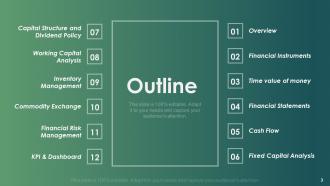
Slide 3: This slide presents an Outline with the following constituents- Overview, Financial Instruments, Time value of money, Financial Statements, Cash Flow, Fixed Capital Analysis, Capital Structure and Dividend Policy, Working Capital Analysis, Inventory Management, Commodity Exchange, Financial Risk Management, KPI & Dashboard.
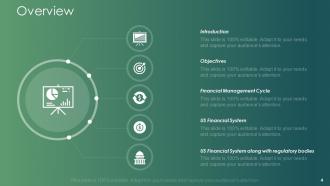
Slide 4: This slide presents an Overview with- Introduction, Objectives, Financial Management Cycle, US Financial System, US Financial System along with regulatory bodies.
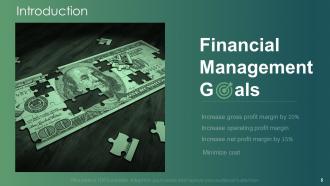
Slide 5: This is an Introduction slide which shows Financial Management Goals.
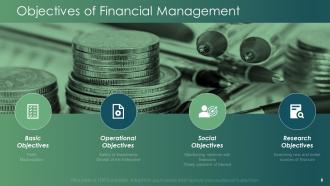
Slide 6: This slide states the Objectives of Financial Management which include the following four categories of objectives- Basic Objectives, Operational Objectives, Social Objectives, Research Objectives.
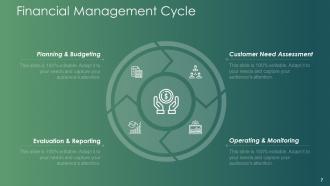
Slide 7: This slide shows Financial Management Cycle with these steps- Customer Need Assessment, Planning & Budgeting, Evaluation & Reporting, Operating & Monitoring.
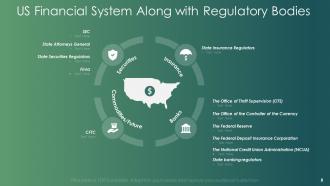
Slide 8: This slide shows US Financial System Along with Regulatory Bodies with US map imagery. It also shows the following points- The Office of Thrift Supervision (OTS), State banking regulators, The Office of the Controller of the Currency, The Federal Reserve, The Federal Deposit Insurance Corporation, The National Credit Union Administration (NCUA), State Insurance Regulators, Insurance, Banks, Commodities/Future, Securities, CFTC, SEC, State Attorneys General, State Securities Regulators, Finra.
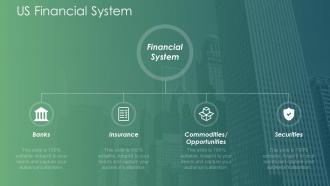
Slide 9: This slide shows US Financial System with the following elements- Banks, Insurance, Commodities/ Opportunities, Securities.
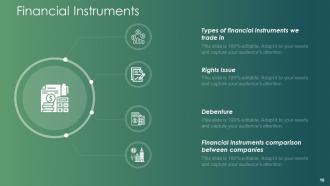
Slide 10: This is Financial Instruments slide showing the Types of financial instruments we trade in, Rights Issue, Debenture, Financial Instruments comparison between companies.
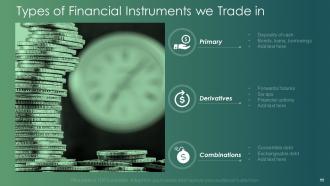
Slide 11: This slide shows Types of Financial Instruments we Trade in divided into three broad categories- Primary, Derivatives, Combinations.
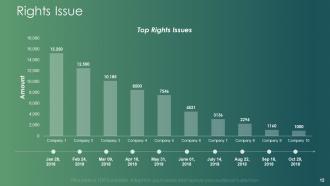
Slide 12: This slide shows the Rights Issue graph.
Slide 13: This slide shows the division of Debenture as per the following categories- On the basis of security On the basis of redemptio On the basis of records On the basis of convertibility.
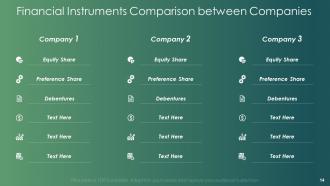
Slide 14: This slide shows Financial Instruments Comparison between Companies. Add the details of three companies and compare Financial Instruments accordingly.
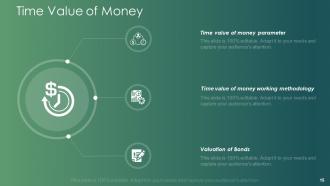
Slide 15: This slide shows Time Value of Money with- Time value of money parameter, Time value of money working methodology, Valuation of Bonds.
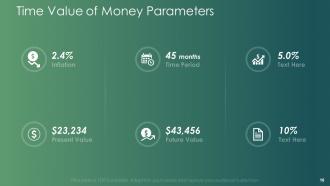
Slide 16: This slide shows Time Value of Money Parameters.
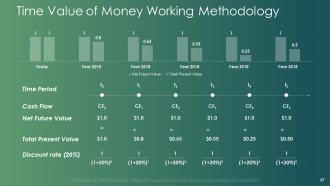
Slide 17: This slide presents Time Value of Money Working Methodology in a graphical form.
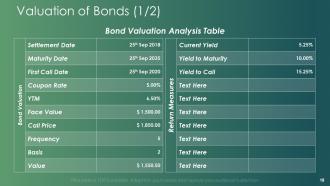
Slide 18: This slide shows the Valuation of Bonds by using Bond Valuation Analysis Table. Add relevant information in this table and use it.
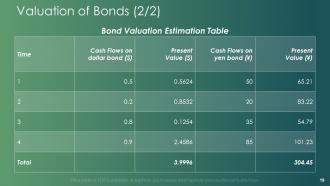
Slide 19: This slide also shows the Valuation of Bonds with Bond Valuation Estimation Table.
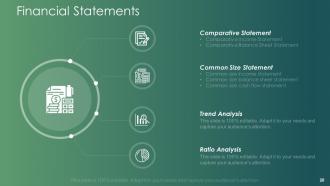
Slide 20: This slide presents Financial Statements with- Comparative Statement, Common Size Statement, Trend Analysis, Ratio Analysis.
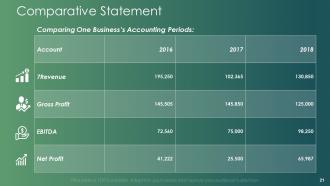
Slide 21: This slide presents Comparative Statement for Comparing One Business’s Accounting Periods.
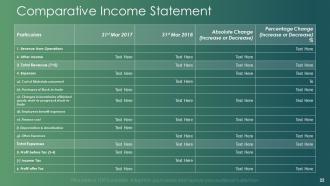
Slide 22: This slide presents Comparative Income Statement.
Slide 23: This slide presents Comparative Balance Sheet Statement.
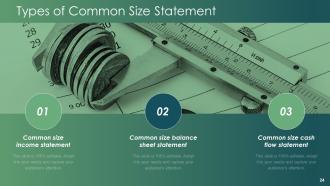
Slide 24: This slide shows Types of Common Size Statement- Common size income statement, Common size balance sheet statement, Common size cash flow statement.
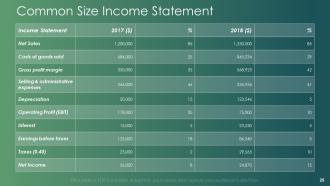
Slide 25: This slide shows the Common Size Income Statement.
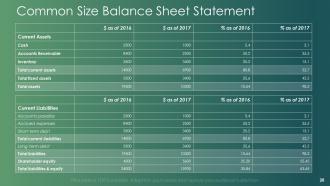
Slide 26: This slide shows the Common Size Balance Sheet Statement. Use it as per your business need.
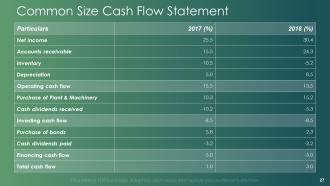
Slide 27: This slide shows the Common Size Cash Flow Statement.
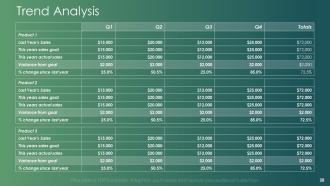
Slide 28: This slide shows the Trend Analysis.
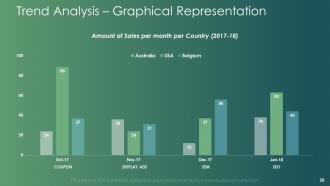
Slide 29: This slide shows Trend Analysis – Graphical Representation which further shows- COUPON, DISPLAY ADS, SEM, SEO.
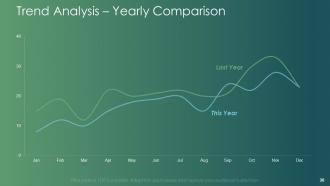
Slide 30: This slide shows Trend Analysis – Yearly Comparison of products/ entities etc.
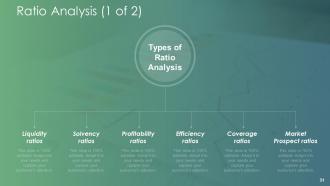
Slide 31: This is a Ratio Analysis slide showing Types of Ratio Analysis- Liquidity ratios, Solvency ratios, Profitability ratios, Efficiency ratios, Coverage ratios, Market Prospect ratios.
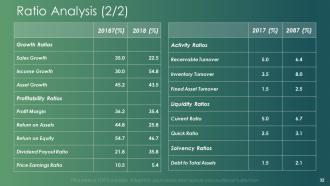
Slide 32: This is a Ratio Analysis slide.
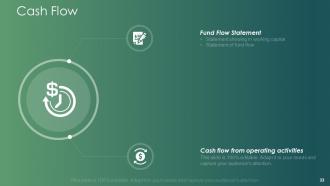
Slide 33: This slide shows Cash Flow with the following two aspects- Fund Flow Statement, Cash flow from operating activities.
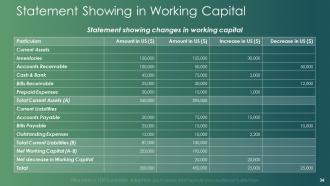
Slide 34: This slide presents Statement Showing in Working Capital.
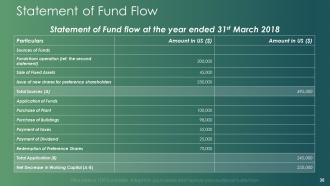
Slide 35: This slide shows a Statement of Fund Flow.
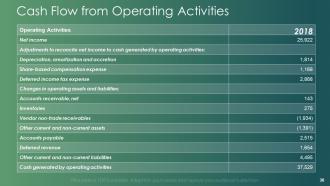
Slide 36: This slide shows Cash Flow from Operating Activities.
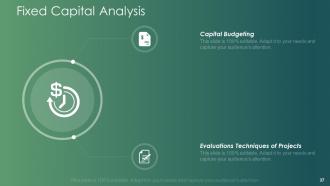
Slide 37: This slide shows Fixed Capital Analysis wth- Evaluations Techniques of Projects, Capital Budgeting.
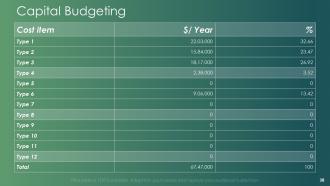
Slide 38: This slide shows Capital Budgeting.
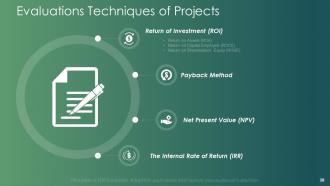
Slide 39: This slide shows Evaluations Techniques of Projects- Return of Investment (ROI), Payback Method, Net Present Value (NPV), The Internal Rate of Return (IRR).
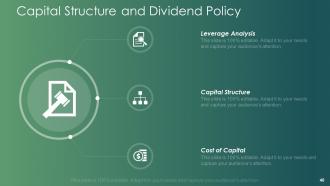
Slide 40: This is a Capital Structure and Dividend Policy slide showing- Leverage Analysis, Capital Structure, Cost of Capital.
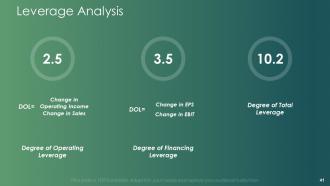
Slide 41: This slide shows the Leverage Analysis.
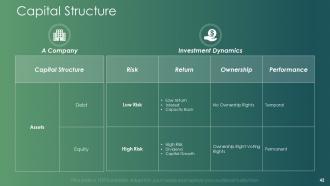
Slide 42: This slide shows the Capital Structure.
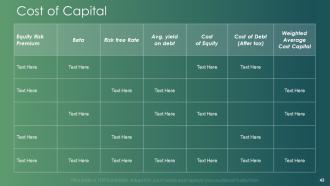
Slide 43: This slide shows the Cost of Capital presented in a tabular form.
Slide 44: This slide presents Working Capital Analysis slide with- Receivables Management, Working Capital.
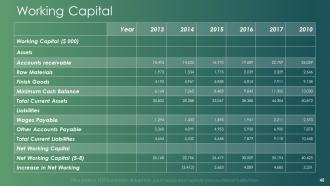
Slide 45: This slide shows the Working Capital generated in different years.
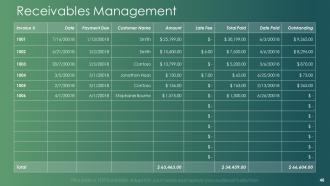
Slide 46: This is Receivables Management slide.
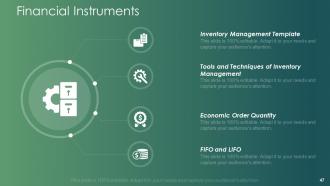
Slide 47: This is Financial Instruments slide with- Tools and Techniques of Inventory Management, Inventory Management Template, Economic Order Quantity, FIFO and LIFO.
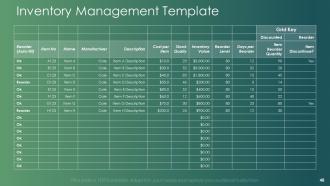
Slide 48: This slide presents Inventory Management Template.
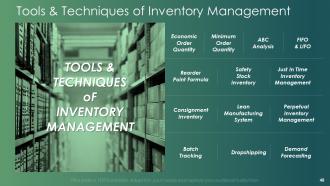
Slide 49: This slide shows Tools & Techniques of Inventory Management. We have named a few of them for your reference here. Use as per your business need.
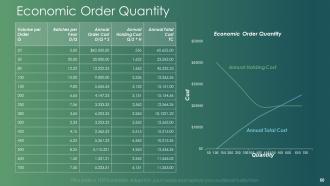
Slide 50: This is Economic Order Quantity graph slide. This graph shows- Annual Holding Cost, Annual Total Cost.
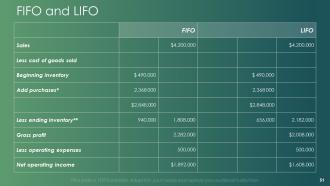
Slide 51: This slide shows FIFO and LIFO.
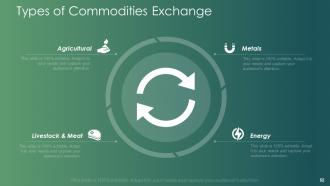
Slide 52: This slide shows Types of Commodities Exchange. We have mentioned four of them which include- Metals, Energy, Agricultural, Livestock & Meat.
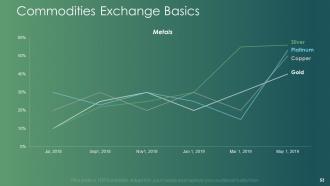
Slide 53: This slide shows Commodities Exchange Basics graphically. These commodities include- Silver, Platinum, Copper, Gold.
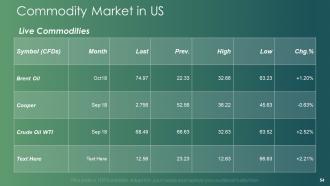
Slide 54: This is a Commodity Market in US slide showing Live Commodities.
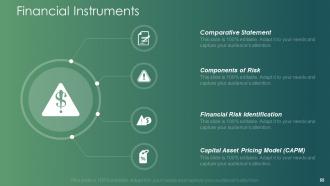
Slide 55: This slide shows Financial Instruments which consist of- Components of Risk, Comparative Statement, Financial Risk Identification, Capital Asset Pricing Model (CAPM).
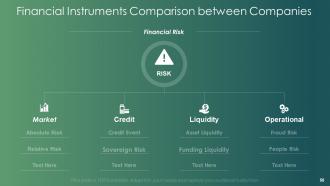
Slide 56: This is Financial Instruments Comparison between Companies slide. It also shows RISK divided into - Market, Credit, Liquidity, Operational.
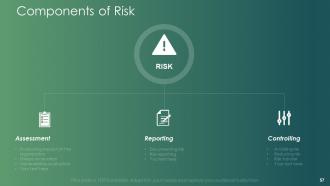
Slide 57: This slide shows the Components of Risk- Assessment, Reporting, Controlling.
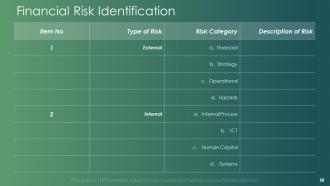
Slide 58: This is Financial Risk Identification slide. Mention the type of risks, risk category along with the description of risk here.
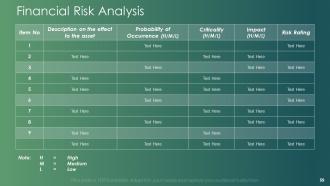
Slide 59: This slide presents Financial Risk Analysis with High, Medium, Low parameters.
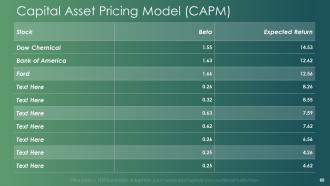
Slide 60: This slide presents Capital Asset Pricing Model (CAPM). This model includes- Stock, Ford etc.
Slide 61: This slide presents Working Capital Analysis with- KPI dashboards, KPI metrics.
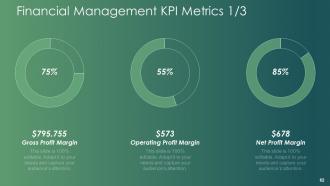
Slide 62: This slide shows Financial Management KPI Metrics which are- Gross Profit Margin, Operating Profit Margin, Net Profit Margin.
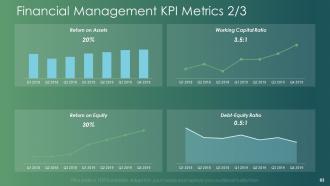
Slide 63: This slide also shows Financial Management KPI Metrics- Return on Assets, Working Capital Ratio, Return on Equity, Debt-Equity Ratio.
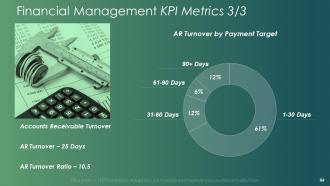
Slide 64: This slide shows another variation of Financial Management KPI Metrics.
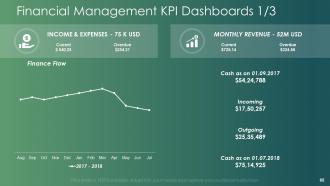
Slide 65: This is Financial Management KPI Dashboards slide showing- INCOME & EXPENSES, MONTHLY REVENUE.
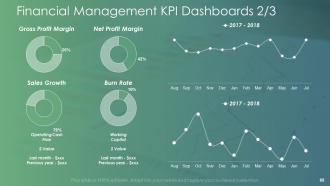
Slide 66: This is also Financial Management KPI Dashboards slide showing- Operating Cash Flow, Working Capital, Gross Profit Margin, Net Profit Margin, Sales Growth, Burn Rate.
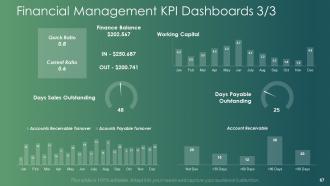
Slide 67: This slide shows another variation of Financial Management KPI Dashboards.
Slide 68: This slide is a Coffee Break slide to halt. Alter as per your need.
Slide 69: This is a Financial Planning Icon Slide. Alter as per your need.
Slide 70: This is also Financial Planning Icon Slide. Alter as per your need.
Slide 71: This is an About Us slide. State about your company team, company essentials, highlights etc. here.
Slide 72: This slide showcases Our Team with Name and Designation to fill.
Slide 73: This slide contains Our Mission, Vision, Goal with text boxes.
Slide 74: This slide shows Target with image and text boxes.
Slide 75: This is a Magnifying Glass image slide to show information, scoping aspects etc.
Slide 76: This is a Venn diagram image slide to show information, specifications etc.
Slide 77: This is a Bulb Or Idea image slide to show ideas, innovative information etc.
Slide 78: This is a Location slide to show global growth, presence etc. on a world map image.
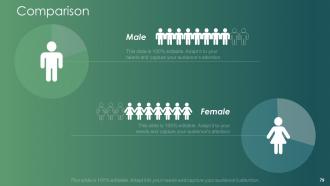
Slide 79: This slide showcases Comparison of two entities in male-female chart imagery form.
Slide 80: This is a Thank You slide with Address# street number, city, state, Contact Numbers, Email Address.
Financial Planing Powerpoint Presentation Slides with all 80 slides:
Get your ideas together with our Financial Planing Powerpoint Presentation Slides. They allow you to put in a concerted effort.













FAQs for Financial Planing
So the main stuff you need to cover: budgeting, emergency fund, paying off debt, insurance, and investing. Track your spending first - I know, super exciting right? Then save up 3-6 months of expenses for emergencies. Tackle any high-interest debt after that. Don't forget health, life, and disability insurance (learned this one the hard way). Investment strategy comes last, but match it to your timeline and what you actually want. Oh, and review everything yearly since life gets weird. Honestly though, just pick one thing to start with or you'll get overwhelmed.
Honestly, financial goals are like having GPS for your money instead of just driving around aimlessly. You know how you spend way less time scrolling Instagram when you have somewhere to be? Same thing happens with spending when you're working toward something specific - like that $10k emergency fund or killing your credit card debt. I used to buy random stuff all the time until I started tracking everything. Goals help you figure out what actually matters to you instead of blowing money on whatever catches your eye. Pick one thing you want to hit and give yourself a deadline. You'll be surprised how fast things change.
Look, budgeting is honestly just figuring out where your money goes so you're not broke all the time. Track your income and expenses for like a month first - that'll show you your actual spending habits (which might be scary lol). Once you see the patterns, you can divvy things up properly between bills, savings, and fun stuff. It's way easier to spot where you're overspending when it's all laid out. Without one, you're basically just winging it and praying nothing unexpected happens. My cousin learned this the hard way when her car died and she had zero emergency fund.
Your investment game totally changes as you get older. Early twenties? Go heavy on stocks - you've got time to weather the crazy ups and downs. Middle age hits and you'll want to mix in some bonds, diversify more. That old "100 minus your age" rule for stock allocation is kinda outdated now, but the idea still works. My dad's always tweaking his portfolio these days since he's getting close to retirement. Once you're near that point, it's more about protecting what you've built than chasing big gains. Just check in with yourself every couple years.
Dude, the worst thing people do is skip the emergency fund - like seriously, start there. Also don't invest while you're drowning in credit card debt, that's backwards. Retirement savings? Yeah, I wish someone had smacked me upside the head about starting earlier. Most people throw everything into one stock or whatever instead of spreading it around. Oh and here's what kills me - you get a raise and suddenly you're eating out every night instead of banking that extra cash. That lifestyle creep is real. Get decent insurance too because one accident can torch everything you've built.
Honestly, just picture your portfolio dropping 20% overnight - would you freak out and sell everything or shrug it off? That's your biggest clue right there. Your age matters a ton too. Young? You can probably handle more volatility since you've got time to recover. Did you invest during the whole 2020 mess? Think about how you handled that chaos. Here's my weird test: if checking your account would mess with your sleep, you're probably taking on too much risk. Those online questionnaires aren't perfect but they're decent for getting a baseline sense of where you stand.
Dude, you NEED an emergency fund. Like, seriously. Mine saved my butt when my car transmission died last year - would've been screwed otherwise. Start with whatever you can, even if it's just $20 from each paycheck. The whole "3-6 months of expenses" thing sounds intimidating but honestly? Even $500 makes a difference. Keep it separate from your regular savings though, maybe in a different bank so you're not tempted to touch it. Trust me, having that cushion means you won't panic when life gets expensive. Credit cards seem easier but they'll bite you later.
Honestly, budgeting apps changed everything for me. Mint and YNAB automatically track your spending so you don't have to log every coffee purchase (thank god). Investment platforms handle portfolio stuff too. The trick is finding apps that sync with your bank - manual entry is the worst and you'll just quit after like three days. AI tools can even spot weird spending patterns you miss. I'm kinda jealous of people starting out now because this tech would've saved me from so many money mistakes in college. Pick one app this week and just see what happens.
Look, retirement planning is honestly what separates people who can actually retire from those who... well, can't. You're building wealth bit by bit instead of hoping you'll magically figure it out at 65. Starting early is huge because compound interest does most of the heavy lifting for you - even small amounts grow into serious money over decades. Having that plan also means you've got options later and way less stress about the future. Oh, and definitely grab any 401k match from your employer first. That's just free money sitting there.
Dude, inflation is sneaky - it just quietly eats away at your money's value. That $100k you're stashing away? It'll buy way less stuff in 20 years. Then you've got all the economic curveballs like recessions and market crashes that can totally mess up your timeline. Trust me, 2008 was a brutal wake-up call for so many people. You really can't just dump money somewhere and ignore it for decades. Keep some cash for emergencies, spread your investments around, and actually check in on your plan once a year. Your risk tolerance will probably change as you get older anyway.
Max out your 401k and IRA first - that's the easiest win. HSA too if you've got one. After that, stick with index funds in taxable accounts since they don't create as many tax headaches as active funds. Tax-loss harvesting is clutch - sell your losers to offset gains. Hold stuff for over a year when you can because long-term capital gains rates don't suck as much. Oh, and I probably should've mentioned this earlier but seriously focus on those retirement accounts first before anything else.
Honestly, start with an emergency fund - like 3-6 months of expenses in a separate savings account you can actually get to. Even throwing $25 from each paycheck helps more than you'd expect. Track your spending for a month (kinda annoying but worth it) to see where money's going. Check your insurance too - you don't want some random medical bill or car thing wiping you out. I'm big on automating transfers to emergency savings. That way you're building it up without constantly deciding whether to save or spend.
Honestly, having a financial advisor is like having someone who actually knows what they're doing look at your money situation. They'll build you a real plan based on your goals, not some cookie-cutter thing. The investment optimization stuff is huge too. But here's what I love most - they stop you from doing dumb emotional trades when the market freaks out (guilty as charged lol). As your life changes, they adjust everything. My cousin swears by hers for retirement planning and tax moves. If you're stressed about money or just want to get serious, definitely chat with one.
Okay so first thing - write down ALL your debts with interest rates and minimum payments. You gotta see the whole mess before you fix it. Pay minimums on everything, then throw extra money at whatever has the highest interest rate (probably your credit cards, ugh). I get that knocking out small balances feels good, but trust me, the math works better this way. Look into consolidation if you can snag a lower rate. Oh, and build up like $500-1000 for emergencies so you don't just rack up more debt when your car breaks down or whatever. Check your progress monthly - it'll keep you sane.
So basically you don't want all your money in one thing, right? Mix it up - stocks, bonds, maybe some real estate or international funds. When one crashes (and something always does), the others hopefully keep you afloat. Honestly, I learned this the hard way when tech stocks tanked a few years back. Even something simple like splitting between a domestic index fund and an international one is way better than picking individual stocks. The whole point is lowering your risk but still making money over time. Pretty straightforward stuff.
No Reviews