


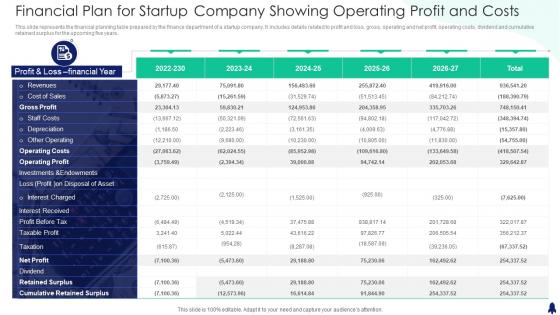
Financial Plan For Startup Company Showing Operating Profit And Costs




Try Before you Buy Download Free Sample Product
 Impress Your
 Audience
 100%
100% Editable
 Save Hours
 of Time


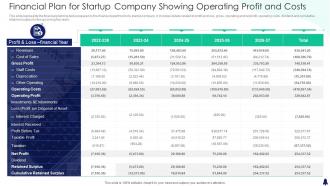
This slide represents the financial planning table prepared by the finance department of a startup company. It includes details related to profit and loss, gross, operating and net profit, operating costs, dividend and cumulative retained surplus for the upcoming five years.
People who downloaded this PowerPoint presentation also viewed the following :
Financial Plan For Startup Company Showing Operating Profit And Costs with all 6 slides:
Use our Financial Plan For Startup Company Showing Operating Profit And Costs to effectively help you save your valuable time. They are readymade to fit into any presentation structure.





FAQs for Financial Plan For Startup Company Showing Operating
Key components of a comprehensive financial projection include revenue forecasts, expense budgets, cash flow statements, balance sheet projections, and break-even analysis. These elements work together by providing stakeholders with clear visibility into future performance, enabling strategic resource allocation and investment decisions, while helping organizations anticipate funding needs and demonstrate financial viability to investors.
Assumptions significantly impact financial projection accuracy by determining revenue growth rates, cost structures, market conditions, and operational parameters that drive all calculations. Overly optimistic assumptions can inflate projections while conservative estimates may undervalue opportunities, with many organizations finding that regularly updating assumptions based on market data, industry benchmarks, and actual performance trends ultimately delivers more reliable forecasts and strategic planning outcomes.
Market trends significantly influence financial forecasts by providing insights into consumer behavior shifts, economic cycles, competitive landscapes, and regulatory changes that directly impact revenue and cost projections. These trends enable businesses to anticipate demand fluctuations, adjust pricing strategies, and allocate resources strategically, with many organizations finding that trend-informed forecasting delivers more accurate budgets and competitive positioning.
Businesses integrate historical data into financial projections by analyzing past revenue patterns, expense trends, seasonal fluctuations, and growth trajectories to establish baseline assumptions. Through comprehensive data analysis, organizations identify key performance indicators, market cycles, and operational benchmarks, enabling more accurate forecasting models that ultimately deliver strategic planning advantages and improved resource allocation decisions.
Common pitfalls include overly optimistic revenue assumptions, underestimating expenses, ignoring seasonal variations, neglecting market research, and failing to scenario plan. These oversights can mislead stakeholders and derail strategic planning, with many organizations finding that conservative estimates, thorough market analysis, and multiple projection scenarios ultimately deliver more credible forecasts and better investment decisions.
Financial projections should be updated monthly for operational decisions and quarterly for strategic planning, with annual comprehensive reviews for long-term forecasting. Many organizations find that frequent updates, especially during volatile market conditions or rapid growth phases, enable better resource allocation, risk management, and investor communication, ultimately delivering more accurate financial planning and competitive advantage.
Stress-testing techniques include scenario analysis, sensitivity analysis, Monte Carlo simulations, break-even analysis, and cash flow stress tests. These methods help organizations evaluate projections by adjusting key variables like revenue assumptions, cost fluctuations, and market conditions, with many financial institutions and startups finding that comprehensive stress-testing ultimately delivers more resilient planning and improved investor confidence.
Startups can create credible financial projections by leveraging industry benchmarks, conducting thorough market research, analyzing comparable companies, and using conservative assumptions with multiple scenarios. Through bottom-up forecasting and regular validation against actual performance, many emerging businesses find that transparent methodology and realistic growth rates ultimately deliver investor confidence and strategic planning advantages.
Short-term financial projections typically cover 12-18 months with detailed monthly or quarterly breakdowns, while long-term projections span 3-5 years with broader annual estimates and strategic assumptions. Short-term forecasts enable immediate operational decisions and cash flow management, whereas long-term projections guide strategic planning, investment decisions, and growth initiatives, with many organizations finding that combining both timeframes delivers comprehensive financial visibility and competitive advantage.
Visual aids enhance financial projection communication by transforming complex numerical data into accessible charts, graphs, infographics, and interactive dashboards that stakeholders can quickly interpret and understand. These tools streamline decision-making processes by highlighting key trends, risk scenarios, and growth opportunities, with many financial institutions and corporations finding that visual presentations significantly improve investor engagement and strategic planning discussions.
Excel remains the foundation for financial projections, complemented by specialized tools like QuickBooks for accounting integration, Tableau for data visualization, PlanGuru for comprehensive forecasting, and LivePlan for startup projections. These platforms streamline complex calculations, automate scenario modeling, and enhance presentation capabilities, with many financial professionals finding that combining Excel's flexibility with specialized software delivers more accurate forecasts and compelling investor presentations.
Non-financial factors significantly influence financial forecasting by affecting customer behavior, operational efficiency, and market conditions through regulatory changes, competitive dynamics, technological disruptions, and economic trends. These variables impact revenue projections, cost structures, and resource allocation decisions, with many organizations finding that incorporating market sentiment, industry developments, and operational metrics alongside traditional financial data delivers more accurate forecasting and strategic planning outcomes.
Regulatory changes significantly impact financial projections by altering compliance costs, operational requirements, revenue recognition standards, and capital allocation strategies. These shifts require organizations to reassess forecasting models, adjust risk assessments, and recalibrate growth assumptions, with many financial institutions and healthcare companies finding that proactive regulatory planning ultimately delivers competitive advantage and improved stakeholder confidence.
Organizations should present financial projections through clear visual dashboards, detailed scenario modeling, executive summaries with key metrics, and interactive presentations that allow stakeholder questions. These approaches enhance transparency by combining charts and graphs with narrative explanations, enabling stakeholders to understand assumptions and risks, while ultimately delivering confidence in strategic decision-making and resource allocation across departments.
Key metrics include revenue projections, gross and net profit margins, cash flow statements, customer acquisition costs, and return on investment calculations. These financial indicators enable investors to assess growth potential, operational efficiency, and market viability across sectors like SaaS, retail, and manufacturing, ultimately delivering transparency and competitive positioning for funding decisions.
-
“I always have a wonderful experience with SlideTeam. It's my ""go to"" when I need a template.”
-
Great experience, I would definitely use your services further.