


Business startup costs table with assets




Try Before you Buy Download Free Sample Product
 Impress Your
 Audience
 100%
100% Editable
 Save Hours
 of Time


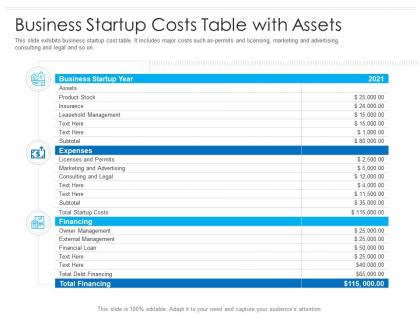
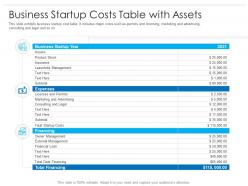
This slide exhibits business startup cost table. It includes major costs such as permits and licensing, marketing and advertising, consulting and legal and so on.
People who downloaded this PowerPoint presentation also viewed the following :
Business startup costs table with assets with all 2 slides:
Use our Business Startup Costs Table With Assets to effectively help you save your valuable time. They are readymade to fit into any presentation structure.
FAQs for Business startup costs
So I'd split your startup costs into two categories - one-time expenses and monthly stuff. Equipment, initial inventory, legal fees, permits fall into the first bucket. Monthly costs are rent, utilities, insurance, payroll, marketing - you know, all the bills that keep coming. Here's the thing though: always pad your estimates by like 15-20% because something will definitely cost more than you think. I learned that the hard way lol. Spreadsheet everything out first so you can actually see where your money's going. Trust me, it's way easier to plan when it's all laid out.
So basically, fixed costs don't change no matter what - rent, insurance, that fancy equipment you bought. Variable costs go up and down with your sales, like materials and shipping fees. Here's what I do: just ask "if I double my sales tomorrow, does this cost double too?" Yes means variable, no means fixed. Some stuff tricks you though - utilities look fixed but they're not really if you're running machines all day. I always make two lists when budgeting. Sounds nerdy but it actually helps you figure out when you'll break even.
Honestly, you need that reality check before you blow your budget. Market research shows you what people actually pay and whether your idea makes sense financially. Skip it and you're just guessing at marketing costs, inventory, pricing - basically everything important. Most founders wing it anyway (hence the cash burn horror stories), but at least do basic validation first. These studies catch hidden expenses too, like weird regulatory stuff or equipment you didn't know existed. Your future broke self will thank you.
Oh dude, definitely pad your budget by like 20-30% right from the start. Trust me on this one - I got absolutely wrecked by our office setup because of all these random fees nobody mentioned. Unexpected stuff ALWAYS comes up. Keep track of everything so you can catch patterns early. Set up a separate emergency fund too, but only use it for actual emergencies, not stuff you just forgot to budget for (guilty of this lol). When weird expenses pop up, be brutal about what's actually needed now vs what can wait. Your future self will thank you.
Dude, it's always the boring stuff that kills you. Insurance, accounting software, legal fees - nobody budgets for that crap but it adds up crazy fast. Banking fees too, which honestly feels like theft sometimes. Then you're buying random office supplies you never thought about. The regulatory nightmare depends on your industry but licenses and permits can get expensive quick. Oh, and I always forget about equipment repairs until something breaks. Add like 25% extra to whatever you think these hidden costs will be, trust me.
Dude, seriously do the business plan thing. It forces you to think through literally every expense - equipment, permits, insurance, all that boring stuff. Plus the random costs you'd never think of otherwise. Yeah, it's tedious as hell, but you'll actually know what you need instead of just winging it. I made the mistake of skipping this step once and ended up scrambling for rent money like an idiot. Break it down by categories first, then get specific. Trust me, you don't want to be that person begging for emergency cash later.
Honestly, you've got a few decent options here. Personal savings is obviously the cleanest route - no one breathing down your neck about it later. Bank loans aren't terrible if your credit's solid, way better rates than putting everything on cards. Friends and family money works but... yeah, that can get weird fast if things go sideways. Angel investors are cool if you can find them, or there's always crowdfunding - though that's basically a marketing campaign in itself. You could even bootstrap it, start tiny and just keep reinvesting whatever you make. Figure out your actual number first, then pick whatever doesn't totally screw you over.
Look, you really need to get your budget sorted before you launch anything. I've watched so many people crash because they had no clue what money was going out the door. Don't just think about the obvious stuff like equipment - there's all these random costs that'll sneak up on you. Permits, insurance, marketing (ugh, marketing gets expensive fast). Map it out month by month for your first year. Honestly, whatever number you land on, add 20% more because something will go wrong. Trust me on this one - start working on it this week.
Yeah, you can deduct most startup costs but the IRS is annoying about it. If your total expenses are under $50k, you get to deduct $5k right away - the rest gets spread over 15 years. Business formation fees count, plus market research and your initial ads. The catch? You actually have to be running a real business, not just thinking about maybe starting one someday. I learned this the hard way lol. Document everything though - receipts, dates, all that stuff. Tax guy might be worth it if you're dealing with bigger numbers.
Honestly, tech can save you SO much money when starting out. Cloud services are way cheaper than buying your own servers. Skip the office rent - remote work tools make that totally doable now. Free accounting software, design apps, all that stuff exists. Social media marketing won't drain your budget like traditional ads either. Shopify handles e-commerce without custom coding (though I still think their fees add up fast). Automation can replace hiring people right away too. Just make a list of your biggest costs first, then find tech solutions for each one.
Dude, location will totally destroy your budget if you're not careful. SF and NYC? Forget about it - rent alone could be like 40% of your costs. I'd honestly just go remote or pick a smaller city at first. Even picking suburbs over downtown saves you tons. Yeah, you might miss out on some networking stuff, but your runway will last way longer. Figure out what space you actually need (not the fancy stuff), then compare maybe 3-4 different spots. The difference in burn rate is wild. You can always move somewhere pricier once you're making money.
Look, you gotta add up everything you're sacrificing. What would you make at a regular job? Include benefits, 401k matches, all that stuff. The stress alone is costing you - startup life will mess with your head and that's real money in therapy bills down the line lol. Plus whatever cash you're putting in could just be sitting in index funds making steady returns instead. Most founders I know totally lowball these hidden costs. My advice? Actually track this stuff monthly. That way you'll know if you should keep grinding or cut your losses and get a normal paycheck again.
Bootstrap hard in the beginning - free tools, work from your couch, hit up your network for those first customers. Skip the fancy logo nonsense (seriously, I've watched so many founders waste money there). Build an MVP with no-code stuff or cheap freelancers instead of jumping straight to full-time hires. Your home office is fine for now. Revenue-based financing beats giving up equity if you can swing it. Only spend on things that'll actually make you money or save major time. Everything else can wait until you're actually making decent revenue.
Oh man, regulatory fees will absolutely wreck your budget if you're not careful. Business licenses, permits, trademark stuff - it adds up fast. Some hit you once, others come back every year or when you hit certain revenue marks. The annoying thing is every industry and state is different, so you can't just Google "startup fees" and get a real answer. I got blindsided by this with my last company tbh. Do your homework on what your specific industry needs in your state, then tack on like 20% extra because you'll definitely miss something random.
Honestly, startup costs are all over the place depending on what you're doing. Tech companies usually need like $50K-500K to get going. Restaurants though? That's brutal - we're talking $175K-750K just to open the doors. Retail is more manageable at $50K-200K, but manufacturing will destroy your bank account at $500K+ because of all the equipment. Service businesses have it easy since you're basically just paying people and buying software. What I'd do is look up 3-5 companies doing exactly what you want to do, figure out what they probably spent, then tack on 20% extra because something always goes wrong.
-
Excellent work done on template design and graphics.
-
Commendable slides with attractive designs. Extremely pleased with the fact that they are easy to modify. Great work!
-
Informative design.
-
Colors used are bright and distinctive.
-
Out of the box and creative design.