

Startup Business Valuation Methods Powerpoint Presentation Slides





Try Before you Buy Download Free Sample Product
 Impress Your
 Audience
 100%
100% Editable
 Save Hours
 of Time


To raise capital, a startup needs to be valued, and thus, any entrepreneur needs to understand how the startup valuation process works. Here is a competently designed Startup Business Valuation Methods template that helps identify and understand valuation tools and techniques. It also helps to analyze the overall equity needs of the company in various stages such as Seed Stage, Series A Stage, Series B Stage, etc. It also shows the multiple challenges the startup faces while doing the valuation. Risks associated with the wrong valuation are also covered in this presentation, along with the key points that should be kept in mind while valuing a business. This presentation covers various startup valuation slides, including the need for startup valuation, factors that influence startup valuation, business introduction details, startup business team, etc. Additionally, it covers startup failure rate with funding sequence, sources available for startup investment, various methods of valuation, etc. In the end, this presentation includes long term goals and strategies, business pre series and post series valuation, etc. Download it now.
People who downloaded this PowerPoint presentation also viewed the following :
Content of this Powerpoint Presentation
Slide 1: This slide introduces Startup Business Valuation Methods. State Your Company Name and begin.
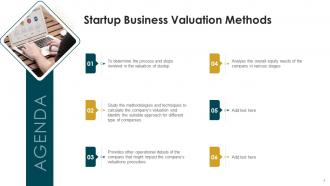
Slide 2: This slide states Agenda of the presentation.
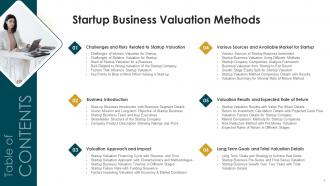
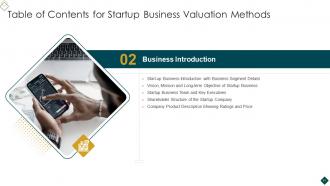
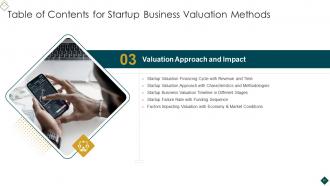
Slide 3: This slide presents Table of Content for the presentation.
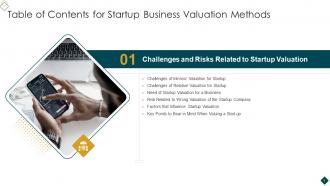
Slide 4: This slide shows title for topics that are to be covered next in the template.
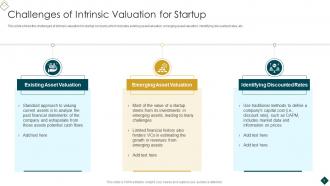
Slide 5: This slide displays the challenges of intrinsic valuation for startup company.
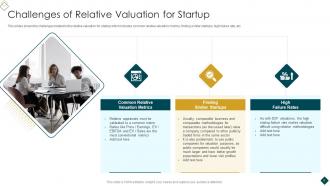
Slide 6: This slide represents Challenges of Relative Valuation for Startup.
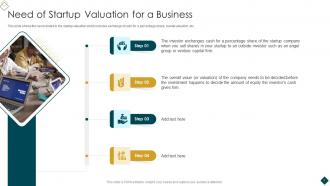
Slide 7: This slide shows the need related to the startup valuation which includes exchange of cash for a percentage share, overall valuation, etc.
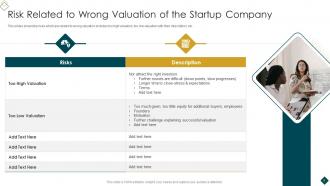
Slide 8: This slide presents Risk Related to Wrong Valuation of the Startup Company.
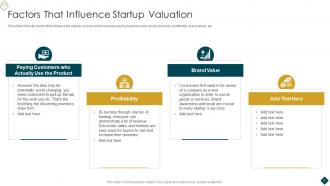
Slide 9: This slide shows the factors that influence the startup company which includes products, profitability, brand values, etc.
Slide 10: This slide displays Key Points to Bear in Mind When Valuing a Start-up.
Slide 11: This slide highlights title for topics that are to be covered next in the template.
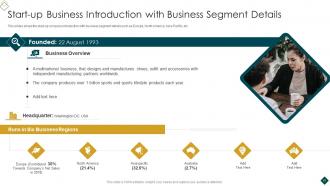
Slide 12: This slide shows Start-up Business Introduction with Business Segment Details.
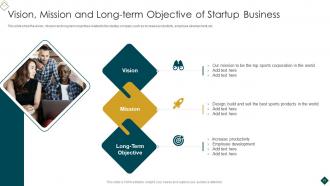
Slide 13: This slide presents Vision, Mission and Long-term Objective of Startup Business.
Slide 14: The slide provides the key executives (C-level, Executive board member and Head of the departments) of the Start-up Company.
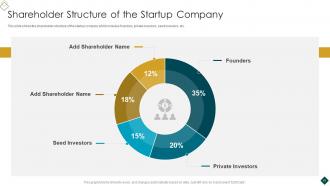
Slide 15: This slide displays the shareholder structure of the startup company which includes founders, private investors, seed investors, etc.
Slide 16: This slide represents Company Product Description Showing Ratings and Price.
Slide 17: This slide highlights title for topics that are to be covered next in the template.
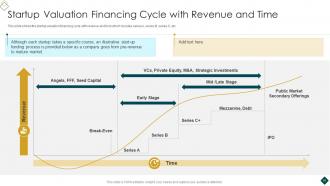
Slide 18: This slide presents Startup Valuation Financing Cycle with Revenue and Time.
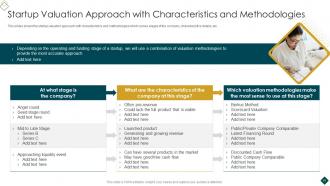
Slide 19: This slide shows Startup Valuation Approach with Characteristics and Methodologies.
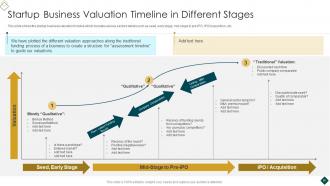
Slide 20: This slide displays Startup Business Valuation Timeline in Different Stages.
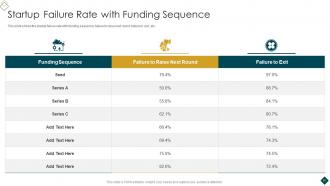
Slide 21: This slide represents the startup failure rate with funding sequence, failure to raise next round, failure to exit, etc.
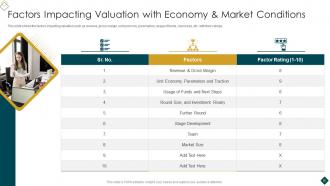
Slide 22: This slide shows Factors Impacting Valuation with Economy & Market Conditions.
Slide 23: This slide highlights title for topics that are to be covered next in the template.
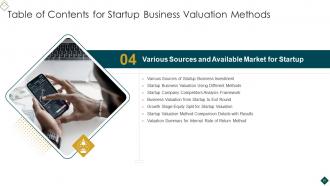
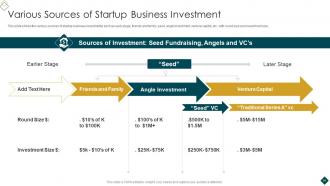
Slide 24: This slide shows Various Sources of Startup Business Investment.
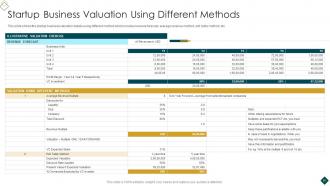
Slide 25: This slide displays Startup Business Valuation Using Different Methods.
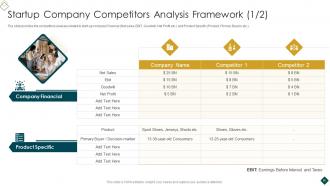
Slide 26: This slide represents Startup Company Competitors Analysis Framework.
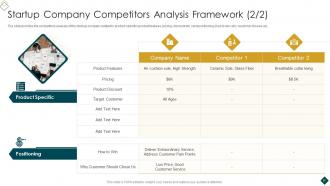
Slide 27: This slide shows competitors analysis of the start-up company related to product specific product features, pricing, discount etc.
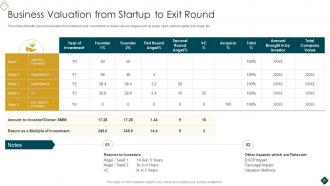
Slide 28: This slide presents the business valuation from startup to exit round which includes various stages such as angel, seed, venture capital, etc.
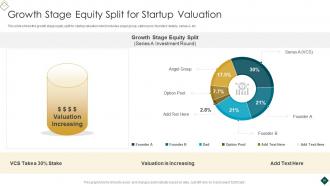
Slide 29: This slide shows the growth stage equity split for startup valuation which includes angel group, option pool, founders' details, series-A, etc.
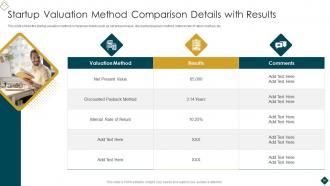
Slide 30: This slide displays Startup Valuation Method Comparison Details with Results.
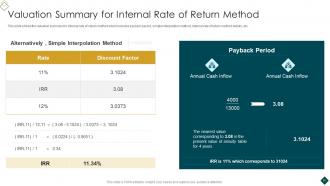
Slide 31: This slide represents Valuation Summary for Internal Rate of Return Method.
Slide 32: This slide highlights title for topics that are to be covered next in the template.
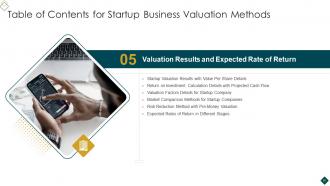
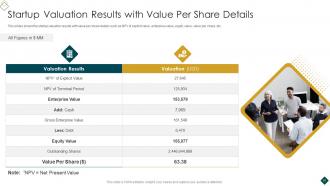
Slide 33: This slide presents Startup Valuation Results with Value Per Share Details.
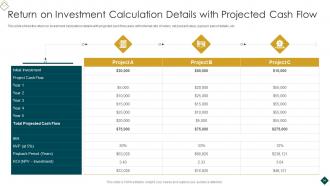
Slide 34: This slide shows Return on Investment Calculation Details with Projected Cash Flow.
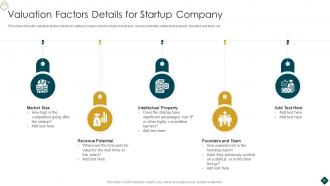
Slide 35: This slide displays Valuation Factors Details for Startup Company.
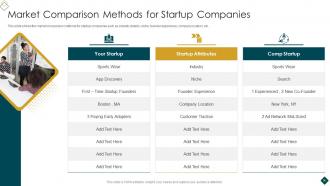
Slide 36: This slide represents the market comparison methods for startup companies such as industry details, niche, founder experience, etc.
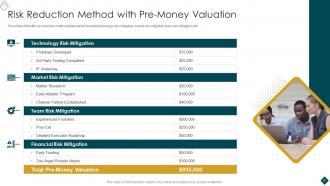
Slide 37: This slide shows Risk Reduction Method with Pre-Money Valuation.
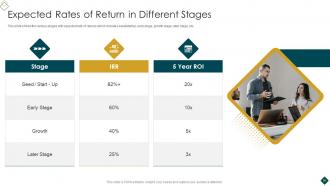
Slide 38: This slide presents the various stages with expected rate of returns which includes seed/startup, early stage, later stage, etc.
Slide 39: This slide highlights title for topics that are to be covered next in the template.
Slide 40: This slide displays Long Term Goals and Strategy to Achieve that Goals.
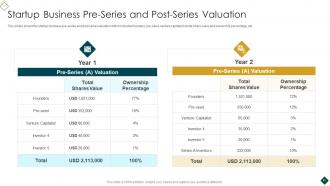
Slide 41: This slides represents the startup business pre-series and post series valuation which includes founders, pre-seed, venture capitalist’s, etc.
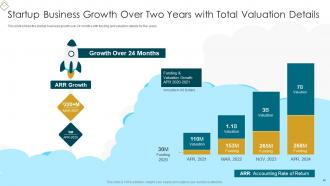
Slide 42: This slide shows Startup Business Growth Over Two Years with Total Valuation Details.
Slide 43: This slide displays Icons for Startup Business Valuation Methods.
Slide 44: This slide is titled as Additional Slides for moving forward.
Slide 45: This is About Us slide to show company specifications etc.
Slide 46: This is Our Mission slide with related imagery and text.
Slide 47: This is Our Team slide with names and designation.
Slide 48: This slide shows Post It Notes. Post your important notes here.
Slide 49: This is a Timeline slide. Show data related to time intervals here.
Slide 50: This is Our Target slide. State your targets here.
Slide 51: This slide provides 30 60 90 Days Plan with text boxes.
Slide 52: This slide shows Circular Diagram with additional textboxes.
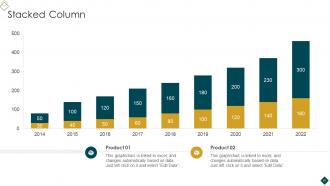
Slide 53: This slide represents Stacked Column chart with two products comparison.
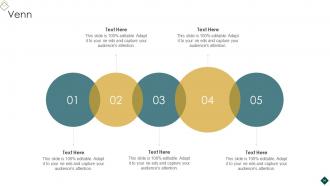
Slide 54: This slide depicts Venn diagram with text boxes.
Slide 55: This is an Idea Generation slide to state a new idea or highlight information, specifications etc.
Slide 56: This is a Thank You slide with address, contact numbers and email address.
Startup Business Valuation Methods Powerpoint Presentation Slides with all 61 slides:
Use our Startup Business Valuation Methods Powerpoint Presentation Slides to effectively help you save your valuable time. They are readymade to fit into any presentation structure.
















FAQs for Startup Business Valuation Methods
So there's three main ways people value startups. DCF is where you project future cash flows and discount them back, but it's kinda useless for early companies with zero revenue. Then there's comparable analysis - basically looking at what similar companies are worth and applying those ratios to your numbers. Risk-adjusted NPV is the third one, which accounts for how most startups actually fail. Honestly though, all these methods suck for startups since there's barely any data to work with. I'd just use all three and average them out - better than putting all your eggs in one basket.
Yeah so if you're super early stage, you're basically stuck with qualitative stuff - scorecard method, Berkus valuation, that kind of thing. You probably don't have revenue numbers worth talking about anyway. Pre-seed and seed rounds care more about your team, how big the market is, maybe some early traction. Once you hit Series A though? That's when you can actually use revenue multiples and compare yourself to similar companies. Way more concrete. Growth stage is where DCF models finally make sense since your financials aren't all over the place anymore. Honestly, just use whatever method matches the data you actually have. Don't overthink it.
Dude, market timing is everything - and I mean EVERYTHING. Your startup could be worth 50% more or less just based on when you raise. Right now VCs are being super picky, but remember 2021? They were throwing money at anything. Your Series A that would've been $20M back then? Yeah, that's maybe $12M today. Honestly feels unfair sometimes, but that's just how it works. Oh and don't even get me started on 2022 - total bloodbath. Point is, you've gotta read the room and set realistic expectations based on where we are in the cycle.
Look, investors don't really trust your projections anyway - they've seen way too many unrealistic hockey stick charts. What they actually care about is whether your assumptions make sense. Can you explain why you think revenue will grow that fast? Do your unit economics actually work? Most of the time they'll just build their own models using data from similar companies. The key is being able to defend every single assumption when they drill down. And trust me, they will drill down. Show them you get your metrics inside and out, even if your numbers end up being wrong later.
Dude, comp analysis is clutch for startup valuations. Basically you find 5-10 companies that are kinda similar to yours - same industry, stage, business model, whatever. Then you look at their revenue multiples, user metrics, growth rates and use those as your baseline instead of just throwing darts at a board. It's like checking house prices in your neighborhood before listing, but way messier obviously. Perfect matches don't really exist for early stage stuff, so don't stress about finding exact twins. Just aim for companies that share 2-3 key things with yours. Way better than pulling numbers out of thin air, trust me.
DCF with early-stage startups is honestly a pain, but you can make it work. Build out a few different revenue scenarios - conservative, moderate, optimistic. Your discount rate needs to be way higher though, like 25-40%, because these companies are risky as hell. The tricky part is your assumptions will probably be wrong anyway (garbage in, garbage out). I'd focus more on testing different scenarios than nailing one "perfect" number. Map out 5-10 year cash flows first, then work backwards. Don't get too obsessed with precision - it's more about the range of possibilities you're looking at.
Asset-based valuation means looking at what they own minus what they owe. You'll check tangible stuff first - cash, equipment, inventory. But honestly, most startups are pretty light on physical assets anyway. The tricky part is valuing intangible assets like patents or tech IP. Those can be worth a lot but good luck putting an exact number on them. Don't forget to subtract debts and future obligations. This method really only makes sense for asset-heavy companies though. If you're dealing with a typical SaaS startup that's basically some developers and a few laptops, other valuation methods will probably work better.
Dude, those non-financial metrics are actually huge for valuation. Growth rates, customer acquisition costs, monthly active users, churn - investors eat that stuff up. Especially when you're early stage and maybe not making much money yet. Like, I've seen SaaS companies with crazy user growth get way better valuations than ones with decent revenue but no growth momentum. It's wild how much those numbers matter. Pick 3-4 metrics that actually make sense for your industry and keep tabs on them. You'll need those stats ready when you're talking to investors anyway.
Honestly, your team can make or break your valuation - we're talking 20-50% swings, especially early on. Investors are basically betting on you before anything else at seed stage. Serial entrepreneurs with exits? They'll get way higher multiples than first-timers. Kinda sucks but that's how it works. You want that mix of tech, business, and industry knowledge covered. When everything else is just ideas on paper, your founding team is what matters most. Missing key people? Either hire them or get some legit advisors who look good on the deck.
Look at what your IP can actually make you money-wise, not just development costs. Get an IP lawyer to check what you really own first - that part's crucial. Patents and trademarks boost your valuation big time if they block competitors or create revenue streams. But honestly? I've watched too many startups get burned overvaluing flashy tech that doesn't give them real market edge. Focus on stuff that's defensible and has clear ways to monetize. Can it protect your revenue or let you charge premium pricing? That's what actually matters for valuation.
Honestly, the Berkus Method is way too subjective for my liking. You're basically slapping random dollar amounts ($0-500k) on stuff like "management quality" - which means two people could look at the same startup and get totally different numbers. There's no real math behind it, just gut feelings. Also, it completely ignores how big the market actually is or whether the company can make money, which seems... important? I'd definitely use it alongside other valuation methods rather than relying on it alone. It's more like educated guessing than actual analysis.
So basically both protect you when your convertible note turns into actual shares. A valuation cap sets the max company value for your conversion - like if the startup raises at $20M but your cap's $5M, you get the better $5M deal (more shares for you). Discount rate? That's just a percentage off the next round's price, usually 15-25%. You only get whichever option's better though, not both - kinda annoying but whatever. When you're negotiating, definitely push for a lower cap and higher discount since that directly affects how much of the company you'll actually own.
Yeah honestly like 70-80% of early deals just come down to straight negotiation. Most VCs will pull some comparable data or basic multiples to start, but then it's just back and forth haggling. Way more art than science at that point. Your negotiating power basically comes from traction, your team, market size, and - this is huge - how badly they want in vs what other options you have. I'd spend way more time getting multiple investors interested than building perfect financial models. That competitive tension is what actually moves the needle on valuation. Spreadsheets are nice but they don't write the checks, you know?
Look, investors want hard proof you've got product-market fit. Show them real metrics - what you're spending to get customers, how much they're worth over time, retention rates, actual revenue growth. Traction beats fancy projections every time. Got paying customers? Strategic partnerships? Lead with those. Honestly, the magic happens when multiple investors start competing for your deal - drives up valuation like crazy. Also explain your competitive edge and market size, but keep it grounded. Bottom line: prove people will actually pay money to solve the problem you're tackling. Numbers don't lie.
Hey! Yeah so investors are totally over the "growth at all costs" mentality after getting burned. Revenue-based valuations are king now instead of just user metrics. B2B SaaS needs to show solid unit economics and a real path to profitability. AI companies? They're getting valued on proprietary data and how different their models actually are. Oh and everyone's doing scenario-based modeling instead of those single estimates - honestly way smarter given how crazy unpredictable everything's been. When you pitch, focus on clear revenue drivers and don't go too hockey stick with projections. Investors are way more skeptical these days.
-
SlideTeam just saved my project! Thank you so much. The variety of templates helped me showcase multiple perspectives easily.
-
I can always count on your designs for my professional needs. I believe I found a one-stop-shop for PPTs.