Startup Business Financial Dashboard Snapshot With Income Statement

Rating:
100%
Startup Business Financial Dashboard Snapshot With Income Statement
Slide 1 of 7
Favourites Favourites

Try Before you Buy Download Free Sample Product

Audience Impress Your
Audience
Editable 100%
Editable
Time Save Hours
of Time
The Biggest Sale is ending soon in
0
0
:
0
0
:
0
0
Rating:
100%
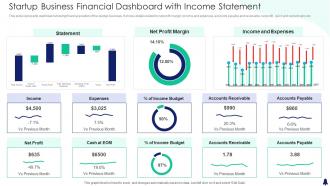
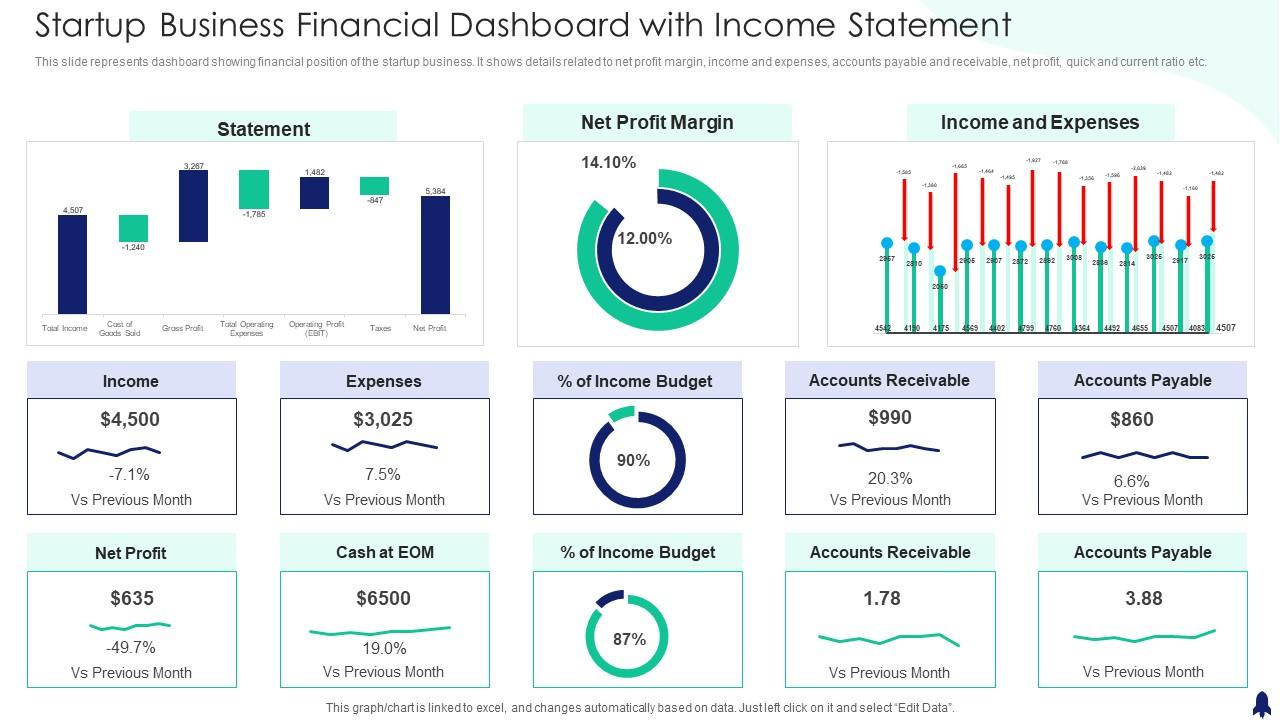
This slide represents dashboard showing financial position of the startup business. It shows details related to net profit margin, income and expenses, accounts payable and receivable, net profit, quick and current ratio etc. Introducing our Startup Business Financial Dashboard Snapshot With Income Statement set of slides. The topics discussed in these slides are Statement, Net Profit Margin, Income and Expenses, Income Expenses . This is an immediately available PowerPoint presentation that can be conveniently customized. Download it and convince your audience.
FAQs for Startup Business Financial Dashboard Snapshot

Burn rate and runway are your lifeline - track those religiously. MRR or monthly revenue growth comes next, plus customer acquisition cost and lifetime value. Cash flow will save or sink you (learned this the hard way). Gross margins matter too. Pick whatever operational metrics actually move the needle for your specific business. Oh and current cash position - investors obsess over that number. Honestly though? Stick to maybe 8-10 metrics tops. Any more and you'll spend all your time updating spreadsheets instead of running the company.

Honestly, just start by hooking up your bank accounts to get real-time tracking - saves you so much manual work. Break everything into buckets like sales coming in, then payroll and rent going out. The burn rate thing is huge because it tells you exactly when you'll hit zero (which is terrifying but necessary to know). I'd definitely add some forecasting for the next few months since cash surprises are startup killers. Update it weekly minimum, and set up alerts when you're getting close to danger zones. Oh, and categorizing everything helps you spot weird patterns - like why did we spend 2x on office supplies last month?

Honestly, just track what matters at your stage - revenue growth, burn rate, runway, and customer acquisition cost. That's your bread and butter right there. Clean line charts work best for showing trends, and please don't make it look like a disco ball with crazy colors everywhere (seriously, some dashboards hurt my eyes). Put your most critical numbers up top where you can't miss them. Use the same time periods when you're comparing stuff, and set it up so everything updates on its own - nobody wants to copy-paste data every damn week. The whole point is catching problems fast, not making something pretty for show.

Honestly, I'd say weekly updates are your sweet spot. Monthly is the absolute minimum – like, don't go less than that or you'll miss stuff. Daily is way too much unless your burn rate is insane or you're in some crazy growth phase. The thing is, weekly gives you enough visibility to catch problems early. Plus your team stays on the same page about where the money's at. I've watched startups get completely wrecked because they only checked numbers quarterly – brutal. Just throw a recurring meeting on your calendar and actually stick to it, even when everything's on fire.

Look, forecasting is just predicting your cash flow and expenses before you're scrambling for money. Track both short-term stuff (3-6 months) and longer projections on your dashboard. Nobody likes financial surprises, trust me. Update your forecasts when real data comes in - that's how you catch trends early. Build three scenarios: best case, worst case, and what'll probably happen. Start conservative though. I learned that one the hard way! Keep adjusting as you go and you'll spot problems before they bite you.

Dude, financial dashboards are a game changer. No more drowning in Excel hell every month. You get real-time data on cash flow, burn rate, CAC, LTV - all that good stuff. Honestly way better than waiting around for reports. When things start trending bad, you'll know immediately instead of finding out weeks later that you're broke. Set up some alerts for when cash gets low. The visual charts make investor meetings so much smoother too - way easier than explaining spreadsheet columns for an hour.

Honestly, if your team knows tech stuff already, just go with **Tableau** or **Power BI**. Both are pretty solid. **Google Data Studio** is free and actually doesn't suck anymore - they've improved it a ton lately. For less technical folks, try **ChartIO** or **Klipfolio**. Way less overwhelming. But real talk? Don't overthink it at first. **Google Sheets** with some basic charts might be all you need right now. I've seen startups waste weeks debating dashboard tools when they could've been analyzing actual data. Pick whatever your team already uses, then switch later when things get messier.

So CAC is pretty straightforward - just divide your total sales and marketing spend by new customers acquired that month. LTV gets messier though. You multiply average revenue per customer by gross margin percentage, then by average customer lifespan. That last part's honestly a nightmare when you're starting out since you barely have data. I'd just work with whatever numbers you've got and improve them later. Track your LTV:CAC ratio religiously - aim for 3:1 minimum. Oh, and measure monthly so you catch trends before they bite you.

So if you're just starting out, watch your burn rate and customer acquisition costs - basically how fast you're bleeding money vs actually growing. Once you find product-market fit, retention becomes everything. Growth stage gets wild because suddenly you're juggling cohort analysis and all these operational ratios (honestly this phase stressed me out the most). Later on you'll obsess over margins and profitability paths. Here's the thing though - don't track everything at once or you'll go insane. Pick maybe 4 metrics max that actually matter for where you are right now. Check them weekly, not daily.

Honestly, automated validation rules are a lifesaver - set those up first along with regular reconciliation checks. Connect everything directly to your accounting software and bank feeds so you're not doing manual entry (trust me on this one). We got burned last quarter with huge discrepancies because I was being lazy about it. Have someone review weekly and call out any weird spikes. Cross-check your revenue totals across different reports too. Oh, and document where your data comes from and how you calculate stuff. Makes auditing way easier later when Karen from accounting inevitably questions everything.

Dude, seriously get a financial dashboard set up. When you're in those investor meetings, you'll have everything right there - revenue trends, burn rate, runway, all that stuff. No more digging through random spreadsheets while everyone stares at you. I've watched founders completely bomb just because they couldn't answer basic financial questions on the spot. Plus you can catch any sketchy numbers ahead of time and figure out how to spin them (or at least explain them). Honestly, build those KPI charts now even if fundraising feels forever away. Future you will thank past you.

Dude, the worst thing you can do is cram like 15 different metrics on there - nobody can process that mess. Focus on maybe 5-7 things that actually move the needle: burn rate, runway, unit economics. Skip the vanity stuff that looks impressive but means nothing. Also? Don't spend forever making it gorgeous then never update the damn thing. I've seen so many beautiful dashboards with data from three months ago lol. Set up some automated feeds if you can so it refreshes itself. Way less headache than manually updating spreadsheets every week.

Dude, benchmarking just gives your numbers actual meaning. Like, seeing "15% churn rate" by itself tells you nothing, but knowing the industry average is 8%? Now you're freaking out for good reason. Your dashboard stops being random pretty charts and becomes something you can actually make decisions with. I always compare against similar-stage companies - way more useful than looking at Google's metrics when you're a 20-person startup. You'll finally know if that growth spike means you're crushing it or just having a decent month. Just make sure your benchmark sources aren't totally outdated.

Honestly, you're flying blind without connecting your marketing and financial data. I learned this the hard way - thought our Instagram ads were crushing it until I actually tracked them to revenue. Turns out they were just pretty vanity metrics eating our budget. When you link ad spend to real customer acquisition costs and lifetime value, suddenly you can see which campaigns actually make money vs which ones just look impressive in reports. Start simple - just connect your ad platforms to revenue tracking. Even basic attribution will show you patterns you're totally missing. Trust me, it'll change how you think about every dollar you spend.

Think of it like your car's speedometer - you wouldn't drive without one, right? Financial dashboards give you those early warning signs before everything hits the fan. Instead of waiting around for monthly reports (when it's already too late), you're tracking burn rate and cash runway in real-time. Honestly, the best part is catching trends early - like when your customer acquisition costs start creeping up or revenue dips. Set up some automated alerts for the scary stuff so you're not glued to spreadsheets 24/7. Way better than playing catch-up later.

Ratings and Reviews

100% of 100
Review Form
Write a review
Most Relevant Reviews
  1. 100%

    by Dewey Stephens

    Thanks for all your great templates they have saved me lots of time and accelerate my presentations. Great product, keep them up!
  2. 100%

    by Davis Mason

    SlideTeam never fails to surprise me with its amazing PPT designs. Thanks team for providing me with your constant support!

2 Item(s)

per page: