


Business financial trend analysis dashboard with sales performance




Try Before you Buy Download Free Sample Product
 Impress Your
 Audience
 100%
100% Editable
 Save Hours
 of Time


Our Business Financial Trend Analysis Dashboard With Sales Performance are topically designed to provide an attractive backdrop to any subject. Use them to look like a presentation pro.
People who downloaded this PowerPoint presentation also viewed the following :
Content of this Powerpoint Presentation
Description:
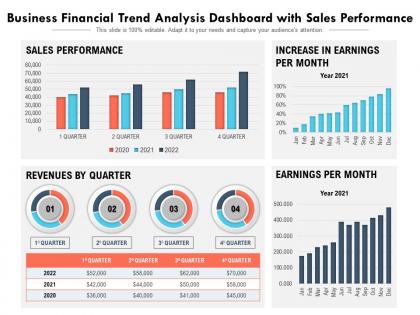
The image is a PowerPoint slide titled "Business Financial Trend Analysis Dashboard with Sales Performance," which provides a visual representation of a company's sales and earnings data.
The slide is divided into three sections:
1. Sales Performance:
A bar chart compares quarterly sales over three years (2020, 2021, and 2022). Each quarter shows the progression or decline in sales, with each year represented by a different color.
2. Revenues by Quarter:
This section includes four donut charts for each quarter of the year, labeled Q1 through Q4. Inside each chart is the corresponding quarter and the revenue figures for 2020, 2021, and 2022, showcasing the growth or changes in revenue over the three years.
3. Increase in Earnings Per Month:
A bar chart for the year 2021 displays the monthly percentage increase in earnings, showing trends or anomalies throughout the year.
4. Earnings Per Month:
A bar chart showing the actual earnings figures per month for the year 2021, indicating the company's financial performance across each month.
Use Cases:
Industries where this type of financial trend analysis slide can be highly useful include:
1. Retail:
Use: Tracking monthly and quarterly sales performance.
Presenter: Sales Manager
Audience: Retail staff, management team
2. Manufacturing:
Use: Monitoring production costs and revenue.
Presenter: Chief Financial Officer
Audience: Investors, department managers
3. Technology:
Use: Analyzing product sales and revenue growth.
Presenter: Business Analyst
Audience: Executives, product teams
4. Healthcare:
Use: Reviewing the financial health of healthcare services.
Presenter: Healthcare Administrator
Audience: Hospital board, department heads
5. Automotive:
Use: Assessing the sales trends of different vehicle models.
Presenter: Marketing Director
Audience: Dealers, marketing team
6. Real Estate:
Use: Visualizing monthly sales and revenue from property deals.
Presenter: Real Estate Broker
Audience: Investors, sales agents
7. Hospitality:
Use: Evaluating the financial success of hospitality services.
Presenter: General Manager
Audience: Stakeholders, hotel/resort staff
Business financial trend analysis dashboard with sales performance with all 2 slides:
Use our Business Financial Trend Analysis Dashboard With Sales Performance to effectively help you save your valuable time. They are readymade to fit into any presentation structure.
FAQs for Business financial trend analysis dashboard
You need three main reports: income statement, balance sheet, and cash flow statement. Income statement tells you if you're actually profitable - just revenue minus expenses. Balance sheet is like a snapshot of what you own versus what you owe at one moment. Cash flow is honestly where the magic happens though - I've seen profitable companies tank because they couldn't pay bills! The balance sheet thing used to confuse me but it's pretty straightforward once you get it. Pull your latest quarter for all three and compare to last year's same period. That'll show you the real picture of where your money's going.
Look, cash flow analysis is way better than just staring at profit numbers. It shows the actual money flowing in and out - helps you catch seasonal dips before they hit you. I honestly think it's the most reliable way to predict if you'll survive the next few months. Your operating cash flow is what really matters though, since that's your core business generating money. Oh, and start with forecasting just the next quarter - don't go crazy trying to predict a whole year out. You'll spot problems early and actually have time to fix them.
Honestly, start with profitability stuff - net profit margin and ROE are solid picks. Current ratio and quick ratio help you see if they can pay their bills. Debt-to-equity shows how much they're borrowing vs owning. ROA is clutch because it tells you if management actually knows what they're doing with company assets. Oh, and don't sleep on operational ratios like inventory turnover - I've seen those reveal problems way before they hit the income statement. Pick 3-4 that make sense for whatever industry you're looking at. Compare to competitors instead of just staring at random numbers.
Startups are trickier since they don't have much history to work with. Focus on cash burn rate and how long their money will last instead of normal ratios. Also check if people actually want what they're selling. Established companies? Way easier - just look at their financial statements, debt ratios, steady revenue patterns. Honestly, startups are pretty much educated gambling with bigger upside potential. You're betting on what could happen vs. what's already proven. Definitely stress-test their projections hard and see how realistic they are compared to companies that didn't crash and burn.
Think of budgeting as your financial GPS - it shows you where you're supposed to be versus where you actually are. Like, if expenses jump 15%, is that bad or expected? You can't tell without comparing it to your budget first. Monthly comparisons are your best bet for catching trends early. When something looks off, that's when you dig deeper to figure out what's actually happening with your business. Honestly, without a budget you're just staring at random numbers hoping they make sense. It's the difference between making smart decisions and basically throwing darts blindfolded.
So variance analysis is just comparing what you planned vs what actually happened - super useful for catching issues before they get worse. Look at your revenue, costs, all that stuff. The key part? Figure out WHY the numbers are off. Was it a fluke or something bigger you need to fix? Honestly, most companies only do this at month-end which is kinda dumb. You should be checking way more often. Focus on your biggest gaps first since that's where you'll see real results. It's great for reallocating money and making better predictions down the road.
Start with your historical data - that's your foundation. Then get your sales team to build up projections from individual accounts and products. Honestly, sales forecasts from corporate always seem way too rosy, but the ground-level stuff is usually solid. You can throw in some trend analysis and regression models if you're feeling fancy. Just don't rely on one method - I've seen that backfire too many times. Top-down market stuff works okay but it's pretty vague for actual planning. Build three scenarios: realistic, conservative, and optimistic. Test different assumptions and see what breaks.
So trend analysis is basically your early warning system - you're tracking key metrics over time to catch problems before they blow up. Like if your profit margins keep dropping or debt keeps climbing, that's way more concerning than just one bad month, you know? Honestly, most people wait until things are already broken to act. Pick maybe 3-5 metrics you care about and check them monthly. Short-term stuff can be misleading, but patterns over quarters? That's where you'll spot real trouble brewing. It's like... preventive maintenance but for your business.
Honestly, break-even analysis is like having a crystal ball for your business finances. It tells you exactly when you'll stop bleeding money and actually turn a profit. Super helpful for setting sales goals that aren't totally unrealistic and figuring out if your pricing makes sense. I always run the numbers before making any big moves – saves you from those expensive mistakes later. You can play around with different scenarios too, like what if your costs go up 20% or sales tank? It's basically your "am I being crazy here?" check before diving into anything new.
Look, external economic stuff can totally wreck your finances if you're not paying attention. When interest rates go up, borrowing gets expensive and your customers have less cash to spend. Inflation jacks up all your costs, so you've got to figure out pricing all over again. GDP growth basically tells you if people actually want to buy your stuff - employment levels too, obviously. Currency swings are honestly the worst part if you're doing any international business. I learned that one the hard way. Just keep an eye on these indicators so you can tweak your budget before everything goes sideways.
So this ratio just compares how much debt you've got versus your own money in the business. High debt means bigger profits when you're doing well, but also way more risk - and those interest payments can really hurt your cash flow. Banks hate seeing super high ratios, makes them think you're reckless. On the flip side, too conservative and you might miss out on growth (though honestly, that's not always bad). The trick is finding the right balance where debt actually helps you instead of keeping you up at night worrying about payments.
Your financial numbers only tell half the story - they show declining margins but not why it's happening. SWOT fills in those gaps. Like, your strengths might point to revenue streams you'd never spot in a spreadsheet. And honestly? I've watched companies tank because they only looked at the numbers and missed obvious competitive threats. Weaknesses show where you need to spend money even if it tanks short-term profits. The sweet spot is when you match your SWOT insights with what you can actually afford. That's how you figure out which moves make sense instead of just throwing darts at a board.
Look, benchmarking gives your numbers actual meaning - otherwise you're just staring at random figures going "is this good?" Compare your stuff to industry averages or competitors to see where you really stand. Your historical data works too. Without it, you're basically guessing whether that 15% growth rate is amazing or terrible (spoiler: context matters). It helps spot trends and shows you exactly where you're falling behind. Pick maybe 3-5 key metrics first and stack them against industry standards. That's honestly the best starting point.
Look, financial analysis is basically your cheat sheet for not making dumb investment moves. Pull the company's income statements, balance sheets, cash flows - boring stuff but necessary. Check their profit margins, how much debt they're carrying, whether revenue's actually growing. ROI and debt-to-equity ratios help you compare options without the guesswork. Honestly, I learned this the hard way after losing money on a company that looked good on the surface but was bleeding cash. Don't just go with your gut - the numbers don't lie, even when everything else looks shiny.
Know your audience first - execs want big picture stuff while department heads need the nitty-gritty details. Charts and graphs are your friend because raw spreadsheets make people's eyes glaze over. Don't just dump data on them; explain what it actually means for the business. I learned this the hard way once. Always include some context like last quarter's numbers or industry benchmarks so they can tell if you're doing well or not. Have backup data ready too because someone will definitely ask follow-up questions you didn't expect.
-
Use of icon with content is very relateable, informative and appealing.
-
Great designs, Easily Editable.
-
Very well designed and informative templates.