


Food and beverage startup company pitch deck ppt template




Try Before you Buy Download Free Sample Product
 Impress Your
 Audience
 100%
100% Editable
 Save Hours
 of Time


There is no surprise that the food and beverage industry is rapidly evolving. Many successful tech-based food startups are currently operational worldwide, along with several upcoming and promising ones. Check out our efficiently designed pitch deck on Food and Beverage Startup Company that will be suitable for the entrepreneurs having a food startup idea but unable to secure funding. To begin, companies can use the company overview slide to showcase their growth, and the founders slide illustrates information about its vision, mission, funding history, sales growth, and critical founders. Problem and solution slides will help the businesses address the significant bottlenecks of the food industry and the proposed solution to overcome them. To illustrate audience, business model, competitors, and revenue generation sources, the company can use slides such as target audience, business model, sources of revenue, and competitive landscape. Why invest with us slide will help the companies address potential investors about the benefits of investing in their startup ideas. At last, organizations can inform investors about their future goals and the funding they are looking for through the investment ask slide. Book a free demo with our expert team and grab a 100 percent editable pitch deck. Get access now.
People who downloaded this PowerPoint presentation also viewed the following :
Content of this Powerpoint Presentation
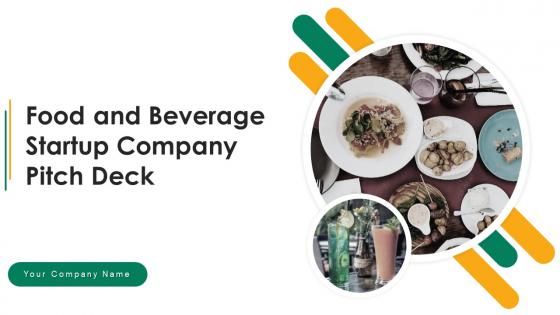
Slide 1: This slide introduces Food and Beverage Startup Company Pitch Deck. State Your Company Name and begin.
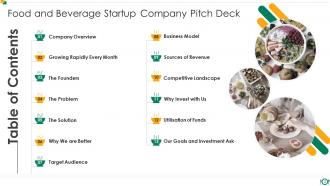
Slide 2: This slide shows Table of Content for the presentation.
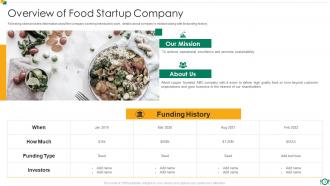
Slide 3: This slide presents about the company covering introductory part , details about company’s mission along with its funding history.
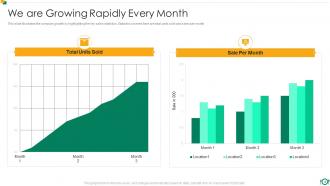
Slide 4: This slide shows company growth by highlighting the key sales statistics.
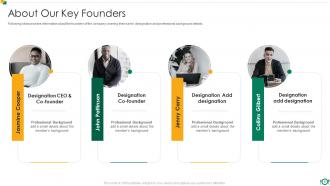
Slide 5: This slide displays founders of the company covering their name, designation and professional background details.
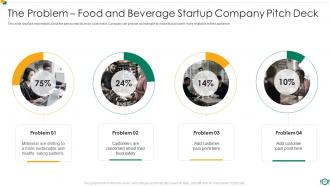
Slide 6: This slide represents pain points faced by customers.
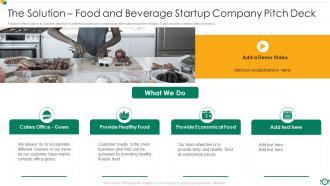
Slide 7: This slide shows grab the attention of potential audience by addressing information about the solution.
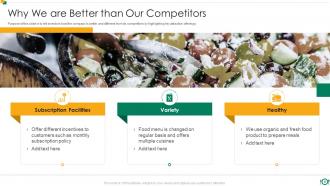
Slide 8: This slide presents how the company is better and different from its competitors by highlighting key attractive offerings.
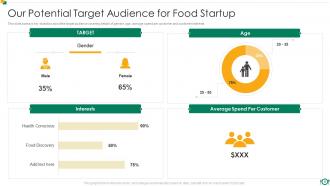
Slide 9: This slide shows target audience covering details of gender, age, average spend per customer and customer interests.
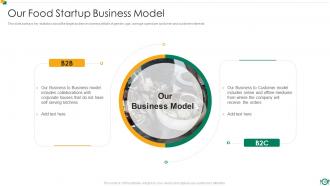
Slide 10: This slide displays Our Food Startup Business Model.
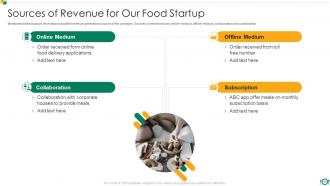
Slide 11: This slide represents revenue generation sources of the company.
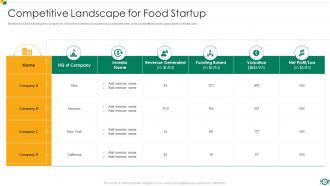
Slide 12: This slide shows investors or audience a complete view of its competitive landscape based on financials.
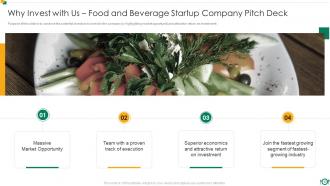
Slide 13: This slide presents potential investors to invest in the company by highlighting market opportunity and attractive return on investment.
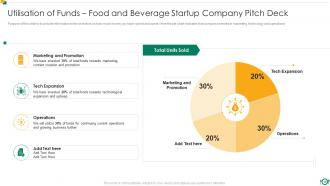
Slide 14: This slide shows investors on how much money you have raised and spent.
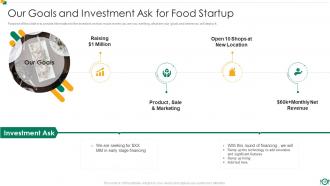
Slide 15: This slide displays Our Goals and Investment Ask for Food Startup.
Slide 16: This slide represents Contact Us – Food Startup Pitch Deck.
Slide 17: This slide displays Icons for Food and Beverage Startup Company Pitch Deck.
Slide 18: This slide is titled as Additional Slides for moving forward.
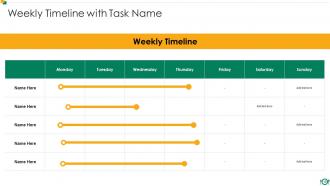
Slide 19: This slide presents Weekly Timeline with Task Name.
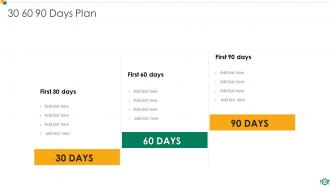
Slide 20: This slide provides 30 60 90 Days Plan with text boxes.
Slide 21: This slide presents Roadmap with additional textboxes.
Slide 22: This is Our Target slide. State your targets here.
Slide 23: This slide depicts Venn diagram with text boxes.
Slide 24: This slide contains Puzzle with related icons and text.
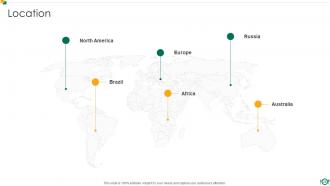
Slide 25: This is a Location slide with maps to show data related with different locations.
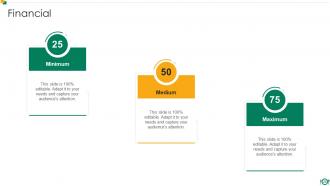
Slide 26: This is a Financial slide. Show your finance related stuff here.
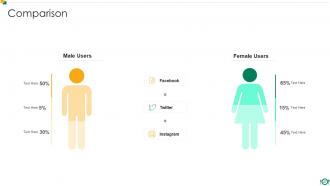
Slide 27: This is a Comparison slide to state comparison between commodities, entities etc.
Slide 28: This is a Thank You slide with address, contact numbers and email address.
Food and beverage startup company pitch deck ppt template with all 33 slides:
Use our Food And Beverage Startup Company Pitch Deck Ppt Template to effectively help you save your valuable time. They are readymade to fit into any presentation structure.






FAQs for Food and beverage startup company pitch
Start with the problem you're solving, then show your solution with killer food shots - seriously, make people hungry just looking at it. Market size is huge for F&B investors, so get those numbers ready. Business model and unit economics matter, but honestly distribution strategy might be even more important in this space. Include your traction (sales, partnerships, whatever you've got), competitive landscape, and team background. Financial projections showing profitability help too. Ask for specific funding amount with clear breakdown. Keep it under 12 slides and if you're pitching live, bring samples!
Look, market analysis basically proves people actually want your food product instead of you just hoping they do. Get specific numbers for YOUR niche - like if it's plant-based snacks, show those growth trends, not just "food industry big." Consumer behavior data helps too. Honestly, investors see right through generic stats. Competitor analysis matters, but focus on what gaps you're filling. Growth trajectory in your exact space is gold. I know it sounds boring but real numbers tell the story of why your timing's perfect. Don't just guess - prove there's demand out there.
Your UVP is make-or-break with investors. Food and bev is crazy competitive - like, thousands of "healthy" snack brands fighting for the same shelf space. What makes yours different? Novel ingredient, weird distribution angle, something that actually stands out. Honestly, most founders can't explain their edge in one sentence their mom would get. That's a red flag. You need to nail why consumers will pick your product over whatever's already there. Investors see so many pitches that look identical, so being genuinely unique isn't optional anymore.
Visuals are everything here - get those high-quality shots of your ingredients and production process front and center. Way more powerful than just describing stuff. Definitely do a whole slide on your supply chain story, especially if you're doing direct-trade or have unique sourcing. Customer testimonials help with the taste thing since that's obviously impossible to show in a deck (unless you're literally bringing samples, which... actually not a terrible idea). Food competition wins or chef endorsements are gold. The whole goal is making investors feel like they can practically taste what sets you apart through the screen.
Focus on the big three: revenue growth, gross margins, and CAC vs LTV ratio. Unit economics matter more than anything - show your cost per unit and how you price things. Monthly recurring revenue is gold if you've got subscriptions. Burn rate and runway too, obviously. Market size feels mandatory but honestly everyone just makes up huge numbers there anyway lol. What investors really want is proof you can scale without bleeding money. Keep that CAC payback under 12 months if you can swing it. Show you actually understand your margins and you're halfway there.
Don't just throw your logo on slides and call it good. Your brand colors should show up everywhere - backgrounds, charts, text highlights, the works. Fonts matter too. Fun startup? Go playful. Health brand? Keep it clean and modern. Product photos need to look like they're from the same shoot (or at least the same universe, you know?). Throw in some lifestyle shots of real people using your stuff. Honestly, half the battle is getting investors to *feel* your brand before you even open your mouth. Make everything feel connected.
Look for the trends that actually prove your product makes sense. Health stuff is massive right now - clean ingredients, functional benefits, the whole transparency thing. Convenience matters just as much, especially with millennials who need everything grab-and-go. Sustainability's become real too (shocking, I know, but people genuinely care about packaging waste now). Instagram changed everything - your product needs to look good and have an authentic story behind it. Honestly, pick 2-3 trends max that support why you'll crush it, then find solid numbers to back them up.
Pick 3-4 companies customers would actually choose over you instead. Don't go crazy listing every food company - that's just a waste of time. Build a simple matrix with price, how they sell stuff, who they target, and what makes them special. Honestly, investors see right through the "we have no competition" BS. Show the gaps where you fit differently. Keep it visual with their logos and short descriptions. The whole point is proving you get the market and aren't just another wannabe startup. Oh and make sure these are actual direct competitors, not just anyone in food.
Dude, start with your "holy shit" moment - when you nailed that flavor or realized everything else on the market was trash. Food is sensory, so don't just throw numbers at them. Tell a story: "Sarah's dragging herself home, wants something that's healthy but doesn't taste like cardboard..." Make it real. Honestly, bring samples if you can - there's no substitute for letting them actually taste what you're talking about. Use descriptive language throughout because food is about experience. End big with how you're gonna change the way people think about eating.
Focus on three main things for your marketing plan. First, figure out where your customers actually find new food products - social media, grocery aisles, farmers markets, food bloggers, whatever. The food world is insanely competitive, so nail down your brand story and what sets you apart. Map out your launch approach too - going direct-to-consumer, pitching to retailers, or targeting restaurants? Oh, and sampling is huge since people won't buy food they haven't tried. Include specific tactics with real budgets and timelines that actually make sense.
Skip the feature list upfront - investors are drowning in food pitches already. You need to nail your market position first. Here's the thing that kills me: founders say "everyone eats" like that's helpful. Get specific about your customer! Also, show real unit economics, not just those dreamy revenue charts. And seriously, cut the food porn slides - this isn't Yelp. The killer mistake though? Having zero clue about distribution. Shelf space is brutal to get. You better have actual retail partnerships lined up or at least a concrete plan, because that's what separates legit businesses from someone's weekend cooking hobby.
Don't just tack sustainability onto your last slide - that's so obvious and investors see right through it. Weave it into your core story instead. Show how your food product tackles market problems AND environmental ones at the same time. Maybe you're cutting food waste while making something tasty, or working with regenerative farms that actually help local communities. The key is proving these sustainable practices boost your profits and keep customers coming back. I've watched too many pitches where this felt like an afterthought. Track specific metrics so you can back it up with real data.
Dude, samples can totally make or break your pitch. Investors need to actually taste your stuff - slides mean nothing if the product sucks. I've literally watched terrible presentations get funded because the food was amazing. Time it right though. Don't just randomly pass things around like you're at Costco. Build it into your flow - maybe right after explaining what makes you special, so the taste backs up what you're saying. And for the love of god, make sure everything's the perfect temperature. Nothing kills momentum like lukewarm soup or melted chocolate.
Focus on the big stuff - your sourcing strategy, key supplier relationships, and how you actually get products from factory to store. Don't waste time on boring details. Investors have seen tons of food startups crash because they didn't think through supply chain complexity. What makes yours different? Maybe it's unique partnerships or cost advantages you've locked in. A simple flow chart helps too. The scalability question is huge - what's your plan when demand jumps 300% overnight? That's honestly what separates the serious founders from everyone else pitching.
Honestly? Get a professional photographer if you can swing it - those blurry phone pics are gonna tank your whole presentation. I've seen too many good pitches ruined by bad food shots. Show people actually enjoying your product, not just boring product-only shots on white backgrounds. Your color scheme should match your brand obviously, but don't make the backgrounds so busy they steal focus from the food. Clean fonts are key, and give everything space to breathe. Oh, and definitely highlight your packaging design since that's what investors picture sitting on store shelves.
-
Unique research projects to present in meeting.
-
Informative presentations that are easily editable.