


Food and beverage firm pitch deck ppt template




Try Before you Buy Download Free Sample Product
 Impress Your
 Audience
 100%
100% Editable
 Save Hours
 of Time


Unlike in other verticals, what the market expects from food and beverage firms is to sell products at even early investment pitches. These pitches address social engagement data, gross margins and unit economies, distribution footprint, velocity per point, etc. Here is a professionally designed Food and Beverage Firm Pitch Deck to convince investors to fund a start-up. The deck displays the information about your company, mission statement, financial highlights, and more. Businesses can present details on why clients prefer to offer investments into such sectors creatively using stats and charts. The proposal also exhibits facts on what the company has to provide its clients in delectable products. One can show the process of supply chain management, keeping particulars for global presence and CAGR too. Firms can highlight revenue opportunities and profitable business models for clients pinpointing value proposition, essential resources, etc. The deck exhibits pie charts and graphs for the growth potential of the food market in progress with the competitive assessment of major players. Impress financial climax for investors by getting access to Food and Beverage Firm Pitch Deck. Download it now.
People who downloaded this PowerPoint presentation also viewed the following :
Content of this Powerpoint Presentation
Slide 1: This slide displays the title i.e. 'Food and Beverage Firm Pitch Deck' and your company name.
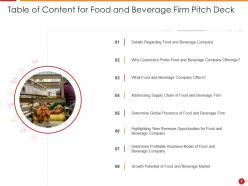
Slide 2: This slide showcases the table of contents for the pitch deck.
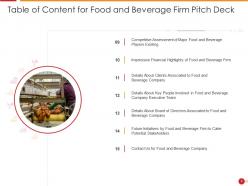
Slide 3: This slide presents the continued table of contents for the pitch deck.
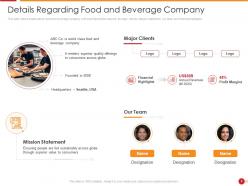
Slide 4: This slide caters details about food and beverage company with brief description about it, its major clients, mission statement, our team and financial highlights.
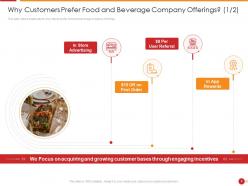
Slide 5: This slide caters details about why clients prefer food and beverage company offerings.
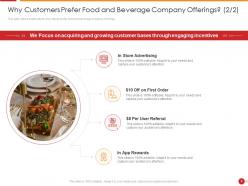
Slide 6: This slide caters details about why clients prefer food and beverage company offerings.
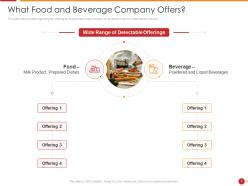
Slide 7: This slide caters details regarding the offering by food and beverage company to its clients in terms of delectable products.
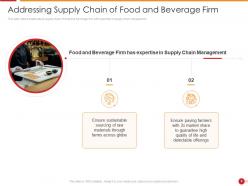
Slide 8: This slide caters details about supply chain of food and beverage firm with expertise in supply chain management.
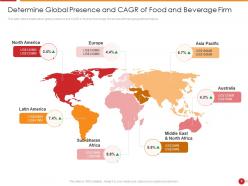
Slide 9: This slide caters details about global presence and CAGR of food and beverage firm across different geographical regions.
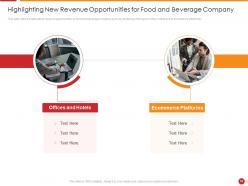
Slide 10: This slide caters details about revenue opportunities of food and beverage company such as rendering offerings to office, hotels and at ecommerce platforms.
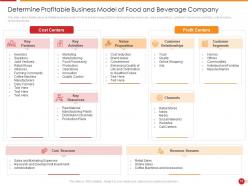
Slide 11: This slide caters details about profitable business model for food and beverage platform addressing key resources, etc.
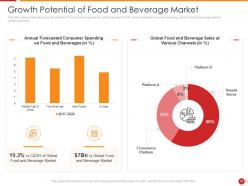
Slide 12: This slide caters details about growth potential of food and beverage market with progress in CAGR, etc.
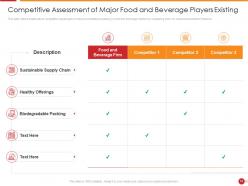
Slide 13: This slide caters details about competitive landscape of various competitors existing in food and beverage market by comparing them on various parameters/ features.
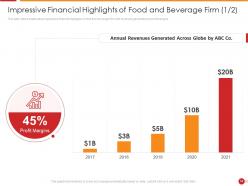
Slide 14: This slide caters details about impressive financial highlights of food and beverage firm with revenues generated and profit margins.
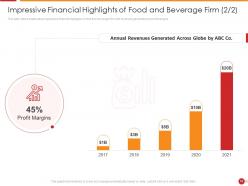
Slide 15: This slide caters details about impressive financial highlights of food and beverage firm with revenues generated and profit margins.
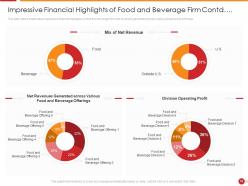
Slide 16: This slide caters details about impressive financial highlights of food and beverage firm with revenues generated across various divisions and offerings.
Slide 17: This slide caters details about clients associated to food and beverage company in terms of major clients and client testimonials.
Slide 18: This slide caters details about key people associated to food and beverage company executive team and are responsible in making key strategic decisions.
Slide 19: This slide caters details about board of directors associated to food and beverage company.
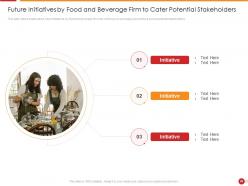
Slide 20: This slide caters details about future initiatives by food and beverage firm that will focus on leveraging connections across potential stakeholders.
Slide 21: This slide showcases the contact details of company including address, company logo, contact no., etc.
Slide 22: This is the icons slide for the pitch deck.
Slide 23: This slide presents the title for additional slides.
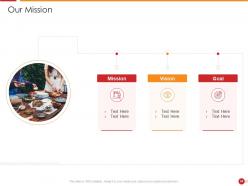
Slide 24: This slide exhibits the vision, mission and goals of the company.
Slide 25: This slide demonstrates the financials of the company.
Slide 26: This slide describes the targets of the company.
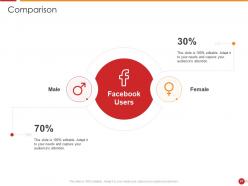
Slide 27: This slide showcases the comparison based on different elements related to the pitch deck.
Slide 28: This slide presents ideas generated
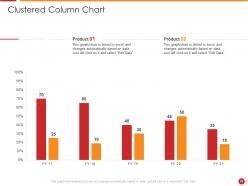
Slide 29: This slide exhibits yearly clustered column charts for different products. The charts are linked to Excel.
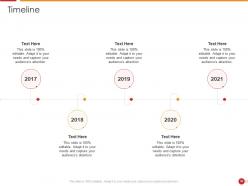
Slide 30: This slide exhibits yearly timeline.
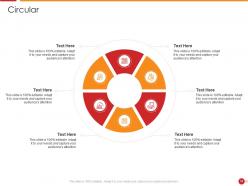
Slide 31: This slide presents circular process.
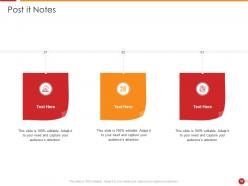
Slide 32: This slide depicts posts for past experiences of clients.
Slide 33: This is thank you slide & contains contact details of company like office address, phone no., etc.
Food and beverage firm pitch deck ppt template with all 33 slides:
Use our Food And Beverage Firm Pitch Deck Ppt Template to effectively help you save your valuable time. They are readymade to fit into any presentation structure.

FAQs for Food and beverage firm pitch
Cover the standard startup stuff but make it food-focused. Your product story and market opportunity come first, then hit them with what makes your food/drink actually different. Traction is huge - sales numbers, retail deals, customer reviews, whatever you've got. Supply chain and production slides are make-or-break (honestly, logistics scare investors more than anything in F&B). Unit economics and go-to-market strategy too. If you've won awards or have taste test data, definitely throw that in - people trust what others validate. Good product photos throughout make a difference. Oh, and your team's background better show they know food.
Dude, stories beat spreadsheets every single time with investors. Yeah, they want the numbers, but what really hooks them? That moment your grandma's recipe inspired your whole sauce line, or watching customers actually use your product. Paint the picture of how you discovered this problem - make it personal. Honestly, even the most buttoned-up investor types are still human beings who connect with real stories. Don't just rattle off market size projections. Show them why this matters through narrative, then get them pumped about being part of where you're headed next.
Dude, you absolutely need market research or you'll get destroyed in the pitch room. I've watched founders crash and burn because they couldn't answer basic questions about market size or competition. Look, investors want proof that people actually want your product - they won't just trust your gut feeling about your amazing keto cookies or whatever. Do surveys, check out industry reports, study your competitors. This stuff helps you figure out pricing and where to actually sell your product. Honestly, skip this step and you're basically gambling with your time and money.
Honestly, visuals do all the heavy lifting when it comes to showing your brand's personality. Stick with your actual product photos, colors, and fonts across every slide - it creates this cohesive "yeah, that's totally us" feeling. Food brands are weirdly good at this with lifestyle shots instead of boring product grids. You know, steaming coffee or families eating together. Even your logo placement and photo filters should match your brand's vibe. Oh, and make a quick style guide first so you're not just winging it slide by slide. Trust me on that one.
Dude, start with unit economics - your COGS, gross margins, and what it costs to get customers. Growth rate is critical, especially if it's consistent month to month. Investors go crazy for anything that shows you can scale. Your average order value matters too, plus repeat purchase rates and customer lifetime value. Food businesses are all about retention honestly. Oh and don't skip operational stuff like inventory turnover and burn rate - boring but they'll ask. Keep slides simple but know every number inside out.
Put your USP right after the problem slide - make it huge and impossible to miss. Don't just say "healthier" because literally everyone does that. Get super specific instead: "30% more protein than competitors" or "the only organic bar with zero added sugars." I'd throw in customer quotes or taste test data if you've got it. Bold graphics help too. The whole point is making investors immediately get why someone would grab your product instead of whatever else is sitting there. You want that "oh, I see" moment to happen fast.
Dude, testimonials are clutch for F&B decks - they're proof people actually love your food. Grab 2-3 solid ones and drop them right after your product slides. Look for stuff like "my kids beg for this" or "ditched my old brand completely." That specific feedback hits way harder than generic "it's good!" comments. Make sure they're from real customers, not your mom (though I know it's tempting lol). Target demo matters too. And honestly? Include customer photos if you can swing it. Makes everything feel legit instead of like you made it up.
Focus on 3-4 things that actually matter in F&B: price point, where you're selling, who you're targeting, and how you position yourself. Build a simple grid showing you vs your main competitors on these factors. Honestly, investors get annoyed when you list every single competitor out there - stick to your direct competition plus maybe 1-2 brands you want to be like someday. Make your advantages super clear and show any gaps you found in the market. Wrap it up with how you're going to stand out differently.
Look for trends that actually affect your customers and grab data from solid sources like Mintel or Nielsen. Don't just chase every viral food thing (though honestly some TikTok trends do turn into real money). Charts showing plant-based growth hit way harder than boring bullet points. Each trend needs to connect to actual revenue or fill a gap your product handles. The big thing? Explain why it'll stick around instead of disappearing in six months. Wrap up with clear numbers on how you'll make bank from these trends.
Map out realistic expansion steps first - geographic growth, new sales channels, maybe product extensions. The magic happens when you prove margins improve as you scale. Bulk purchasing cuts ingredient costs. One facility serves multiple regions, you know? Skip the fantasy revenue numbers though. Investors hate that. Break it down: "retail launch year 2, neighboring states year 3." Show specific improvements like dropping customer acquisition costs or better production efficiency. End with concrete funding needs for each phase. Don't overthink the projections - they want to see you've actually thought through the mechanics of growing bigger.
Dude, start with some crazy stat that'll grab them right away. Bring actual samples if you can - seriously, nothing works better than letting people actually taste your stuff. Tell the story behind it, like how you came up with the recipe or whatever problem you're solving. Your slides need killer food photos (trust me, terrible pics will tank your whole presentation). Ask questions to keep them thinking, and don't rush through everything at the same speed. Oh, and practice those transitions between slides! Fumbling around kills your momentum way faster than you'd think.
Definitely give sustainability its own slide, but also sprinkle it throughout your pitch. VCs are obsessed with this right now - especially the younger ones who actually give a shit about impact. Show where you source ingredients, your farmer partnerships, certifications like Fair Trade. Don't just say you're "committed" though, that's meaningless. Back it up with real numbers - carbon reduction percentages, how much of your supply chain is ethically sourced. Oh and make sure they understand this isn't some PR stunt but actually baked into your business model and costs.
Flowcharts with arrows showing farm-to-consumer movement work really well - investors want to see that journey mapped out. Geographic maps are clutch for showing your supplier locations and distribution reach. I'd also throw in process maps that highlight what makes you different, like if you do direct sourcing or have solid cold chain stuff. Color-code the different stages so people can follow along easily. Simple icons work best - trucks, warehouses, the usual. Honestly, boring supply chain slides will tank your whole presentation faster than you think. Keep it visual and straightforward.
Start with your food industry background - that's what investors really care about. Restaurant experience, CPG work, culinary school, whatever you've got. Then add your business skills like operations or marketing. But here's the thing - don't just rattle off job titles like it's your LinkedIn profile. Connect everything to why it matters for THIS venture. "Sarah ran restaurant supply chains for 8 years, so she knows distributor relationships inside and out." Show them why your team can actually execute when others fail. Make it personal and specific.
Don't just say "let's stay in touch" - that's basically code for "never hearing from you again." Ask for something concrete instead. Schedule a follow-up meeting in the next week or two to talk terms. Maybe suggest a facility tour or get their team to try the product if that makes sense. Give them your one-pager so they can share it around internally. References help too - let them talk to other retailers you're already working with. Oh, and tell them to hit you up with questions after they've had time to think it over. Basically make their "yes" as easy as possible.
-
Attractive design and informative presentation.
-
Attractive design and informative presentation.
-
Great quality slides in rapid time.
-
Great product with effective design. Helped a lot in our corporate presentations. Easy to edit and stunning visuals.