


Financial Instruments Powerpoint Presentation Slides




Try Before you Buy Download Free Sample Product
 Impress Your
 Audience
 100%
100% Editable
 Save Hours
 of Time


Our Financial Instruments Powerpoint Presentation Slides are topically designed to provide an attractive backdrop to any subject. Use them to look like a presentation pro.
People who downloaded this PowerPoint presentation also viewed the following :
Content of this Powerpoint Presentation
Slide 1: This slide introduces Financial Instruments. State Your Company Name and begin.
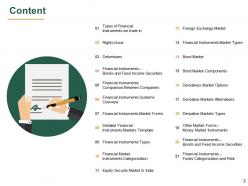
Slide 2: This slide shows Content of the presentation.
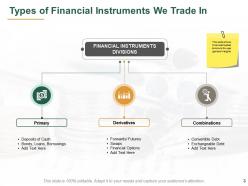
Slide 3: This slide presents Types of Financial Instruments We Trade In.
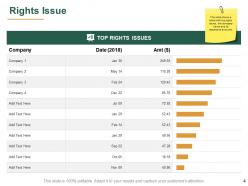
Slide 4: This slide displays Rights Issue in tabular form with the company name and its respective amounts.
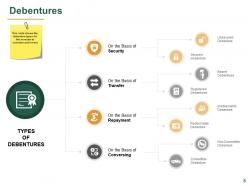
Slide 5: This slide shows the debenture types for the investor to consider and invest
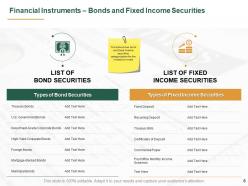
Slide 6: This slide shows bond and fixed income securities categorization for the investor to invest in.
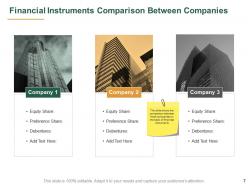
Slide 7: This slide shows the comparison between three companies on the basis of financial instruments.
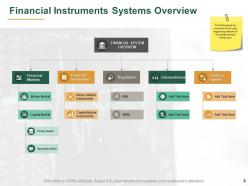
Slide 8: This slide represents Financial Instruments Systems Overview describing- Financial Instruments, Intermediaries, Banking System, Financial Markets, Regulators.
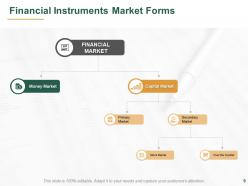
Slide 9: This slide showcases Financial Instruments Market Forms.
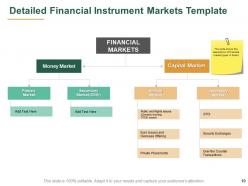
Slide 10: This slide presents Detailed Financial Instrument Markets Template.
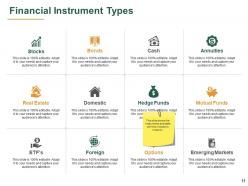
Slide 11: This slide shows the instruments available with the investor to invest in.
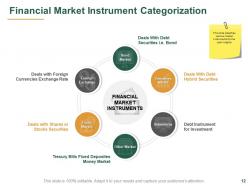
Slide 12: This slide displays Financial Market Instrument Categorization describing- Bond Market, Derivatives Market, Debentures, Other Market, Equity Market, Foreign Exchange.
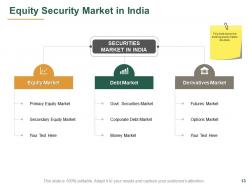
Slide 13: This slide showcases The Equity Security Market in India.
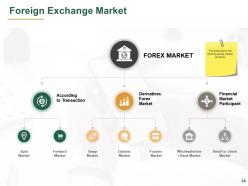
Slide 14: This slide shows the Foreign Exchange Market.
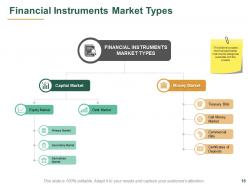
Slide 15: This slide showcases the financial market instrument categories available with the investor.
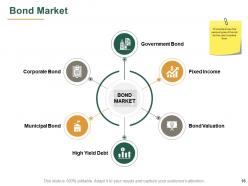
Slide 16: This slide shows Bond Market describing- High Yield Debt, Government Bond, Fixed Income, Bond Valuation, Municipal Bond, Corporate Bond.
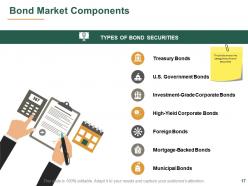
Slide 17: This slide shows Bond Market Components including- Treasury Bonds, U.S. Government Bonds, Investment-Grade Corporate Bonds, High-Yield Corporate Bonds, Foreign Bonds, Mortgage-Backed Bonds, Municipal Bonds.
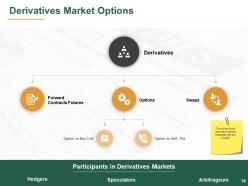
Slide 18: This slide presents Derivatives Market Options available with the investor.
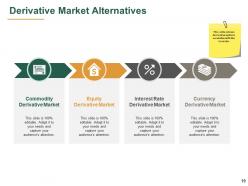
Slide 19: This slide displays Derivative Market Alternatives describing- Commodity Derivative Market, Equity Derivative Market, Interest Rate Derivative Market, Currency Derivative Market.
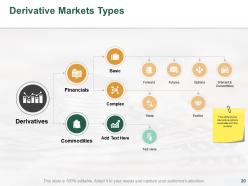
Slide 20: This slide represents Derivative Markets Types with related flow chart.
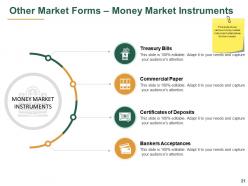
Slide 21: This slide showcases Other Market Forms – Money Market Instruments describing- Treasury Bills, Certificates of Deposits, Bankers Acceptances, Commercial Paper.
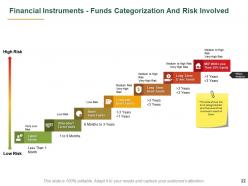
Slide 22: This slide shows Financial Instruments - Funds Categorization And Risk Involved.
Slide 23: This is Our Team slide with names and designation.
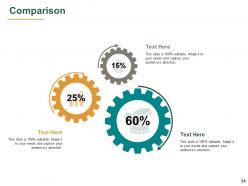
Slide 24: This is a Comparison slide to state comparison between commodities, entities etc.
Slide 25: This is Our Mission slide with related imagery and text.
Slide 26: This is an optional slide for Our Mission.
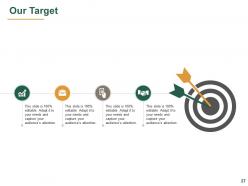
Slide 27: This is Our Target slide. State your targets here.
Slide 28: This is Our Goal slide. Show your firm's goals here.
Slide 29: This is a Quotes slide to convey message, beliefs etc.
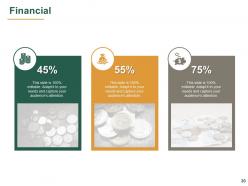
Slide 30: This is a Financial slide. Show your finance related stuff here.
Slide 31: This is a Venn slide with text boxes.
Slide 32: This slide shows Puzzle with text boxes to show information.
Slide 33: This is a Timeline slide to show information related with time period.
Slide 34: This is a Thank You slide with address, contact numbers and email address.
Financial Instruments Powerpoint Presentation Slides with all 34 slides:
Use our Financial Instruments Powerpoint Presentation Slides to effectively help you save your valuable time. They are readymade to fit into any presentation structure.

FAQs for Financial Instruments
So there's basically three main types: debt, equity, and derivatives. Bonds are debt - you're lending money so they're safer but returns are meh. Stocks are equity, meaning you actually own a piece of the company. Way more upside potential but obviously riskier. Derivatives are this whole other beast that's either super conservative hedging or complete gambling depending on how you use them. Honestly, I'd just focus on bonds and stocks first since that's what 90% of normal investing is anyway. You can worry about the fancy stuff later once you get the basics down.
So with stocks, you're literally buying a piece of the company - voting rights, maybe dividends, the whole deal. Bonds? Totally different animal. You're just loaning them money, no ownership whatsoever. But here's the thing - if the company crashes, bondholders get their money back first while stockholders are left holding the bag. I always think of it like being a business partner vs being the bank that gave them a loan. Stocks can moon or tank, bonds are way more predictable but boring. Depends what kind of risk you can stomach, honestly.
So derivatives are basically contracts that get their value from other stuff - stocks, bonds, commodities, whatever. People use them for three main reasons: hedging risk (think portfolio insurance), speculating on price moves, and arbitrage plays. The trading volume is absolutely insane, we're talking trillions daily. Main types are futures, options, swaps, and forwards - honestly the options market alone is wild to watch sometimes. Pretty much every big bank and corporate treasury department uses these things to manage risk and boost returns. It's just how modern finance works now.
Look at the bid-ask spread first - tighter means better liquidity. Daily volume is huge too, higher numbers = easier to get in and out. I always check market depth to see how many buyers/sellers are waiting at different prices. Corporate bonds are honestly a pain since they barely trade sometimes. With stocks, see if they're in major indices. ETFs? Check what's underneath too. Seriously though, do this research before buying. You don't want to be that person stuck holding something nobody wants when you need cash. Been there, it sucks.
So there's basically three main ways to value stuff: DCF, comparable company analysis, and precedent transactions. DCF is where you project future cash flows and discount them back - honestly it's the most important one to nail down first since it teaches you the actual logic behind everything. Comparable analysis just looks at what similar companies are trading for right now. Then precedent transactions show what people actually paid for similar deals (though sometimes that data's pretty old). Oh and for bonds specifically, you'll do yield-to-maturity calculations too. I'd definitely start with DCF then add the market-based stuff once you get comfortable.
So basically each country has its own crazy set of rules for trading. The EU's got MiFID II, US has Dodd-Frank, then there's Basel III for banks worldwide - it's such a headache keeping track honestly. These regulations control what you can trade, where you can do it, plus how much capital you need sitting around. Derivative limits, reporting stuff, cross-border restrictions - they cover everything. What kills me is something totally legal in one market might be completely banned somewhere else. Always double-check the rules before you jump into international trading, trust me on that one.
Look, commodity investing is pretty risky stuff. Prices go crazy over weather, wars, supply chain disasters - you name it. Storage costs are brutal if you're dealing with physical stuff, though ETFs have their own fees and tracking problems. Here's the thing that sucks: no dividends or interest payments like you'd get elsewhere. They're honestly better as inflation protection than actual growth investments. I'd keep any allocation super small - maybe think of it like insurance for your portfolio rather than betting the farm on it.
So basically you can protect your portfolio with options, futures, and swaps - they move opposite to your main investments. Put options are solid if you're nervous about stocks tanking. Currency forwards work great for international stuff too (honestly saved me big time in 2020). Don't go crazy with hedge sizes though - match them to your actual risk. Futures contracts are another route when you expect markets to drop. Start small and see how well they're actually working for you. Takes some trial and error to get the sizing right.
So convertible bonds are debt that you can swap for stock at a set price. Pretty neat setup actually. You collect interest payments like any regular bond, but if the stock takes off, you can convert to shares instead. Downside protection is built in since you'll get your money back if things don't go sideways. The upside potential comes from that conversion option - though honestly, the ratios they set can be kinda tricky to figure out sometimes. It's like getting both safety and growth potential in one investment, which doesn't happen often.
Honestly, fintech changed everything. You can trade stocks for free now through apps, get robo-advisors to handle your portfolio, even buy fractional shares with like $5. Back in the day you needed an actual broker for all this stuff - kinda crazy how fast it shifted. Regular people can now mess around with ETFs and options that used to be just for big institutions. Zero fees on most platforms too, which is pretty sweet. I'd definitely check some of these apps out if you haven't. There's basically no barrier anymore to start investing.
So here's the deal with bonds - rates and prices are enemies. Your 3% bond becomes trash when new ones pay 5%, right? You'd have to sell yours cheap because who wants the crappy yield. Longer bonds get hit way harder when rates move, which honestly sucks if you're not paying attention. Duration tells you how much you'll lose per 1% rate jump - pretty useful number. If rates are climbing, stick with shorter stuff or maybe ladder your maturities so you're not totally screwed. It's like musical chairs but with your money.
So here's the deal - ETFs trade like stocks all day long, but mutual funds only price once after markets close. Kind of annoying if you ask me. You can jump in and out of ETFs whenever during trading hours, which is nice for flexibility. Mutual funds make you wait until end-of-day for pricing. Plus ETFs usually have lower fees and better tax treatment since they don't constantly shuffle their holdings around like active funds do. Honestly, if you're doing passive investing, ETFs are probably your best move for the cost savings alone.
Yeah, ESG stuff is actually worth looking into - environmental, social, and governance factors. Basically whether companies match your values on climate, worker treatment, business ethics. I used to think it was just feel-good investing, but turns out ESG companies often perform better long-term anyway. Screen out whatever you hate first - tobacco, weapons, oil companies, whatever. Then maybe find some funds that actually invest in companies doing good things. It's not just about avoiding the bad stuff anymore, you know? Some of these impact-focused funds are crushing it.
So credit ratings show how likely a company is to actually pay you back on their bonds. AAA rated stuff is super safe but pays crap yields. Junkier bonds pay way more but obviously you risk losing money if they default. I personally think it's easier than people make it sound - just match the rating to what you can stomach losing. Conservative? Stick with BBB or higher investment grade bonds. Want better returns and don't mind some stress? High-yield bonds might work. Just don't forget to check for downgrades after you buy.
Honestly, tokenization is huge right now - you can literally trade real estate or bonds 24/7 now that they're getting digitized. DeFi protocols and smart contracts are creating this whole "programmable money" thing that's pretty wild. CBDCs are picking up steam globally too, which might completely change how we think about money. AI trading algorithms used to be just for Wall Street but now regular people can access them through robo-advisors. Oh, and blockchain's cutting out all the middlemen for peer-to-peer stuff. You should probably start learning about this now because it's moving way faster than most people think.
-
Understandable and informative presentation.