

VC Pitch Deck Ppt Template





Try Before you Buy Download Free Sample Product
 Impress Your
 Audience
 100%
100% Editable
 Save Hours
 of Time


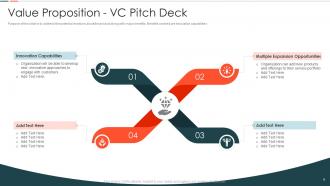
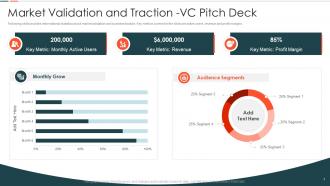
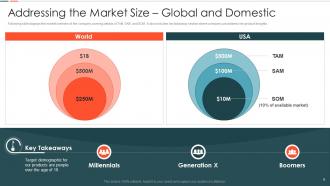
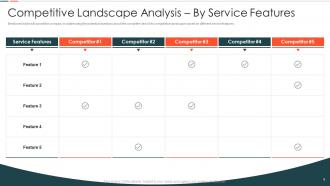
Here is a professionally designed VC Pitch deck that will benefit the company seeking funding of several million dollars. The structure covered by the deck starts from the title page, where the company can address the investors with its tagline and contact information. The title slide is followed by problem and solution slides a company can use them to highlight the pain points and solutions proposed to overcome them. Value Proposition slide will help the company highlight the unique features of its product. Market validation and traction slide will help the company illustrate audience segments and monthly growth information. The company can provide a market overview covering TAM SAM and SOM with a market size slide. The competition slide will help the investors identify the companys features compared to its competitors. The company can address the potential investors business model, growth, and critical members through slides, namely business model, growth strategy, and team. Finally, the company can tell its investors how much funding they have raised and spent, the budget they seek through slides, namely the use of funds and what we need. Get access now.
People who downloaded this PowerPoint presentation also viewed the following :
Content of this Powerpoint Presentation
Slide 1: This slide display the title VC Pitch Deck.
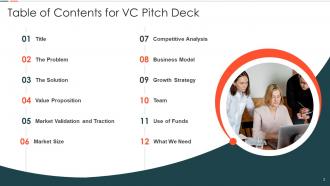
Slide 2: This slide exhibits Table of Contents.
Slide 3: This slide display about the company.
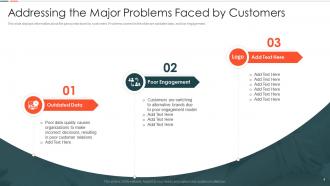
Slide 4: This slide Address the Major Problems Faced by Customers.
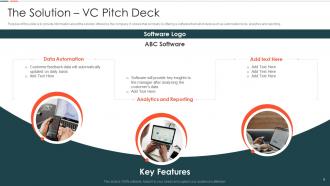
Slide 5: This slide provides information about the solution offered by the company.
Slide 6: This slide is to address the potential investors about the product.
Slide 7: This slide provides informational statistics about market validation and business traction.
Slide 8: This slide displays the market overview of the company covering details of TAM SAM and SOM.
Slide 9: This slide showcase Competitive Landscape Analysis – By Service Features.
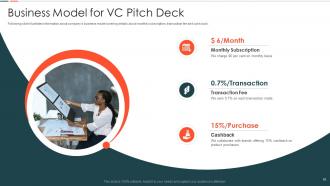
Slide 10: This slide illustrates information about company’s business model.
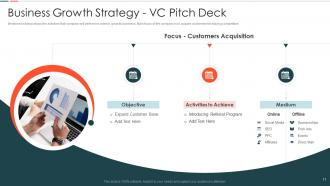
Slide 11: This slide portrays the activities that company will perform in order to grow its business.
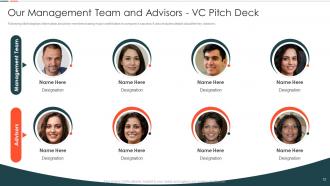
Slide 12: This slide displays information about key members having major contribution in company’s success.
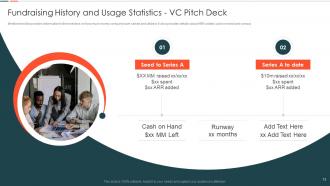
Slide 13: This slide provides information to the investors on how much money company have raised and utilized.
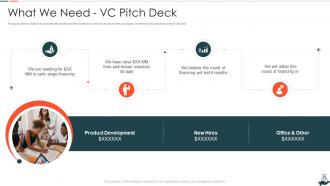
Slide 14: This slide provides information to the investors on how much money company is seeking.
Slide 15: This is the icons slide.
Slide 16: This slide presents title for additional slides.
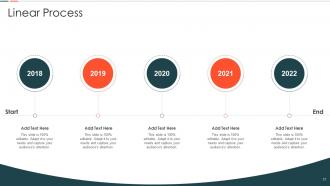
Slide 17: This slide display Linear Process.
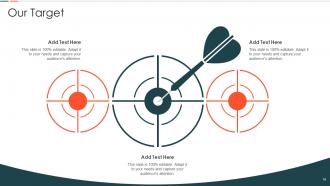
Slide 18: This slide display Our Target.
Slide 19: This slide display 30 60 90 Days Plan.
Slide 20: This slide shows puzzle for displaying elements of company.
Slide 21: This slide display Our Goal.
Slide 22: This slide display Post it Notes.
Slide 23: This slide display Roadmap.
Slide 24: This slide display Timeline.
Slide 25: This slide exhibit Idea Generation.
Slide 26: This slide display Venn.
Slide 27: This is thank you slide & contains contact details of company like office address, phone no., etc.
VC Pitch Deck Ppt Template with all 32 slides:
Use our VC Pitch Deck Ppt Template to effectively help you save your valuable time. They are readymade to fit into any presentation structure.








FAQs for VC Pitch
You're looking at about 10-12 slides max. Hit the basics: problem, solution, market size, business model, traction, competition, team, financials, and funding ask. Honestly? Your traction slide is make-or-break territory - lead with whatever numbers make you look like a rockstar. The problem slide needs to hit hard too so VCs actually *feel* the pain you're solving. Keep your pitch under 15 minutes but design each slide to work solo since they'll review the deck later without you there. Oh, and don't sleep on the team slide - I know it feels boring, but investors really do bet on people over ideas. Practice until your story flows smoothly from "here's what sucks" to "here's why we're gonna fix it."
Dude, storytelling beats data dumps every single time. Start with the actual problem your customers deal with - make it feel real and painful. Then your solution becomes the hero swooping in to fix everything. Most founders just rattle off features which is honestly boring as hell. Picture it like a short film where investors can see the whole journey from "this sucks" to "holy shit, this actually works." Oh and tie each section back to your main story thread. Keeps everything flowing nicely toward your big ask at the end.
Definitely include your TAM, SAM, and SOM - that's the total market size, what you can actually go after, and what's realistic to capture. Growth rates are critical too. I'd show historical trends plus 3-5 year projections. Competitor revenues are gold if you can dig them up, along with market penetration data. Customer acquisition trends in your space matter a lot. Oh, and spending patterns - VCs eat that stuff up. The whole point is proving there's a massive opportunity that's growing fast enough to hit their return timelines. Market size slides can make or break a pitch honestly.
Honestly, your team slide is make-or-break stuff - probably top 3 most critical slides you'll have. VCs bet on people way before they bet on ideas, so you've got to show why your crew can actually pull this off. Skip the boring job title lists though. Instead, highlight past wins, relevant experience, and what makes each person perfect for their specific role. Show how your skills complement each other as founders. Got any impressive exits or deep domain expertise? Flaunt it. Oh, and don't forget killer advisors if you have them - they're worth the extra slide space.
Dude, less text is always better - go for high-contrast fonts people can actually see from the back. One main point per slide, tons of white space. Your brand colors are perfect for keeping everything consistent. I swear, half the pitch decks I see look like Excel vomited everywhere. Make sure it flows: problem → solution → market size makes sense. Visuals should back up what you're saying, not distract from it. Oh and definitely test it on a big screen first - I've seen presentations that looked fine on a laptop but were totally unreadable projected.
Start with your "only we can do this because..." statement right at the front of your deck. Be crazy specific too - not just "we're faster" but "we cut processing time from 3 hours to 12 minutes with our proprietary algorithm." So many founders are way too vague here, drives me nuts honestly. Get proof points to back it up - customer testimonials, pilot results, competitive comparisons showing why other options suck. Connect your unique advantage directly to some painful problem that's keeping your customers awake at night. Oh and definitely test your value prop on real potential customers first. If they don't immediately get why it matters, keep tweaking until they do.
Ugh, the worst thing you can do is cram everything onto slides like you're writing a novel. Investors will check out instantly. Most founders get obsessed with product features but totally skip explaining their market or how they'll actually make money - drives me nuts! Stick to the basics: problem, solution, market, traction, team, money stuff, what you need. One point per slide, that's it. Oh and definitely run it by someone clueless about your business first. If your neighbor doesn't get it, VCs won't either.
Honestly, just stick to 3-5 years and the big numbers that matter - revenue, expenses, burn rate. VCs hate those crazy detailed spreadsheets you can barely read anyway. Your unit economics need to make sense, and you've gotta show how you'll actually scale this thing. They're definitely going to poke holes in your assumptions, so make sure they're solid. Oh, and don't forget the most important part - tell them exactly how much you need and what you'll do with their cash to hit those numbers. Simple beats fancy every time.
Look, VCs want to see you actually get your market - not just pretend competition doesn't exist. That "we have no competitors" line? Total red flag. Even doing nothing is competition sometimes. Pick 2-3 direct competitors for your slide and clearly show what sets you apart. Don't be a jerk about other companies though. Just focus on your unique angle. Honestly, this is where a lot of founders trip up because they can't articulate why they're different. You'll definitely get grilled on this stuff during Q&A, so nail down your positioning beforehand.
Honestly, visuals are everything because our brains process images like 60,000x faster than text. Investors are drowning in pitch decks every week - they all start looking the same when it's just walls of bullet points. You'll want to swap those out for actual product screenshots, growth charts, team photos, whatever tells your story better. I always tell people to pick their 3 most crucial slides first and replace at least half the text with something visual. Makes sense, right? Each slide should hook them with the visual first, then you support it with just enough text to get the point across. Way more memorable that way.
Dude, totally look up each investor's portfolio before you pitch them. If they're all about SaaS companies, play up your recurring revenue angle. Love sustainability? Start with your environmental stuff. I'd also switch up your market size examples based on what they know. Some VCs go crazy for huge markets, others want something smaller they actually get. Same deck structure, just shift what you emphasize. Oh and tweak your competitor comparisons too - use companies they've probably heard of or invested in before. Honestly, just spend like 30 minutes customizing instead of blasting the same thing everywhere. Makes such a difference.
Keep it to 10-12 minutes max with 8-10 slides. VCs are basically goldfish - they've already sat through like three other pitches that day. Save 15-20 minutes for Q&A because that's honestly where the good stuff happens. Spend extra time on your business model and traction slides since those actually move the needle. One minute per slide is the general rule, but don't be super rigid about it. Oh, and definitely have backup slides ready because they'll ask about something random you didn't cover. Practice until you can do it in your sleep.
Honestly, just use whatever you're comfortable with. Canva's got tons of startup templates if you want it to look decent without much effort. Figma works too. PowerPoint is totally fine - I know it sounds boring but most VCs don't care about flashy animations anyway. There's also Pitch and Beautiful.ai which auto-format everything for you. But here's the thing - I've watched so many founders get stuck perfecting slide designs when their actual story is still a mess. Focus on getting your narrative right first. The visuals can wait. You can always make it prettier later once you know what you're actually trying to say.
Don't try to fix every single comment - you'll lose your mind! Group the feedback by themes first, like "confusing story" or "weak numbers." Focus on stuff that multiple people mentioned, especially around your main pitch and key slides. Honestly, some feedback is just bad and you can ignore it. I'd make a quick tracker to see what changes actually work when you test with new people. Stick to your core message though - that's what matters. Maybe pick 2-3 big changes per round so you're not constantly tweaking everything.
Dude, yes - you definitely need a solid call to action. I've watched so many pitches just... fizzle out at the end. Super awkward. Investors sit there confused about what you actually want from them. Be specific! Don't just say "we're fundraising." Tell them exactly how much you're raising and what you'll do with it. Something like "We're raising $2M to hire three more engineers and expand into the midwest market." Then suggest next steps - maybe a follow-up meeting to talk terms. Honestly, it's the difference between looking professional and leaving people scratching their heads.
-
“I've always gotten excellent slides from them and the customer service is up to the mark.”
-
Amazing variety of PowerPoint slides. Really helpful in designing professional presentations.