

Enterprise Pitch Deck Ppt Template





Try Before you Buy Download Free Sample Product
 Impress Your
 Audience
 100%
100% Editable
 Save Hours
 of Time


Enterprise Pitch Deck gives an overview of the company, which will help the entrepreneurs to understand the financing rounds of investments. Check out our efficiently designed Enterprise Pitch Deck that covers the problem faced by the customers and the solutions offered by our company. We have also provided an outline of the company and its objectives. The details of the product and services are covered in this deck, along with target customers, business model, go-to-market plans, and roll-out plans. To understand the market better, we have focused on the competitors, competitive analysis, and market size of the company. In this PowerPoint presentation, we have discussed the funding investments, project performance over the years, company traction, milestones, business strategy, team details, and client testimonials. Customize this 100 percent editable pitch deck based on your specific business needs.
People who downloaded this PowerPoint presentation also viewed the following :
Content of this Powerpoint Presentation
Slide 1: This slide introduces Enterprise Pitch Deck. State your company name and begin.
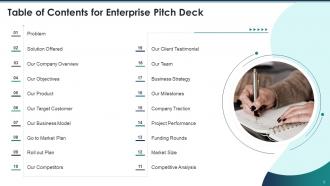
Slide 2: This slide presents Table of Content for the presentation.
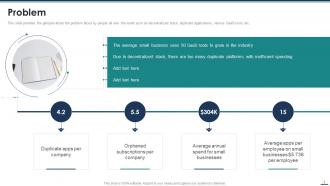
Slide 3: This slide provides the glimpse about the problem faced by people all over the world such as decentralized stack, duplicate applications, various SaaS tools, etc.
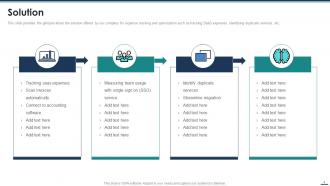
Slide 4: This slide provides the glimpse about the solution offered by our company for expense tracking and optimization.
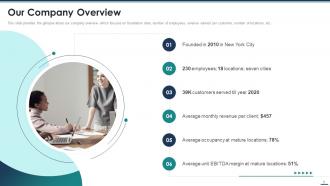
Slide 5: This slide provides the glimpse about our company overview which focuses o foundation date, number of employees, revenue earned per customer, etc.
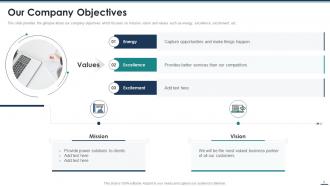
Slide 6: This slide provides the glimpse about our company objectives which focuses on mission, vision and values such as energy, excellence, excitement, etc.
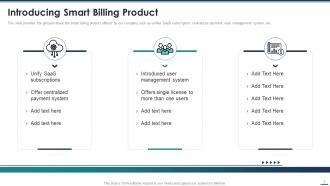
Slide 7: This slide provides the glimpse about the smart billing product offered by our company such as unified SaaS subscription, centralized payment, etc.
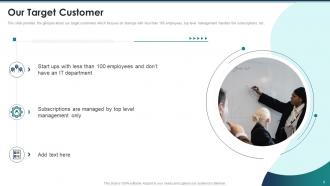
Slide 8: This slide exhibits target customers which focuses on startups with less than 100 employees, top level management handles the subscriptions, etc.
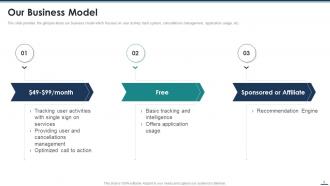
Slide 9: This slide provides the glimpse about our business model which focuses on user activity track system, cancellations management, application usage, etc.
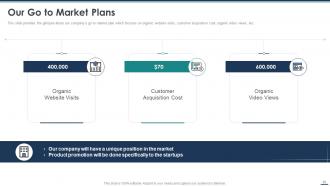
Slide 10: This slide highlights company’s go to market plan which focuses on organic website visits, customer acquisition cost, organic video views, etc.
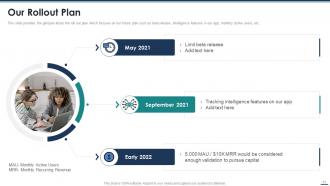
Slide 11: This slide illustrates roll out plan which focuses on our future plan such as beta release, intelligence features in our app, monthly active users, etc.
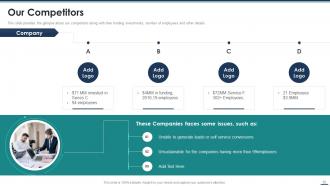
Slide 12: This slide provides the glimpse about our competitors along with their funding investments, number of employees and other details.
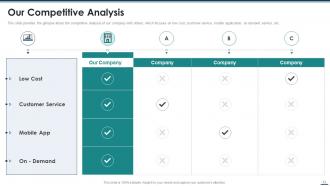
Slide 13: This slide displays competitive analysis of our company with others, which focuses on low cost, customer service, mobile application, on demand service, etc.
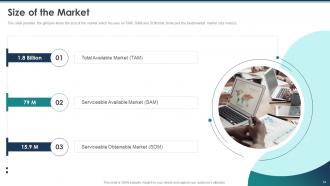
Slide 14: This slide provides the glimpse about the size of the market which focuses on TAM, SAM and SOM that showcase the fundamental market size metrics.
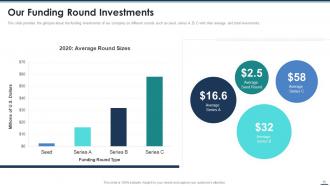
Slide 15: This slide presents funding investments of our company on different rounds such as seed, series A, B, C with their average and total investments.
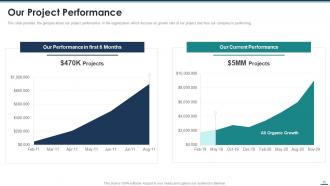
Slide 16: This slide provides the glimpse about our project performance in the organization which focuses on growth rate of our project and how our company is performing.
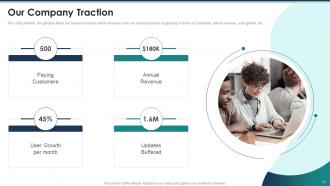
Slide 17: This slide exhibits business traction which measures how our startup business is growing in terms of customers, annual revenue, user growth, etc.
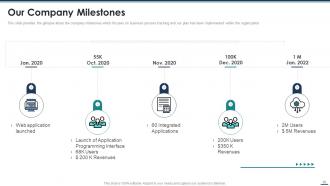
Slide 18: This slide displays company milestones which focuses on business process tracking and our plan has been implemented within the organization.
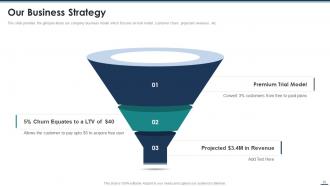
Slide 19: This slide provides the glimpse about our company business model which focuses on trial model, customer churn, projected revenues, etc.
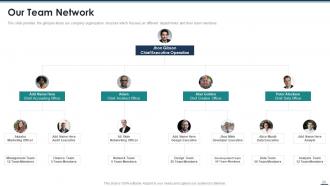
Slide 20: This slide provides the glimpse about our company organization structure which focuses on different departments and their team members.
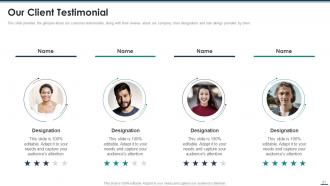
Slide 21: This slide presents customer testimonials, along with their reviews about our company, their designation and star ratings provided by them.
Slide 22: This slide contains all the icons used in this presentation.
Slide 23: This slide is titled as Additional Slides for moving forward.
Slide 24: This is About Us slide to show company specifications etc.
Slide 25: This slide provides 30 60 90 Days Plan with text boxes.
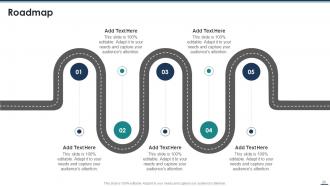
Slide 26: This slide presents Roadmap with additional textboxes.
Slide 27: This is Our Goal slide. State your firm's goals here.
Slide 28: This slide shows Post It Notes. Post your important notes here.
Slide 29: This slide displays Mind Map with related imagery.
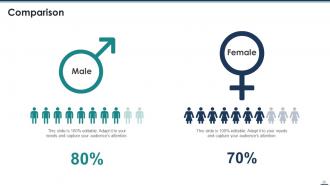
Slide 30: This is a Comparison slide to state comparison between commodities, entities etc.
Slide 31: This is a Thank You slide with address, contact numbers and email address.
Enterprise Pitch Deck Ppt Template with all 36 slides:
Use our Enterprise Pitch Deck Ppt Template to effectively help you save your valuable time. They are readymade to fit into any presentation structure.







FAQs for Enterprise Pitch
Start with the core stuff - problem, solution, market size, business model. Show real traction numbers, not just "we're gonna crush it" promises. Be upfront about your competition (they exist, trust me). Your team slide matters tons since investors are betting on you, not just your idea. For enterprise, definitely include unit economics and revenue streams - those bigger deals need solid math behind them. Map out your go-to-market strategy and throw in realistic financial projections. Keep it tight at 10-12 slides and practice until you're not stumbling over words.
Dude, forget the boring feature lists - nobody remembers those anyway. Tell a story instead. Walk investors through an actual customer's pain, how they found you, what changed after. Way more memorable than rattling off specs, you know? Your narrative becomes this thread you can pull through the whole deck. Opens with the customer story, then you keep circling back to it. Honestly, it's just more engaging than the typical "we do X, Y, Z" approach. Controls the whole flow too - builds naturally toward your ask instead of feeling forced.
So for enterprise decks, go minimal with lots of white space - execs get annoyed by cramped slides. Use strong visuals and keep text light. Stick to maybe 2-3 fonts max, and make your colors work with both company brands. Each slide = one clear point. I'd build a template first, then tackle each section. Oh, and definitely test it on a big screen beforehand! I learned that the hard way when my charts looked tiny during an actual presentation. High-quality graphs tell the story way better than bullet points anyway. The whole thing should feel clean and data-driven.
Honestly, less is more with financial slides. Show 3-5 years of revenue, main expenses, and when you'll hit profitability - all on one clean slide. Charts work way better than tiny spreadsheet numbers that nobody can read anyway. Start with your revenue story first, then get into costs. Oh, and definitely have your assumptions locked down because investors will grill you on those. I'd keep a detailed backup slide handy just in case, but your main slide should be super digestible. You don't want people squinting or getting lost in the weeds during your pitch.
Dude, market analysis is huge - it shows you actually get your space instead of just winging it. You've gotta prove the market size, growth trends, and who you're up against. So many pitch decks bomb because founders either skip this or make it way too vague. Identify your target customers and show demand actually exists. Position yourself against competitors too. Oh and use real data sources, not just gut feelings - investors can smell BS from a mile away. It's basically how you prove you're not delusional about the opportunity.
Definitely do 1-2 slides just for your business model, but make it super visual - diagrams and flowcharts showing money flow. Who's paying what and when? Skip the text walls, they're painful to sit through. Break it into clean sections: customer segments, what value you're giving them, revenue streams, key partnerships. Your unit economics should be dead simple to explain - "we spend $X to get a customer who gives us $Y over Z months." Oh and don't forget your revenue timeline at the end so investors can see where you're headed growth-wise.
Dude, the two big killers are cramming everything onto slides and talking features instead of business impact. I've literally seen decks that looked like someone dumped their entire product manual onto PowerPoint – nightmare fuel. Keep slides visual and focus on the problem, your solution, and what ROI they'll see. Enterprise people will definitely grill you on implementation timelines and security stuff, so don't skip that. Oh, and practice your demo! Nothing's worse than tech failing mid-pitch. Have backup slides ready for when they inevitably ask super technical questions.
Dude, get your value prop up front - like slides 2-3, not buried somewhere in the middle. Start with the actual problem that keeps your customers awake at night, then boom - here's how you fix it differently than everyone else. Too many founders just dump features on me instead of showing real benefits. What transformation are you delivering? Got numbers? Use them. Make it obvious why competitors can't copy your approach - that's honestly the part most people screw up. Wrap it with one sentence that nails your whole advantage. That's what sticks.
Honestly, tailor your pitch to whoever you're talking to. VCs get excited about massive growth potential - hit them with market size and those crazy hockey stick charts. PE investors? They want to see cold hard cash flow and how you'll actually make money. Strategic folks care about fit - show how you'd mesh with what they're already doing. It's basically like dating but with spreadsheets. I'd make 2-3 versions of your deck, same info but different angles. Oh, and definitely stalk their portfolio first to see what types of companies they usually go for.
You absolutely have to tell them exactly what you want next. I've watched so many solid pitches just... die because nobody knew what to do after. Super awkward. Your call to action needs to be specific - not some vague "let's connect soon" nonsense. Ask for something real: a pilot program, technical review with their team, whatever makes sense for your deal. Decision-makers actually appreciate when you make it simple for them. Don't leave them guessing what "yes" looks like. Be direct about the next step and you'll get way better results.
Honestly, the "one concept per slide" thing is a game-changer. Ditch the text walls and throw in charts or diagrams instead - people's attention spans are shot anyway. I always try to weave the data into some kind of story rather than just barfing numbers everywhere. Headers and bullets help tons for scanning. Oh, and enterprise folks? They sit through like 50 of these things a week, so keeping it tight actually works in your favor. End with a summary slide that gives them clear next steps they can actually act on. Short sentences work. Trust me on this one.
Definitely include 1-2 slides on risks and competition - enterprise folks actually respect the honesty. Don't pretend problems don't exist (implementation timelines, integration headaches, security stuff). Just show how you handle them. Competition slide should be a clean comparison matrix focused on your strengths, not trash-talking others. Honestly, customer references work way better than feature lists anyway. Find clients who ditched competitors for you - that's gold. Make it clear why you're the safer bet for their specific situation. The whole "we're obviously better" approach just comes off as amateur hour.
Dude just go with PowerPoint or Google Slides - investors expect those formats and you won't have tech disasters mid-pitch. Canva Pro's actually pretty decent if you want nicer templates without hiring a designer. I've watched so many founders create gorgeous decks in random software that straight up wouldn't open when it mattered. Your designer can use Figma for assets then export everything over. But honestly? Don't overthink the tools part. Pick what your team already knows and spend time on your story instead. I'd rather see a basic deck with killer content than some over-animated mess that crashes.
Case studies are absolute gold for enterprise decks, but don't just dump them all together. Sprinkle quantified wins throughout - like "boosted efficiency 40%" right on your solution slides where they hit hardest. Customer logos work early for credibility, but save the meaty testimonials for your value prop sections. I'm obsessed with those little "Company X hit Y results in Z months" callout boxes - they're clutch. Oh, and definitely get permission before using their numbers publicly. Our legal team nearly had a heart attack when we didn't once.
Keep it short - 10-12 slides, under 20 minutes. These enterprise people are crazy busy and honestly their attention spans aren't great. Lead with your strongest stuff right away because if you lose them in the first few minutes, you're done. Focus on the problem you solve, market size, and what makes you different. The demo needs to be specific to their situation, not some generic tour of features they don't care about. Skip the whole company origin story - nobody wants that. Instead, show traction with other enterprise clients like them. Oh, and work backwards from your best proof points first.
-
The website is jam-packed with fantastic and creative templates for a variety of business concepts. They are easy to use and customize.
-
It makes easy work of my work presentations. I’ve never had to be nervous about my presentations for meetings.