

 0 Comment
 Customer Reviews

In 2005, a college student named Blake Mycoskie visited Argentina and noticed something simple yet heartbreaking—children walking barefoot without access to basic shoes. What followed was the birth of TOMS, a social enterprise built on the idea: “One for One.” For every pair sold, one would be given.
That simple pitch—business as a force for good—won over investors, customers, and communities worldwide. But here’s the thing: it wasn’t just the cause that clicked. It was the clarity of purpose, the scalability of the model, and how well the story was told.
Social enterprises around the globe, today, are tackling the world’s biggest problems—climate change, poverty, inequality—not through charity, but through sustainable, scalable business models. The challenge? Convincing others to believe in that model, too.
That’s where SlideTeam’s Social Enterprise Pitch Deck Templates come in. These templates guide changemakers, founders, and impact-driven organizations to communicate their mission with clarity, purpose, and passion.
Explore our must-read blog on Enterprise Pitch Deck Templates with a click here.
In the world of impact, the right pitch doesn’t just raise capital — it raises hope. Let’s explore these decks.
Want to learn more about social enterprises? Explore our flagship blog with a click here.
Template 1: Social Enterprise Pitch Deck PPT Template
Win your audience and establish credibility with this content-rich PowerPoint Template. It is designed to engage potential investors and supporters by visually presenting the organization’s mission, defining the challenges addressed, explaining the target audience and detailing the means by which the business will be run in a financially responsible way. It enables social enterprises to outline their objectives using clear and effective messaging. This pitch deck provides the building blocks for an effective story about how your social enterprise delivers value.
[product_image id=1394329]
Template 2: Social Enterprise Pitch Deck Introduction PPT Set
This PPT Slide helps create an effective and organized introduction to your social enterprise pitch deck. It previews three core elements—mission statement, target audience, and financial model—allowing presenters to communicate their organization's mission, the communities they seek to impact, and the approach for sustainable expansion. Use this presentation template to frame the context with investors or stakeholders, this PPT establishes credibility and invites further exploration.

Template 3: Identifying Social Issues and Gaps PPT Preset
This PPT Presentation identifies four major social issues that drive the mission. Scarcity of clean water, widespread youth and minority unemployment, limited access to nutritious food in poor communities and underfunded public schools are social concerns. Each social challenge is backed by examples to highlight significance and impact. This organized overview of social challenges helps explain why the enterprise’s solutions are essential for addressing issues facing the community.

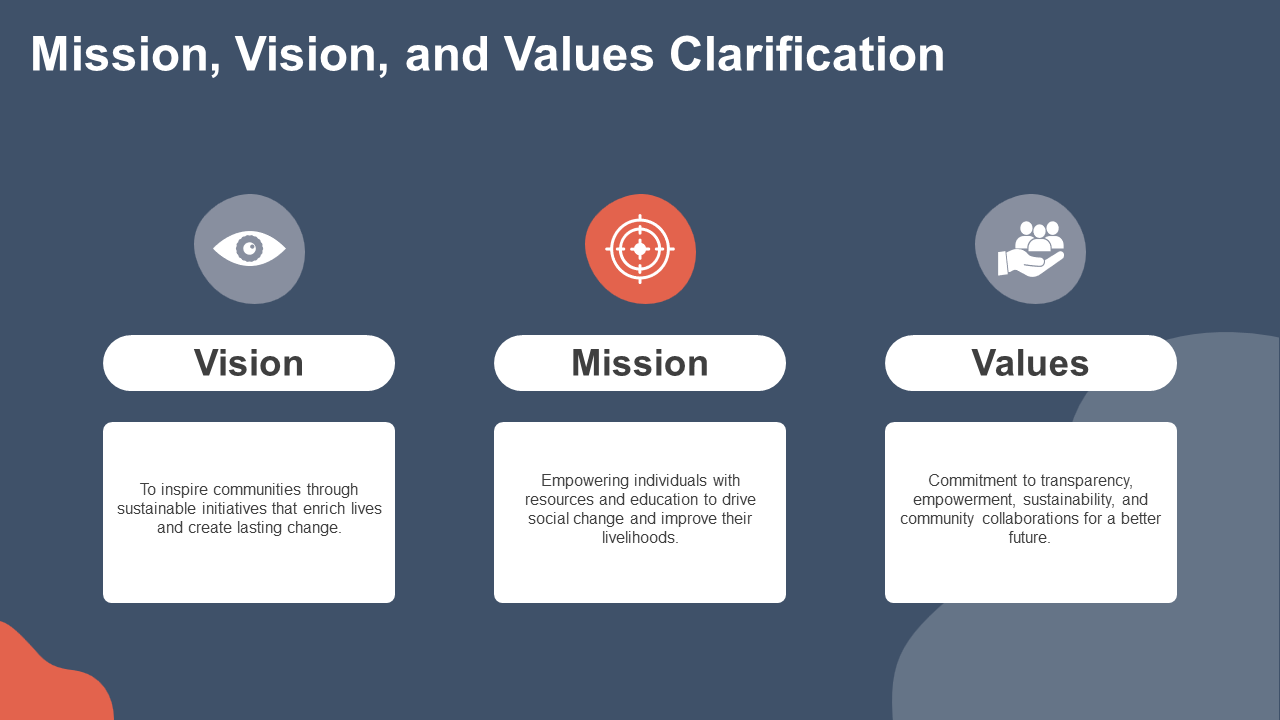
Template 4: Mission, Vision, and Values Clarification PPT Slide
This PPT Set illustrates the pillars of a social enterprise: its vision, mission, and core values. The vision drives long-term transformation by fostering sustainable community-based interventions. The mission captures the organization’s focus on empowering citizens through knowledge and resources for impactful social change. Finally, the values stress transparency, sustainability, empowerment, and collaboration. These components present an engrossing story that integrates internal initiatives with external expectations, creating trust between stakeholders. This slide is useful for articulating the organization's purpose and its ethical foundation in any pitch, presentation, or stakeholder engagement environment.
Template 5: Business Model Overview of Social Enterprise PPT Design
This PPT Slide displays a five-step, cyclical model that encapsulates the operation of a social enterprise. The process starts with the determination of social issues in the community.
The subsequent step is the formulation of a sustainable model that creates social value. Implementation helps ensure actions are in line with the mission of the enterprise, and lastly, evaluation of impact allows improvement based on quantifiable outcomes. This concise, ordered diagram gives stakeholders a look at enterprise strategy, and it's the perfect tool for pitches, planning meetings, or investor presentations centered on purpose-driven business models.

Template 6: Market Analysis and Competitive Landscape PPT Presentation
This PPT Framework provides a complete picture of the market dynamics of a social enterprise. It showcases the size of the market as $1 billion and a strong growth potential with a 15% CAGR. Low-income populations are targeted, and trends reveal increasing focus on sustainability and technology adoption. It also compares incumbent players with new-start players, pointing out opportunities versus saturation issues. This slide is perfect for highlighting market positioning, investment feasibility, and the competitive advantage to potential investors and stakeholders.

Template 7: Revenue Streams and Sustainability Plan PPT Slide
This PPT Design illustrates the primary sources of income for sustaining the viability of a social enterprise. Ordered in a funnel system, there are six varied sources of funding: grants from governments or foundations, income from product sales, client service fees, subscription fees from members, donation funds from individuals or corporations, and sponsorships from brands. The format depicts the multilayered aspect of income generation and the focus on financial strength. It is perfect for highlighting a balanced funding approach that achieves sustainable long-term existence, investor trust, and proving how funds are leveraged.

Template 8: Marketing Strategy and Outreach Plan PPT Set
This slide describes an extensive outreach and marketing strategy, designed for social enterprises. It emphasizes eight main initiatives: using social media, hosting community activities, forming partnerships, conducting email campaigns, reaching influencers, developing content, establishing feedback loops, and promoting volunteer recruitment. Each strategy is intended to maximize visibility, create engagement, and promote stakeholder involvement. The layout with a visual structure provides straightforwardness while demonstrating the multi-faceted approach necessary for effective outreach.

Template 9: Operational Plan and Workflow Processes
This PPT introduces an organized, six-step operational process intended to ensure social enterprises navigate effective program implementation. It starts by defining community requirements, followed by program design based on targeting, establishing local partnerships, and rolling out initiatives with experienced staff. The plan places strong weight on continuous monitoring to evaluate performance and ending with integrating feedback for strategy improvement. This unambiguous, linear arrangement makes it easy for stakeholders to see the enterprise's dedication to systematic, effect-oriented implementation. Suited to highlight operational readiness, accountability, and flexibility, this slide is ideal for proposals, strategy briefs, or internal planning within mission-oriented organizations.

Template 10: Plans and Growth Opportunities PPT Template
This slide offers a strategic year-by-year plan for the growth and development of a social enterprise from 2024-2031. It starts with the launch and goes through recognition, growth, partnerships, impact evaluation, fund raising, implementation of sustainability, and scaling up across the country. The timeline structure provides an easy-to-read visual representation of milestones and activities planned, and as such, is suited for conveying long-term objectives to investors, partners, and stakeholders. It serves to emphasize the business dedication to organized expansion, social influence, and environmental sustainability, enhancing the credibility and vision within the business strategy.

Pitching Purpose with Precision
A powerful idea isn’t enough unless it’s heard, understood, and backed. Social enterprises operate at the intersection of profit and purpose, and that balance demands clarity, structure, and storytelling when you step into a room full of investors or partners.
These Social Enterprise Pitch Deck Templates from SlideTeam are not just visual aids—they are your platform to communicate vision with conviction. They help you highlight not just the "what" of your business, but the "why"—the reason your enterprise exists, and the lives it intends to transform.
Here’s a list of handpicked Business Pitch Templates. Click here to explore!
The best pitches do more than seek funding—they rally belief, mobilize change, and ignite shared missions.
FAQs on Social Enterprise Pitch Deck
1. A social enterprise usually addresses what kinds of problems?
A social enterprise tends to solve social, environmental, and economic issues that are usually neglected or under-addressed by conventional businesses or state agencies. Such enterprises function with the objective of delivering beneficial social impact in lieu of maximizing profit. Typical issues they address involve reducing poverty, access to quality education, gender inequality, unemployment, and health disparities. Most social enterprises are also eco-friendly, combating climate change, minimizing waste, and encouraging renewable energy or sustainable farming. Social enterprises are different from non-profits, as they raise their own funds from commercial activities to support their own operations and amplify their impact.
2. What makes the social enterprise unique?
A social enterprise stands out by blending the purpose-driven approach of a nonprofit with the financial autonomy of a business. It aims to make a meaningful difference in the society or the environment while also earning enough income to remain self-sufficient. Social enterprises focus on tackling long-standing problems such as poverty, inequality, education gaps and environmental degradation, all the while maintaining their financial independence.
Social enterprises frequently interact with the communities they serve, offering employment, training or vital resources. Their focus on the community gives their work a unique sense of meaning and ensures their long-term viability.\
3. What are the barriers to entry or challenges to launching a social enterprise?
Starting a social enterprise presents a range of distinct obstacles and hurdles.
Funding and Financial Sustainability: Social enterprises face challenges in securing funding because they focus more on creating social value than generating profits.
Balancing Mission and Profit: Striking the right balance between pursuing social impact and ensuring financial sustainability is a challenge. Maintaining the mission while also generating sufficient income is a continuous challenge.
Lack of Awareness and Support: Most environments offer limited resources and infrastructure to help social enterprises grow.
Market Trust and Credibility: Establishing trust with customers, partners and communities is often a lengthy process, particularly when dealing with delicate social matters.
Regulatory Hurdles: The legal framework for social enterprises is often unclear, which can cause uncertainty about licensing, taxation and compliance.
Access to Talent: Finding employees who share the organization’s values and are willing to accept lower compensation can be difficult. Social enterprises often overcome these challenges by staying true to their mission, innovating and receiving support from the community.